A process guide to be used in training workshops and planning sessions to develop campaign strategy. This process will help reduce the scope of campaigns in order to focus efforts on where change can really be achieved, and consider the possible consequences of working on one part of a problem rather than others.
A process guide to be used in training workshops and planning sessions to develop campaign strategy. This process helps you cut or break down the issue/problem into bite sized chunks, rather than biting off more than you can chew!
This guide has been developed by the Change Agency who suggest you allow 60 minutes or more for the full process.
Objectives
Help reduce the scope of campaigns in order to focus efforts on where change can really be achieved.
Consider the possible consequences of working on one part of a problem rather than others.
Some activist organisations find the idea of ‘cutting the issue’ a helpful way to translate a daunting and complex problem into one or more ‘bite-‐sized’ issues where they can realistically consider making a difference.
‘Cutting’ or reducing the scope of a problem in several ways through creative brainstorming processes can help your group consider the relative merits of different approaches you might take. For instance, you can cut an issue to maximise its immediacy in the community, guard your campaign against claims of extremism or appeal to different allies and constituents.
How it’s done
1. Think of a significant social or environmental problem you’d like to address.
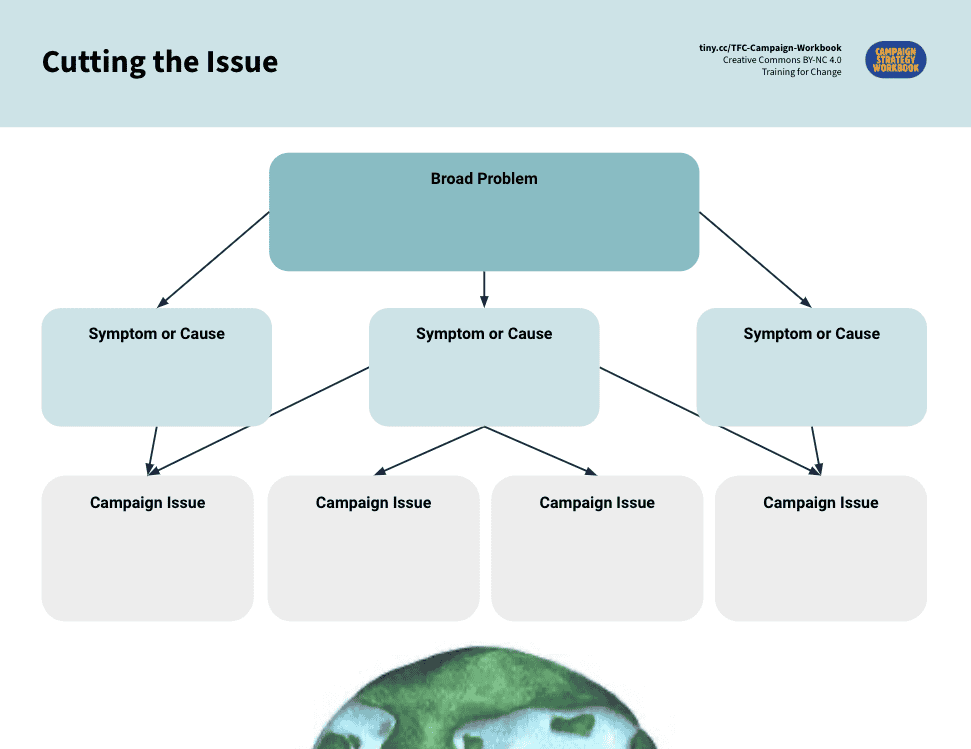
2. Consider how to cut this bigger problem into smaller issues that have traction with (or appeal to) different targets, community groups and other audiences. What are some ways that people interpret, respond to or campaign around the problem. See examples below.
3. You might need to experiment with the different issues you suggest to create a logic that works for you and your group. Here’s where post-it notes come in handy. Can you cluster things?
4. (Optional) Perhaps you could then try a ‘forcefield analysis’ exercise (another exercise on The Change Agency website) to assess the relative strengths of some of these issues. Will some approaches to cutting the issue mobilise your constituency more effectively, counteract some of the forces that oppose the changes you’re working on, create alliances with powerful stakeholders who might not otherwise align with your campaign.
Examples of Cutting the Issue
This climate change example is far from complete, but illustrates how the vexing problem of climate change might be cut into different issues. Each issue implies a different approach, including corporate campaigning, community organising and solutions-based work.
When we started this exercise with a group campaigning around climate change, their first response was, ‘Oh, no! Now we need to work three times as hard to tackle all the different issues!” This is absolutely not the point of the exercise! On the contrary, the suggestion here is that to make a difference and work within your sphere of influence (and what’s actually possible), you need to select a particular way of cutting the issue that takes you in a direction that will best use your resources and strengths, gain traction with the media and community, and create an impact that will flow on to bigger changes
The uranium mine example was developed with environmental campaigners in Alice Springs during 2009. Once we’d mapped out these many ways their problem might be ‘cut’, we asked small groups to consider which issue was most immediate, specific and realizable (winnable) in their community. Working independently, each three small groups reached the same conclusion. Community members are universally concerned about dust. The township experiences intense dust storms. The prospect of being clothed with dust that came from a uranium mine, and children breathing it were considered the best way to mobilize the community and generate support for the campaign.
Cutting the Issue example for Human Rights
Cutting the Issue example for Climate Change
Cutting the Issue example for a Uranium Mine Proposal