What is a Campaign, and How to Start One
The most common question I hear is “am I a campaigner?”. There are loads of different words for what a campaigner is, some people say activist, changemaker, protestor, community leader, community organiser or troublemaker.
I think of a campaigner as anyone who sees something that they want to change in the world and goes about trying to do that.
Most people campaign in their free time, some are lucky enough to have it as part of their job, but that’s very rare.
To be a campaigner you don’t need to have lots of cash, make lots of speeches, be a whizz with computers, or be the most confident person around — all you really need is to want to change something.
So if you’re reading this you probably are already a campaigner. You’re in good company! All over the world, every single day, people are campaigning for things they believe in. Throughout history some of the biggest changes we’ve seen have been brought about by a small group of passionate people working together to bring about change.
What is a Campaign?
The second question I normally get is “ok, so what is a campaign”. This is a super important question – lots of people waste a lot of time doing activities that aren’t actually a campaign.
So what is a campaign? Put simply a campaign is when a group of people work together in an organised and active way towards a goal.
Our friends at 350.org describe it really well in a bit more detail. From “What is a Campaign” by 350.org.
Why do we Campaign?
Campaigning is one of the key ways that change happens today – because they help people tell the powerful that something is going wrong, and get them to fix it.
Campaigning has been a core part of holding the powerful to account, and changing the way our society works, for centuries. Some of the biggest injustices, like the Hillsborough Disaster, have only been confronted because some people came together to form a campaign for justice.
OK – I’m in. How do I plan an Effective Campaign?
OK great! Now that that’s all cleared up let’s get into the exciting bit — the rest of the guide will focus on how you can plan a really effective campaign.
The most important thing with a campaign is that you start! Many campaigns have won with little, or no plan.
People often call a campaign plan a “campaign strategy”. Plans don’t have to be complicated or long, they’re really there to help everyone involved with a campaign to work together, in an organised way to make change happen.
However, from seeing hundreds of campaigns happen I’ve put together some key steps below that should help you plan a successful campaign.
The Three Steps to a Great Campaign
The most important thing with a campaign is that you start!
Many campaigns have won with little, or no plan. However, from seeing hundreds of campaigns happen I’ve seen three steps that’ll help you win. Here they are:
Step 1 – Getting Ready to Campaign!
A – Figure out your campaign goal – the big change you want to see
At the start of any campaign will be a problem – the thing you’re trying to fix.
A goal is the big change you want to see. For example:
- Our community is safer for children
- Wider acceptance that sanitary products are essential and affordable
- Quality of life for homeless people in our town is improved
- The elimination of fox hunting in the UK.
B – Research
Do some research to check you’ve got the facts right & make sure you can win any arguments that might happen as you campaign.
The best place to start is Google and your local library. Here are some key questions you may want to look into:
- Why is this happening?
People in power don’t normally set out to do bad things — so it’s helpful to find out how they explain what they’re doing. - Who might support you in this work?
It’s always easier to campaign when you have allies. So it’s helpful to look for people who have already campaigned on this issue, or a local politician who has recently said something about this. - What have the press said about this?
It can be helpful to find out if a local or national newspaper is regularly writing about the issue you’re thinking of campaigning on. If you find a particular journalist following the story it’s a good idea to reach out to them and tell them about your campaign. - Who might be against you?
As you’re looking into the big questions above it’s helpful to note down anyone who might criticise your ideas. - Who is your campaign target?
This should be the person who has the power to make change happen. It’s normally best if it’s a person (rather than an organisation, political party, or company) because it’s easier to figure out what might influence them. It’s fine if it’s the leader of a council, organisation, political party or company.
It maybe that you need to do some of your own original research to get vital information, for example standing outside the local shop asking passers by a quick questionnaire about the potential impact of closing the local Children’s Centre.
C – Set some objectives
Objectives are specific things you can do to achieve your goal.
It’s good to aim to set no more than a couple of objectives at a time. One objective at a time is fine! If possible try to make them specific and measurable.
If we take the street homeless campaign goal I mentioned earlier (i.e. quality of life for homeless people in our town is improved) an objective could be “Increase the number of emergency beds for homeless people in our town by 30%’ ”
Other objectives could include:
- Stop the closure of the pop up cafe in the Library
- Every young homeless person in our town to be offered a work experience placement with a mentor.
Deciding your campaign objective/s will force you to be much more specific about what it is you’re trying to achieve. Now you’re clearer you may need to go back and do a little more research for example to be clear about who your campaign target is.
Step 2 – Launching your Campaign
A – Figure out how to influence your Campaign Target
Great! You’ve done some research, set an objective and have some idea who your supporters are, who is talking about the issue, who is against you and who your campaign target should be. Don’t worry if you’re not quite clear yet, this can be complicated business.
Now you need to figure out who has the power to influence your campaign target. The best way to do this is to get some post-its (or just some pieces of paper) and list on each one all the people or organisations who might have power to make change happen (including who you think might be your campaign target).
Going back to the objective from our homeless campaign, we would list all the people and organisations that we think have the power to increase the number of emergency beds for homeless people in our town
Then draw your own version of the “power map” you can find it here.
Great! Now you need to place the post its on the two axes of the Power Map.
So if someone is very powerful and supports your campaign, they’d go in the top right. If they’re very powerful and oppose your campaign they’d go on the top left.
Ideally you want 5-20 things on the map. If you’re struggling, think about local, family, political or work ties.
Once it’s done talk to the people you’re working with to figure out if you need to rethink your objectives, or campaign target.
B – Pick your tactics
OK great! Now you get to focus on the fun bit – picking the things you’ll do to make change happen — the tactics.
One of the biggest mistakes people make when campaigning is to start by picking your tactics, before figuring out the problem, goal and objectives. The problem with this is you’ll often waste lots of your time and energy, by doing a tactic that isn’t linked to fixing the problem you care about.
Tactics can be anything from starting a petition, holding a demonstration, organising a meeting or getting the campaign in your local newspaper.
The best way to pick your tactics is by figuring out which tactics help to achieve your objective. Here’s an example:
Objective: “A road crossing should be built outside school”
Possible Tactics
- Tactic 1 – Petition
Start an online petition and send it around all your local friends asking them to sign the petition to join the campaign. Or start a paper petition (as well as online) and go door to door asking people to join the campaign by signing the petition. - Tactic 2 – Demonstration
Hold a demonstration and ask the local newspaper to come along. - Tactic 3 – Get the support of local organisations
Make a list of local religious groups, unions, clubs and charities and go to meet them, then ask them to join the campaign - Tactic 4 – Meeting with the campaign target
Present the petition to the person at the council who has the power to get a road crossing built. This person is your “campaign target” or “decision maker”. Before you do this you will need to work out who this person is. You could call the council help line to ask them or find out the name of your local councillor (using www.writetothem.com) and email them.
There are a huge number of tactics you could use. Some of the most popular ones are:
- Starting a petition
- Hosting a local protest
- Going on strike
- Boycotting a product
- Getting lots of local people to go and visit a local politician
Gene Sharp made a great list of 198 different non-violent tactics you may want to check out
There are so many tactics, you shouldn’t aim to use them all! You should look for tactics that help you achieve your objectives and stay focussed on that. It’s fine to change tactic – if you’ve tried them and they don’t work. But whatever you do don’t overstretch yourself by doing loads of tactics all at once.

To help use a Tactics Timeline – This tool is useful for mapping your tactics strategically. It is a rough timeline and should be reviewed regularly as a campaign progresses.
C. Spreading the word – so you have lots of supporters who will help you win!
Campaigns are never won by one person working alone.
To win your campaign you’ll need to bring together a group of people who work with you to plan your campaign, and then attract some campaign supporters.
Supporters are important – as they’ll show your campaign target that this is a problem lots of people care about. This not only gives you more power – but also means that you don’t have all the pressure on yourself.
The foundation of many campaigns is a petition. They allow you to explain to the world what you’re doing, and they allow the public to show their support quickly and easily. Ultimately petitions are about building and showing your power — by showing how many people care about your campaign.
But always remember that a petition alone is not a campaign. A campaign should build over time using a variety of tactics — with a petition as one of them.
It’s best to start a petition online, as you can get lots of supporters quickly, and if you choose a good petition platform you can message your supporters and tell them all about your campaign as it grows stronger.
Once your online petition is up and running it’s a good idea to also collect signatures on paper, at events you might run or other places where lots of people gather.
Step 3 – Building Pressure
A. Keep going & escalate your campaign – so your campaign target feels the pressure
One of the key decisions a campaign target will make is “can I ignore this campaign?”. When most campaigns start they’ll look at what you’re doing and think “yes, I can ignore this, it’s not a big deal”.
Your challenge is to change their mind by planning for your campaign to keep going for many months. Then as your campaign grows your campaign target will realise that your campaign isn’t just going to go away.
The best way to do this is to plan to gradually escalate your campaign over time, by figuring out a series of tactics which will help you achieve your objectives over a number of months. The Escalation Guide from Fossil Free Europe has great examples of how this might work.
B – Finally, look after your physical and mental health.
It’s very hard to campaign on things that matter a lot to you, it can be exhausting and make managing your mental and physical health rough. Campaigns are successful because they are sustained and build pressure over time. So as you plan your campaign it’s important to look after your own and , each others mental health, so you can keep campaigning for as long as it takes.
There are lots of resources out there to help you think about this.
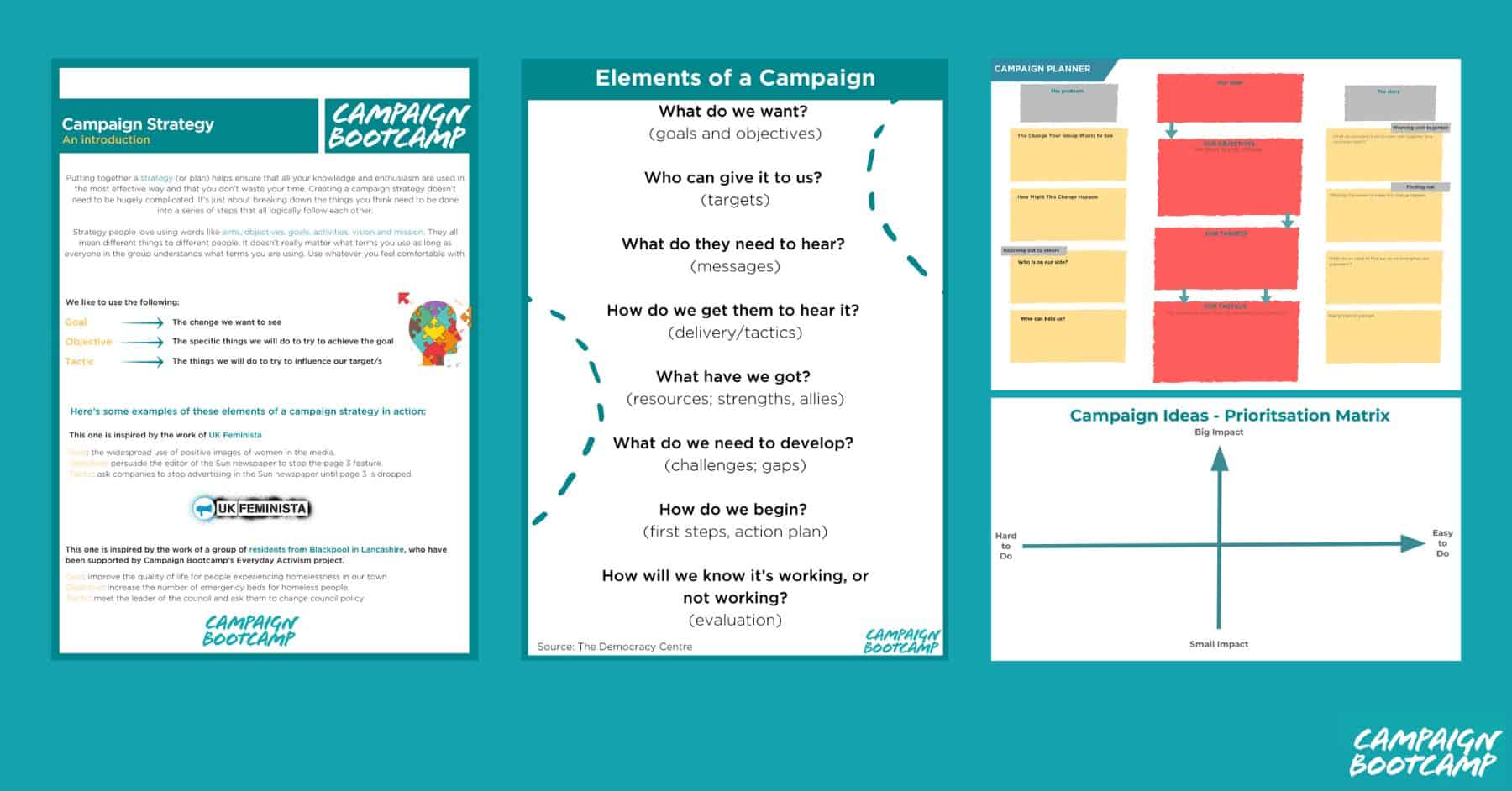
Campaign Planning Handouts
Here are handouts to help you get started with your campaign planning.
Campaign Planner Handout

This handout allows participants to map out their entire campaign – including the goals, tactics, objectives, and the story that goes alongside it.
Campaign Strategy: An Introduction
A 3 page handout about the basics of campaign strategy.
Elements of a Campaign
What do we want? Who can give it to us? This handout will help you to identify the different elements of campaign planning.
Campaign Ideas: Prioritisation Matrix
This handout will help you to prioritise your campaigning ideas, weighing up impact and how easy it is to do
Easy Read Version
Here is an Easy Read Guide called, How to start a campaign, based on the above resource, Campaign Planning: How to Get Started.

- Click to open PDF: How to Start a Campaign
Easy Read uses clear, everyday language matched with images to make sure everyone understands. – Council for Intellectual Disability
Easy Read documents are helpful for:
- people with disability
- people with English as a second language
- people with lower literacy levels
- people who want to learn about a topic quickly
Explore Further
- Campaign Bootcamp Collection
- Campaign Strategy Resources in the Commons Library
- Campaigning for Social Change: beyond just protesting for it!
- Campaign Accelerator Toolkit
- Growing your Campaign Group, Seeds for Change
- 5 tools to plan your campaign strategy
- Developing Strategic Campaigns: An ITF Manual for Trade Union Activists, Educators and Organisers