
Blimey, I’ve read a lot of books about leadership.
Over time, they get less useful. This is because, firstly, I’ve read the great ones and am now reading the less great ones, and, secondly, because I start out already knowing more of what they have to say.
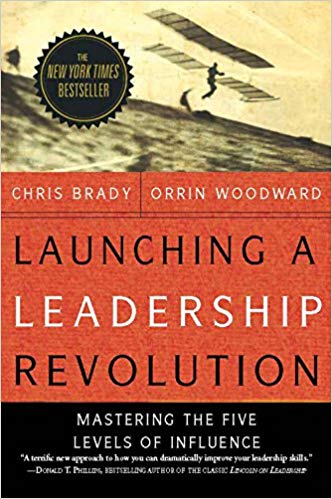
This point came home to me with Launching a Leadership Revolution, a much-applauded leadership book that, honestly, I didn’t find remarkable.
However.
It did have three ideas that I have liked and taken away from it, and I don’t consider that terrible returns. These ideas were: the five levels of leadership, the raw material of a leader, and the role of vision.
The five levels of leadership
According to Launching a Leadership Revolution, the “five levels of leadership” are:
- Learning
- Performing
- Leading
- Developing leaders
- Developing leaders who develop leaders.
This jumped out at me, because this book is totally written by corporate hacks, yet this model of leadership corresponds perfectly with organising principles, in that the role of leadership is to develop leadership. In this sense, I prefer to think of them not as ‘levels’ but as ‘layers’ – that as a leader grows they move inwards through the layers (or they develop layers outwards of themselves). This model has a clear delineation between followers (layers 1 and 2) and leaders (layers 3, 4 and 5). And it has a really worthwhile way of thinking about how one becomes a leader – firstly be learning, secondly by performing, and eventually by supporting others to learn and perform.
This is a simple model, and that is its value. It is a handy way of thinking about leadership, about thinking about how I practise leadership, and for helping other, new, potential leaders, to think about their own journey.
The raw material of leadership
Early on in Launching a Leadership Revolution we read that the “raw material” for a leader is that they are:
- Hungry. They are highly motivated to change things for the better.
- Hone-able. They “have an attitude that allows intensifying and sharpening.”
- They behave with integrity (not doing what’s wrong) and character (doing what’s right.)
Three ‘H’s? Makes it nice and simple.
I think one of the greatest challenges of leadership is what Marshall Ganz calls ‘identifying’: being able to discern who is worth developing. Everyone and anyone has the potential to be a leader, but plenty of people won’t become leaders. I don’t think anyone really fully knows the difference between those who do become leaders and those who do not. Nonetheless, it’s helpful to have a few ideas for thinking about this difference, or at least for being able to identify the qualities in those leaders who do end up working out.
And I certainly think that “hungry” and “hone-able” are two things to think of. Learning leadership is a battle, and there is plenty of frustration along the way. The hunger is a crucial source of motivation in the face of this. And then hone-ability. After all, the first layer of leadership is learning – if someone isn’t willing to learn and to be taught, they’re not going to make a good leader. Someone who is hungry should also yearn to be honed, to become more effective to be, as they say, ‘sharpened’. So I think these are some useful ideas about the raw materials of leadership.
The role of vision in leadership
Some ‘leaders’ don’t want to lead from the front. Instead, they act like they want to be led. They refuse to develop and promote their own vision, instead trying to prod their followers to come up with some ideas, which the leader can then manage. This, I suppose, is at best management. It isn’t really leadership.
Rather, leadership means having a vision, sharing it, and using it to inspire people and motivate their best. It means giving people something to follow or, perhaps, something to head towards.
This idea comes up in Launching a Leadership Revolution. “Leaders,” write Brady and Woodward, “must cast the vision consistently before the people they influence.” They take this idea further though, arguing that a vision itself isn’t enough – people must also have a leader they can believe in:
“People must first buy in to the leader before they buy in to the vision. It is not important that people believe in the vision, but they must believe the leader believes in it! Followers can run on the leader’s conviction until they gain their own.”
I think this is great, and very consistent with the idea of ‘hungry’. I think any organiser practices leadership be knowing their own vision and using it to inspire others – as well as using their own example and relationships. This idea is neatly explored in Launching a Leadership Revolution.
Now you don’t need to read it.
I realise this isn’t much. But the good news for you is that it is basically all that this halfway-decent book had to offer. If you think this is good though, I still caution you against reading the Launching a Leadership Revolution – you’ve basically got it all already.