
Introduction
An introduction and history of organising as an approach to social change from Amanda Tattersall, ChangeMakers Organising School Trainer and ChangeMakers Podcast Host.
What is this Thing called Organising?
Before 1990 no one in Australia used the term organising. The word first emerged in the union movement in the mid-1990s when the ACTU (Australian Council of Trade Unions) Organising Works program started to talk about organising as a way to recruit new union members and build new union leaders.
The concept was adapted from the US union movement who had gone through a similar change process. (Curious about union organising? There is a short overview in Tattersall, “Power in Coalition”, Ch 1).

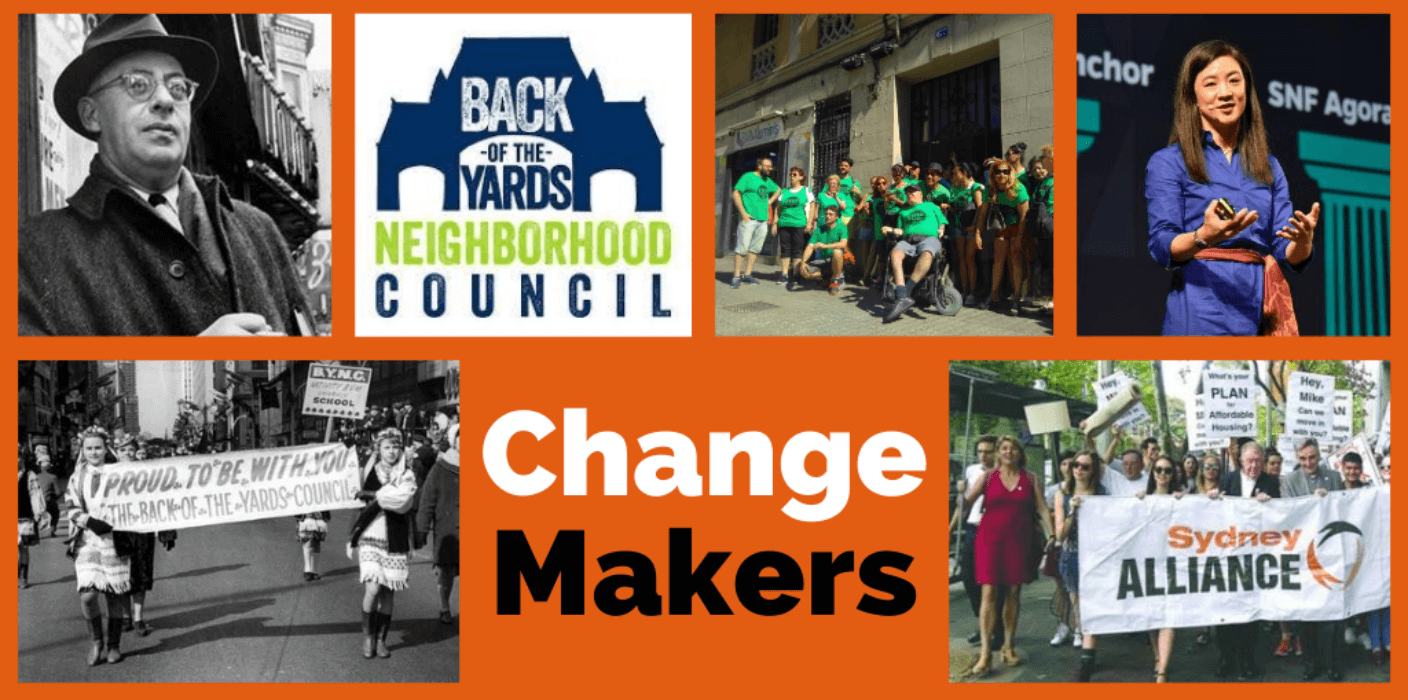
Saul Alinsky
Quite separately, the language of organising surfaced in the mid 2000s in community and climate settings. The origins of this conversation were different – here the roots were the community organising traditions of Saul Alinsky, the Industrial Areas Foundation and broad based organising.
Today – there are a *lot* of community organisers. But even though the word is in common use, the phrase is not well defined.

I had the privilege of being part of each of these waves of organising in Australia. I worked at Unions NSW as unions grappled with organising in the early 2000s, then, I traveled to the US in 2005 and brought back with me the Industrial Areas Foundation, helping to set up Australia’s first Alinsky style organisation – the Sydney Alliance. It all begs the question – what is community organising?
Community organising is a way of building people power that focuses on building the capacity, skills and leadership of the people involved in making change.
Whereas a mass rally focuses on the number of people involved in action, organising focuses on working with those people to support their leadership and their ability to act into the future.
Classic community organising emerged in the 1930s in Chicago. It brought together a variety of traditions – from communal self-organising in Judaism, to union approaches, to public action, to Catholic social teaching and even research traditions like urban ethnography. (For more on this see, Luke Bretherton “Resurrecting Democracy” Chapter 1 (pp 5-10)).

In the heat of founding the inaugural community organising organisation – ‘Back of the Yards’ Neighborhood Council – these ideas catalysed into a way of being.
Over the following 40 years, through the hands of talented organisers like Ed Chambers and Dick Harmon, an oral tradition turned into an education, giving birth to a major training program, somewhat didactically named the ‘10 day national training.’
That training taught the foundations of organising and its core principles –
- relationships,
- organisation,
- action,
- power,
- leadership.
Over time, different groups took these ideas to Europe, the UK, Canada, Australia, others split from the IAF or emerged separately with their own emphasis, but these concepts remained.
Organisers build (or ‘reorganise’) organisations as institutions of democratic power. While rallies come and go, groups and institutions stay – anchoring the voice of people so they can forever contest the decisions of the state and market.
Deep relationship-building skills create broad based organisations across the diversity of a city, town, nation or world (for instance, like the Sydney Alliance). They are learning relationships where everyone changes. Relationships are forged between leaders.
Leaders are people who bring others with them, who are ready for action, who have a sense of anger and injustice and an eye for understanding power.
These relationship-based networks – or deep coalitions – are a form of power. They represent ‘power with’, contesting the dominating or arbitrary forms of ‘power over’ that are held by too few people in modern life.
These networked organisations contest that power through action, animated with solutions identified through listening to and working with thousands of people active across a broad based network.

The purpose of this battle is to negotiate with power, to polarise – to press, to compromise where needed but always be ready to fight another day.
The fight is not over an issue – but over creating greater justice for life itself, and to radically expand the number and strengths of those contesting the world as it is, so we can create a world that could be.
In a lifelong battle, reflection and evaluation are everything.
Leaders grow not by being born ready for the fight, but by being made through their experiences in battle. Mentors, organisers and buddies (peers) work with people to draw out their growing leadership.
The iron rule of organising says ‘don’t do for someone what they can do for themselves.’ Organisers and leaders don’t take up room where others could shine, their role is to enhance and amplify – to see the potential in others and make space.
Our ChangeMakers Organising School is a space that is working to expand this kind of work across the grassroots movements and organisations of Australia. Every week we will run new content and new case studies of remarkable change making, and draw lessons out.
We run a broadcast rather than have a curriculum. You can tune in and out, or stay for the long haul. It’s up to you.
The School puts new people in relationship with one another – union members with climate activists, lay church leaders with student strikers. We are modelling how to build a broad based network every week in how we run our training.

We practice ‘learning for life.’
While we are strong advocates for the principles of community organising, we are not devout. Learning is a process of being open to new ideas.
Already we have featured plenty of approaches that sit beyond a traditional community organising approach – like our sessions on digital organising or people power. And we will feature more.
The world is not okay, and in the same way that the world needs change, so do our approaches to how to make change.
We are proud to stand on the shoulders of giants – of decades and decades of wise organisers. And we are also delighted to learn from those making change right now, building on their own traditions.
Some of these stories have also been introduced in ChangeMakers Podcasts episodes (like movements skills of the Hong Kong Protests or the political skills of Barcelona en Comu) – but when you think about it, the insights and learning available to us all is virtually endless.
Keen to Learn More?
- Register for the ChangeMakers Organising School
- Access recordings from ChangeMakers Organising School – Season One: Organising in a Pandemic
- Access recordings from ChangeMakers Organising School – Season Two
- Read more articles from Amanda Tattersall and find ChangeMakers podcast episodes in the ChangeMakers collection
- Definitions of Organising Models
- Organising: Start Here – a guide to many more organising resources in the Commons Library