
Introduction
Would you like to understand social movements better? Frameworks and models can help us analyse changing situations, and match the right tactics to those situations. It can also help us understand the role and strategic importance of different players at different points in time.
Explore this list curated by the Commons librarians, offering snapshots of key social movement frameworks and models, each with links for deeper exploration. It complements Holly Hammond’s article, Frameworks for Winning Change.
Social Movement Frameworks
Frameworks can assist us in thinking about “what’s next” for us and contextualising our day-to-day work. – Training for Change
Movement Action Plan MAP – Bill Moyer

Bill Moyer’s framework relates to change in liberal democratic societies, and is based on experience and research of many social movements. A number of case studies are included in Doing Democracy and online. Moyer’s ‘four roles of activists’ is also a valuable contribution, and the Movement Action Plan MAP shows how different roles are key at different stages. The stages are:
- 1. Normal times
- 2. Prove the failure of institutions
- 3. Ripening conditions
- 4. Social movement take-off
- 5. Identity crisis of powerlessness
- 6. Majority public support
- 7. Success
- 8. Continuing the struggle
Reference:
For more:
- Bill Moyer’s Movement Action Plan and Four Roles of Activism
- Bill Moyer’s Movement Action Plan
- Doing Democracy: The MAP Model for Organizing Social Movements (Book)
- Introduction to MAP and case studies on the History is a Weapon site.
Adaptations of Moyer’s Movement Action Plan:

Strategizing for a Living Revolution – George Lakey

The five stages are presented in sequence which shows how each preceding stage builds capacity for the next stage – but in reality the stages overlap and are cyclical.
The five stages are:
- Cultural preparation;
- Organization-building;
- Confrontation;
- Mass noncooperation;
- Parallel institutions which can carry out the legitimate functions formerly carried out by the Old Order (economic, maintaining infrastructure, decision-making, etc.)
Reference:
For more:
- Strategizing for a Living Revolution (George Lakey’s chapter in Globalize Liberation: How to Uproot the System and Build a Better World, edited by David Solnit, 2004)
- How ‘Strategy for a Living Revolution’ came to life, G Lakey, Waging Nonviolence, 2016
Counterpower – Tim Gee

“The power of any regime rests on three main things:
- ideas (the ability to persuade us of their right to rule),
- economics (the ability to extract land, labour and capital from us) and
- physical coercion (the ability to punish us if we do not obey).”
If a movement can seriously challenge those facets of power, then elites will give away whatever concessions that they have to in order to maintain their rule – and so campaigns are won. If the movement is strong enough it can topple regimes altogether – hence the argument that a successful campaign is an unfinished revolution. The ability to remove the power of elites is our Counterpower. – Tim Gee, Source
The four stages:
- Consciousness is the stage of realizing that there is a problem and creating the conditions for Counterpower.
- Coordination is the stage of building Counterpower through a movement to challenge the problem.
- Confrontation is the stage when Counterpower is used most intensely, as the movement challenges the target’s power outright.
- Consolidation is about maintaining Counterpower, adjusting to the new balance of power following the Confrontation Stage, and ensuring that it turns into real-life change.
Reference:
For more:
- Read an interview with Tim Gee on Waging Nonviolence.
- Counterpower – an interview with Tim Gee
Political Process Theory – Doug McAdam

- Political Opportunities
- Mobilizing Structures
- Framing Processes
- Protest Cycles
- Contentious Repertoires
“Political opportunities are the most important aspect of PPT, because according to the theory, without them, success for a social movement is impossible. Political opportunities–or opportunities for intervention and change within the existing political system–exist when the system experiences vulnerabilities. Vulnerabilities in the system can arise for a variety of reasons but hinge on a crisis of legitimacy wherein the populace no longer supports the social and economic conditions fostered or maintained by the system. Opportunities might be driven by the broadening of political enfranchisement to those previously excluded (like women and people of color, historically speaking), divisions among leaders, increasing diversity within political bodies and the electorate, and a loosening of repressive structures that previously kept people from demanding change.
Mobilizing structures refer to the already existing organizations (political or otherwise) that are present among the community that wants change. These organizations serve as mobilizing structures for a social movement by providing membership, leadership, and communication and social networks to the budding movement. Examples include churches, community and nonprofit organizations, and student groups and schools, to name a few.
Framing processes are carried out by leaders of an organization in order to allow the group or movement to clearly and persuasively describe the existing problems, articulate why change is necessary, what changes are desired, and how one can go about achieving them. Framing processes foster the ideological buy-in among movement members, members of the political establishment, and the public at large that is necessary for a social movement to seize political opportunities and make change. McAdam and colleagues describe framing as “conscious strategic efforts by groups of people to fashion shared understandings of the world and of themselves that legitimate and motivate collective action” (see Comparative Perspectives on Social Movements: Political Opportunities, Mobilizing Structures, and Cultural Framing [1996]).
Protest cycles are another important aspect of social movement success according to PPT. A protest cycle is a prolonged period of time when opposition to the political system and acts of protest are in a heightened state. Within this theoretical perspective, protests are important expressions of the views and demands of the mobilizing structures connected to the movement and are vehicles to express the ideological frames connected to the framing process. As such, protests serve to strengthen solidarity within the movement, to raise awareness among the general public about the issues targeted by the movement, and also serve to help recruit new members.
The fifth and final aspect of PPT is contentious repertoires, which refers to the set of means through which the movement makes its claims. These typically include strikes, demonstrations (protests), and petitions.” Source
According to PPT, when all of these elements are present, it is possible that a social movement will be able to make changes within the existing political system that will reflect the desired outcome.
References:
- Crossman, A. Political Process Theory: An Overview of the Core Theory of Social Movements, ThoughtCo.
- McAdam, Doug. “Social Movement Theory and the Prospects for Climate Change Activism in the United States.” Annual Review of Political Science 20 (2017): 189–208.
- McAdam, Doug, John D. McCarthy, and Mayer N. Zald. Comparative Perspectives on Social Movements: Political Opportunities, Mobilizing Structures, and Cultural Framings. Cambridge: Cambridge University Press, 1996.
For more:
- Publisher’s Website
- Book Preview (Google Books)
- Political Process Theory: An Overview of the Core Theory of Social Movements
- Borrow from a library near you (Worldcat)
- Mapping Climate Change Civil Resistance onto Movement Frameworks, Political Process Model – pgs 82 – 85
Climate Insurgency Model – Jeremy Brecher

Climate Insurgency Components:
- 1: An Insurgency of Civil Resistance
- 2: Self-Organization and De-isolation
- 3: Legal Arguments and Litigation
“To realize their objectives, the climate protection movement needs to weld the people of the world into an effective force capable of compelling corporations, governments, and institutions to shift from fossil fuels to clean energy. That requires creating understanding and determination in every community, geographical and virtual. It requires breaking down the invisible rules that currently discourage people from thinking and talking about the one thing that will most determine their future and that of their posterity. It means self-organization through which people move out of isolation and become part of a movement. It means creating ways for people to reach out and join with others. Conversely, it also means creating ways that those who are already organized can reach out and draw in those who are not. This underlying process of de-isolation and movement construction is the necessary condition for the ultimate success of the climate insurgency.” p 29, Against Doom
‘The climate insurgency will develop the power to impose these changes by:
- Taking actions that change millions of people.
- Undermining fossil fuel’s “pillars of support.”
- Reducing dependence on fossil fuels by implementing alternatives.
- Discrediting the legitimacy of the climate destroyers.
- Increasing the negative consequences of continuing fossil fuel extraction and burning.
- Developing a “dual power”.
- Integrating a wide range of other popular needs and concerns into plans for climate protection.
- Creating a global climate protection race.’
pgs 30-32, Against Doom
Developing a “dual power”: “people withdraw their support and cooperation from the established authorities and form their own tribunals and popular assemblies to authorize the fossil freeze and impose Climate Action Plans. The threat to established authority posed by the development of dual sovereignty and parallel government will provide the ultimate sanction against those governments that continue to authorize climate destruction.” p 31
Creating a global climate protection race: “The insurgency will instigate a competitive bidding war among nations, businesses, and institutions to demonstrate their commitment to climate protection.” p 32
“Criteria for deciding on infrastructure and project targets:
- Threat to climate,
- Threat to local people and environment,
- Local support,
- Allies,
- Cost,
- Availability of alternatives,
- Injustice,
- Vulnerability of identifiable decision-makers to pressure,
- Moral responsibilities,
- Democratic accountability,
- Public disapprobation,
- Vulnerability to exposure,
- Hypocrisy,
- Vulnerability to mass nonviolent direct action.“
pgs 35-39
References:
For more:
- A Strategy for Climate Insurgency
- Brecher, Jeremy. Climate Insurgency: A Strategy for Survival. Milton Park, Routledge, 2015.
- Mapping Climate Change Civil Resistance onto Movement Frameworks, Brecher’s Climate Insurgency – pgs 80 – 82
Strategic Interaction Framework – James Jasper

Formulated by social movement theorist James Jasper this is more a framework for mapping and analysis of situations than one predicated on a particular theory of change. His various works, and those which utilise the framework, provide insights into typical strategic dilemmas, how alliances can be formed, external conditions that help movements win, etc.
The neatest summary of the framework is in the introduction to ‘Players and Arenas’, which is available as a free download.
It proposes a model of analysis which considers the degree to which “the main constraints on what protestors can accomplish are not determined directly by economic and political structures so much as they are imposed by other players with different goals and interests… To understand how protest arises, unfolds, and affects (or does not affect) the world around it, research needs to begin with catalogs of the players involved on all sides. These lists often need to be quite extensive, and include the multiple goals and many capabilities a player has at its disposal. The goals and the means, furthermore, change over time, as do the players themselves. Because today we tend to see culture as contested, constructed, and ever-shifting, rather than unitary and static, we must admit that players and arenas are always emerging, changing, and recombining… An arena is a bundle of rules and resources that allow or encourage certain kinds of interactions to proceed, with something at stake. Players within an arena monitor each others’ actions, although that capacity is not always equally distributed.”
Reference:
For more:
- Jasper’s earlier book, Getting Your Way: Strategic Dilemmas in the Real World is broader in scope and includes useful insights as well.
- A Strategic Approach to Collective Action includes a list of key dilemmas that Jasper sees social movement actors facing including “Naughty or Nice?” and “Reaching Out or Reaching In?”
How We Win – George Lakey

“How This Guide Helps Build a Movement of Movements
Summary of themes/lessons in How We Win:
- Practices for unity and inclusion.
- Support for innovation.
- Words into action/walking the talk.
- Sustainability and positivity.
- Leadership development in context of team, collective effort.
- Credibility provided by nonviolent discipline.
- A learning curve with vision-led goal setting.”
Pgs 184-185 includes explanation of each of these with the themes explored in depth throughout the book.
Reference:
For more:
- Read Full Book (Internet Archive)
- Publisher’s Website
- Webinar – How We Win: Reflections on Nonviolent Direct Action Campaigning (1.01 mins)
- Podcast – New Books Network, 2018 (46 mins)
When to Talk and When to Fight – Rebecca Subar

Provides a strategic framework with decisions based on considering 4 factors:
- “power dynamics,
- structural barriers that limit your choice of action,
- principles, and
- biases that groups have about whether to appease or to antagonize.”
The book provides “an easy-to-learn model for talking across the modalities of negotiation and resistance. The model will help groups that prefer one or the other approach and communities that study and teach one or the other approach to have useful and coherent conversations with each other. This model is as simple as A, B, C, with all conflict activity divided into three buckets: talking, fighting for power, and fighting to vanquish an opponent.”
Discusses currencies of power- structural power, resources on hand, and potential power and breaks them into numerous sub-categories. Includes various diagrams and discussion about personal/organisational persuasions, dilemmas, approaches associated with the ‘3 buckets’, factors in making decisions related to the 4 factors, types of ‘biased characters’ within social movements. Provides a case study example of how to look at a situation and decide which strategy is best to use.
Reference:
For more:
Campaign Planning Framework – Martin Luther King, Jr.
This framework assists groups to think ahead and plan as the campaign builds. The starting point is framing the group’s issue, then the following stages:
1. Gather information;
2. Do education and leadership development;
3. Negotiate with target;
4. Increase motivation and commitment for the struggle ahead;
5. Direct action;
6. Create new relationship with opponent which reflects the new power reality.
Reference:
Principles of Nonviolent Direct Action
These principles were first developed in the context of the struggle for civil rights in the U.S. for which it was written and published by the American FOR at the request of Dr. Martin Luther King. The present version has been slightly revised for international use by the International FOR. Based on Martin Luther King-related campaigns in the Deep South of the U.S. Read more from the American Peace Test Nonviolence Trainer’s Manual.
For more:
- The King Philosophy – Nonviolence 365
- Martin Luther King’s lessons on negotiation from the successful Birmingham campaign
- Martin Luther King on the rules of non-violent protest, just v unjust laws and his disappointment with the white moderate
The Great Turning – Joanna Macy

Grace happens when we act with others on behalf of our world. – Joanna Macy, p 106
Joanna Macy’s three components of The Great Turning:
1. Holding Actions/Resisting
- Campaigns
- Protest marches
- Legal and regulatory approaches
- Engaging in nonviolent action
2. Shift in Consciousness/Values
- Scientific and spiritual revolution
- Seeing the sacred
- Learning from new science
3. Creating Alternative Structures
- New patterns of organising
- New structures and systems
Reference:
For more:
- Publisher’s Website
- See this summary by Robyn Gulliver, Kelly S. Fielding, Winnifred R. Louis in Civil Resistance Against Climate Change.
- Learn from Joanna Macy
- The Great Turning, Active Hope
- 3 Dimensions of The Great Turning w Joanna Macy & Lydia Violet (Video)
- Three Dimensions of the Great Turning – Examples, Work the Reconnects
- Mapping Climate Change Civil Resistance onto Movement Frameworks, Macy’s Great Turning – pgs 78 – 80
Four Strategies for Large System Change – Steve Waddell
The matrix serves as a device to raise valuable questions and spark insights for understanding change strategies or initiatives holistically. All change initiatives reflect some mix of the two dimensions. – Waddell, pg. 41
Two dimensions:
- destruction to creation
- confrontation to collaboration
Four Strategies for Large Systems Change:
- Doing Change: The Entrepreneurs
- Forcing Change: The Warriors
- Directing Change: The Missionaries
- Co-creating Change: The Lovers
Six Lessons of Societal Change:
- Each of the four strategies can contribute critically to one transformation.
- Particular transformations emphasize a particular strategy.
- As a transformation progresses, the comparative importance of each strategy changes.
- The particular circumstances and environment that a transformation confronts determine the order of the strategies and their interaction.
- Enabling environments support experimentation and the creation of networks.
- Each strategy requires distinct competencies.
Reference:
Waddell, S (2018) Four Strategies for Large Systems Change, Stanford Social Innovation Review Spring 2018.
For more:
- Societal Learning: Creating Big Systems Change, S Waddell
- Societal Change Systems: A Framework to Address Wicked Problem
Momentum Model
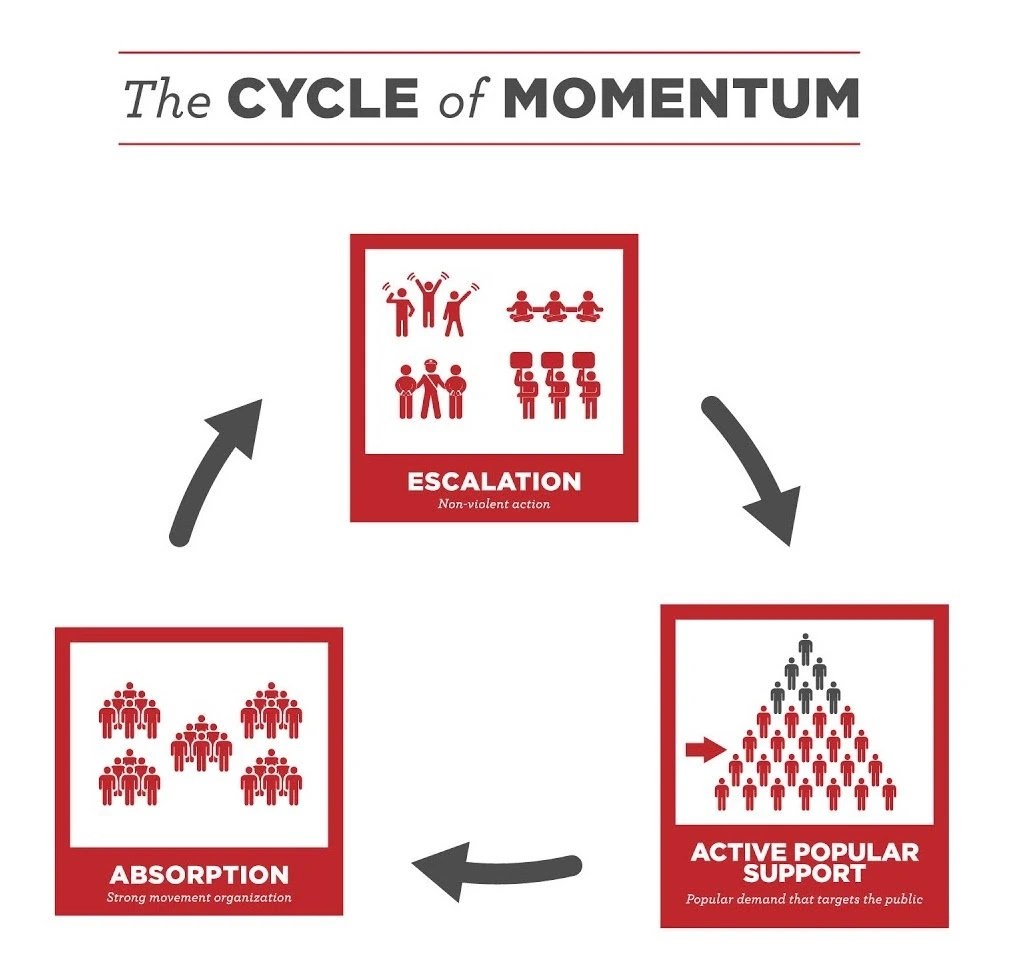
Cycle of Momentum: Escalation > Active Popular Support > Absorption
The Momentum model fuses the strengths of the structure-based organizing and mass protest to seed a new tradition of organizing in the United States. Built on the foundation of nonviolent civil resistance developed by Gandhi and Martin Luther King, Momentum synthesizes the lessons of various 20th century movements, including the Color Revolutions of Eastern Europe and the Arab Spring in North Africa.
Ayni Institute developed the foundational teaching and This is an Uprising is a key text. ‘Frontloading’ is a central concept which came from Otpor (Serbia).
Reference:
For more:
- Momentum 101 Concepts
- Organizing Traditions: Structure & Mass Protest
- Frontloading and DNA
- Movement Power: The Science of Nonviolent Direct Action
- Momentum Webinars on movements, mass decentralised organising and mobilisation by Momentum Community
Four Stages – New World Foundation
As quoted in Masters & Osborn (2010):
Social movements are not built overnight, but in stages.
“The New World Foundation (2003) identifies four different stages, although it is a fluid process:
- Stage 1: Building Movement Infrastructure – Organizing centers, anchor institutions, and networks mobilize new constituencies or a broad base of activists with the most at stake.
- Stage 2: Building Identity and Intention – The vision is developed, which gives urgency and guides and deepens participation. This is not a laundry list of demands, but an aspirational social agenda.
- Stage 3: Social Combustion: The “Movement Moment” – Transformative and collective, this highly visible time produces a profound shift in moral legitimacy and expands democratic terrain.
- Stage 4: Consolidation or Dissipation – Movements flow and ebb, and the fruits of change become incorporated into society as policies and new attitudes, or the movement dissipates.” – pg. 15
Reference:
- Masters, B., & Osborn, T. (2010). Social Movements and Philanthropy: How Foundations Can Support Movement Building. The Foundation Review, 2(2).
Other Frameworks, Models and Tools
- Act-Recruit-Train – 350/Fossil Free initiatives
- Networked Change – NetChange
- Places to Intervene in a System – Donella Meadows
- Movement as Network – Gideon Rosenblatt
- Consent Theory of Power – Gene Sharp
- Flank effect, Overton window, Moving the Rock
- The Master’s House – Wildfire Project
- Tactic Star & Action Star – Beyond the Choir & Beautiful Trouble
- Sierra Club Planning Matrix/Monitoring, Evaluation, and Learning (MEL)
- Ayni School – Social Movement Course
- Making our demands both practical and visionary – Englers
- Backfire – Brian Martin
Books
The Commons has short summaries of many of these books and can dig deeper if you have particular interest in any of them.
- Hegemony How To – Jonathan Matthew Smucker
- Emergent Strategy – adrienne maree brown – Short explanatory video
- Activist Wisdom: Practical Knowledge and Creative Tension in Social Movements – Sarah Maddison & Sean Scalmer
- Secrets of a Successful Organiser – LaborNotes
- No Shortcuts – Organizing for Power in the Gilded Age – Jane McAlevey
- How Organizations Develop Activists – Hahrie Han
- Prisms of the People: Organizing in 21st Century America – Hahrie Han, Elizabeth McKenna, and Michelle Oyakawa
- Tools for Radical Democracy: How to Organize for Power in Your Community – Joan Minieri and Paul Getsos
- Roots to Power: A Manual for Grassroots Organizing – Lee Staple
- Accompanying: Pathways to Social Change – Staughton Lynd
- Ideas for Action: Relevant Theory for Radical Change ed 2 – Cynthia Kauffman
- The Sea Is Rising and So Are We – Cynthia Kauffman
- Organize! Building from the Local for Global Justice – edited by Aziz Choudry, Jill Hanley, and Eric Shragge
- Books to Read if you are Interested in Activism, Social Change and Justice
Explore Further
- What is a Social Movement? Social Movement Definitions
- How do you Measure the Impact of Activism and Advocacy Work?
- Campaigns and Movements: How Are They Connected, How Do They Differ? Convergence Magazine, 2023
- Supporting a Movement for Health and Health Equity: Lessons from Social Movements: Workshop Summary
- Social Movements and Social Change, Introduction to Sociology, Canadian Edition
- Movements and Leaders have Seasons – it’s Important to Know which one you are in