
Introduction
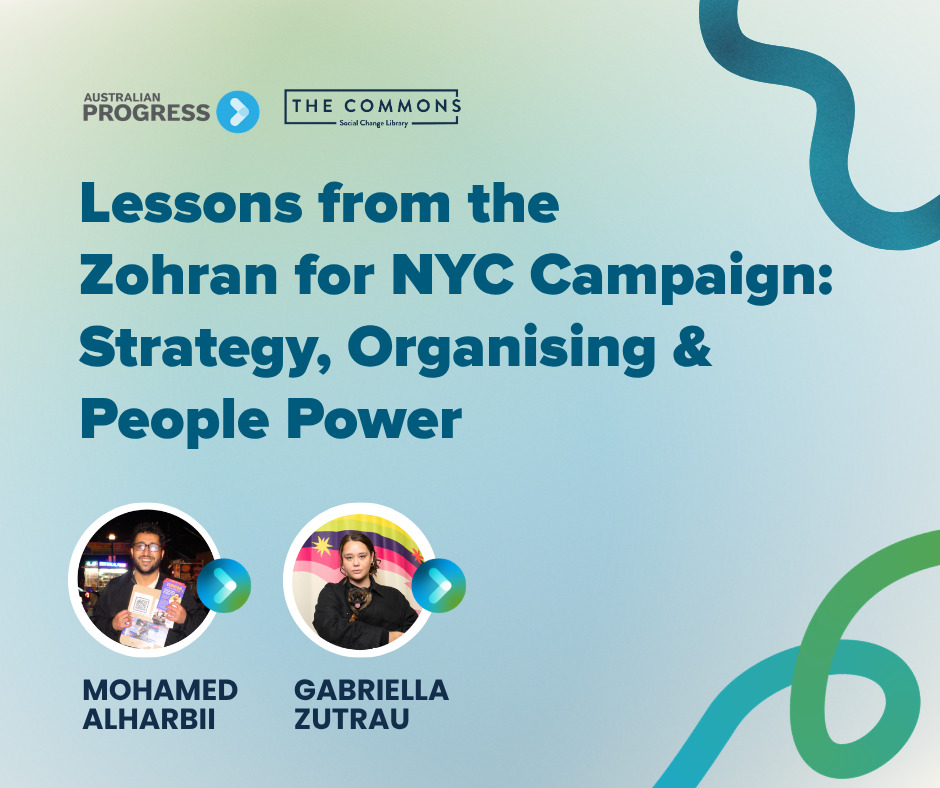
Mohamed Alharbii and Gabriella Zutrau from the Zohran for NYC campaign share the story of how Zohran Mamdani won the 2025 New York City mayoral election. Mohamed and Gabriella both spoke at the Australian Progress 2026 Conference in Melbourne/Narrm.
In November 2025, Zohran Mamdani was elected the Mayor of New York City. Mamdani became the first Muslim and South Asian mayor of New York City. His campaign for mayor drew heavily on digital campaigning and grassroots organising, particularly focusing on younger voters, tenants’ unions, and communities of colour who had often felt excluded from traditional city politics.
The Progress 2026 conference was hosted by Australian Progress on March 24-25 at the Melbourne Convention and Exhibition Centre in Narrm/Melbourne. This article was produced by The Commons Library to enable ongoing learning.
Campaign Background
At the beginning of 2025, Mamdani was polling at less than 1%. By November that same year, he had won the mayoralty of New York City with over 50% of the vote. The Zohran for NYC campaign was built from the ground up. It started with listening: not as a token exercise, but as a genuine strategy to understand what people were experiencing and what they needed from the local government. Those early conversations shaped both the policy agenda and the way the campaign communicated.
Field really wins campaigns, but having a strong comms backbone is so important, and I really think that the connection between the two on this campaign can be seen from the beginning, where it was like they were going out canvassing people, asking them what was wrong, what they were most anxious about, listening to them and crafting policy and messaging around those worries that they had, like freezing the rent and universal childcare. It was honestly like a constant feedback loop. – Gabriella Zutrau
From that foundation the campaign’s key messaging was formed: simple and repeatable messaging on affordability. Rather than seeking to speak to every issue simultaneously, the campaign focused on the cost of living, making it easy for people to relate to and connect over, rather than be divided by.
Take back the idea of affordability and cost of living being a right party’s agenda and the left that never talks about this, reaching communities across the city, communities that have often been neglected or are often classified as ‘hard to reach’. – Mohamed Alharbii
Instead of focusing on the issues that make us different, focusing on the issues that bring all humans together. – Mohamed
From early on the Zohran for NYC campaign made a significant investment in organic social media. Recognising the decline in traditional media, particularly amongst younger voters, it dedicated a significant portion of resources to social media. This meant the campaign could reach people directly, creating content that felt accessible and authentic.
However, what set the campaign apart most was its field operation. It mobilised more than 104,000 volunteers, the largest in New York mayoral history, who knocked on 3.1 million doors and made 4.5 million calls. The campaign was committed to sustained, direct contact with voters. The campaign also rethought who it was trying to reach. It made a deliberate effort to get out of the political bubble and engage people often written off as “too hard to reach” or “unlikely to turn out” (which is particularly significant in the US where voting is not compulsory). This meant focusing on those who are often treated as an afterthought: people who feel neglected, disconnected, and cynical about politics.
The Key Pillars of Success
- Relationship Building
- Volunteer Engagement
- Social Media
- Affinity Groups
- Charismatic Leadership
1. Relationship Building
The Zohran for NYC campaign involved a deliberate and sustained investment in relationship building, particularly with South Asian and Muslim communities.
From early on, the campaign made a strategic decision to engage these voters not just as a demographic, but as communities with specific concerns, internal diversity and a strong desire for direct connection. In the early stages of the campaign, this meant very personal interactions directly between Mamdani with community members. There was no event that was considered too small to attend, sometimes there were as few as 10 community members.
The campaign was also committed to meeting people where they were. For the South Asian and Muslim communities this meant mosques, temples, coffee shops and shisha bars. For many of these voters, it was important not just to hear from the campaign, but to meet Mamdani directly. That visibility helped establish credibility and build trust early on. These were not one-off interactions. The campaign returned to the same communities multiple times, creating space to build trust over time. This continuity allowed for deeper conversations, including clarifying misunderstandings about the campaign’s platform and addressing community concerns.
Importantly, the campaign also understood that communities are not a monolith.
It understood that there were tensions within and between communities, hence meeting with all the different congregations in the city was very important. Underlying all of this was a commitment to open lines of communication. The campaign prioritised responsiveness, making sure people received follow-ups, felt heard and had ways to stay in touch. Even when answers weren’t immediately available, offering contact details and maintaining accessibility helped reinforce a sense of respect and accountability.
Mamdani’s clear and unwavering stance on Palestine was another key factor in building trust with many within these communities. For many voters this was a critical issue, and Mamdani’s consistent position helped maintain integrity.
2. Volunteer Engagement
The field operation behind Zohran Mamdani’s campaign in New York City was central to its success. Managing and meaningfully engaging more than 104,000 volunteers is no small task, and the campaign’s approach offers important lessons in how to build and sustain people-powered movements.
Canvassing
At the core was canvassing. Traditional door knocking remained the most effective tool, and the campaign invested heavily in it. Every community was canvassed at least once a week, including many neighbourhoods that had rarely (if ever) been contacted by previous campaigns. This consistent presence helped build familiarity and trust over time. But the approach went beyond knocking on doors, it involved volunteers regularly attending community spaces.
The campaign prioritised having volunteers from within the communities they were engaging, who could bring cultural context, language skills, and lived experience. At the same time, it also ensured that volunteers from outside those communities were actively involved. Mohamed emphasised that there was a noticeable and positive response when people from outside a community made the effort to engage and speak in their language, both literally and culturally. He explained how simple gestures, like greeting someone with “assalamu alaykum,” signalled respect and awareness, helping to build immediate rapport.
Speaking their language literally and figuratively. Being there and showing that you are there to actually communicate with him specifically. Because if you are in the street like, ‘do you want to sign this petition’, you could ask that to everyone, but if you say ‘assalamu alaykum’, then it is like this person knows something about me. – Mohamed
It reflected a broader principle: people are more receptive when they feel seen and understood.
Model of Support for Volunteers
Supporting volunteers at this scale was no small task. From the outset, the campaign sign-up process was tailored specifically for target demographics, for example, volunteers would be asked specifically about their availability on Friday afternoons to align with mosque attendance.
From there, organisers manually followed up with volunteers to confirm availability and build a more personal connection. They tracked key information such as mosque congregations and language preferences, ensuring that they could match volunteers with the appropriate congregation. Volunteers were then grouped into dedicated chats based on specific mosques or communities. Volunteers would then be sent a one-page document outlining mosque etiquette, ensuring culture and religion was respected.
3. Social Media
The Zohran for NYC campaign built a significant social media presence. From the viral “Rent Freeze” cold plunge video to a steady stream of content that felt timely, human and authentic.
A key strength was its multilingual approach. The campaign produced videos in multiple languages, including one where Mamdani spoke Spanish. What made this stand out wasn’t just the language itself, but the choice to show the process behind it, sharing behind-the-scenes footage of him learning his lines. It added a layer of honesty and effort that audiences could connect with.
Zohran’s campaign was mostly focused and optimising for Instagram but he also had a large presence across TikTok, YouTube and Facebook. Gabriella noted that Facebook remains an active and relevant platform.
Facebook is not dead… We were not prioritising Facebook but we were cross posting to it and it grew like wild. There’s tons of engagement on Facebook, and the people who are big fans on Facebook. – Gabriella
Central Components of Zohran’s Winning Social Strategy
- Craft simple, repeatable messages
- Excite your base so they spread your message
- Post consistently and with a variety of content
- Meaningfully invest resources in organic social early
- Experiment, iterate and repeat what works
- Get people off of social media
Social Media Chatbot
The Zohran for NYC campaign used automated messaging to turn attention into action at scale.
A simple but effective hook drove engagement: “Comment [keyword] and I’ll DM you the link.” From there, links were automatically delivered via direct message – creating a seamless path from content to conversion.
Using ManyChat, the campaign sent over 144,000 automated Instagram DMs between May and November 2025, generating more than 45,000 clicks, with an average cost per click of just $0.03.
Types of automated messages:
- Comment-to-DM: users comment a keyword on a post and automatically receive a direct message with a link or next step.
- Default DM replies: instant, automated responses to incoming messages, ensuring no enquiry goes unanswered.
- Story mention replies: every time Zohran Mamdani was tagged in a story, the campaign followed up with a message like: “Thanks for the mention, we wanted to follow up…” turning passive engagement into a direct connection.
- Email capture flow: users were prompted to stay in touch with a simple message: “If you want to stay updated, just type your email address.” They could reply directly in the chat, and the system would automatically capture and sync their email into the campaign’s CRM.
Why this worked:
- Frictionless conversion moved people off the feed and into a deeper engagement channel without requiring them to click a link. This helped to reduce the likelihood of drop off.
- Chat filtering based on factors like follower count, verification status, and user tags allowed the campaign to tailor responses and prioritise high-impact audiences.
Creator Engagement
Accounts with larger followings (25,000+) were directed into a specific flow where they were sent a creator/influencer form. This form would capture details like contact info, agent, audience and niche. The campaign then invited these creators to events, but avoided giving talking points or prescribing content. Instead, influencers were trusted to create in their own voice, producing content that felt natural to their audiences. The approach proved highly effective, throughout the campaign, influencer-generated content reached over 1.4 billion views.
Instagram Broadcast Channel
An additional tactic from the campaign was the creation of an Instagram Broadcast Channel to engage their “warmer” audience; being people who had already shown some level of interest. This channel became a direct line for updates, mobilisation and deeper engagement beyond the main feed. It grew to 66,000 members during the primary, reached 70,000 between June and November, and has since expanded to more than 180,000 subscribers.
Prioritising Social Media
For a long time now, the right has outpaced the left online, and it has had devastating effects. This gap is not just about content, it is also about strategy, investment and a willingness to meet people where they are.
Progressive campaigns are still slow to shift budgets in line with the realities of the attention economy. Traditional media continues to dominate budgets, even as influence, reach and persuasion increasingly happen on social platforms.
There is a clear need for realignment. That means investing seriously in organic social, in creator engagement and in the people who understand how these spaces actually work. Not just as an add-on or a nice-to-have, but as core infrastructure.
The lesson is simple: organic social is no longer optional.
The value and efficacy of organic social media has never been more clear… Organic social is not so much performance marketing. It’s brand marketing. It is helping you to establish how people feel about your organisation – Gabriella
4. Affinity Groups
In addition to the Zohran for NYC campaign’s volunteer engagement and social media strategies, they effectively leveraged affinity groups to spread the campaign’s messaging and strengthen connections with various demographics.
Groups began emerging across a wide range of identities and communities, like Gays for Zohran, Hot Dads for Zohran, and Hot Girls 4 Zohran. Most of these were not centrally coordinated, but instead formed organically, reflecting genuine enthusiasm and resonance with the campaign.
When the groups popped up, the campaign moved quickly to connect with them, bringing them into the broader ecosystem, supporting their activity and amplifying their reach.
5. Charismatic Leader
Finally, a key strength of Zohran Mamdani’s campaign was his personal charisma. Mohamed emphasised how initially many community groups would show no interest in Zohran, but that shifted completely after spending a few hours with him.
This proved critical in in-person engagements, where he was able to build trust, connect across differences and ultimately win people over.
Conclusion
Mohamed and Gabriella both emphasised that there was no single “silver bullet” behind the campaign’s success. Instead, its strength came from how each strategy complimented each other.
I think why Zohran’s social media meant so much to people was because he had the ground game to match it… He was not just making TikToks, and people knew that because canvassers work all over the place in New York. It only really worked that his social media was so good because his field was so good and so many people were getting organised. – Gabriella
Speakers
Mohamed Alharbii (he/him), is a Yemeni born, New York raised community organiser. Formerly Zohran Mamdani’s Muslim and South Asian (MSA) Constituency Field Manager, he’s broken the record three times for the largest single day Muslim voter engagement in the US and increased MSA voter turnout by over 300% in New York City.
Gabriella Zutrau (MoveOn / Zohran for NYC) is a Digital strategy Advisor to campaigns and organizations, like MoveOn and Zohran Mamdani’s mayoral campaign. She specialises in organic social media, and has a background in community organising, and she is best known for her social chatbot infrastructure builds.
Explore Further
- Lessons for Campaigners from Zohran Mamdani’s Victory
- Working with Influencers: #NurseTok Case Study
- Fixing our Democracies and Winning Elections in the Age of Junk Politics: A Guide to Transformational Campaigning
- Election Campaign Skills
- Political Organizing Series: Public Narrative, Relationship Building, and 4C’s in Electoral Campaigns
- Explore Election Related Resources on The Commons Library
- Explore the Australian Progress collection on The Commons Library
- Autralian Progress Events & Training