
Introduction
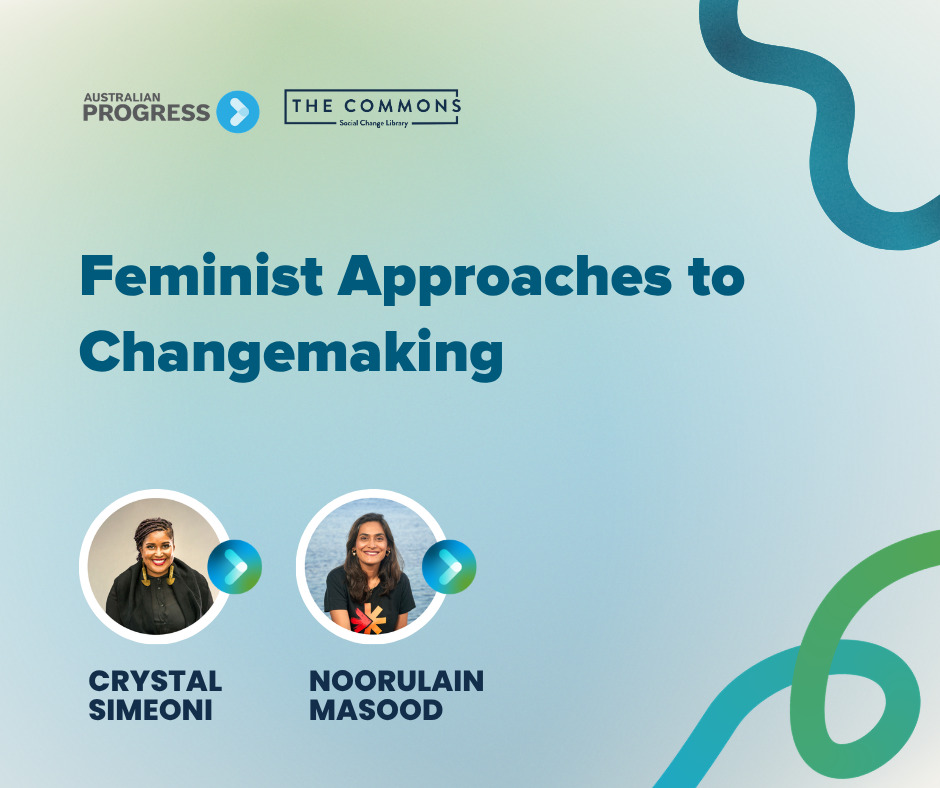
How does feminist organising shift strategy, leadership, and outcomes for climate, energy, and economic justice? During Progress 2026, Michelle Higelin explored this question with Crystal Simeoni, from the Nawi -Afrifem Collective in Kenya, and Noorulain Masood, from the Center for Social Innovation for Developing Countries in Pakistan. Below we share a summary of the session, along with a selection of quotes highlighting key lessons these case studies offer for building solidarity across movements.
Feminist movements are reshaping how change happens, from energy transition and climate justice in Pakistan to economic justice campaigns across the African continent. These approaches centre lived experience, collective power and care, while challenging extractive systems at their roots. – Session Abstract
The Progress 2026 conference was hosted by Australian Progress on March 24-25 at the Melbourne Convention and Exhibition Centre in Narrm/Melbourne. This article was produced by The Commons Library to enable ongoing learning.
Case Studies in Feminist Change Making
The Nawi Collective
Presented by Crystal Simeoni

Crystal Simeoni positioned the Nawi ecosystem in the context of broader decolonial shifts towards Pan-Africanism: the idea that all of Africa has a shared history and need to collectively act for better futures. Alongside this belief, there is also a tension between the ‘golden age’ view of post-independence and the erasure of women during this time. In this context, African women are the invisible ‘shock absorber’, paying for the state debt and the tools of colonial extraction. Nawi is building possibilities for a future where women’s labour is the foundation of the economy rather than an invisible safety net.
There is something political and important about working with our own who are thought-leaders in their own right; not just in the ways western knowledge is valued but also in the way women tell stories and build art. – Crystal Simeoni.
We recognise that debt sustainability is currently built on the infinite elasticity of women’s labour… when the IMF demands austerity, they are simply transferring the cost of survival from the state back onto the bodies of women. – Crystal Simeoni.
In ten years, our progress must be measured by our collective well-being, sovereignty and justice. – Crystal Simeoni.
By redefining the questions from the vantage point of women, the Nawi Afrifem Collective is advancing decolonial macro-economic knowledge, narratives and approaches that are rooted in the lived-experiences of African working women.
At Nawi, we don’t look at “the economy” from the glass towers of central banks; we look at it from the vantage point of African working women—farmers, traders, and caregivers. – Crystal Simeoni
We believe that macro-level economic policy is a gender justice issue. We therefore leverage Pan-African feminist political economy approaches to understand, name, and expose the root causes of injustice and worsening inequalities. – Nawi Afrifem Collective
We challenge debt and tax policies as political tools that disproportionately burden African women. – Crystal Simeoni
Connecting this approach to broader movements for change, Crystal described how “the margins of theory are moving to the centre of the streets” with people increasingly connecting their everyday lived-experiences with the relevant macro-economic conditions.
The 2024 Gen-Z protests that happened in Kenya against the tax regime… were uprising against a macroeconomic architecture that has lost its legitimacy and these young people connected the dots between a very dry finance Bill in Parliament and the empty plates in their kitchens. – Crystal Simeoni
You don’t really need a PhD in economics to understand the system that you feel intimately in your body every single day. – Crystal Simeoni
Similarly, the Nawi strategy simultaneously connects the everyday microeconomics of the lives, human rights, and dignity of African women and girls with macro-level economic policy and development contexts.
Our strategy at Nawi is multi-pronged as well. On one hand, we contribute to theory and technical spaces to ensure African women’s thought leadership is no longer excluded from a world that continues to shape what the world looks like in faraway spaces of power, like the UN or the World Bank or the IMF. At the same time we know it is just as important to make deliberate choices in how we communicate to ensure we are articulating our language and our analysis in the language of life, not just the language of policy. – Crystal Simeoni
We recognise that when a state takes on predatory debt and is forced into austerity, it is African women who pay. If a clinic closes, she becomes the doctor and nurse; if water is privatised, she walks further. She is the invisible shock absorber keeping the global financial system, her country and community afloat.” – Crystal Simeoni
We know the macro level — debt and tax — is more political than technical. These are tools of extraction that maintain a colonial relationship with our continent. – Crystal Simeoni
The connection between theory and practice in participating in a Pan-African Feminist Economics is reflected in the name Nawi; a memorial to African women who have been erased from history.
Nawi is the name of the last known survivor of the N’Nonmiton who died in 1979 at over 100 years old. The N’Nonmiton were a group of women soldiers who protected the Kingdom of Dahomey from attack and French colonization. N’Nonmiton means our mothers. In Turkana, a language spoken by a community in Kenya, Nawi means home – Nawi Afrifem Collective
Center for Social Innovation for Developing Countries (CSIDC)
Presented by Noorulain Masood
Noorulain Masood shared stories of transformative moments as a young researcher in Pakistan seeing the real effects on people when development projects were set up without benefiting the communities living nearby. This experience was positioned in sharp contrast to the simplified economic models she was taught in international development contexts that ‘invisibilised’ human beings.
Bringing the lessons from these contrasts into the foundation of CSIDC, Noorulain aimed at developing the leadership capacity of communities through the Ganz pedagogy as well as through campaigns that actually organise people on the ground towards locally relevant issues of a just energy transition in Pakistan.
In Pakistan, like many other countries of the Global South, there’s a real conversation around the indigenisation of local energy resources and using that to basically run with the rest of the economy. – Noorulain Masood
Noorualin shared her experiences organising with communities impacted by the practice of coal refining where poisonous water seeps into the ground; with communities living near renewable energy plants; and with communities where women were not participating in governance decisions.
What we started to see is when renewable energy plants were being set up, they were making energy and actually sending it into the grid, but the communities that were sitting and living in the vicinity of those power plants were getting no benefits of it. – Noorulain Masood
When you ask a question often: how many people in a leadership team are women? The answer is zero. So obviously women are not going to be organised because they are not represented in the leadership, their issues are not represented in the leadership, et cetera. – Noorulain Masood
Today, CSIDC is a women-led justice oriented leadership and strategy institute based in Pakistan, working with organizations and campaigns locally and across South and Southeast Asia, Australia, United Kingdom, and the United States. For example, one of the streams of work within CSIDC focuses on engaging women in leadership within community organising that embeds a gender lens into on-the-ground local campaigns.
It’s extremely difficult, I think, to organise women everywhere, but also I think in Pakistan, and we honestly just grapple with that question on a daily basis and make small gains and really reflect a lot around how do we stay more relevant to the lives of invisible populations and stay in communication and conversation with them. – Noorulain Masood
Grounded by a feminist ethic, the broader aim of the CSIDC is to help shift humanity away from scarcity, extraction, and violence, and towards abundance, interconnection, and peace when we too have internalised the very mindsets we seek to change.

Discussion
Facilitated by Michelle Higelin
The following sets of quotes illustrate how the discussion highlighted key lessons we can learn from these two case studies.
Using a poly-crisis lens to highlight that gender, economic, and energy injustices all share the same roots causes
Understand that our problems have the very same root causes. The extractivism hitting First Nations lands in Australia and the debt distress in Zambia, are symptoms of the same neoliberal engine. – Crystal Simeoni
The world is currently facing a very pervasive, extractive, patriarchal, white supremacist and capitalist logic that views people and nature as infinitely exploitable [so] we see the debt crisis, the climate crisis and the rise of authoritarianism… as interconnected issues. – Crystal Simeoni
What we do know is that the world is being run… by hypermasculinist, misogynist, capitalist logics where… certain bodies, or certain colours, [or] certain nationalities, are more important than others. – Noorulain Masood
Economic injustice and energy injustice should be at the heart of our efforts to drive social change; taking a global lens and really understanding the deep connection of the root causes that are behind these two issues and how they play out globally. – Michelle Higelin
Seeking out, and learning from, what is being done all around the world
Many times it has been certain identities that have been more invisible, but in this world, I think it’s really a question for us as any space that we’re walking into, it’s a question for me: who is not being heard. – Noorulain Masood
Listen to other communities. The Global North does not have a monopoly on solutions. Learn what others are doing—not as case studies to prove Western theory, but listen to them as thought leaders in systemic re-imagining. – Crystal Simeoni
Read and cite the works of others. If your theory only comes from the West, it is incomplete. Move beyond the “canon” and cite Majority World thinkers. Nawi has curated a knowledge repository called Kofa, a space for African feminist thought leadership on political economy. I invite you to explore it, learn from African women directly, and cite them. – Crystal Simeoni
Maintaining an emphasis on care, lived experience, and the collective power of imagination
Unlike traditional advocacy, feminist change-making centers people and care. Our work demands a global architecture that prioritizes the logic of life over the logic of the market. – Crystal Simeoni
For me personally, the core of feminism is really lifting up the living experience of all living things and seeing that as sacred… centring that and creating a world that speaks to that. – Noorulain Masood
We need to unlearn, learn and really re-centre our knowledge, our ideas, our lived experience, and really focus on how we reaffirm life and the protection of nature in our feminist approaches. – Michelle Higelin
The feminist movement is really the base of imagination…. making sure that we have that image so clear in our heads to work towards, is something that is so important. – Crystal Simeoni

”In a time not so far away”, a poem by Agazit Abate, 2021
Doing the internal work to build relationships across differences to navigate the tensions between feminist and class politics
I’d love to hear advice from Elders and sisters… on how to navigate class politics in the conversation around feminism and the role it plays in upholding the disparities. – Mahek
We have to do our own internal work before we start to think about how we change the world out there and make it better. We start with our homes, our families, our workplaces and communities and we build from there. – Michelle Higelin
The relational aspect of organising – transformational, not transactional, relationships. Human relationships that really change and enable each other’s leadership is important, I think, as a feminist. – Noorulain Masood
I think the more effective I am in calling out oppression in my own behaviour, and becoming more and more self-aware about how I am perpetuating some of these ways of being (and it’s an ongoing process forever), I think the more love I’m receiving from the communities I’m seeking to organise (who) come from a completely different class background than me…. You can’t really organise when you’re living different values. So for me it’s a question of what is really core to my life and how that translates into my politics. – Noorulain Masood
Using our proximity to power to take responsibility for the role of the Australian government in global injustices
Use your proximity to power. Australia has a seat at the G20 and IMF—demand your government backs unconditional Debt Cancellation and the UN Tax Convention to stop the active bleeding of our economies. – Crystal Simeoni
I think there is something really beautiful around Australia being actually a bit disconnected from the rest of the world. I think there’s something really safe and good around that. But also, [the relative safety in Australia is] an invitation to really see and examine the role of the Australian State and Business in what’s happening in the world right now. – Noorulain Masood
We can support women overseas on the front lines of the climate crisis, but we also need to hold our own government and Australian corporations accountable. We are also one of the leading exporters of fossil fuels; we aren’t a good guy in this picture, so there’s a lot we need to do around our own accountability. – Michelle Higelin
About the Speakers
Crystal Simeoni is a Pan-African feminist activist and Director of Nawi – the Afrifem Collective (The Nawi Collective). She works at the intersection of the technical and the colloquial, of critique and imagination, of knowledge and practice, of language and of the creation of community. She curates the work of the Nawi collective who, in community with other African feminists and organizations, work on analyzing, influencing and reimagining macro level economic policies and narratives. In her understanding, in her critique and her imagining of a different way, her work is always at the service of life.
Noorulain is Founder and CEO of the Center for Social Innovation for Developing Countries (CSIDC), a Global South organisation that specialises in providing training and facilitation services to enhance the practice of leadership and organising in campaigns, particularly those in the climate, energy, and gender spaces. After getting a Master’s degree in International Development from Harvard University in 2009 as a Fulbright scholar, Noor has trained and coached over 1,500 campaigners and social justice leaders across South Asia, East Asia, Australia, Africa, and the United States. She first taught with Professor Marshall Ganz at Harvard in 2012, and since has been teaching and leading teams in the instruction of Marshall Ganz’s Organizing and Heifetz’s Adaptive Leadership with Harvard University, LCN, and other institutions. Prior to founding CSIDC, Noor ran a rural leadership program; led a 1.2M USD non-profit called Teach For Pakistan; worked in the poverty and equity practice at the World Bank headquarters; and supported the Pakistan Mission in United Nations General Assembly proceedings.
Michelle Higelin is Executive Director of ActionAid Australia, a global women’s rights organisation working at the intersection of gender equality, climate change and global justice. She brings nearly three decades of experience advancing women’s rights and global justice domestically and internationally. Her experience spans strategy, programming, campaigning, fundraising and communications, with a strong focus on feminist leadership and coalition building. Under her leadership, ActionAid Australia has supported innovative models of solidarity, including the growth of a 10,000-strong women’s movement in Vanuatu and the Shifting the Power Coalition which promotes Pacific women’s leadership in climate action. Michelle is a member of the Global Leadership Team at ActionAid International, which works with movements and communities in more than 70 countries to campaign for a fair and just world for all. She is also Co-Chair of the Australian Women, Peace and Security Coalition and Vice-President of the Australian Council for International Development
Resources
Collections
- Kofa Knowledge Repository
- Feminist Africa journal
- Facilitating for Political Change: Building Collective Power: Toolkit by Action Aid
- Climate Justice and Feminism Resource Collection by CounterAct, Womens’ Climate Justice Collective (WCJC), 2020
- Notes on Solidarity – a Blog by Mumbi Kanyogo
Additional Context
- ”In a time not so far away”, a poem by Agazit Abate, 2021
- Insights from the Frontlines of Kenya, by Jacob Okumu, 2025
- Nawi macroeconomics 101, by Agazit Abate, 2025
- Feminist Macroeconomic Policies, by Busi Sibeko, Sonia Phalatse, and Lyn Ossome, 2025
- Lessons from Pakistan: How are the IMF and the World Bank shaping climate policy? by the Alliance for Climate Justice and Clean Energy and Alternative Law Collective, 2023
Explore Further
- All in For A Feminist Recovery – A recording of a plenary session from Virtual Progress 2020
- Films about Women and Social Justice and Change
- Inspiring Quotes from Women Leaders and Activists
- Movements and Campaigns for Women’s Rights
- Explore the Australian Progress collection on The Commons Library
- Explore other resources from Progress 2026
- Australian Progress Events & Training