
Introduction
This toolkit, Facilitating for Political Change: Building Collective Power – Spaces for Participative and Action Oriented Learning, focuses on tools for trainers. The toolkit includes processes for participants to learn and acquire new tools and opinions. It is for trainers who are supporting youth, volunteers, social movements, etc. in empowerment, organising and broader positive social change.
The toolkit is by Global Platforms, a network for youth-led activism, which is a part of ActionAid. They support movements, youth networks, organisations and individuals who promote progressive social, political and economical change around the world. Through capacity building and support, they seek to promote young people as drivers of change towards a more just, sustainable and democratic world.
Structure of the Toolkit
Empowerment process:
1. Global Platform’s pedagogy
2. Reading our world: Trainer tools
3. Awareness of problems: What are we dealing with?
4. Political reflection and analysis: Why is it an issue?
5. Facilitating for political change: How do we facilitate?
6. Acting on awareness and analyses: How do we act?
7. Follow up and support: Post training tools
8. Evaluate: How do we map our contribution to change processes?
Learning Development Cycle
All of Global Platform’s work is guided by their ‘Learning Development Cycle’ – their system for designing, carrying out and evaluating capacity building. With this system as their guiding principle, they can ensure that their work is supported by common quality standards, is locally rooted and makes a difference.
Their pedagogy is a cyclical process, not a linear one, so when designing they can go back and forth based on the needs of the context.
Their final aim is to create a positive change in society, so learning is a means to enhance people’s capacity to act for the desired change.
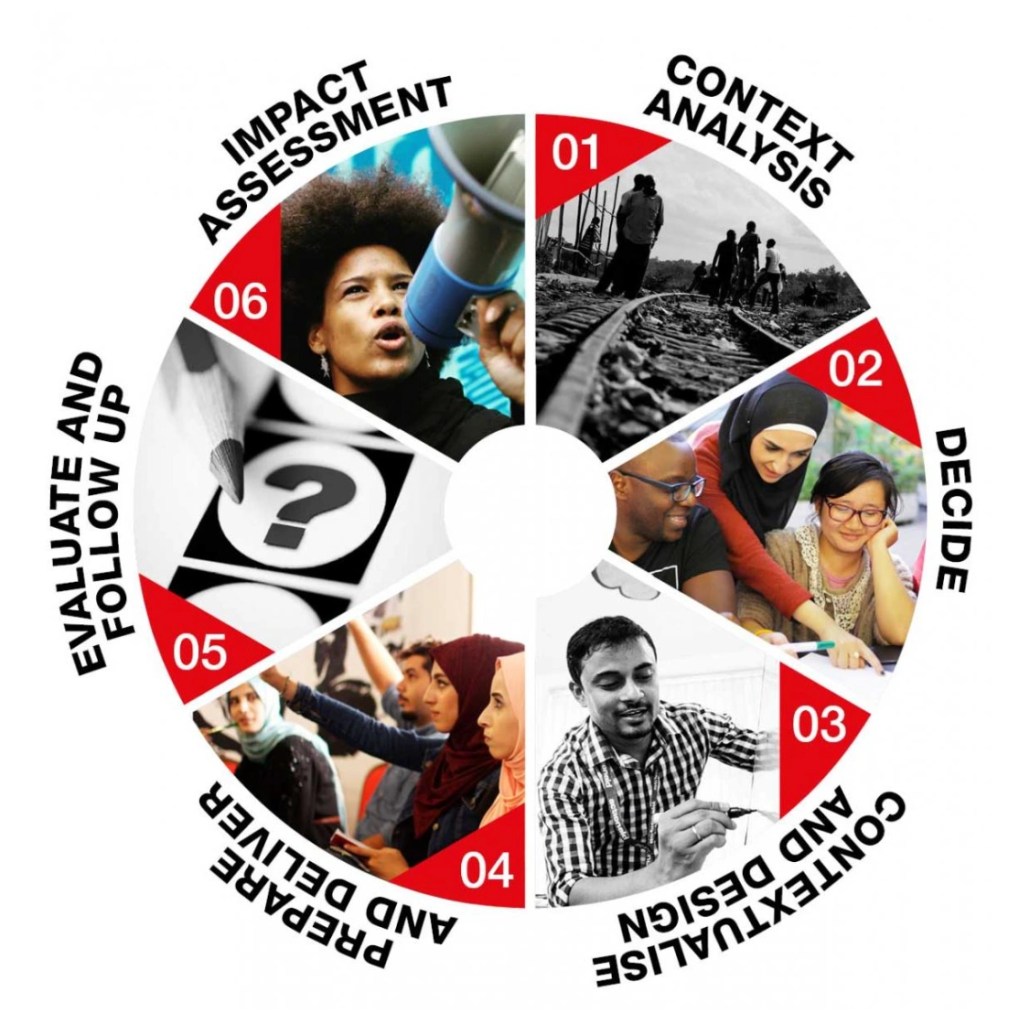
- 1. Context Analysis
- 2. Decide
- 3. Contextualise and Design
- 4. Prepare and Deliver
- 5. Evaluate and Follow Up
- 6. Impact Assessment
Reflection Questions for Trainers
The toolkit includes reflection questions with each chapter and a Self Reflection Tool for trainers to learn about their own competencies in five areas:
- Institutional Knowledge,
- Activism
- Facilitation
- Learning Design and
- Development of new tools/methods/learning and self-care.
Here is an example of the reflection questions that accompanies their Learning Principles.
Political empowerment: Analyse and change power structures
- What are my beliefs and values?
- How do I share power with my participants and still hold the responsibility for the learning process?
- How do I ensure that my facilitation and behaviours remain political yet creates space for participants to disagree and develop their own opinions?
Participatory methods: Learn together
- What is my role as a trainer?
- How do I learn with and from my participants?
- How do I create space for participants to take ownership of a process and share power with them?
Learning by doing: Act, reflect, learn and apply
- How do I make sure that I reflect on my role, my behaviours and my learning as a trainer? And who can I reflect with?
- How can I make sure that I keep learning from what I am doing?
- How do I keep challenging myself on different levels?
Public Action Learning PAL: Society as a classroom
- Do I challenge myself to plan PAL elements in all learning processes?
- Do I debrief with my colleagues after learning processes to focus on what worked and what could be improved? And to maximise organisational learning?
- Do I have the resources to grab unplanned opportunities that arise as a basis for new learning?
Dreaming big: Be creative and seek alternatives
- What are my hopes and how do I transfer hope?
- Can I imagine a better future that I want to live in and what actions have I taken or do I take to create that future?
- How can I co-create a dream with participants, colleagues and peers?
Feminist lens: Challenging patriarchy and inequality
- What are my biases and blind spots? Am I reinforcing stereotypes and how can I challenge them? Who is excluded by our language/method/approach/location/etc.
- How do I intervene, and use my trainer skills to override stereotyping?
- How do we make sure to have voices of the Global South in the learning materials?
Excerpt – Chapter 5: Facilitating for Political Change: How do we Facilitate?
From the beginning, this toolkit has already addressed that we are not facilitating taking a neutral stance. Our facilitation processes and methodologies are designed to create spaces for political discussions.
When we are facilitating political discussion, it is important to mention that we define politics in terms of who has the power in any given situation and how the power is used. For us, politics is not only limited to the election processes and who governs the country.
Facilitating political discussions in a learning setting is not an easy task. We understand that when people walk into a learning space they walk in as a whole person in terms of what they think, what they believe in, what they feel and what they bring to the space. We acknowledge that the participants are different and are socialized in a different way and they might not come with the same values as another. But while facilitating, we as trainers
acknowledge that and create a space to disagree.
The objective of facilitating political discussion does not mean we are pushing for our agendas but we in fact are providing space and skills to have that discussion. This will make the participants able to form their own views and for us to somehow touch their head, heart and hands.
The sole objective of us as trainers is to open the world to the participants and to open the participants to the world so that they are able to analyse inequalities, power structures and to navigate in those power structures and challenge them.
As political facilitators, we should not only take a stand on issues that are important to us. We should in particular be able to create processes enabling everyone to have their own voice.
We are not afraid to have a difficult conversation and engage participants in a difficult conversation. We are ready to improvise when needed by the situation. However, improvisation does not mean changing the learning objective of the learning process but creating methodologies to deliver to the learning objectives.
We reflect on the fact that the skills of the facilitator are to have a good listening ear and how to respond to what we hear.
We acknowledge the power of asking questions as well as the power of silence and debrief, and we include that in the design process. We create spaces to give and receive feedback and do not consider ourselves as either perfect or the only one to provide feedback to the participants.
Learning objectives:
- Gain tools to facilitate political discussion
- Critically analyse and plan facilitation processes
- Reflect on the power of improvisation in facilitation processes
- Tactic to deal with difficult participants
- How to listen as a facilitator and ask questions
- How to tap into head, heart, hands and feet
Explore Further
- Other resources from MOVE
- Facilitation, democracy, and climate action: Nick Willis on building power through community
- Feminist Influencing Basket of Resources
- Leaderful Organizing Tool: Good Meetings
- Leaderful Organizing: Action Learning Cycle Framework
- Beautiful Action Trainer Modules (BATMo): Resources for Nonviolent Action Trainers
- The Creativity and Skill of Co-Facilitation
- Nonviolence Trainer’s Resource Manual
- Diagnostic Tools for Trainers and Facilitators
- Working in Groups: Start Here