
Introduction
A practical guide of how Civil Society Organisations CSOs can support social movements beyond funding alone. This guide is an excerpt from Building a Movement Mindset: A Guide for Civil Society Organisations.
Social movement engagement and support is about building relationships.
Movement support means investing time and resources in understanding the nature of the specific movement, building strong relationships with its leadership or key people identified by the movement, and finding the most appropriate ways and moments to support them. It is a lot more than just funding, although funding can be part of the resources used alongside your time, staff expertise, space and infrastructure, connections, and other CSO capacities.
CSOs support movements by meeting them on their own terrain and building trust with them over time.
What Does Movement Support Look Like?
Two key principles of supporting social movements are building strong, long-term relationships, and basing the support on an analysis of the movement’s capacity, needs, and goals.
Support for social movements must be based on listening to their needs and concerns and prioritising their leadership and decision-making. Movements need space to set their own strategy and direction — even when it may seem ineffectual or complicated from a CSO perspective.
Some of the recent key studies that talk about the importance and types of movement support and assistance are: The role of external support in non-violent resistance from 2021 and Fostering a Fourth Democratic Wave from 2023.
Their key recommendations for organisations are:
- to adopt the flexibility of a movement mindset,
- strategically invest in training and building activists’ skills on nonviolent organising,
- conflict management,
- negotiations,
- strategic planning and
- providing spaces for peer and inter-generational learning, support research and educational efforts that amplify local contemporary histories of nonviolent resistance, and
- finally engage groups outside of the capitals and facilitate urban-rural, local-national, and grassroots-traditional CSO connections.
Our framework of support largely follows and validates these recommendations.
Many assume that movement support is exclusively or primarily about funding. This assumption quickly leads to conversations about the challenges of transferring funds to (or receiving accountability from) unregistered entities. However, the most beneficial support for movements does not necessarily require money transfers, and sometimes funding can even be detrimental to a movement’s integrity or cohesion.
Financial support may be needed, but it is important to also understand the broader spectrum of support possibilities, including training, conscientization, strategic guidance, research, and solidarity of various forms.
In the following section, we share from our experience a few ways we have supported certain movements. Then we explore the broad spectrum of ways to support movements, including basic approaches for funding them. This list is not exhaustive, of course, but it serves to show that there are many ways support can be rendered to movements.
Use of Existing Organisational Resources
Staff Time and Expertise
Staff time and expertise can make a huge difference. Such availability and talent can help tremendously to build relationships, understanding, and trust with a movement.
Meeting and getting to know the movement leaders and the communities where they live and work can do wonders. Movements can benefit from the advice and expertise of staff.
Both parties can provide access to other movements, alliances, training, knowledge, events, decision makers, etc. For this to work well, staff must have knowledge and experience in organising and movement building. This necessitates investing in capacity strengthening and/or hiring staff with this specific experience. Hiring experienced organisers can provide a wealth of insight into a CSO’s movement support work.
Lend Physical Spaces
Lend physical spaces for meetings, workshops, and other events to provide physical locations for organising, convening, learning, or simply to relax and chat with like-minded people.
Knowledge Creation and Sharing
Share Resources
Share resources available like toolkits, knowledge products, and platforms on how to organise and build movements. Before developing your own material, look for what is out there and make this avail- able to the movement. Here are just some for inspiration:
- Global Platforms – Network for youth-led Activism
- Beautiful Trouble
- Feminist-toolkits
- ICNC – Blog (nonviolent-conflict.org)
- New to Activism, Organising and Campaigning?
Translate and Adapt Existing Resources
Translate and adapt existing resources into different languages and formats relevant to your part- ners. Use the means of communication that is commonly used in communities of your context e.g. radio, social media, text messages with small videos or pictures.
Assist with Research
Assist with producing research or where to find existing research. Proper information and data is vital for most movements’ work and the campaigns that they lead. You may have time, access or knowledge that can make this part of the work easier for movements.
Capacity Strengthening
Training
Offer training to equip activists with necessary knowledge and tools on how to organise people, build leadership, assess and develop security plans, and develop strong campaigns and creative actions. This can be through self-paced online courses, webinars and workshops, or skill-building sessions and in-person trainings.
Explore our free online training and check out what these strong training partner organisations have to offer:
- Beautiful Trouble
- Ahel
- International Center for Nonviolent Conflict
- Africans Rising
- Leading Change Network
Coaching and Mentorship
Offer longer term coaching and mentorship to leaders or certain groups in the movement to assist with:
a) strategic campaign planning that helps social movements develop and implement effective campaign strategies with a robust risk analysis that leverage media, advocacy, direct action, and other tools to achieve their goals.
b) leadership building and decision-making structure that helps a movement expand, nur- ture new leaders, develop a culture that reflects their identity and goals, and survive short term losses.
Networking
Building Networks and Alliances
Contribute to building networks and alliances with other groups, movements, and organisations to foster collaboration, coordination, and joint struggle. Create opportunities for mutual learning, sharing of experiences, strategizing, and connecting with one another. Many struggles are closely connected and benefit from being lifted from local to regional or national levels. CSOs can convene groups themselves — or better yet, support movements to organise their own convenings.
Access to Power Holders
Extend and facilitate access to power holders by using your own network and channels to strengthen any advocacy aspect of the movement’s work and help them to find allies in unexpected and usually “closed” spaces.
Partners and Allies
Facilitate links with a wider circle of partners and allies especially outside of those movements usually work and engage with. Urban CSOs, for instance, can help connect rural struggles to regional and national struggles, donors, international partners, and other external stakeholders.
Transformative Solidarity
Increase the visibility of the social movement struggles by promoting its causes, messages, and stories through media out- reach, social media, and other channels.
Stand Together in Solidarity with the Struggle
The legitimacy of the movement (as well as your credibility as a movement ally) can be strengthened if you not only support the movements from the sidelines but also stand with them in their struggle and take public positions against the injustices they are surviving.
Transformative solidarity goes beyond symbolic and transactional gestures of joint events or sharing posts. It means building a relationship and developing new strategies and political direction together that requires changing one’s self internally, one’s perspective and commitments.
True partnership means both sides put something on the line. However, consider your context first.
Public solidarity can sometimes be harmful to a movement or a cause, inciting perceptions of cooptation, security issues, or sensitive and complex identity politics disputes. Public solidarity might play into an opponent’s propaganda that a movement is “externally funded” or “sponsored by the West.” Solidarity actions should always be well assessed and planned with the movement that you want to support.
Support the Spread of Knowledge
Support the spread of knowledge on movements within mainstream society (e.g. pop culture, film, tech, sports, art, physical infrastructure, etc). Investigate and demystify public assumptions about people power (that it is only demonstrations, only mobilising, necessarily violent, etc.) and explore viral ways to spark curiosity over the nuances of social movements.
As mass uprising is becoming an increasingly common political trend receiving more media coverage than ever before, you can contribute to promoting new and more nuanced narratives and counternarratives about self-organised people that struggle to create change.
Rapid Response under Repression and During Crackdowns
Provide or help movements access quick and easy ways to support activists at risk during crises and crackdowns through legal assistance, safe houses, evacuation, rehabilitation, and psychosocial support.
There are many rapid response mechanisms available, so you don’t necessarily need an internal one. What is important is to know who you can reach out to for what kind of threat or support on behalf of the activists.
Here are some rapid response funds:
Funding
Here are some of the elements for which movements may need funding:
Action Funds
Quick and easy ‘action funds’ for collective actions, protests, demonstrations, direct actions, and mobilisation initiatives. These may include providing small amounts for materials, transport, accom- modation, food, etc. Either do this on your own or refer the movements to existing funds like:
- GURU Direct Action Fund — Beautiful Trouble that provides small action funds monthly, and within a few weeks of the application.
- Claim Your Space – Global Fokus that provides rapid financial support to civil society and human rights defenders at risk within weeks. The mechanism is a response to the global shrinking of civic space; freedoms of expression, gathering and association.
Strategic Funding
Strategic funding on core mission and campaign work of the movement. In combination with mentoring movements through a period of strategic campaign planning, for instance, it is useful to have a joint agreement on plans and provide funds for the work to be implemented.
Movement funding is relatively small compared to funding for other civil society and non-profit programmes. You can always start with smaller funds and shorter cycles with partners with whom you have little experience. Long term partners with an established level of trust may be better suited for bigger and longer investments.
Honariums for Movement Leaders
Providing a movement leader or organiser group with a small monthly fee and social security is a practice well established in some places. This provides the movement with the much needed financial stability as it frees up the time of its leaders to more fully dedicate themselves to movement work, while also yielding the added benefit of establishing clear lines of communication between the movement and CSO.
Supporting individual members or certain groups within a movement needs to be done with careful consideration. It can lead to both accusations of foreign instigators paying people to cause trouble as well as envy within the movement itself. If done badly, it can also force certain individuals into perceived leadership roles and foster counterproductive gatekeeping.
Here are different approaches to funding movements:
Holding/Managing Funds for Movements
You can set aside an amount for a movement but manage the funds for them so that they can choose to be money-free movements. You can purchase things for them instead of availing cash: campaign materials, banners, transportation, meals for front- line activists, etc. You can also make agreements with service providers directly that they can then use.
Fiscal Hosting
You can find a willing fiscal host for the movement you want to support who would hold the funds for them. This provides assurance to funders that money will be spent on agreed activities and allows movements to access funds freely without registering or being burdened with extra administration.
Transferring Funds to Movements
Some movements are established and have an organisational and financial setup that allows for direct funding.
Examples
Youth4Parliament, Zambia
Building a movement mindset WEB 3
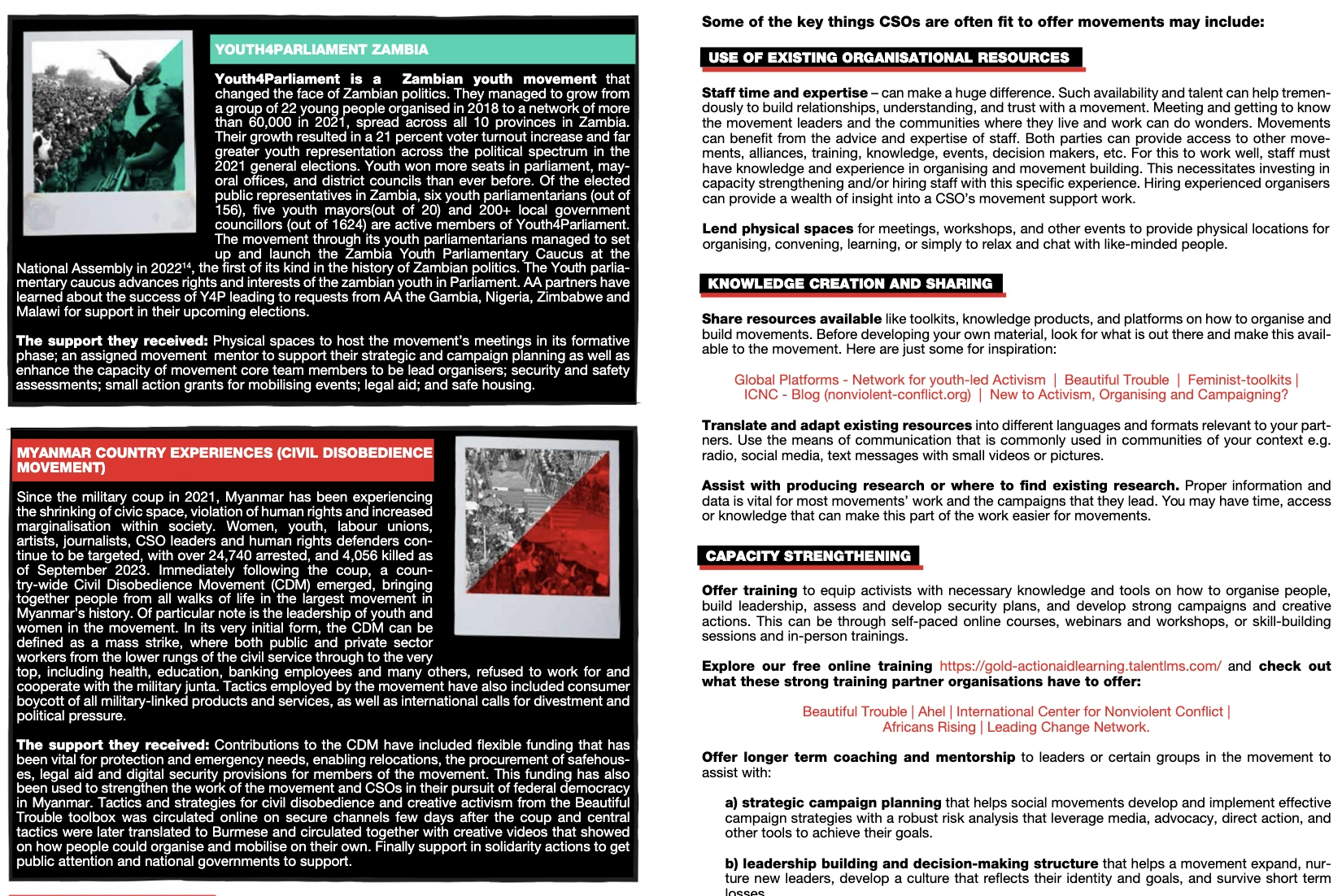
Youth4Parliament is a Zambian youth movement that changed the face of Zambian politics. They managed to grow from a group of 22 young people organised in 2018 to a network of more than 60,000 in 2021, spread across all 10 provinces in Zambia. Their growth resulted in a 21 percent voter turnout increase and far greater youth representation across the political spectrum in the 2021 general elections. Youth won more seats in parliament, may- oral offices, and district councils than ever before. Of the elected public representatives in Zambia, six youth parliamentarians (out of 156), five youth mayors(out of 20) and 200+ local government councillors (out of 1624) are active members of Youth4Parliament. The movement through its youth parliamentarians managed to set up and launch the Zambia Youth Parliamentary Caucus at the
National Assembly in 2022, the first of its kind in the history of Zambian politics. The Youth parlia- mentary caucus advances rights and interests of the zambian youth in Parliament. AA partners have learned about the success of Y4P leading to requests from AA the Gambia, Nigeria, Zimbabwe and Malawi for support in their upcoming elections.
The support they received
Physical spaces to host the movement’s meetings in its formative phase; an assigned movement mentor to support their strategic and campaign planning as well as enhance the capacity of movement core team members to be lead organisers; security and safety assessments; small action grants for mobilising events; legal aid; and safe housing.
Myanmar Country Experiences (Civil Disobedience Movement)
Since the military coup in 2021, Myanmar has been experiencing the shrinking of civic space, violation of human rights and increased marginalisation within society. Women, youth, labour unions, artists, journalists, CSO leaders and human rights defenders continue to be targeted, with over 24,740 arrested, and 4,056 killed as of September 2023. Immediately following the coup, a country-wide Civil Disobedience Movement (CDM) emerged, bringing
together people from all walks of life in the largest movement in Myanmar’s history. Of particular note is the leadership of youth and women in the movement.
In its very initial form, the CDM can be defined as a mass strike, where both public and private sector workers from the lower rungs of the civil service through to the very top, including health, education, banking employees and many others, refused to work for and cooperate with the military junta. Tactics employed by the movement have also included consumer boycott of all military-linked products and services, as well as international calls for divestment and political pressure.
The support they received
Contributions to the CDM have included flexible funding that has been vital for protection and emergency needs, enabling relocations, the procurement of safehouses, legal aid and digital security provisions for members of the movement. This funding has also been used to strengthen the work of the movement and CSOs in their pursuit of federal democracy in Myanmar.
Tactics and strategies for civil disobedience and creative activism from the Beautiful Trouble toolbox was circulated online on secure channels few days after the coup and central tactics were later translated to Burmese and circulated together with creative videos that showed on how people could organise and mobilise on their own. Finally support in solidarity actions to get public attention and national governments to support.
Access Full Resource
Building a Movement Mindset: A Guide for Civil Society Organisations (pgs 9 – 13)
The purpose of this guide is to help CSOs and others change organisational culture and practice to better understand and support social movements so they can achieve systemic change together.
This movement mindset guide comes with a toolkit that is not just about theoretical concepts; the toolkit guide is a roadmap for action. It is designed to empower CSOs to adapt their organisational culture, practices, and strategies to better support social movements. By embracing a movement mindset, CSOs can become genuine allies, catalysts for change, and driving forces behind the collective pursuit of a more just, equitable, and transformative world.
Note: There is also a 2025 version of this guide.
Explore Further
- The Role of External Support in Nonviolent Campaigns: Poisoned Chalice or Holy Grail?
- Scaling Social Movements: An Overview
- TED Talk: The Success of Nonviolent Civil Resistance by Erica Chenoweth
- Movement Support Teams: Examples of Volunteers Supporting Each Other in the Movement
- Telling the Story of Civil Society: A Toolkit | Creando Narrativas sobre la Sociedad Civil (Spanish – Español)