
Introduction
When issues are complex, contested, or emotionally charged, helping people “understand what is happening” is rarely just a matter of giving them better information. People may disagree about facts, distrust sources, interpret the same events differently, or bring different values and lived experiences into the room.
This resource draws from “Facilitating Shared Sensemaking in Complexity,” a co-learning panel organized by Democracy Resource Hub and the National Coalition for Dialogue and Deliberation (NCDD), featuring practitioners working across journalism, facilitation, deliberative democracy, and citizens’ assemblies.
The session was part of the Democracy Resource Hub Learning Series, a project of the Shift Action Lab to develop cross-field learning opportunities for practitioners in the movement for civic renewal. It is designed for community leaders, facilitators, journalists, organizers, educators, and anyone interested in supporting shared learning and understanding in the midst of uncertainty, disagreement, or distrust.
What Question Did This Session Explore?
The session explored a central practitioner question:
What supports shared learning and understanding when issues are complex and contested?
The panel did not offer one universal answer. Instead, four practitioners approached the question from different contexts: journalism and narrative work, facilitation and inner practice, deliberative framing, and citizens’ assemblies. Together, their contributions help practitioners think more clearly about what kind of process, container, information, and relational conditions may be needed in different situations.
When facts are contested, experiences differ, and values are in tension, people don’t just need more information. They need a way to make meaning together.
Featured Frameworks and Tools from the Session
This session brought together four different approaches to shared sensemaking. Each approach offers a different way to help people move from confusion, distrust, or fixed positions toward deeper understanding.
These frameworks are not interchangeable. Some are most useful when the challenge is misinformation or narrative collapse. Others are better suited for emotionally charged group process, public deliberation, or formal decision-making.
Complicating the Narratives
Shia Levitt introduced Complicating the Narratives, a journalism-based approach developed to help people cover and understand conflict without amplifying polarization. The approach is especially useful when public issues have collapsed into simple binaries, slogans, or “us versus them” stories.
Watch Shia Levitt introduce Complicating the Narratives
The framework includes four pillars:
- Listen better
- Go beneath the problem
- Embrace complexity
- Counter confirmation bias
For practitioners, this means slowing down before treating someone’s stated position as the whole story. Instead of asking only what someone believes, ask what experiences, concerns, or contradictions shaped that view. This can help groups move beyond shallow pro/con debates and make room for nuance.
Complicating the Narratives also includes practical tools such as looping, a reflective listening practice where someone says back what they heard and checks whether they understood correctly. This can be especially useful when people feel misrepresented, suspicious, or defensive.
Useful questions from this approach include:
- What experiences shaped your view?
- What is oversimplified about this issue?
- What do you want to understand about the other side?
- What do people on the other side get wrong about you?

Additional Resources;
- “22 Questions that ‘Complicate the Narrative’: Conversation techniques, interview questions, and stellar story examples born from a conflict mediation training — for journalists” (Article)
- “Complicating the Narratives: What if journalists covered controversial issues differently — based on how humans actually behave when they are polarized and suspicious?”
- Amanda Ripley: Complicating the Narrative (YouTube Video 3min)
- 22 Interview Questions to Complicate the Narrative (PDF)
Four Principles for Facilitating Meaning-Making
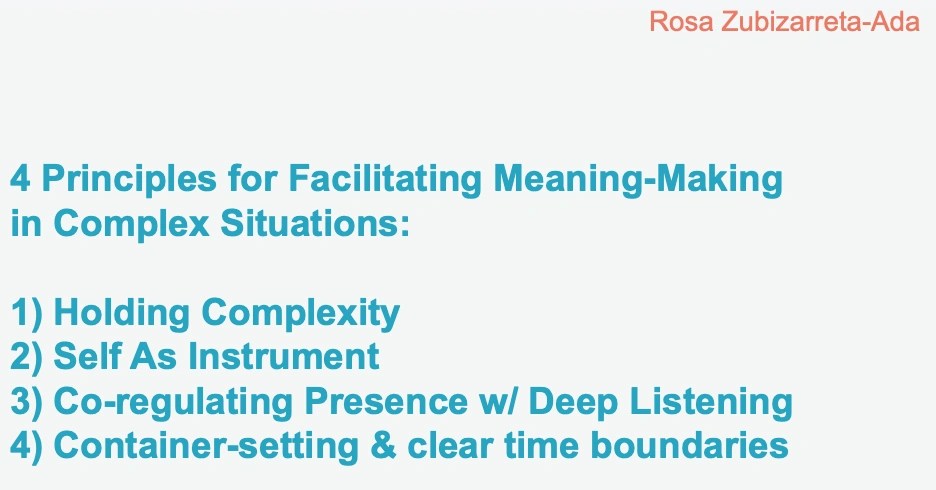
Rosa Zubizarreta-Ada offered four principles for facilitating meaning-making in complex situations:
- Holding complexity
- Self as instrument
- Co-regulating presence through deep listening
- Container-setting with clear time boundaries
This approach focuses less on external tools and more on the facilitator’s capacity to create conditions where people can stay present with difficulty. Rosa emphasized that facilitators need to be able to hold contradictory perspectives without rushing toward premature resolution.
“Self as instrument” points to the way a facilitator’s own inner state affects the group. In emotionally charged settings, facilitators may need to notice their own reactivity, regulate themselves, and avoid unconsciously steering the conversation toward their preferred outcome.
The principle of co-regulating presence highlights the importance of deep listening. When people feel heard and understood, they are often more able to move out of defensive states and into curiosity. Container-setting adds the structure needed to keep the conversation from becoming chaotic or unsafe, including time boundaries, reciprocity agreements, and skillful interruption when needed.
Watch Rosa Zubizarreta-Ada introduce the four facilitative capacities
Deliberative Framing
Cristin Brawner introduced deliberative framing through the work of the National Issues Forums Institute. This approach is useful when a community needs to move beyond conversation into public judgment, especially when there is no single right answer and people must weigh real trade-offs together.
Watch Cristin Brawner explain deliberative framing
Deliberative framing begins with public concerns rather than expert solutions. It asks how people are experiencing an issue, what worries them, what they care about, and what choices are actually available.
A deliberative frame:
- Starts with public concerns
- Names a shared public problem
- Presents real choices for addressing the problem
- Makes trade-offs explicit
- Invites people into decision-making and problem-solving
Cristin also emphasized the Talk, Decide, Act framework. In this model, deliberation begins with talk, but does not stop there. Participants work to understand how an issue affects people’s lives, weigh possible responses, and identify responsibilities or actions that may follow.
This approach is especially useful when people disagree but still need to live with shared decisions. It is less useful when a decision has already been made or when participation is being used only to inform people after the fact.

Citizens’ Assemblies
Marjan Ehsassi introduced citizens’ assemblies as a more formal democratic process for shared learning, deliberation, and policy recommendation. Citizens’ assemblies are designed to bring a representative group of people together to learn about an issue, deliberate with one another, and produce recommendations for a public body.
Watch Marjan H. Ehsassi explain citizens’ assemblies
This approach is especially useful when legitimacy and representativeness matter. Rather than relying only on people who already show up to public meetings, citizens’ assemblies use sortition, or democratic lottery, to select a group that reflects the wider community.
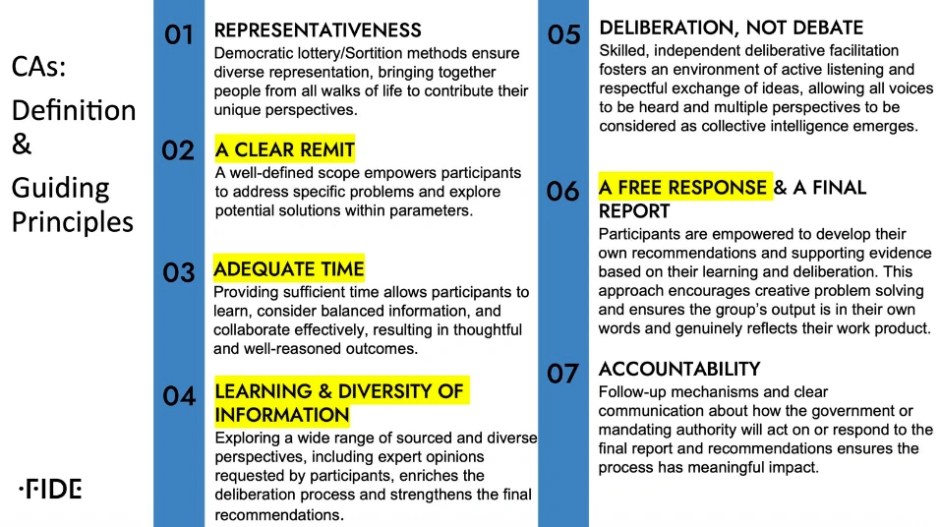
Core elements include:
- Representativeness through sortition
- A clear remit or guiding question
- Adequate time
- A structured learning phase
- Facilitated deliberation
- Proposal-writing
- Recording minority views
- Accountability from the mandating body
Marjan emphasized that the learning phase is central. Participants hear from academic experts, community stakeholders, and people with lived experience before moving into deliberation. This helps create shared grounding without assuming that expert knowledge should replace community judgment.
Citizens’ assemblies require more time, resources, facilitation, and institutional commitment than many other engagement formats. They are not casual conversations or open-ended listening sessions. Their strength comes from careful process design, representative participation, and a clear relationship to public decision-making.
Additional Citizen Assembly Resources:
- “Citizens’ Assemblies: An Introduction to Definitions & Guidelines” (PDF)
- Strengthening Democracy – Democracy Resource Hub (Resource Library Here)
How These Frameworks Fit Together
Taken together, these approaches show that shared sensemaking is not one method. It is a design challenge.
A group dealing with misinformation may need credible sources, better questions, and narrative complexity. A group that is emotionally activated may need deep listening, self-aware facilitation, and a stronger container. A community facing a public problem may need deliberative framing to weigh trade-offs. A government seeking legitimate public guidance may need a citizens’ assembly.
The practical lesson is to choose the container based on the situation. Before selecting a process, ask what kind of shared understanding is needed, who needs to be involved, what level of trust exists, and whether the group is trying to listen, learn, deliberate, decide, or act.
What Emerged in the Conversation
The session included time for panelists to ask each other questions and respond to questions from participants. These exchanges surfaced several practical dilemmas that civic practitioners often face when helping groups make sense of complex or contested issues.
How do we honor different perspectives without treating all claims as equally grounded?
Shared sensemaking requires both care and discernment. The panelists returned to a key tension: facts matter, but facts alone rarely resolve disagreement.
A useful move is to keep the group connected to the shared problem while making room to understand why people trust, distrust, or interpret information differently. Watch the exchange on facts, misinformation, and contested information.
Practical question to try: What experiences or concerns are shaping how people are interpreting this information?
How can expert input support community learning without taking over?
Expertise can help groups understand an issue more clearly, but it can also dominate if it is introduced too early or treated as more important than lived experience.
The panelists emphasized balancing multiple forms of knowledge: academic or technical expertise, community stakeholder perspectives, and lived experience. Watch the exchange on expert input and community voice.
Practical question to try: What kinds of expertise are needed here, and how will community knowledge shape the group’s understanding?
What helps when people distrust the information being shared?
Distrust is not only an information problem. It is also a trust, relationship, and sequencing problem.
Panelists suggested using trusted sources, visual evidence, side-by-side perspectives, and questions that connect information back to people’s lived experience. In some cases, groups may need to build trust around less polarizing parts of the issue before moving into the hardest questions. Watch the exchange on engaging distrusted information without turning the session into a debate.
Practical question to try: How does this information connect, or not connect, with your experience of this issue?
How do we prepare for bad-faith disruption or harmful behavior?
The panel did not offer a simple way to distinguish bad-faith engagement from sincere participation shaped by false or distorted information. Instead, the conversation pointed toward preparation, strong containers, and clear agreements.
Practitioners can reduce risk by doing pre-work, understanding the local context, working with trusted conveners, and setting expectations before conflict escalates. Watch the exchange on good faith, bad faith, and strong containers.
Practical question to try: What agreements, boundaries, or trusted relationships need to be in place before this conversation begins?
What should facilitators do when the group starts to wobble?
When a group moves toward chaos, shutdown, or deference, facilitators do not have to pretend they have total control. They can pause, name what they are noticing, and ask the group for help.
Sometimes the right move is to shift the purpose of the gathering. A group may not be ready for deliberation or decision-making and may need more space for storytelling, dialogue, or repair first. Watch the exchange on what to do when the group wobbles.
Practical question to try: This is what I’m noticing. What do you think is happening here, and what would help us move forward?
How does this work become more than a one-time event?
The conversation closed by widening the frame from individual sessions to civic infrastructure. Shared sensemaking becomes easier when communities have trusted local conveners, honest brokers of information, civic hubs, third spaces, and ongoing opportunities to practice talking across difference.
The deeper question is not only how to facilitate one difficult conversation, but how to build the local conditions that make better conversations possible over time. Watch the exchange on moving from one-off engagement to civic infrastructure.
Practical question to try: What local relationships, institutions, or civic spaces could help this work continue beyond a single event?
Watch the Recording
About the Speakers
This session was part of the Democracy Resource Hub Learning Series, curated through a collaboration between Keiva Hummel of NCDD and Duncan Autrey of the Democracy Resource Hub a project of the Shift Action Lab.
Cristin Brawner
Cristin Brawner is the Executive Director of the National Issues Forums Institute. Her work focuses on helping communities frame public issues as public choices so people can weigh competing priorities, consider trade-offs, and decide how they want to move forward together.
Connect with Cristin Brawner on LinkedIn
Shia Levitt
Shia Levitt is the Director of News Ambassadors, a longtime public radio journalist, and an accredited trainer of Solutions Journalism and Complicating the Narratives. Her work focuses on helping journalists and communities strengthen democracy by sharing credible information, surfacing diverse perspectives, and telling more nuanced stories across difference.
Connect with Shia Levitt on LinkedIn
Rosa Zubizarreta-Ada
Rosa Zubizarreta-Ada is a scholar-practitioner in organization development and group facilitation, and founder of Diapraxis. Her work, which she calls “Co-Creating Desired Futures,” integrates Dynamic Facilitation, Empathy Circles, Nonviolent Communication, and inner listening practices to help people work creatively with conflict, complexity, and difference.
Explore Rosa Zubizarreta-Ada’s resources
Connect with Rosa Zubizarreta-Ada on LinkedIn
Marjan H. Ehsassi
Marjan H. Ehsassi is Executive Director of FIDE North America, the Federation for Innovation in Democracy. Her work focuses on the design, training, and evaluation of citizens’ assemblies as a way to bring the public back into public decision-making, policy reform, and democratic problem-solving.
Connect with Marjan H. Ehsassi on LinkedIn
Additional Resources
Core Articles and Tools on Complicating the Narratives
- Complicating the Narratives
- 22 Questions to Complicate the Narrative
- The Dignity Index
- High Conflict by Amanda Ripley
Solutions-Centered Journalism and Civic Media Organizations
- News Ambassadors
- Solutions Journalism Network
- News Futures
- Institute for Nonprofit News
- FindYourNews.org
- Trusting News
Tools for Media Literacy and Assessing Information Sources
Listening Practices and Dialogue Resources
- Empathy Circles
- NCDD Resource Page on Empathy Circles
- Compassionate Listening Project
- The Five Core Skills of Compassionate Listening
- StoryCorps One Small Step
Facilitation Methods for Working with Complexity
- Dynamic Facilitation from the Co-Intelligence Institute
- Participedia: Dynamic Facilitation
- Participedia: Lewis Method of Deep Democracy
- Polarity Mapping from Civic Canopy
Inner Work and Facilitator Development
- British Focusing Association: Introduction to Focusing
- Rosa Zubizarreta-Ada’s Links and Resources
- Diapraxis
Deliberation, Citizens’ Assemblies, and Democratic Innovation
- National Issues Forums Institute
- FIDE North America
- Debra Hawhee on Deliberation as Imagining Shared Futures
Resource Libraries and Practitioner Networks
- National Coalition for Dialogue and Deliberation
- NCDD BUILD Community of Practice
- Democracy Resource Hub
Articles Mentioned
- The Future is Digital, Local, and Read All Over: Visions for Library-Newsroom Collaboration
- Civic space is closing: How local journalism can open it up
- Join or Die Documentary (Trailer)