Introduction
Civic technology can help people participate across distance, scale, and difference. But technology alone does not create trust, good process, or meaningful engagement. Digital tools are most useful when practitioners are clear about what kind of democratic work they are trying to support: listening, deliberation, public decision-making, accountability, norm repair, or collective action.
This resource draws from “Civic Technology for Meaningful Engagement,” a co-learning panel organized by Democracy Resource Hub and the National Coalition for Dialogue and Deliberation (NCDD), featuring practitioners working across participatory democracy, social cohesion technology, legislative engagement, hybrid civic organizing, and local digital listening. The session was part of the Democracy Resource Hub Learning Series, a project of the Shift Action Lab to develop cross-field learning opportunities for practitioners in the movement for civic renewal. It is designed for facilitators, civic practitioners, community organizers, local government staff, technologists, educators, and democracy organizations exploring how digital tools can support more inclusive, transparent, and human-centered engagement.
What Question Did This Session Explore?
The session explored a central practitioner question:
How can civic technology support meaningful engagement?
The panel did not offer one universal answer or promote a single platform. Instead, speakers approached the question from different contexts: participatory democracy platforms, online civic norm repair, verified legislative input, hybrid local organizing, and neighborhood-scale listening. Together, their contributions help practitioners think more clearly about how to choose tools based on purpose, context, trust, capacity, and the kind of participation or action they hope to make possible.
The civic tech didn’t replace the facilitation, but it made it possible for us to get participation happening at scale.
Featured Frameworks, Tools, or Core Ideas from the Session
The session introduced a range of civic technology tools and approaches, but one theme cut across the conversation: the tool should follow the purpose. A platform that works well for public input may not support deliberation. A tool that helps people vote on legislation may not build shared understanding. A social media intervention may shift public norms without creating a deeper dialogue space.
Rather than asking, “What civic tech tool should we use?” practitioners may need to begin with a different question:
What kind of civic engagement are we trying to support?
Match the Tool to the Civic Purpose
One of the clearest lessons from the session was that civic technology is not one category of practice. Different tools support different democratic functions, and the right tool depends on what kind of engagement you are trying to support.
Civic technology may be used to help people:
- listen across a community
- propose ideas or projects
- deliberate about trade-offs
- vote or prioritize options
- understand complex policy
- repair civic norms online
- organize local action
- hold representatives accountable
- stay connected between gatherings
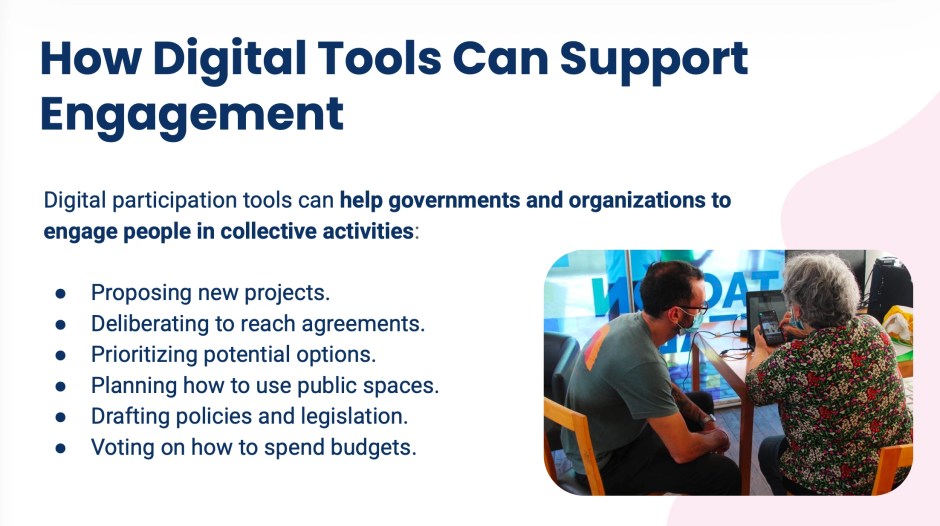
Josh introduced resources from People Powered that help practitioners select and use digital participation tools more intentionally, including tool ratings, a guide to digital participation platforms, a participation playbook, online courses, case studies, and mentorship.
The core idea is simple: start with program design before choosing a platform.
This distinction matters because many civic tech efforts fail when the tool does not match the actual engagement goal. A voting tool may collect preferences, but not necessarily support learning. A survey may gather input, but not create accountability. A digital platform may reach more people, but not create trust.
This lens is especially useful for governments, institutions, and organizations designing participatory budgeting, public consultation, participatory planning, policy development, or other forms of participatory democracy.
Useful links:
Guide to Digital Participation Platforms: When to Use Them, How to Choose & Tips for Maximum Results
Watch Josh explain how to choose the right digital participation tool
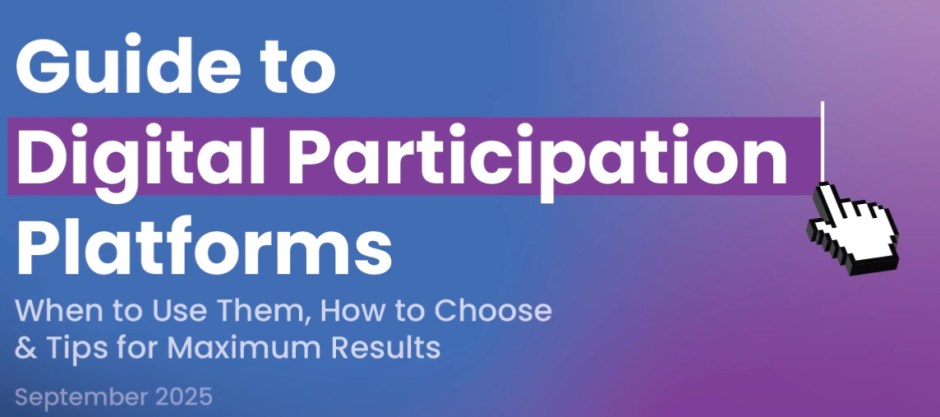
Guide to Digital Participation Platforms
Normsy: Strengthening Online Civic Norms at Scale
Ann Reidy introduced Normsy, a tool developed by Civic Health Project to support healthier civic norms in online spaces. Normsy identifies high-visibility toxic conversations on X and helps users craft prosocial, pro-democratic responses.
This approach expands the meaning of civic technology beyond formal participation processes. Not all civic engagement happens in meetings, forums, surveys, or public hearings. Much of today’s civic culture is shaped in ambient online spaces, where people absorb cues about what is normal, acceptable, or expected.
Normsy is designed less to persuade the original poster and more to reach the silent bystanders who are watching the exchange. Its purpose is to make healthier civic norms visible in spaces where toxic behavior can otherwise appear uncontested.
This lens is especially helpful when the question is: How do we intervene in toxic online spaces without censorship, shame, or escalation?
Watch Ann introduce Normsy and online civic norm repair

Digital Democracy Project: Lowering the Barrier to Policy Participation
Ramón Perez introduced the Digital Democracy Project, which allows verified voters to weigh in on pending legislation and compare public preferences with how elected representatives vote.
This approach focuses on a different civic challenge: many people are affected by legislation but have little practical way to understand, track, or influence bills as they move through government. The Digital Democracy Project uses tools such as voter verification, mobile voting, AI-generated summaries, and legislative tracking to make policy engagement more accessible.
The session also surfaced important questions about this approach. Voting on bills may help people express preferences, but it does not automatically create deliberation or shared judgment. Participants raised concerns about whether people have enough information before voting and how to distinguish informed participation from quick reaction.
This lens is especially helpful when the question is: How can people engage more directly with legislation and hold representatives accountable?
Watch Ramón introduce the Digital Democracy Project
Qiqo, Open Space, and Scrappy Civic Infrastructure
Lucas Cioffi, creator of QiqoChat brought a long-term practitioner lens, connecting open government, open space, online conferences, local campaigns, and community organizing. His examples showed that civic technology does not always need to be complex or specialized. Tools such as Google Forms, Zoom, Google Sheets, maps, wikis, and online meeting platforms can become meaningful civic infrastructure when they help people connect, organize, and act.
Watch Lucas explain why civic tech needs to meet people where they are
Lucas’s contribution emphasized meeting people where they are. Instead of waiting for the perfect platform, practitioners can start with accessible tools and use them to make participation visible, document shared concerns, and build momentum over time.
This lens is especially helpful when the question is: How do we use the tools we already have to support real community participation and action?
Watch Lucas describe Qiqo, Open Space, and online convening

Neighborhood Democracy with Tech + Dialogue: Listen → Discuss → Act Sequence
Duncan Autrey shared a neighborhood-scale example using Polis in Oakland. In this process, digital listening came before in-person dialogue. Community members first responded to an open-ended prompt and then voted on one another’s statements. Polis helped identify patterns of agreement, disagreement, and opinion groups, including perspectives that might otherwise have been lost in a traditional public meeting.
The key sequence was:
Listen → Discuss → Act
This sequence helped separate broad community input from live discussion. Instead of beginning with a meeting where the loudest voices shaped the conversation, the process began by listening across the neighborhood. The results then informed an in-person dialogue, where participants could respond to what the wider community had said and identify actionable next steps.
This lens is especially helpful when the question is: How can we listen at scale before bringing people into dialogue or action?
Watch Duncan share an example of using polis and dialogue in his neighborhood

A Shared Design Principle: Technology Should Complement Facilitation
Across these examples, civic technology was not presented as a replacement for facilitation, organizing, judgment, or relationship-building. The strongest uses of technology were paired with human process design.
Digital tools can help practitioners reach more people, process more input, visualize patterns, support participation, or intervene in online spaces. But they do not automatically create legitimacy, trust, wisdom, or accountability. Those depend on how the process is designed, who participates, how information is handled, and what happens after people contribute.
A useful rule of thumb from the session is: Use technology to strengthen the civic process, not to avoid designing one.
What Emerged in the Conversation
The session included time for panelists to ask each other questions and respond to questions from participants. These exchanges surfaced several practical dilemmas that civic practitioners often face when applying civic technology in real-world settings.
How do we reach beyond the people already interested in this work?
One recurring challenge was how to introduce civic technology and participatory practices to people who do not already know the language of civic engagement, participatory democracy, or deliberation. Josh Lerner emphasized partnerships, accessible language, and impact-focused storytelling as ways to move beyond the field’s existing bubble.
Watch the exchange on reaching beyond the civic tech bubble
Practical question to try: Who already has trust, reach, or credibility with the people we are trying to engage?
How do we name harmful online behavior without flattening cultural or political differences?
Josh asked Ann Reidy how Normsy handles the fact that what counts as “toxic” or “uncivil” can vary across contexts. Ann responded that Normsy focuses on foundational democratic norms, such as resisting dehumanization, defending civic institutions, and protecting basic democratic principles, while approaching the work with humility.
Watch the exchange on toxicity, norms, and context
Practical question to try: Are we enforcing a narrow idea of civility, or are we protecting conditions people need for democratic life?
When does technology build trust, and when does it only scale participation?
Ramón Perez named a core design principle: technology does not solve civic problems by itself. It can enable people to solve problems, but trust depends on design choices, governance, transparency, verification, communication, and organizational behavior. This reframed civic tech as trust-building infrastructure, not simply a product.
Watch the exchange on technology, people, and trust
Practical question to try: What would participants need to see, know, or experience in order to trust this process?
When is in-person interaction still essential?
Josh Lerner cautioned against relying on technology alone, especially when the goal is relationship-building, empathy, or reducing hate. Digital tools may help people participate, but direct human interaction often creates the emotional connection that leads people to re-engage online and continue participating.
Watch the exchange on why technology alone is not enough
Practical question to try: What part of this work needs digital reach, and what part needs live human interaction?
How should practitioners use AI in a polarized civic context?
Audience questions raised concern about the polarized social context around artificial intelligence. Panelists did not treat AI as either inherently good or inherently harmful. Instead, they emphasized using AI for specific tasks it does well, such as translation, clustering, summarizing, coaching, and processing large amounts of input, while staying alert to risks around transparency, privacy, bias, and accountability.
Watch the exchange on AI benefits and risks
Practical question to try: What exact task are we asking AI to perform, and where must human judgment remain clearly responsible?
How do we introduce technology where people are skeptical or uncomfortable?
A participant asked how practitioners can introduce technology in communities where residents may be skeptical, uncomfortable, or limited in their ability to travel. Panelists emphasized peer examples, transparency, familiar tools, and practical demonstrations. The strongest answer was not “convince people technology is good,” but show how it can meet a real need in a trusted context.
Watch the exchange on introducing technology in skeptical communities
Practical question to try: What small, low-risk use of technology would solve a real problem people already recognize?
Watch the Recording
- Watch the full session: “Civic Tech for Meaningful Engagement” (January 2026)
- Slide Deck
About the Speakers
This session was part of the Democracy Resource Hub Learning Series, curated through a collaboration between Keiva Hummel of NCDD and Duncan Autrey of the Democracy Resource Hub, a project of the Shift Action Lab.
Ann Reidy, Civic Health Project
Ann Reidy is Managing Director of Civic Health Project, a nonpartisan nonprofit working to strengthen civic capacity, bridge-building, and social cohesion. In this session, Ann shared Normsy, a tool designed to strengthen online civic norms by helping users respond to toxic online conversations with prosocial, pro-democratic content.
Josh Lerner, People Powered
Josh Lerner is Co-Executive Director of People Powered, a global hub for participatory democracy. In this session, Josh shared guidance on selecting and using digital participation tools effectively, emphasizing that good technology must be paired with intentional planning and human effort. Explore People Powered’s digital participation resources, newsletter, and membership opportunities.
Ramón Perez, Digital Democracy Project
Ramón Perez is Executive Director of the Digital Democracy Project, which helps verified voters weigh in on legislation and compare public preferences with representative votes. In this session, Ramón described how mobile voting, voter verification, legislative tracking, and artificial intelligence tools can lower barriers to policy participation while raising questions about trust, information quality, and accountability.
Lucas Cioffi, Qiqo
Lucas Cioffi is a veteran, software engineer, civic entrepreneur, and founder of QiqoChat. His work spans open government, public participation, online conferences, open space technology, local campaigns, and hyperlocal civic engagement. In this session, Lucas shared examples from Qiqo, conversation-mapping, and local organizing. Contact Lucas at lucas@qiqochat.com.
Duncan Autrey, Democracy Resource Hub
Duncan Autrey is Librarian for the Democracy Resource Hub, founder of the Omni-Win Project, and curator of the Democracy Resource Hub Learning Series. In this session, Duncan shared an Oakland example using Polis to support neighborhood-scale listening before in-person dialogue and action through a Listen → Discuss → Act sequence.
Explore Further
Additional Organizations and Resources
Organizations Featured in This Session
Civic Tech Tool Selection and Digital Participation Guides
- People Powered digital participation resources
- People Powered digital participation platform ratings
- Understanding the People Powered platform ratings criteria
- Guide to Digital Participation Platforms