
Introduction
This resource is based on “Facilitation Skills for Deliberative Democracy,” a Democracy Resource Hub Learning Series session created in collaboration with Peacebuilders and the Practitioner Mobilization for Democracy. The session brought together facilitators, mediators, civic hub leaders, and democracy practitioners to explore how facilitation skills translate into deliberative democracy settings, especially citizens’ assemblies.
Across the United States and internationally, communities are experimenting with citizens’ assemblies and other participatory democracy processes to help ordinary residents study complex issues, deliberate together, and recommend collective solutions. These processes depend on skilled facilitators who can build trust, support balanced participation, protect the integrity of the process, and help people reason together across difference.
This resource is designed as a practical orientation, not a complete manual for running a citizens’ assembly. It introduces core facilitation principles, highlights different practitioner perspectives, and offers transferable lessons for people supporting deliberative public dialogue, civic hubs, participatory governance, and community decision-making.

Deliberative Democracy
Model of government that emphasizes informed, reasoned and respectful discussion in political decision-making - rather than making decisions based on private interests, bias, and power.
When would I use this?
Use this resource when you are trying to understand what makes facilitation in deliberative democracy contexts different from general dialogue, mediation, or meeting facilitation.
It can help when you are:
- exploring how to facilitate citizens’ assemblies, deliberative polls, or public deliberation processes
- supporting a local civic hub or participatory democracy initiative
- designing structured conversations on complex or contested public issues
- helping residents move from opinion-sharing toward collective reasoning
- preparing facilitators to support larger groups with mixed perspectives
- looking for pathways into deeper training in deliberative democracy facilitation
This resource is especially useful for facilitators and mediators who already have strong group process skills and want to understand how those skills apply in democratic governance contexts.
What makes facilitation of deliberative processes different?
Deliberative democracy is not simply open discussion. In the session, Danielle Reiff described deliberative democracy as a model that emphasizes informed, reasoned, and respectful discussion in political decision-making, rather than decisions driven primarily by private interests, bias, or raw power.
Citizens’ assemblies are one common form of deliberative democracy. They usually involve a representative group of residents, often selected by sortition, who learn about an issue, hear balanced information, deliberate together, and develop recommendations. In stronger versions of the model, public officials agree in advance to consider the assembly’s recommendations.
For facilitators, this changes the work. The facilitator is not simply helping people feel heard. They are helping protect the legitimacy of a public reasoning process.
Deliberative facilitation often requires:
- clear process design
- balanced information flows
- equitable participation
- strong neutrality around outcomes
- protection from domination or derailment
- skillful handling of conflict and disagreement
- respect for both lived experience and shared evidence
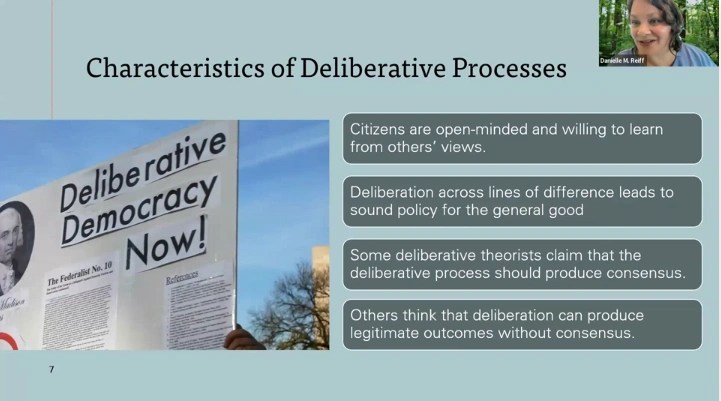
Characteristics of Deliberative Processes
- Citizens are open-minded and willing to learn from others' views.
- Deliberation across lines of difference leads to sound policy for the general good.
- Some deliberative theorists claim that the deliberative process should produce consensus.
- Others think that deliberation can produce legitimate outcomes without consensus.
Speaker Contributions: Four Lenses on Deliberative Facilitation
Danielle Reiff, Peacebuilders
Danielle Reiff opened the session by framing deliberative democracy as part of a broader response to democratic crisis and declining trust. Drawing on her background in democracy, peacebuilding, and conflict mitigation, she introduced key concepts including democracy as self-governance, deliberative democracy, and citizens’ assemblies.
Her contribution was to locate facilitation inside a larger democratic purpose. Facilitators are not only helping groups talk. They are helping create conditions where people can participate meaningfully in decisions that affect their lives.
Learn more: Peacebuilders
Lauren Babcock, Healthy Democracy
Lauren Babcock shared lessons from Healthy Democracy’s work designing and implementing civic assemblies, including a Deschutes County assembly on youth homelessness. She described how Healthy Democracy uses democratic lotteries, representative selection, stipends, transportation support, childcare, and structured information processes to reduce barriers and create more legitimate participation.
Her most distinctive contribution was the separation between process and content. In Healthy Democracy’s approach, moderators are active in upholding the process but do not engage in the content of the assembly. Lauren emphasized that this protects against perceived political bias and gives delegates a high level of autonomy.
Learn more: Healthy Democracy
Jump to Video: Lauren Part 1, Lauren Part 2
Nick Gardham, Community Organisers
Nick Gardham brought a community organizing and assembly culture lens from the United Kingdom. He described how Community Organisers had spent years supporting grassroots groups, but increasingly saw that much local work was responding to the symptoms of inequality rather than addressing root causes.
His work with the Humanity Project focuses on building local assembly culture through listening, trust, relationship-building, and community participation. Nick emphasized that people want more say over the places where they live, and that deliberative democracy depends on building local cultures of participation, not just running formal processes.
Learn more: Community Organisers
Jump to Video Nick Part 1, Nick Part 2
Alex Levy, Better Together America / Public Democracy LA
Alex Levy led a short deliberation exercise to give participants a lived experience of structured deliberation. Her exercise used quick opinion polling, timed individual sharing, and small-group synthesis to help participants experience how facilitation structure can shift a conversation away from debate and toward shared inquiry.
Her contribution was practical and experiential: deliberation is easier to understand once people have felt the difference between open-ended discussion and a structured process designed to surface shared perspectives, tensions, and questions.
Learn more: Better Together America
Learn more: Public Democracy LA
Core Facilitation Lessons from the Session
1. Design for legitimacy before the conversation begins
Deliberative facilitation starts before people enter the room. The design of the process shapes whether the outcomes will be trusted.
Important design questions include:
- Who is invited, and who is missing?
- Is participation representative, open, organized, or some combination?
- What barriers might prevent people from participating?
- What information will participants receive?
- Who decides what information is considered balanced or relevant?
- How will decision-makers respond to the recommendations?
Lauren’s examples showed how compensation, childcare, transportation support, and representative selection all matter because they shape who can participate and whether the process feels legitimate.
Video: What is a Citizen’s Assembly?
2. Build trust through listening and local relationships
Nick’s contribution emphasized that deliberation cannot be separated from trust. Communities need more than a formal event. They need relationships, local leadership, and cultures of listening.
In his framework, listening is not a soft opening activity. It is the foundation for assembly work. Outreach, one-to-one conversations, and local organizing help people believe the process is worth entering.
This is especially important in communities where people feel distant from formal politics or public institutions.
Video: What does it mean to “Take back control”?
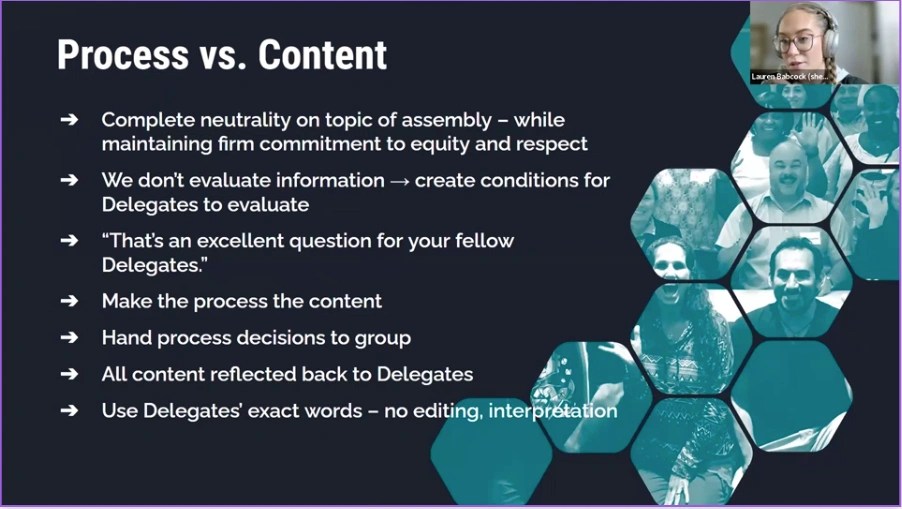
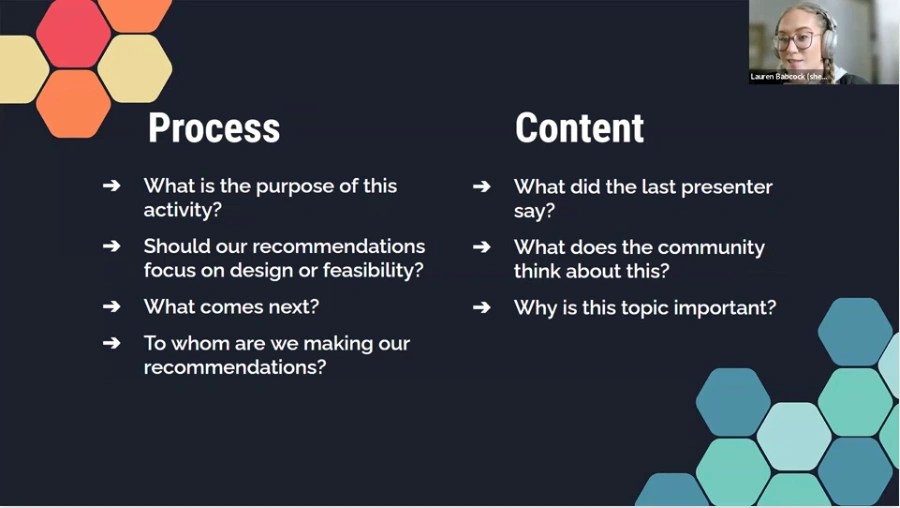
3. Separate process from content
One of the clearest facilitation distinctions came from Lauren Babcock: moderators uphold the process, but they do not shape the content.
In practice, this means:
- facilitators do not evaluate participants’ ideas
- facilitators do not interpret recommendations in their own words
- facilitators redirect content questions back to the group
- facilitators protect equity and respect without steering conclusions
- final recommendations use participants’ own words wherever possible
Lauren described this as “thriving in the process” while letting go of content. The facilitator’s job is to make the process strong enough for participants to do the meaning-making themselves. View the related video clip.
4. Use structure to protect participation
Deliberative facilitation depends on structure. Without clear structure, public conversations can easily become dominated by the most confident speakers, the most familiar arguments, or the strongest emotions in the room.
A well-structured deliberative process helps participants move through different modes of conversation, such as:
- learning relevant information
- sharing lived experience
- asking clarifying questions
- identifying shared concerns
- naming disagreement or uncertainty
- weighing tradeoffs
- developing recommendations or next steps
Facilitators can protect participation by using simple process tools:
- timed rounds so each person has a chance to speak
- clear prompts that focus the conversation
- small groups before full-group discussion
- explicit roles such as facilitator, timekeeper, or note-taker
- visible documentation of shared themes and open questions
- structured moments for disagreement, not only agreement
- a “parking lot” for important ideas that do not fit the current task
Structure is not meant to control what people think. It is meant to create the conditions for people to listen, compare perspectives, and reason together. In deliberative settings, good structure helps participants move from individual expression toward shared judgment.
5. Prepare for conflict and challenging group dynamics
Nick’s training framework named several capacities facilitators need in assembly work:
- the power of listening in assemblies
- listening as an active skill
- reflective practice
- facilitation methods and practice
- understanding conflict
- handling challenging group dynamics
He also described the goal as moving “from tension to transformation,” where conflict is not treated as a failure but as something that can be worked with if the process is strong enough.

Practical Moves for Facilitators
Deliberative facilitation requires both warmth and discipline. The following moves were surfaced across the session and participant reflections:
- Clarify the purpose of the process before inviting people in
- Make instructions simple, visible, and repeatable
- Use timed rounds to support equal participation
- Ask participants to speak from experience before moving to analysis
- Surface shared perspectives and points of contention
- Treat disagreement as useful information
- Use a “parking lot” for important ideas that do not fit the current task
- Redirect content questions back to participants
- Avoid paraphrasing in ways that change participant meaning
- Use participants’ exact words when documenting outputs
- Build in reflection before and after deliberation
- Prepare for strong emotions and challenging group dynamics
- Create hospitable conditions: room setup, warmth, breaks, food, comfort, and care
- Remember that trust is not automatic. It has to be built.
Video: Participant Autonomy in Civic Assemblies
Key Tensions for Facilitators
Neutrality vs. equity
Deliberative facilitators often need to remain neutral on the content while still upholding equity, respect, and inclusion. The facilitator may not take a position on the topic, but they still need to intervene when the process is being undermined.
Structure vs. warmth
A deliberative process needs clear structure, but too much rigidity can make the space feel cold or artificial. Several speakers and participants pointed toward the need for both procedural fairness and a warm, welcoming environment.
Lottery & Sortition vs. community organizing
Lauren’s examples emphasized representative selection and democratic lotteries. Nick’s examples emphasized local organizing, listening, and community-based invitations. These are not necessarily opposed, but they reflect different pathways into deliberation: one starts from representative design, the other from rooted local relationships.
Expertise vs. lived experience
Citizens’ assemblies rely on high-quality information, but participants also bring lived knowledge. The facilitation challenge is to create conditions where expert input informs the discussion without overpowering residents’ own judgment.
Urgency vs. trust-building
Many people want democratic renewal to happen quickly. But trust, participation, and local capacity take time. Danielle closed by naming this tension directly: how do we build patiently and relationally while responding to urgent democratic challenges?
Where to go next
This session was an orientation, not a complete training. Facilitators who want to work in deliberative democracy settings may want to continue learning about citizens’ assemblies, democratic lotteries, information design, conflict facilitation, and methods for supporting group decision-making across difference.
For deeper training or partnership support, consider contacting Healthy Democracy or Community Organisers. Both organizations work directly with deliberative and assembly-based processes and can help facilitators understand what these models require in practice.
Selected resources to continue learning:
- OECD Guidelines for Citizen Participation Processes
A detailed guide to designing citizen participation processes, including principles for good practice, planning, implementation, and evaluation. - How Do I Plan A Participatory Process?
A practical planning resource from Involve for people designing public participation processes. - What is a Citizen’s Assembly?
A clear introduction to citizens’ assemblies and how lottery-selected groups can deliberate on public issues. - How to Run a Civic Lottery
A practical guide to civic lotteries and random selection processes. - Deliberative Cafe: Mini Citizens’ Assembly
A lighter-weight model for introducing deliberation in a smaller, more accessible format. - Where Citizens’ Assemblies Are Happening Around the World
A map and overview of citizens’ assemblies and related processes internationally.
Watch the Recording
Related Resources
- Healthy Democracy: Deschutes Civic Assembly on Youth Homelessness: Case study discussed by Lauren Babcock about a civic assembly focused on youth homelessness in Central Oregon.
- Humanity Project: Project discussed by Nick Gardham about building local assembly culture through listening, trust, and community participation.
- Building Bottom-Up Democracy Through Co-Governance: Article mentioned by Nick Gardham in relation to embedding assemblies into local democratic decision-making structures.
About the Facilitators and Speakers
This session was part of the Democracy Resource Hub Learning Series, created to strengthen the civic skills needed for democratic renewal. It was developed in collaboration with Peacebuilders and the Practitioner Mobilization for Democracy.
The session featured Danielle Reiff of Peacebuilders, Lauren Babcock of Healthy Democracy, Nick Gardham of Community Organisers and the Humanity Project, and Alex Levy of Better Together America and Public Democracy LA. Duncan Autrey hosted the session for the Democracy Resource Hub and Practitioner Mobilization for Democracy.
The Democracy Resource Hub is part of the SHIFT Action Lab and supports organizers, bridge-builders, facilitators, and civic innovators working to strengthen democratic culture and practice.