
Introduction
Facilitation 101 is a beginner-friendly guide to designing and guiding conversations that help people learn together, build trust, and move toward shared purpose. It is based on a Democracy Resource Hub Learning Series training led by Keiva Hummel of the National Coalition for Dialogue and Deliberation, in partnership with the Democracy Resource Hub, a project of the SHIFT Action Lab.
This resource is for civic hub builders, local leaders, organizers, librarians, community practitioners, and anyone who finds themselves hosting conversations across difference. Use it as a navigation layer: read the summaries, watch the relevant training sections, jump into the slide deck, and explore linked tools when you want to go deeper.
This guide is not meant to turn you into an expert overnight. It is meant to help you start with more clarity, confidence, and care.
What Dialogue, Deliberation, and Facilitation Are
Before choosing an agenda or inviting people into a room, it helps to understand what kind of conversation you are trying to host. Dialogue, deliberation, and facilitation are related, but they are not the same thing.
Watch this part of the training
Jump to Section One slides: What are Dialogue & Deliberation?

Dialogue: learning together through listening and understanding
Dialogue is a conversation where people exchange ideas, experiences, and perspectives in order to deepen understanding. It is especially useful when people need to listen, learn, build relationships, or explore an issue before moving toward decisions or action.
Key practices of dialogue include:
- Curiosity over certainty
- Listening to understand, not just to respond
- Suspending judgment
- Speaking from lived experience
- Making space for multiple perspectives
- Staying present with ambiguity or discomfort
Dialogue is not debate, persuasion, or a process for forcing agreement. It can inform decisions, but its first purpose is understanding.
Deliberation: weighing options to inform decisions or action
Deliberation is a process for weighing options, tradeoffs, and consequences. It is especially useful when a group or community needs to make choices, consider public impacts, or move toward action with greater shared understanding.
Key practices of deliberation include:
- Using credible information and community wisdom
- Focusing on issues, not personalities
- Exploring pros, cons, and tensions
- Identifying shared values and points of difference
- Considering impacts on the broader community
- Seeking inclusive and thoughtful decisions
Dialogue often helps prepare the ground for deliberation. People may need to hear one another and understand the issue more deeply before they are ready to weigh options together.
Facilitation: guiding the process so groups can work well together
Facilitation is the practice of guiding a group process so people can participate more clearly, equitably, and purposefully. A facilitator helps shape the structure, flow, and conditions for a good conversation.
Facilitation includes:
- Guiding the conversation
- Designing structure and flow
- Supporting equitable participation
- Helping groups stay aligned with purpose
Facilitation is not:
- Teaching content
- Solving problems for the group
- Advocating for a particular outcome
- Controlling people’s thinking or decisions
The facilitator’s role is to help a group focus on the how of a discussion, to support the process… You don’t need to be an expert on the issue.
Choose the Right Kind of Conversation
Good facilitation starts before the meeting. One of the most important early choices is deciding what kind of conversation is actually needed.
A common mistake is to use the same meeting format for every situation. But a conversation meant to build trust should not be designed the same way as a conversation meant to make a decision. A conversation meant to explore an issue should not be structured the same way as a conversation meant to coordinate collective action.
Watch this part of the training
Jump to Section Two slides: Choosing the Right Process: Engagement Streams
Download NCDD’s Engagement Streams Framework
What kind of conversation are you trying to host?
| If your group needs to… | Use this stream | Good for… | Key design question |
| Learn, listen, and understand an issue | Exploration | Building insight and shared understanding | What do people need space to reflect on? |
| Work through tension or strained relationships | Conflict Transformation | Building trust and helping people feel heard | How can all sides feel welcomed and respected? |
| Weigh options or inform a decision | Decision Making | Public choices, tradeoffs, policy, priorities | What options, impacts, and values need to be considered? |
| Move from conversation to shared action | Collaborative Action | Coordinating across people, groups, or sectors | Who needs to work together, and what will they do next? |

The Engagement Streams Framework
The National Coalition for Dialogue and Deliberation’s Engagement Streams Framework helps organizers and facilitators match their process to their purpose. It identifies four broad streams of dialogue and deliberation practice.
These streams are not a hierarchy. They are a map. The right stream depends on what the group or community needs.
Process choice matters, because mismatch leads to frustration. Having clarity and a good process equals trust and progress.
Exploration: deepening understanding
Exploration is useful when people need to learn more about themselves, their community, or an issue. It can help new insights, relationships, and possibilities emerge.
Use exploration when the goal is to:
- Learn from one another
- Understand an issue more deeply
- Surface experiences, values, or assumptions
- Create space for reflection and insight
Conflict Transformation: navigating tensions
Conflict transformation is useful when relationships are strained, trust is low, or people need a structured way to engage across tension.
Use conflict transformation when the goal is to:
- Address conflict
- Improve relationships
- Help people feel heard
- Build enough trust for future deliberation or action
This resource introduces some basic facilitation moves for working with tension, but it does not cover advanced conflict navigation. For more support, see the related conflict management and de-escalation resources listed below.
Learn More Conflict Management and De-escalation Tips
Decision Making: weighing options
Decision making is useful when a group or community needs to consider options, tradeoffs, and impacts before making or informing a decision.
Use decision making when the goal is to:
- Weigh possible actions
- Consider pros, cons, and consequences
- Inform public decisions or policy
- Clarify public values and priorities
Collaborative Action: working together
Collaborative action is useful when people need to move from conversation into shared work.
Use collaborative action when the goal is to:
- Generate ideas for community action
- Coordinate across groups or sectors
- Develop shared plans
- Support implementation and follow-through
A simple design question
Before choosing your format, ask:
What do people most need from this conversation right now?
- Do they need to be heard?
- Do they need to learn together?
- Do they need to work through conflict?
- Do they need to weigh options?
- Do they need to decide what to do next?
The clearer you are about the purpose, the easier it becomes to choose a process that builds trust instead of frustration.
Facilitator Stance and Core Responsibilities
Facilitation is not only about what you do in the room. It is also about how you show up. A facilitator helps create the conditions for a group to participate with clarity, care, and purpose.
This section focuses on the facilitator’s stance: the presence, mindset, and responsibilities that help people trust the process.
Watch this part of the training
Jump to Section Three slides: Facilitation 101: Stance & Responsibilities
How facilitators show up
A facilitator’s presence helps set the tone for the conversation. This does not mean being perfect, fearless, or endlessly calm. It means practicing the kind of grounded presence that helps others participate more fully.
Helpful facilitator qualities include:
- Warmth and welcome
- Calm and grounded presence
- Curiosity over judgment
- Openness to multiple perspectives
- Comfort with uncertainty
- Active listening
Good facilitation begins before technique. How the facilitator enters the room can shape how others enter the conversation.
Neutrality vs. impartiality
Facilitators are sometimes told they need to be neutral. This training offers a more useful distinction: facilitators may not be neutral about process, inclusion, or human dignity, but they can work to be impartial toward viewpoints.
That means a facilitator is not there to advocate for a particular outcome or decide what people should think. At the same time, they do have a responsibility to protect the container, support fair participation, and prevent dehumanizing or harmful language from taking over the space.
A facilitator can hold the process with care while honoring a range of viewpoints.
Facilitators are not neutral. We strive to be impartial and to uphold the process with care while ensuring dignity and preventing harm.

Self-awareness, power, and tension
Facilitators bring their own assumptions, biases, identities, and reactions into the room. Part of the work is noticing what is happening in yourself while also paying attention to what is happening in the group.
This includes noticing:
- Your own assumptions and reactions
- How bias may shape questions or responses
- Power dynamics in the room
- Who is speaking often and who is not
- Your own comfort level with silence, tension, or conflict
Tension is not automatically a problem. Sometimes it means people care. The facilitator’s job is not to eliminate all discomfort, but to help the group stay connected to the purpose and to one another.
Core responsibilities before, during, and after
Facilitation is not just the live moment. Facilitators help steward the whole experience.
Before the conversation:
- Clarify the purpose
- Design the process
- Prepare the event
During the conversation:
- Uphold the process
- Support participation
- Help manage time
- Protect the container
After the conversation:
- Reflect on what happened
- Follow up when needed
- Clarify next actions, if appropriate
Follow-through matters. When facilitators or organizers say they will do something afterward, doing it helps build trust.
What this role does not require
You do not need to have all the answers. You do not need to be the expert on the issue. You do not need to control the group’s thinking or solve the group’s problem.
A facilitator’s role is to support the process so that the group can do better thinking, listening, learning, deciding, or acting together.
Prepare Before You Facilitate: Designing Simple and Inclusive Conversations
Much of the work of facilitation happens before the conversation begins. A clear, thoughtful design helps people know why they are there, how they are being invited to participate, and what kind of conversation they are entering.
This does not mean overengineering every detail. It means making a few important choices with care.
Watch this part of the training
Jump to Section Four slides: Designing Simple, Inclusive Conversations

Start with clarity
Before planning the agenda, get clear on three basic questions:
Purpose: Why are we gathering? What impact do we want this conversation to have?
Outcomes: What would make this conversation useful? What is realistic to accomplish in one conversation?
Participants: Who needs to be in the room? Who is missing, and why?
When the purpose is fuzzy, everything else gets harder. Clarity helps you choose the right process, frame the invitation honestly, and design a conversation people can trust.
Work with community partners
Trusted community partners can help make a conversation more relevant, grounded, and welcoming. They may help you understand the issue, shape the framing, reach participants, or notice what you are missing.
Good partners might include:
- Organizations already trusted by the community
- People or groups connected to those most affected by the issue
- Informal leaders, not only formal institutions
The goal is not to “use” partners for outreach. The goal is to build relationships that strengthen the conversation and the community over time.
Choose the topic, framing, and format
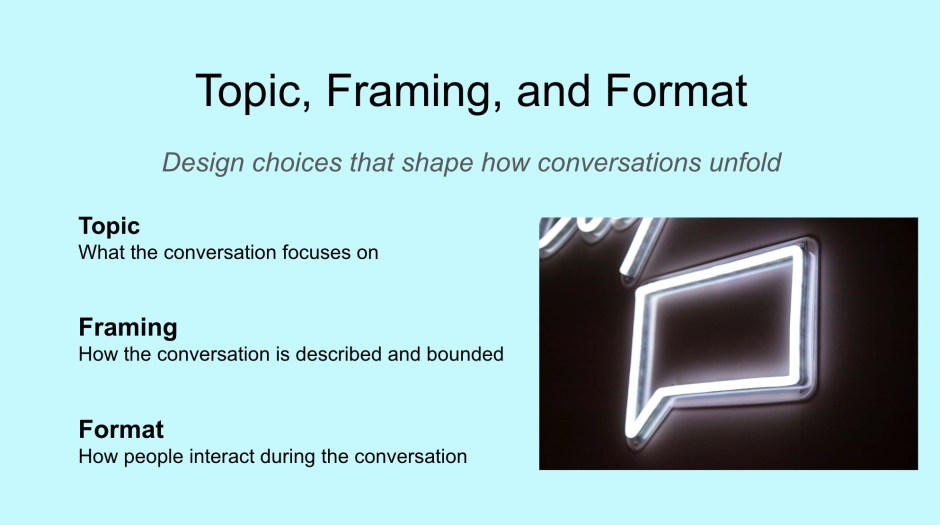
The topic is what the conversation focuses on. The framing is how the conversation is described and bounded. The format is how people will interact.
Each choice shapes who feels invited, what expectations people bring, and what kind of participation becomes possible.
When choosing a topic, ask:
- Is this relevant to the community?
- Is it aligned with the purpose?
- Is it appropriate for dialogue, deliberation, or another kind of process?
When framing the conversation, ask:
- What is this conversation about?
- What is it not about?
- Does the language assume a particular answer?
- Would people with different perspectives feel welcomed?
When choosing a format, ask:
- Should people talk as one whole group?
- Would small groups work better?
- Are pair or trio conversations useful?
- Is the group size realistic for the time available?
Start simple. A meaningful conversation does not require a complicated process.
Use the “Framing Your Topic” tool.
Create a supportive container
A supportive container helps people understand what is expected and feel safe enough to participate. This includes the purpose, group agreements, roles, and inclusion basics.
Group agreements are shared expectations for how people will treat one another and participate. They might include:
- Speak from your own experience
- Listen to understand
- Share the space
- It is okay to pass
- Respect confidentiality when requested
- Assume good intentions and attend to impact
Roles also help people relax into participation. In addition to the facilitator, a conversation may benefit from a timekeeper, note-taker, tech support person, or report-out person for small groups.
Get help with the Facilitator Introduction Cheat Sheet
Design for participation, not just attendance
Inclusion is something facilitators design for. It is not something to assume.
Some basics include:
- Use clear, accessible language
- Avoid unnecessary jargon
- Offer multiple ways to participate
- Consider timing, location, access needs, and language needs
- Name norms that support equitable participation
This guidance can stay simple on the page, with deeper accessibility resources linked for people who want to go further.
Resource: Accessible Conversation Guide
Craft good questions
Good questions shape good conversations. They invite reflection rather than defensiveness and help people speak from values, experiences, and hopes.
Good questions are usually:
- Open-ended
- Clear and simple
- Reflective
- Non-leading
- Grounded in curiosity
- Focused on possibilities
Avoid questions that are yes/no, stacked with too many parts, or written in a way that assumes agreement.
For example, instead of asking a question that implies a system is broken or that one solution is already preferred, try asking a question that opens space for multiple perspectives.
Good questions open doors; bad ones close them.
Download the “Crafting Good Questions” tool.

Beginner preparation checklist
Before hosting a facilitated conversation, ask yourself:
- Have we clarified the purpose?
- Do we know what is realistic for this conversation?
- Have we identified who should be involved?
- Have we talked with trusted community partners?
- Is the topic appropriate for this kind of conversation?
- Is the framing welcoming to different perspectives?
- Have we chosen a format that fits the group size and goals?
- Do we have group agreements?
- Are roles clear?
- Have we designed for participation and access?
- Are our questions open, clear, and non-leading?
Prepare with the Conversation Planning Tool.
Facilitate the Conversation: Core Moves
Once the conversation begins, facilitators use simple moves to help the group participate, stay oriented, and return to purpose when needed.
These moves are not about controlling the room. They are about supporting the group.
Watch this part of the training
Jump to Section Five slides: Facilitating Conversation Core Moves
Support participation
Facilitators help create room for different people to participate in different ways. This may mean inviting quieter voices, gently balancing airtime, or reminding the group that people can participate by listening, reflecting, writing, or speaking.
Useful language might include:
- “We haven’t heard from everyone yet.”
- “Let’s pause and hear from a few new voices.”
- “You’re welcome to pass if you need more time.”
The goal is not to shame people who speak often or force people who are quiet. The goal is to make participation more possible for everyone.
Manage the flow
Groups often need help staying oriented. Facilitators can support the flow by naming transitions, summarizing periodically, and making room for silence.
Useful language might include:
- “Let me pause us and reflect what I’m hearing.”
- “We’re moving from sharing experiences to noticing themes.”
- “Let’s take a moment before we move to the next question.”
Silence is not failure. It often gives people time to think, feel, and decide whether they want to speak.
Redirect with care
Sometimes conversations drift, speed up, or heat up. Redirecting helps the group return to the purpose without making people wrong.
Useful language might include:
- “Let’s reconnect this back to our purpose.”
- “I want to pause us and return to the question.”
- “Can we bring this back to our group agreements?”
- “Would it help to take a breath before we continue?”
Redirection works best when it is calm, clear, and connected to the purpose of the gathering.

Stay grounded
A facilitator’s nervous system can affect the room. When tension rises, slowing down can help the group stay present.
Grounding can look like:
- Taking a breath
- Slowing your pace
- Pausing before responding
- Noticing the urge to fix
- Asking for a short break if needed
The facilitator does not need to solve everything in the moment. Sometimes the most useful move is to slow the conversation down enough for people to think together again.
Our nervous system really does set the tone for how people engage with one another.
Watch for common pitfalls
Every facilitator makes mistakes. What matters is noticing and adjusting.
Common pitfalls include:
- Over-explaining
- Ignoring power dynamics
- Asking vague or stacked questions
- Letting dominant voices take over
- Skipping synthesis or closure
You are not failing if the room gets quiet, if someone talks too much, if the group drifts, or if you need a moment to decide what to do next. Facilitation is a practice. Repair and adjustment are part of the work.
Core moves at a glance
When in doubt:
- Invite participation
- Reflect what you are hearing
- Redirect to the purpose
- Pause when needed
- Return to the agreements
- Close with care
Use a Simple Dialogue Structure
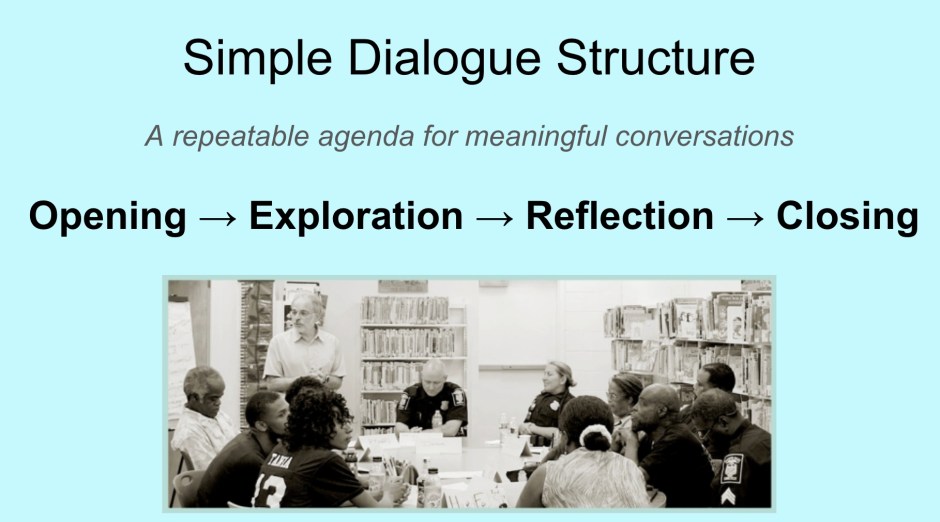
When you are new to facilitation, it helps to have a simple structure you can rely on. This dialogue structure is not the only way to guide a conversation, but it gives you a clear starting point that can be adapted for many community settings.
The basic flow is:
Opening → Exploration → Reflection → Closing
Watch this part of the training
Jump to Section Six slides: Simple Dialogue Structure
Opening: set clarity, safety, and purpose
The opening helps people feel welcomed, oriented, and clear about why they are there. This is where the facilitator sets the tone and helps participants transition into the conversation.
An opening may include:
- Welcome and orientation
- Introductions
- Group agreements
- Purpose
- An opening question or personal stake question
Sample opening questions:
- What brings you to this conversation today?
- What is one experience that shaped how you think about this issue?
- What would make this conversation feel worthwhile to you?
Facilitation tip: Start with clarity and welcome before moving into content.
Exploration: hear perspectives and experiences
The exploration phase gives people space to share stories, experiences, concerns, assumptions, and perspectives. This is where the group begins to understand the issue more fully.
Exploration may include:
- Story sharing
- Perspective-taking
- Surfacing assumptions
- Listening across differences
Sample exploration questions:
- What feels important to you about this issue?
- What concerns are you hearing from others?
- What assumptions might we need to test?
Facilitation tip: Help people speak from their own experience before moving too quickly into analysis or solutions.
Reflection: make meaning together
The reflection phase gives the group time to notice what has emerged. Rather than rushing toward answers, this phase helps participants name themes, patterns, surprises, and missing pieces.
Reflection may include:
- Naming themes
- Noticing patterns
- Surfacing what is missing
- Making sense of what the group has heard
Sample reflection questions:
- What stood out to you?
- What patterns or themes are emerging?
- What feels missing from this conversation?
Facilitation tip: Pause long enough for meaning to surface. Reflection is not just summary; it helps the group hear itself.
Closing: create a sense of completion
A strong closing helps people leave with clarity, appreciation, and a sense that the conversation was held with care. Not every dialogue needs to end in action, but every dialogue benefits from some kind of completion.
Closing may include:
- Synthesis
- Appreciation
- Next actions, if appropriate
Sample closing questions:
- What is one takeaway you are leaving with?
- What do you appreciate about today’s conversation?
- What questions feel most alive moving forward?
Facilitation tip: Completion is a form of care. Even when there are no next steps, help people understand what happened and what, if anything, will happen next.
Start simple. You don’t have to do a complex process to have a meaningful conversation.
Keep Learning and Take One Small Next Step
Facilitation is a practice. You do not need to master everything before you begin. Skills grow through preparation, practice, reflection, and trying again.
Watch this part of the training
Jump to Section Seven slides: Encouragement and Next Actions
Facilitation is a practice, not a performance
Every conversation teaches you something. A conversation may get quiet, someone may dominate, a question may not land, or the group may need more time than expected. That does not mean you failed.
What matters is noticing, adjusting, and reflecting afterward.
As you build your practice, remember:
- You do not need to have all the answers
- Small conversations can build confidence
- Reflection is part of the work
- You can start with one simple move or structure
- You are part of a larger ecosystem of people practicing dialogue, deliberation, and facilitation
Try one small action
After reading this guide or watching the training, choose one small next step.
You might:
- Use the simple dialogue structure to plan a conversation
- Try one facilitation move, such as summarizing or naming a transition
- Practice writing clearer, more open-ended questions
- Ask a trusted partner to review your framing
- Reflect after a meeting on what worked and what you would change
The goal is not to become an expert immediately. The goal is to practice with more clarity, care, and intention.
Keep Learning / Related Facilitation Resources
Practical tools mentioned in the training:
Guides below tailored for libraries but still very relevant:
- Framing Your Topic
- Crafting Good Questions
- Conversation Planning Tool
- Facilitator Introduction Cheat Sheet
- Conflict Management and De-escalation Tips
Organizations with Further Resources and Training
- Art of Hosting — participatory leadership practices for hosting meaningful conversations
- Convergent Facilitation — facilitation approaches for collaborative decision-making
- Essential Partners — resources for dialogue across differences
- Everyday Democracy — resources for community dialogue and public engagement
- International Association for Public Participation USA — public participation training, frameworks, and professional resources
- Interactivity Foundation — resources for collaborative discussion and civic imagination
- Sustained Dialogue Institute — dialogue practices for transforming relationships and communities
Watch the Recording
Watch the full Facilitation 101 training
Related Resources
Use these materials to explore the training and adapt the tools for your own context.
About the Facilitator
Keiva Hummel is the Executive Director of the National Coalition for Dialogue and Deliberation, a network and resource center for people working with dialogue, deliberation, public engagement, and group process. In this training, she introduces foundational facilitation concepts and practical tools for people hosting community conversations.
This training was offered through the Democracy Resource Hub Learning Series, a project of the SHIFT Action Lab, in partnership with the National Coalition for Dialogue and Deliberation.