
Introduction
Political differences show up in families, neighborhoods, workplaces, organizations, public meetings, advocacy campaigns, and civic institutions. For people who design or hold spaces for others, the question is often not simply “How do we bring people together?” but “What kind of engagement is actually appropriate for this situation?”
This resource draws from “Bridging Across Political Differences,” a co-learning panel organized by Democracy Resource Hub and the National Coalition for Dialogue and Deliberation (NCDD), featuring Katie Hyten, Pearce Godwin, Bo Harmon, and Ryan Nakade. The session was part of the Democracy Resource Hub Learning Series, a project of the Shift Action Lab to develop cross-field learning opportunities for practitioners in the movement for civic renewal. It is designed for facilitators, organizers, civic leaders, educators, librarians, democracy practitioners, and community conveners who are navigating political, cultural, or ideological differences in real-world settings.
The session explored bridging as a set of context-dependent practices, including structured dialogue, local civic action, conservative engagement, de-escalation, credible messenger work, and violence prevention. Rather than offering one universal method, this resource helps practitioners compare different approaches and sharpen their judgment about when to engage, how to design the engagement, and when another approach may be needed.
What Question Did This Session Explore?
The session explored a central practitioner question:
How can practitioners engage across political differences in ways that are grounded, relationally skillful, and strategically appropriate to context?
The panel did not assume that dialogue is always the right answer. Instead, four practitioners approached the question from different contexts: reflective structured dialogue, local civic action, conservative engagement, and violence prevention. Together, their contributions help practitioners think more clearly about what kind of process, invitation, messenger, language, and relational conditions may be needed in different situations.
Bridging across political differences is not about being endlessly patient or perfectly neutral. It’s about developing practices that help people stay in relationship, navigate tension, and remain human with one another.
Featured Frameworks, Tools, and Core Ideas from the Session
The session surfaced several practical frameworks and approaches that can help practitioners think more clearly about how to engage across political differences. These tools do not all serve the same purpose. Some are designed for structured dialogue, some for local civic action, some for cross-partisan advocacy, and some for reaching people who would never attend a typical “bridging” event.
Reflective Structured Dialogue
Katie Hyten shared Essential Partners’ approach to Reflective Structured Dialogue, which is designed to shift patterns of communication within communities and institutions. Rather than treating difficult conversations as isolated events, this approach looks at the systems, cultures, and relationships that shape how people communicate over time.
Watch Katie Hyten explain Reflective Structured Dialogue
Reflective Structured Dialogue can be useful when people’s lives, work, or futures are concretely intertwined, such as in schools, universities, congregations, workplaces, civic groups, or local communities. It is not primarily about finding agreement or common ground. Instead, it helps people speak, listen, and stay in relationship across meaningful difference.
Key ideas from this approach include:
- Build strong containers that support participation.
- Design conversations around a clear purpose.
- Help people prepare for difficult moments before they happen.
- Focus on changing patterns of communication, not just individual behavior.
- Do not open a conversation that you cannot responsibly close.
One simple practice Katie highlighted is having “a question in your pocket.”
Before entering a difficult conversation, prepare a question that can help you stay curious when something activates defensiveness or frustration. For example: “Can you tell me why that matters so much to you?” or “Is there a story behind how you came to see it that way?”
Watch: Question in Your Pocket (video)
The ABCs of Constructive Conversation
Pearce Godwin shared Urban Rural Action’s ABCs of Constructive Conversation, a simple tool for helping people communicate across difference.
The ABCs are:
- Ask to understand their perspective.
- Break down your view so they understand your reasoning.
- Check your understanding of their perspective.
This framework helps people notice that many conversations get stuck because participants spend most of their energy explaining their own view, rather than asking about the other person’s perspective or checking whether they understood it accurately.
The ABCs can be especially useful in community workshops, civic groups, public meetings, or local projects where people need a memorable shared language for better conversation. It gives participants something practical to practice, not just a general instruction to “listen better.”
Watch Pearce Godwin introduce the ABCs of Constructive Conversation

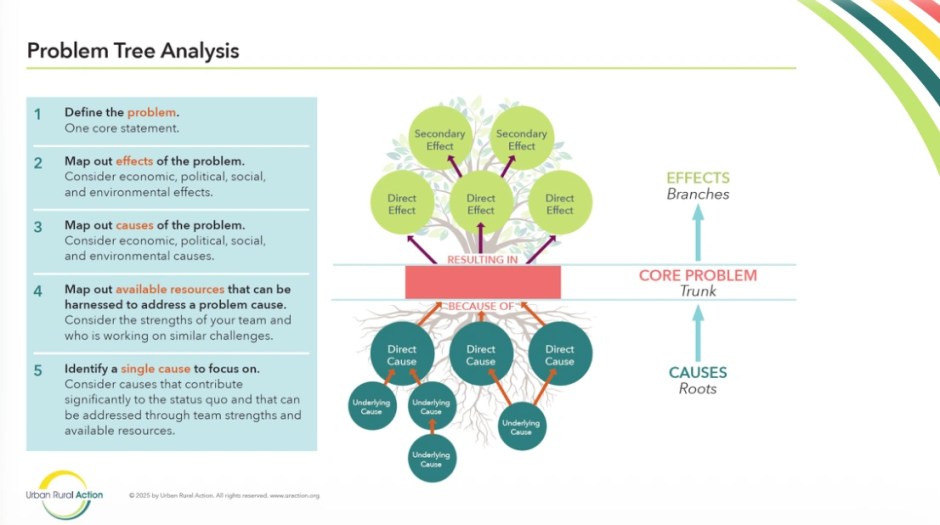
Problem Tree Analysis
Pearce also described Problem Tree Analysis, a tool for helping groups analyze complex social problems together. Rather than jumping straight to solutions, participants identify:
- the core problem,
- the effects or consequences of the problem,
- the causes or root conditions contributing to it,
- available resources that could help address it,
- and a specific cause or intervention point to focus on.
This can help groups move from polarized positions into shared analysis. It is especially useful when people disagree strongly about what should be done, but may still be able to investigate what is happening, what is driving the problem, and where local action could make a difference.
Problem Tree Analysis also supports one of the session’s larger themes: bridging is often easier when people are working together on concrete local problems, not just talking abstractly about political identity.
Watch Pearce Godwin explain Problem Tree Analysis
Listen First, Identify Shared Objectives, Co-create Solutions
Bo Harmon offered a framework for engaging conservatives and right-leaning participants in policy, advocacy, and democracy work. His central warning was that many organizations start with a fully formed solution and then ask how to “message” it to conservatives. In his view, that is not collaboration.
Instead, Bo emphasized a different sequence:
- Listen first.
- Understand concerns, values, motivations, and political incentives.
- Identify shared objectives.
- Create solutions together.
- Craft policy collaboratively.
This framework is especially useful for nonprofits, foundations, civic organizations, and advocacy groups that want cross-partisan support. It asks practitioners to move beyond persuasion after the fact and toward genuine co-creation from the beginning.
A key distinction from this lens is that language can keep doors open, but it cannot substitute for substance. If an approach does not create genuine value or mutual benefit, better wording will not make it durable.
Watch Bo Harmon explain why collaboration cannot start with a finished solution

Credible Messengers
Ryan Nakade shared a violence-prevention and de-escalation approach rooted in the idea of credible messengers. Credible messengers are people who already have trust, social ties, or legitimacy with the communities or networks a project hopes to reach.
This approach matters when the people most affected by polarization, extremism, or potential violence are not likely to attend a public dialogue, training, or bridge-building event. In those contexts, the messenger may matter more than the message.
Ryan described building a “meta-credible messenger” team: people who could go into public events, protests, school board meetings, political conferences, and other spaces to identify people with credibility in specific groups. Those people could then help reach others through trust-based relationships.
Credible messenger work can support:
- acute de-escalation,
- longer-term relationship-building,
- violence prevention,
- community norm change,
- and outreach to people who are distrustful of formal institutions.
This approach also raises practical and ethical questions about safety, transparency, funding, and accountability.
Watch Ryan Nakade explain credible messengers

Empathy Booths and Public Conversation Tables
Ryan also described setting up public conversation tables, sometimes called Empathy Booths or mindfulness conversation tables, in everyday spaces such as libraries, coffee shops, bars, universities, or public venues. These tables used simple hospitality, such as coffee, cookies, chairs, and a provocative but invitational sign, to invite people into conversation.
Participants were asked questions such as:
- What relationships have been impacted by polarization?
- What is the biggest divide in our country?
- What do solutions look like?
These conversations could last a few minutes or much longer. They also created pathways for follow-up, including community dialogue events.
This tactic is useful because it lowers the barrier to engagement. Instead of asking people to register for a formal dialogue, it starts where people already are and invites them into a human conversation.
Watch Ryan Nakade describe Empathy Booths

The Oblique Approach
The oblique approach is useful for complex problems where many causes, motivations, and actors are tangled together. Instead of trying to get everyone to adopt the same goal, language, or theory of change, start with what they already care about, then look for actions that serve their purpose while also contributing to a broader outcome.
Key points:
- Don’t force one shared frame. Different groups may not share your language, politics, or theory of change.
- Meet people “on their own turf and on their own terms.” Start with their worldview, values, needs, and goals.
- Look for indirect alignment. A group can pursue its own goal while also reducing escalation, violence, or polarization.
- Design for shared effects, not shared motives. People do not need the same reason to contribute to a better outcome.
- Use this when people are unlikely to attend a formal dialogue or depolarization event.
Watch Ryan share how he uses oblique approach in his work
Read More: Obliquity: Why Our Goals Are Best Achieved Indirectly by John Kay
What Emerged in the Conversation
The session included time for panelists to ask each other questions and respond to questions from participants. These exchanges surfaced several practical dilemmas that civic practitioners often face when applying these ideas in real-world settings.
How do we adapt language without losing integrity?
The panelists returned several times to the role of language in cross-partisan engagement. Some words can signal care and inclusion to one audience while signaling judgment, elitism, or insider status to another. The practical insight was not to abandon values or avoid hard truths, but to ask what the language is doing in context: opening a door, closing a door, clarifying impact, or performing identity for people who already agree.
Watch the exchange on language and trust
Practical question to try: What words or phrases might be helping our own group feel aligned while making it harder for others to stay in the conversation?
Local Action: How can bridging become more than a conversation?
Several speakers emphasized that people are often more willing to engage across difference when the invitation is connected to concrete local needs. Pearce Godwin described local action as a way to create “literal common ground,” where people can work together on shared neighborhoods, towns, institutions, or community problems. This shifts bridging from an abstract appeal to “talk across divides” into a practical opportunity to address something people already care about.
Watch the section on bridging through local action
Practical question to try: What local issue, shared place, or concrete problem could give people a real reason to work together across difference?
What motivates people to show up for bridging work?
Participants asked how to get people with different views to participate at all. The speakers emphasized that people rarely show up for abstract “bridging” simply because practitioners value it. They are more likely to show up when the invitation connects to something concrete: a local issue, a shared institution, a meaningful relationship, a real decision, or a problem that affects their lives.
Watch the exchange on getting people to participate
Practical question to try: What do the people we hope to engage already care enough about to make participation worth their time?
When is bridging the right move, and when is it not?
Audience questions pushed the panel to consider when dialogue can help and when it may be premature, unsafe, or ethically inappropriate. The speakers did not offer a single rule. Instead, they pointed toward purpose, stakes, safety, boundaries, and who bears the risk of participation. Bridging is not automatically good simply because it brings people together.
Watch the exchange on when to bridge and when not to
Practical question to try: Is this engagement creating conditions for learning, accountability, or problem-solving, or is it asking some people to absorb harm in the name of dialogue?
How do we respond when people disagree about reality?
Participants raised concerns about falsehoods, misinformation, mistrust, and situations where people do not agree on what the problem is. The speakers suggested that simply arriving with better facts can backfire if people feel judged or humiliated. One useful move is to explore how people came to trust a claim, source, or interpretation before trying to adjudicate the facts directly.
Watch the exchange on misinformation and shared reality
Practical question to try: Before correcting a claim, can we ask what experiences, sources, or relationships shaped the person’s trust in that claim?
How do practitioners respond in moments of acute political harm or crisis?
The session took place during a week when a highly charged political incident was shaping public conversation. This raised a live question: what does grounded engagement look like when emotions are high and consensus is not possible? Speakers pointed toward local relationships, clear purpose, careful containers, protest de-escalation, and knowing whether the moment calls for processing, action, safety, or restraint. (Note: This event occurred soon after the killing of Renée Nicole Good)
Watch the exchange on engagement during charged political moments
Practical question to try: In this moment, are people needing grief, action, safety, accountability, de-escalation, or understanding, and are we designing for the right need?
How does this work last beyond one event or one grant?
Ryan Nakade named a hard-earned lesson from credible messenger and violence-prevention work: funding made it possible to build and hold a diverse network, but the network did not automatically continue when payment ended. This points to a larger field challenge. Bridging work often depends on relationships, time, trust, facilitation, and coordination, all of which require real support.
Watch the reflection on funding and sustaining diverse networks
Practical question to try: What would help people continue this work because it is meaningful, useful, and relationally rewarding, not only because a project is funded?
Watch the Recording
- Watch the full Session: “Bridging Across Political Differences”
- Slide Deck
About the Speakers
This session was part of the Democracy Resource Hub Learning Series, curated through a collaboration between Keiva Hummel of NCDD and Duncan Autrey of the Democracy Resource Hub a project of the Shift Action Lab.
Katie Hyten, Essential Partners
Katie Hyten is Co-Executive Director of Essential Partners, which helps communities and institutions bupild systems and cultures of dialogue across differences. Her work focuses on helping people navigate political, existential, and everyday conversations in ways that support better decisions and stronger relationships.
Connect with Essential Partners: events, resources, or info@whatisessential.org.
Pearce Godwin, Urban Rural Action and Listen First Project
Pearce Godwin is Senior Director at Urban Rural Action and founder of Listen First Project. His work focuses on bringing Americans together across political, racial, religious, generational, economic, geographic, and other divides to build understanding, trust, relationships, and solutions.
Contact Pearce at Pearce@URAction.org.
Bo Harmon, Engage Right
Bo Harmon is the founder of Engage Right and a longtime Republican political strategist. His work helps nonprofits, foundations, and democracy organizations engage conservatives more effectively by listening first, understanding political incentives, and building support from the beginning.
Ryan Nakade, Ruminant Resolutions
Ryan Nakade is a mediator, de-escalation trainer, and founder of Ruminant Resolutions. His work focuses on dialogue, depolarization, de-escalation, violence prevention, and engaging people with extreme ideologies or people at risk of political violence.