Introduction
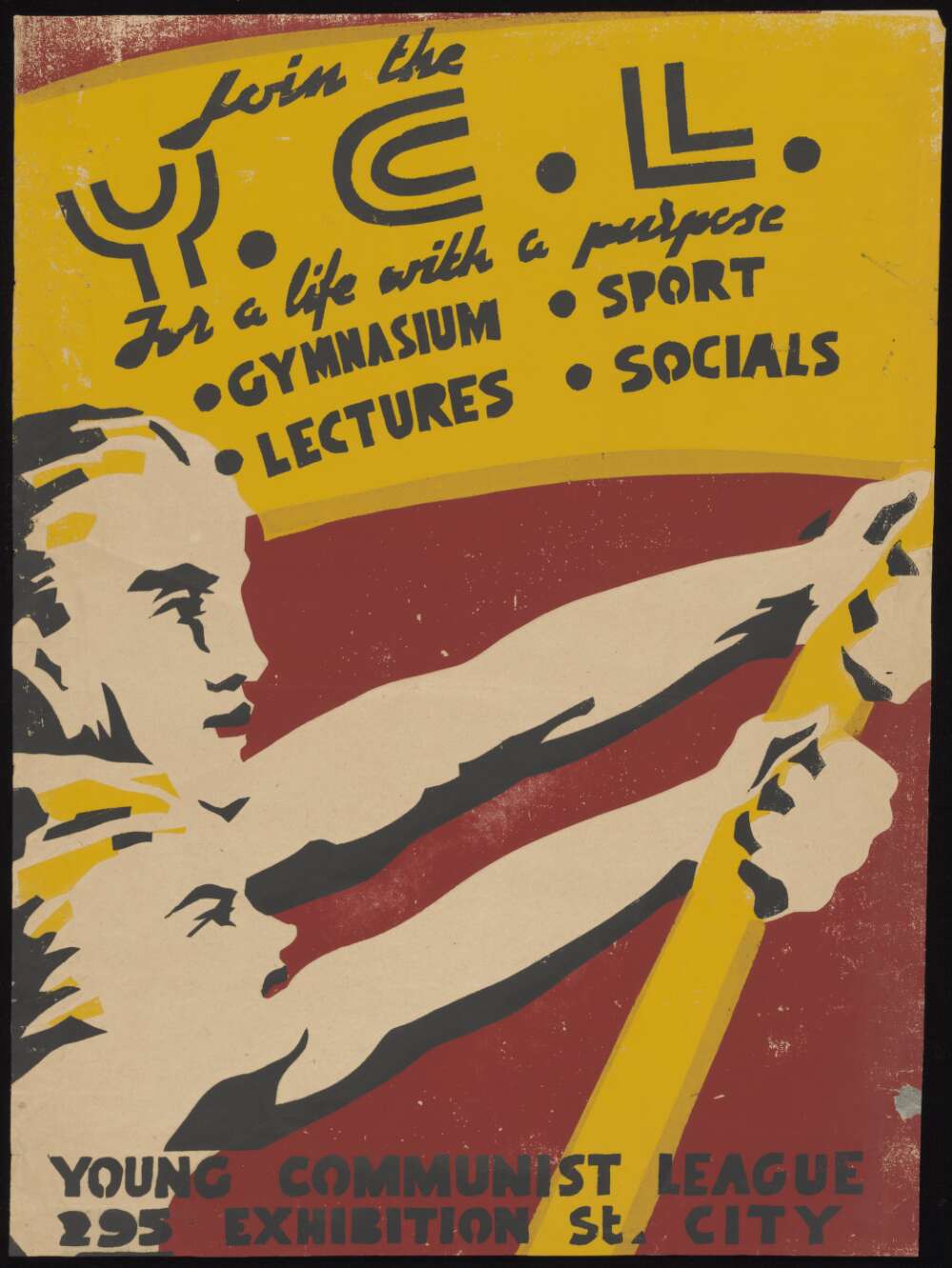
‘For a life with purpose’ declares the propaganda poster. It is coloured in stark black, red and yellow, featuring virile young workers holding a flag. ‘Gymnasium, lectures, sport, socials’ it advertises. This is one of many materials of the Young Communist League (YCL), the youth wing of the Communist Party of Australia, from 1922-37.
While never huge numerically, the young communists kept busy, throwing themselves into campaigns, producing publications such as the Young Communist and the Young Worker, and clashing with the forces of the state. They organised the unemployed and agitated in workplaces. In this period young workers suffered mass unemployment in the Great Depression, frequently lived in tough surroundings and poorly built homes, and if they went to school, experienced the brutality of authoritarian teachers. As a section of what would become the largest far left organisation in Australian history, young communists would play their part in the group, fighting, resisting, rebelling.
The Early 1920s
The Communist Party of Australia was founded in 1920. Inspired by the 1917 Russian Revolution, a small band of radicals including Guido Baracchi gathered in Sydney to launch the party. A youth wing, the Young Communist League, was established, in line with the Communist International across the world. The league accepted members from the ages of 14-26. In October 1922 a monthly paper, the Young Communist, was produced. The Young Communist began as a 4 page paper orientated towards youth. It aimed explicitly to win young workers ‘to the side of the revolutionary movement’.
In these early days the main activity of the league appears to be a Communist School for children. In 1922 the school met at 2.45pm every Sunday at the Communist Hall, 395 Sussex Street, Sydney. The key organisers were communists Hettie Weitzel (a teacher) and Hector Ross (editor of the communist paper, Workers Weekly) The school taught children of both sexes, all ages and, filled with the heady optimism of the post Russian Revolution period, aimed to:
Teach children to understand the class struggle; to let them know the facts of class rule, and to show them the truths of natural history in place of Church myths… Within the lifetime of the children now attending school, Australia, too will probably be a working class republic, and our young people must then become the directors of the new order of things.
The children of the school put on social evenings filled with dances, recitations and songs. When it met on April 2 1922 there were 25 children in attendance. It was soon vitriolically denounced by the NSW Minister for Justice, T.J Ley, as building ‘a race of criminals and disloyalists’. Ley attempted to ban the school but ended his career in the 1940s in jail for murder in London. He was incarcerated in an asylum where he died.
More broadly, the Young Communist printed international news of youth exploitation and struggle, pieces aimed at inciting youth radicalism, and analysis of the links between capitalism and youth oppression. A manifesto of the league was published, declaring its aim to ‘organise and educate the young workers to an understanding of their true position in class society’. While the CPA would become Stalinist, ironically that future renegade of the Soviet Union, Leon Trotsky, was approvingly quoted on the role of youth by the publication several times. Maud Woodbury (possibly a pseudonym) was a frequent contributor to the journal. Woodbury wrote poetic articles that tried to galvanise youth revolt. One declared:
So dear Young Comrades, we must – like the roses in my garden – sing the song of revolt against the sordidness and ugliness of our lives, and fight for Communism. And in the promised land of Communism the children will not be born in vile surroundings, ill-fed, ill-clothed, ill-developed, physically and mentally, because under Communism only will it be possible for all to have plenty.
In these early days the Communist Party struggled to find a mass base, and it only consisted of several hundred members. The YCL’s fortunes waned in line with the party, and Young Communist soon ceased publication – the latest issue I have found is from July 1923. Yet these early years show an attentiveness towards youth as a distinct social formation. It was in the 1930s however, that the YCL was at its peak.
The 1930s
In October 1929 Wall Street came crashing down, and capitalism entered one of its most serious crises. Australia, dependent on exports to countries that could now not afford them, soon experienced mass unemployment and poverty. While it was easier for working class children to find jobs than adults, these were dead-end jobs and they typically got the sack after a few years. Marjorie from Tasmania remembered to oral historian Wendy Lowenstein:
When I was fifteen I got a job through my two elder sisters… working in Launceston, in gentle-people’s houses for ten shillings a week and keep. You were up at six in the morning and finished at eight at night… By that time you were tired and happy to fall into bed. It was constant.
At the department store Grace Brothers one mocking slogan by workers even was ‘be sure you’ll get it at Grace Brothers – the sack at 21!’.
Communist Parties across the world did not necessarily grow with the Great Depression. The line from Moscow was now that the social democratic labour parties were ‘social fascist’ and should be treated with the utmost hostility. This antipathy towards a united front was frequently not a popular move, and many historians have argued that this isolationism helped facilitate the rise of fascism.
Australia was an exception. The ALP was in power federally and in many states. Federally they were implementing austerity measures in response to the Depression. Here, with an ALP working hand in glove with the bosses, the ‘social fascist’ line seemed to make more sense. The CPA grew considerably to around 5000 members, building grassroots networks, and reaching a mass audience for the first time.
In this context youth organising was revitalised. Melbourne YCL reached a membership of 100. A new paper, the Young Worker, was established in March 1931. Unlike the earlier Young Communist, which concentrated more on rhetorical attacks on capitalism, Young Worker clearly had roots in the community. For instance, it published an array of letters from young people about their experiences of oppression and how they fought back.
One ‘Worker Correspondent’ wrote of how in 1931 Edna Stack, a young Sydney worker employed at the Wonderwear textile factory, was sacked from her job for taking part in an anti-eviction fight. Workers being dispossessed of their homes was one of many recurring injustices of the period. Stack had helped staff the picket line at an eviction case in Leichhardt, and was arrested by the police. Stack did 7 days in Long Bay Gaol, and was fired. In response to her dismissal a demonstration of 300 was held outside the Wonderwear factory, although they were not successful in getting her job back.
N.M Baldwin wrote of a migrant 17 year old farm worker who died of over work and undernourishment. Baldwin recounted how the lad was given ‘a scanty diet of the poorest food’ and was forced to work excruciatingly long hours, leading to his death. D. Ross from the small Hunter Valley mining community of Kurri Kurri informed the Young Worker’s readers about the formation of a youth section of the Unemployed Workers Movement in the town. The group won the May Day prize for the best banner, organised a sports committee and sold 120 copies of Young Worker. An impressive achievement in such a small town. Tasmania saw some organising too. CPA member Max Bound set up the Cobbers Club in Devonport, a club for anti-fascist youth.
How were these community links made? Audrey Blake’s unpublished collection of notes on communist youth organising, written in the 1950s, offers some clues. Blake, a communist youth organiser herself, with access to an array of primary sources which have since been lost, provides a detailed and fascinating history of the time. Amongst waged workers, Blake describes how:
The League did begin to organise ‘concentration work’ amongst the young workers in factories. A group of members took responsibility for a particular factory: one or two of them would go amongst the young workers as they ate their lunch in the street or nearby park, since few factories had lunch rooms then: they would ask about working conditions and wages and then arrange this material together with ideas as how to organise, and the policy of the YCL, into a roneod bulletin and distribute this to the factory in the morning.
The YCL were also prolific practitioners of ‘agit prop’: organising street and factory meetings, meetings at the dole dumps, and chalking and painting slogans.
There were problems with the group and its approach to recruiting. Blake recounted how the very process of becoming involved was elaborate:
It was not easy to join: you applied for membership, and then you were called before an examination commission of YCL leaders who asked such questions as – what is your social origin? What is your attitude to Trotskyism?
A high level of activity was asked: once you were accepted as a member you became a street corner speaker in a few weeks and the expulsion rate for ‘inactivity’ was high.
To expect members as young as 14 to have a fully developed analysis of Trotskyism seems unreasonable. Yet a few young people did embrace this tendency. Jewish communist Issy Wyner was one of the most notable Trotskyists. Wyner joined the YCL briefly and was expelled. Aged 12 at the start of the Depression, Wyner joined occupations of houses to prevent them from being evicted. Later in the Depression Wyner organised successfully to win free access for unemployed young people to a swimming pool at Birchgrove (now the Dawn Fraser Pool). Wyner would become a key member of the Painters and Dockers’ Union, and was its historian.
YCL organisation continued. Impressively, the YCL organised an early protest against sexual harassment in the workplace. Eclipse Radio in Brunswick had a boss, Kerr, who was named and shamed ‘for his obnoxious conduct to the girls’. Even ju-jitsu training was organised: perhaps as a form of protection against the police and the far right. In 1931 a Young Pioneers group for younger children in Sydney was established as well. The Young Pioneers aimed to agitate against conditions in schools, against corporal punishment and for free meals and milk for children in school. Hurstville soon had its own group, with a textbook for reading (which was Edward Bellamy’s The Parable of the Water Tank, a socialist fable critiquing the lack of morality of capitalism). Distribution of the League’s paper hit respectable levels by April 1931: 1800 in Sydney, 960 in Melbourne, 960 in Port Adelaide, 720 in Brisbane, and 240 in Broken Hill. When the Spanish Civil War broke out in 1936, the YCL were in the forefront of fundraising efforts for the Republican cause.
The young communists had many encounters with the law. One of the targets of their ire was Baden Powell, the founder of the Boy Scouts. The Scouts, a huge mass movement in this period, were seen as anti-working class and as inculcating their members with pro imperialist propaganda. Several young communists put up anti Baden Powell posters in Sydney, and three were arrested. In August 1932 the Young Worker newspaper was banned from distribution by the postal authorities. Taking this as a badge of honour, the paper soon declared on the front page of future issues that it was ‘banned from the post because of its working class content’.
A gathering against the NSW Stevens government’s Disloyal Organisations Bill led to the gaoling of 6 YCL members for 14 days. Finally Ken Miller, a prominent YCL member, was arrested for demonstrating against visit of the German fascist Von Luckner. They faced the far right too – Laurie Aarons recalled a story of how the fascist New Guard attacked a camp of Young Pioneers in NSW. Encounters with a hostile state, its legal apparatus and the far right were a regular part of communist organising in this period.
Famous Campaigns
Perhaps the most famous example of YCL activity was the ‘Battle of Phoenix Street’ in Brunswick, Melbourne in 1933. The Victorian United Australia Party (the main conservative party of the time) government and the police commissioner, Thomas Blamey (incredibly, also the head of the right wing paramilitary and near fascist group, The White Army) had placed a ban on left wing publications and demonstrations. This lead to the ‘Free Speech Fights’: a concerted campaign against the undemocratic laws. Labor Party politicians supported the campaign, and Communist figures started speaking on corners in defiance of the ban.
In this moment YCL members Noel Counihan (later to become a famous artist) and Shorty Patullo came up with a brilliant plan. In the working-class neighbourhood of Brunswick, Patullo initially distracted the police, jumping on to a moving tram, declaring ‘We are fighting for freedom of speech and we will defy the police!’
And then the piece de resistance. A horse drawn cart emerged, with a metal cage inside. Counihan manoeuvred himself inside and locked himself in. The police, of course, couldn’t simply remove Counihan because of the cage. Counihan started speaking about the injustice of the laws, magnifying his voice by using an old gramaphone horn. Patullo was shot in the thigh by the police and arrested, but Counihan continued speaking for hours, to an audience of thousands. A whole squadron of police was required to disperse the crowd.

The event, dubbed ‘The Battle of Phoenix Street’, became a turning point in the free speech campaign. The activists were able to use their trials as a platform for further agitation, and eventually the bans were lifted. Patullo, who faced a charge of riotous behaviour, was let off. The South Coast town of Wollongong also saw a concerted, successful free speech campaign in this period.
Another memorable moment was an action by YCL-ers Laurie Aarons and Les Jury at Bronte Beach in Sydney. Here they campaigned to win dress reform on Sydney’s beaches: a torso had to be worn by men and bare male chests were prohibited. Aarons, dressed solely in a pair of shorts, and Jury, attired in a neck to knee bathing costume, a pith helmet and carrying a flower, wandered down to Bronte beach. With the support of other YCL members they handed out leaflets against the law. They were fined by a court, but refused to pay and there appears to have been no attempt to force them.
Finally, February 1933 saw one of the earliest school student strikes in Australian history. Beatrice Taylor, a Communist teacher working in Paddington who joined a visit of the Soviet Union, had been stood down from her job. A mass protest meeting was held in the Sydney Town Hall, and several hundred protestors clashed with police outside the school. Ultimately this led to a YCL initiated school strike: a third to a half of children at her school were withdrawn from the first day in solidarity with her. After all this Taylor won her job back.
The period ends: Late 1930s and the League of Young Democrats
Yet as the 1930s went on, the Communist leadership decided to re-orientate their youth wing to have a broader focus. Communist groups worldwide had adopted the ‘popular front’ tactic, where groups mellowed their revolutionary rhetoric and collaborated with social democratic or even bourgeois forces. This was informed by the Soviet Union’s foreign policy: attempting to win allies in the West against Nazi Germany and develop an anti-fascist front.
In Australia this meant dissolving the YCL and forming a new youth organisation, the League of Young Democrats (LYD). The LYD was founded in 1937, at a conference of 1500 at the Majestic Theatre in Melbourne. The LYD soon wrote an agitational pamphlet, New Deal for Youth, of which 5000 copies were distributed. When in 1939 the Victorian Blue Top taxi drivers went on strike, the league provided them with ‘hot drinks, food and tobacco’, delivered sketches for them and helped them write material. After the strike was won, several of the drivers joined the league.
Yet the LYD’s existence was short lived. When the Nazi Soviet non-aggression pact was signed and the Second World War began, the Communist Party (which initially opposed the war) was banned by the Menzies government. While the LYD did not actually come out against the war, as an organisation with communist leaders, it was in the target sights of the government. On February 24, 1941 it was banned by the Australian government and it briefly operated illegally.
For nearly 20 years young communists had formed a distinct wing of the labour movement, opening a space to contest the particular needs of youth. After the ban a new organisation was formed, the Eureka Youth League, which would become one of the largest youth radical organisations in Australian history, going through what historian Barrie Blears describes as the ‘heady years’ of the 1940s with a membership peaking at 2000. The Eureka Youth League, at its best an organisation full of vitality, community and political commitment, built on the earlier traditions of young communism.
Explore Further
- People’s History of Australia Podcast
- ‘We saw ourselves as ratbags’: The Australian Student Environment Network
- The Revolution Begins in Bankstown! The 1999 University of Western Sydney Campus Occupation
- “When the Bombs Drop, School Stops” – Over 100 years of Australian School Strikes and Direct Action
- Tertiary Student Activism in Australia, 1989-2006
- Against Fascism and War: Pig Iron Bob and the Dalfram Dispute, Port Kembla 1938
- Lock Out The Landlords: Australian Anti-Eviction Resistance 1929-1936
- Walking Tours of Unemployed Resistance in Brunswick, 1929-35
- From Little Things Big Things Grow: Events That Changed Australia
- Resources About Australian Housing Justice and Unwaged Rights Campaigns
- Activism and Campaign History: Start Here