Introduction
Youth activists have been campaigning for environmental justice for decades. One of the key organisations involved is the Australian Student Environment Network (ASEN), which has existed for close to three decades and continues to organise today. In the 1990s and 2000s ASEN was involved in a veritable flood of activism. The case study that follows details the network’s formation and many of the activities it has undertaken.
Case Study
It just blew me away that there were young people my age that were so committed – Anne O’Brien
In its early years ASEN organised around uranium mining, around protecting forests, and in early protests around climate change and coal. Even its logo provides an insight into its politics. The ‘A’ in ASEN is pictured like a tripod in a forest blockade, echoing the circle A of the anarchist movement. ASEN billed itself in this vein as:
…a youth led organisation. It is non-hierarchical and grassroots. It is constantly evolving, depending on what students are doing in our collectives and communities. ASEN can help you set up a food co-op, participate in a national campaign, or support your local one, learn how to climb trees or shut down a coal fired power station.., ASEN works to be inclusive and explicitly breaks down sexism, homophobia, racism and class and geographical barriers.
Two key events every year were related to the ASEN milieu. Firstly the Students of Sustainability Conference (attended by up to 800 people, and beginning in 1991, before ASEN) and from 2006 the ASEN Training Camp, designed to skill up a core of activists for organising campaigns. SoS existed until 2020, while Training Camps have been held recently. SoS and Training Camps were self-organised by collectives of autonomous activists each year.
Once a year, state convenors and national convenors were elected to help facilitate the functioning of the network. Importantly, ASEN activists often drew the links between capitalism and environmental destruction, helping articulate a broad critique of capitalism. Beyond just the environment, ASEN activists were involved in the alter-globalisation movement, in refugee rights campaigns, and in challenging gender norms. Above all ASEN recognised the importance of First Nations leadership and organised in solidarity with Indigenous people.
Nicky Ison, a mid 2000s student activist at UNSW and a National Convenor of ASEN, wrote a piece boldly titled ‘Why ASEN is So Fuckin’ Cool’. She described how ASEN activists were able to revitalise environmental activism at UNSW, transcending the ‘backstabbing, hackery, long meetings going nowhere, intimidation’ that she saw as associated with student politics. For Ison:
One of the most inspiring things about ASEN is that it attempts to be the change we want to see. Not only are we working to stop climate change, old growth logging, neoliberalism and capitalism, but we are establishing structures and processes that do not perpetuate and even break down such systems. Decentralised, participatory organising is hard, particularly across this vast continent, but there are reasons why we do it… We are developing skills that will be essential in a more sustainable future, as localised and decentralised control and management is synonymous with such a future.
Julia Dehm, the Melbourne University Environment Officer in 2006, described how a strength of the network was:
the DIY attitude that we had, that we did everything ourselves, we made banners, we screenprinted t-shirts, I made so many badges! People learnt rope climbing, people learnt surveying, people learnt all these various practical skills, cooking in big quantities, bike repair, I learnt welding! So during that period there was this real DIY skill development…
Dehm concluded simply that ‘we saw ourselves as ratbags.’ When so much space in the environment campaigning sector is taken up by professionalised NGOs and small l liberal groups, a radical, grassroots, direct action focused tendency is worth remembering.
‘A really different space’: Students of Sustainability
Vital to ASEN was the annual student environment conference. This was initiated in 1991 as Students, Science and Sustainability, and later changed to Students of Sustainability (SoS). The first conference was held in Canberra. It initially attracted around 200 students annually. It was a massive camp at a university campus held during the mid semester break.
While it would later be hyperbolically denounced by National Queensland State MP Mark Stoneman as a ‘training ground for guerillas’, the early politics of the conference was fairly mild – with discussion of the philosophy of science and urban planning sitting alongside a more specific focus on the environment. Both Labor and Liberal politicians were occasionally invited to address the conference. Organisers saw inviting anti-environmental speakers as part of a plan to prepare people for the arguments of the opposition. At times environmentalists clashed with black activists – with 1993 seeing ‘a great deal of anger’ from Aboriginal participants critical of the lack of acknowledgement that they were on Aboriginal land. They were nevertheless an important starting point for activism, what former student activist and Greens MP Jamie Parker described to me as an ‘organic, grassroots’ movement of young people and environmentalists that was distinct from anything else in the student movement. These early conferences were important in cohering the Non Aligned Left student faction, an independent left-wing activist grouping within the National Union of Students that was able to win several office bearing positions.
By the mid 1990s there had been a shift to more radical politics, and analyses started to focus more on how existing power structures were related to the causes of environmental problems. In 1996 for instance, in an interview with Green Left Weekly, NUS National Environment Officer Matt Fagan discussed the need to challenge ‘capitalist structures and consumerism’. SoS became larger too: 1996 was estimated at having 600 participants. 1996 moved away from being ‘a talkfest’ and involved more scheming for actions.
I interviewed a number of activists from the mid 1990s to the 2010s about their experiences of SoS, and for many it was a hugely important time in their lives. Anne O’Brien attended her first SoS in 2000 in Brisbane. She recalled that:
I ended up coming along to Students and Sustainability in Brisbane, that was at Griffith University. And I think it changed a lot of things for me. It just blew me away that there were people my age who were so committed and I just was very inspired by a lot of the people there. It felt like it really mattered. It was at a time where there was a lot of anti corporate stuff. I went along to a workshop that Fleur Chapman did on the World Bank and the IMF and that was really great…. I knew a little bit about it, but it was so galvanising to hear people, my peers, give workshops on this, saying we’re taking action about it.
Galvanised by SoS, O’Brien ended up attending the S11 protest against neoliberal globalisation and the World Economic Forum two months later. This was ‘life changing’ and solidified her commitment to social justice activism. Julia Dehm recalled that:
The thing that was powerful about SoS was that you feel like you’re in a really different space, and it was for me as a young person… it was a different way of living life is possible, that was quite exciting and radicalising…
SoS actively challenged gender norms – for instance one ‘genderfuck’ workshop insisted that ‘real boyz wear skirts, girly-girls wear ties’. It had a communal cooking structure – with participants required to help with cooking throughout the event. Even going to SoS was an event – for Julia Dehm one required a three-day train ride to get there with a ‘festival’ like atmosphere, building relationships with other activists. Activists in vans drove across the Nullarbor for a week, others hitchhiked and others cycled across state lines. SoS was a hub for connecting students with the wider environment movement and forming alliances.
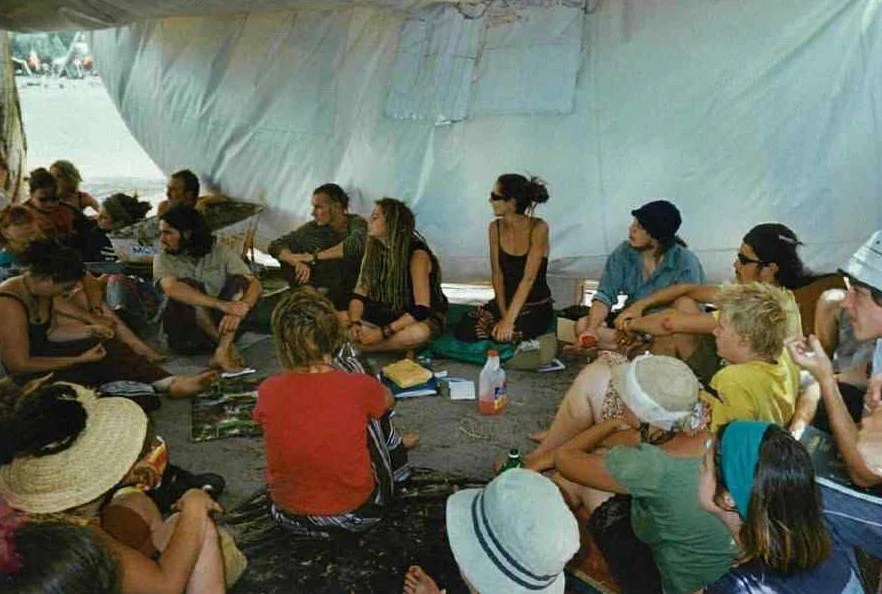
Seth Dias, a Sydney University activist from the late 2010s, described how Students of Sustainability was:
Geared as the sort of place where young radicals could be educated, from everything from direct action skills to protest organising and left wing theory, introduction to anarchism, introduction to communism and whatever. So it was a very important structure…
There were a huge number of workshops at SoS – the 2008 conference, for instance, saw over 100. Dias met his long term partner at the event – and he wasn’t the only one.
After overcoming its early failings, crucial to SoS was the part played by Indigenous activists, and the emphasis on Indigenous solidarity. At the 1996 conference, for instance, around 20% of the speakers were Indigenous people, while in 2008 Indigenous activists gave critical accounts of the federal government’s “intervention” into their communities. At this conference, Indigenous speakers further criticised coal, uranium mining and the dumping of nuclear waste on Aboriginal land. Dias recalled that:
SoS was really important in my political education because it was where I first met some of the Indigenous organisers who taught me a lot about the world. I remember there was one plenary about Aboriginal deaths in custody or campaigns for sovereignty generally. One of the speakers went on a full on monologue about how the reconciliation campaign is fucked and how things like Recognise are really damaging… And I was like ‘wooo’, these are all things that I thought were quite good, but it made me realise how tokenistic they are or how they’re not going to lead to the kind of change we need. And I kind of put all these things together and realised you can’t actually have justice for Indigenous people and stop deaths in custody without a fundamental change to the capitalist system… those conferences helped me put all those things together.
ASEN activist and former national convenor Holly Creenaune stressed how the conferences emphasised that colonialism was an ongoing process, and recalled vividly:
The format of them, there was always a strong welcome to country and a large Indigenous contingent. Always had an elders tent and attempted to kind of bring in Aboriginal people leading resistance battles against mining, including the Lake Cowal gold mine in western NSW… And to really hear about those impacts and to connect that to 200 odd years of invasion and occupation, and situate the current environmental injustice as a part of a continued understanding of occupation. I think that was really politicising for a lot of people, when you go through school you learn about Captain Cook and Governor Macquarie and if you’re lucky you might learn a little about Aboriginal people but… invasion and colonisation is at best referred to as something historical. And so I think the centrality of Aboriginal led battles and Aboriginal leadership in social movements was really key to those conferences and the campaigns and actions that came out of it.
From the mid-nineties SoS began regularly organising protests as well. In 1997 after the end of the Townsville conference, students travelled to the Northern Territory to protest the Ranger uranium mine and the proposed Jabiluka mine, after being invited by traditional owners. Demand for the trip was so high that students had to be turned away. Anne O’Brien recalled after the 2002 conference in Perth, a bus filled with students went up the Western Australian coast, even organising a naked protest at Ningaloo Reef. It culminated in a memorable protest at Port Hedland immigration detention centre. O’Brien recalls that:
We had the vigil all night outside Port Hedland detention centre, it was amazing. We played music and danced and heard stories from the refugees. They threw food in bundles over the razor wire and hot tea in thermos glass. It just was a really powerful moment. Some of the refugees remembered that for years to come and they called us the ‘party on the beach’ [because the centre is near the beach].
SoS always saw a tension between more personal workshops (often derided as ‘lifestylist’) and more explicitly political issues. Yet despite the limitations of lifestylism, for many involved it was a moment of transformational, radical pedagogy. In the SoS programs that I have had access to, the large majority of the workshops were quite political in some way. It saw the development of tight-knit networks of people, who would go on to participate in movements for social change.

Jabiluka and the formation of ASEN
Let’s go back a bit. While ASEN was officially formed at the Students and Sustainability conference in 1997, it was the experience of concrete campaigning that cohered ASEN, most notably the campaign against the Jabiluka uranium mine.
In 1998, Energy Resources Australia began construction of the mine in the Northern Territory’s Kakadu National Park, on the land of the Mirrar people. Aboriginal traditional owners Yvonne Margarula and Jacqui Katona argued that there had been limited consultation with the Mirarr and that the mine violated their claims to the land. An eight month blockade of the site was established. Throughout the eight months, around five thousand people participated in the blockade, and there were over six hundred arrests. Environmental student activists throughout the country soon began prioritising the campaign, raising funds for students to travel there. During the mid-semester break, there was a particularly strong influx of students, and the blockade grew to over 600. Civil disobedience became an important strategy for the activists, with specifically designated ‘arrestable’ protesters breaking the law and disrupting the construction process, through methods such as locking on to machinery and blockading entrances to the site. Scott Alderson, the Queensland NUS environment officer for 1998, recalled how large numbers of student activists were involved and on one occasion:
We did a big lock-on … I think it was an old Kingswood station wagon. We originally rolled that up in front of the gates, and had a huge almost conical shaped lock on device, with a lot of people in the car locked in on it and everything like that. That took a fair few hours … to get everyone removed … I think (on another occasion) they arrested over a hundred people in one day. And they couldn’t process everyone in one day, so a lot of people stayed in the cell overnight.
In the second semester of 1998, a ‘Defer Second Semester’ campaign was launched — encouraging students to take the semester off and travel to or stay at the Jabiluka blockade. Beyond the camp, Jabiluka Action Groups in the major cities popped up. Including students as well as community activists, the groups organised rallies against the mine, major blockades of North company offices in Sydney and Melbourne and helped raise awareness. One blockade of North in Melbourne lasted a week. After eight months of campaigning, the activists were winning the public relations battle — with polling suggesting that two-thirds of the Australian public opposed the construction of the mine. Although in October the onset of the Northern Territory wet season forced the closure of the blockade camp, and the conservative Howard government won re-election, the activism had impact. Amidst falling prices for uranium, Energy Resources Australia abandoned the construction of the mine. In 2005 a treaty with the Mirrar people was signed, guaranteeing consultation with them before the commencement of any new uranium projects. A memorable victory. Out of all this came the consolidation of ASEN, which would develop over the following years.
Initially, ASEN was closely tied to the National Union of Students (NUS) environment office. Throughout ASEN’s early years, the NUS environment officer automatically became the ASEN co-ordinator. But in 2001, a member of the Democrats with no background in environmental activism became the environment officer. This encouraged a renewed push to develop ASEN’s autonomous structures. In January 2003 a national ASEN gathering was held at the Aboriginal Tent Embassy, and for the first time ASEN co-ordinators were directly elected by the network. By 2005, this new level of co-ordination was beginning to take off. The threat of Voluntary Student Unionism, eventually passed by the Howard government, where student unions would be stripped of funding was a key factor in encouraging the creation of a stronger network. One article from an ASEN-produced ‘Green Bloc Zine’ declared enthusiastically:
This year it seems that everything is finally coming together. ASEN is coming into its own, as a super organised, inspiring force poised on the brink of changing the Australian political landscape forever. The most dedicated, creative and intelligent student environmental activists of this generation are involved. We are working in partnerships and getting support from all Australian Environmental NGOs. We are going through a period of reflection and self- organisation to make sure we do it right.
In 2006 ASEN was registered as a not-for-profit association, and an inaugural, five day long ASEN training camp was held in the Hunter Valley. It was later moved to a location near Canberra: in order to support the annual Invasion Day protests there. The training camps drew around eighty activists for their first several years. With the support of environment NGOs, national ASEN convenors were paid a stipend to help organise the network. A regular publication, Germinate, was established with several issues released annually.
‘These beautiful places were being destroyed’: Forest campaigning in Victoria
Another crucial environmental campaign was ‘forest defending’ in East Gippsland in Victoria, stopping old growth logging that would destroy the rich biodiversity of the forest. 2005-2006 saw the mobilisation of hundreds of students to the forests, participating in actions, learning about ecology, going on walking trails, and participating in militant direct actions, such as blockades and tree sits. Visiting the forests was highly motivating, making them see that, as one activist put it ‘these beautiful places were being destroyed’. In the lead up to the Victorian state election in 2006, the Victorian campaigners organised one action per week for an entire year.
The main organising hub of the campaign, the Goongerah Environment Centre (GECO) building, was about five and a half hours drive from Melbourne, and even further by public transport. From there, it was another few hours to the forests themselves, where all the actions were. Simply getting out to the forests was therefore quite difficult. Holly Creenaune recalled:
There was a lot of logistics to making it happen… we really did lean on the resources of student unions, I think I drove my first semi electric vehicle which I think was from Monash! That car took a beating in the bush…. Borrowed vehicles from UNSW, got student unions to contribute, the food co-ops were a really big part of that…that made putting on those gatherings actually affordable for people to attend. And a lot of car pooling, and a lot of desperate borrowing of vehicles… I remember I met some woman in a pub in the Strawberry Hills hotel in Surry Hills, told her all about East Gippsland, what an incredible fight it was, got her to lend us her car the next day, drove it to East Gippsland and then I wasn’t the driver but someone wrote it off! That was a bad day. Everyone was fine. We were all just uni students, young people, most people didn’t have a car, or didn’t have a lot of money to spare.
There were actions in the city, twice bringing tripods to blockade Swanston Street. Numerous fundraiser gigs were organised, to support those who had been arrested in blockades or fundraise more generally. At the state election, Labor committed to saving 40000 hectares of forests – a significant victory. Here students supported an ongoing campaign and made a decisive contribution to its success. Creenaune recalls that the organising was key to shaping the political understanding of students:
There was a core of people that organised them from across NSW and Victoria … The vast majority are still deeply involved in fights for environment and climate justice… I think we also learned a lot about the history of the struggle in East Gippsland as well, so when you’re first starting to become an activist and some of the first stories you hear are about the blockade, I think that really shaped our sense of how change happens, and how if people take action together they can actually win… That was a really motivating thing, that we got to continue this battle that people had been in for decades, that had had successes but there was more to fight for.
The forest campaign was yet another example that showed that collective action can win.
Clean energy campus campaigns
ASEN activists also worked locally. Campus environment collectives across Australia organised trail blazing campaigns for clean energy on campus. At Sydney University, activists initiated a campus referendum – the first in 27 years – on the issue of whether the campus should purchase clean energy. A petition with 4000 signatures was organised, and 16 of the 17 faculties signed on. The vote went in their favour, with 92% of students voting for the purchase. At Monash University, activists similarly organised, resulting in Vice Chancellor Richard Larkins agreeing to a 15% GreenPower purchase. RMIT saw some success too, with the university committing to a 20% purchase in 2009 and investing $6.2 million into energy efficiency.

‘We can’t dig our way out of climate change’: Climate camp and direct action
One of ASEN’s key contributions to the climate movement was its part in the 2008 Climate Camp in Newcastle. Inspired by Climate Camps in the UK, the camps were a tactic designed to bring people together for a week of discussion and action against the fossil fuel industry. Rising Tide, a grassroots environment collective in Newcastle, took the leading role but ASEN was able to support them. ASEN’s Students of Sustainability Conference was deliberately held in Newcastle that year, in order to promote the Climate Camp. Despite freezing conditions in the Newcastle winter, several hundred people pitched tents and got involved.
A mass action was held on Sunday 13th July, of which the media reported that 1000 people attended. The action was held at the Newcastle coal train line, with plans cooked up to disrupt the site using direct action. Despite ‘160-odd’ police, with water cannon, horses and dogs, activists were able to infiltrate the railway line, to huge cheers from the crowd outside. Sneaky direct action took place, fooling the police. Teams of zombies and clowns were tasked with slowing down the police, and helping spread out the police line. This gave the opportunity for teams of arrestable activists to get onto the train as an act of civil disobedience.
Climate Camp was key in introducing mass direct action to the movement in Australia. Wenny Theresia, a key organiser in ASEN, reflected that Climate Camp was ‘a movement space’, bringing diverse people working on climate change together. She continued that it was:
Geared towards giving everyone present an experience of mass collective direct action in a safe, supportive and participatory environment. By and large a successful model of mass direct action in the numbers of people involved, the no’s of arrests, the experimentations in participatory decision-making on a mass scale…. CC’s have certainly played a massive role in legitimising DA [direct action] on climate change within and outside of the climate movement. It’s been the vehicle that’s given a lot of people the confidence and skills to be involved in DA.
Later groups such as Extinction Rebellion, Blockade Australia and School Strike for Climate have taken up this legacy. Later NSW Climate Camps were organised at Helensburgh and at the Bayswater coal-fired power station in the Hunter Valley in 2010. Perhaps the main successor to this tradition is Rising Tide’s ‘People’s Blockade’ of the Newcastle Coal Port, which continues to this day and has resulted in hundreds of arrests. Beyond 2010, ASEN has been involved in the mass movements for climate justice, such as the climate strikes. The incredible Climate Strike movement will be part of my future writing.
Conclusion
What is the significance of ASEN? The activists I talked to constantly stressed its long-term role in politicising and radicalising a core of people. In a zine reflecting on the history of ASEN, Basil stressed that ‘people who were in ASEN do not forget they were in ASEN’. Julia Dehm recalled that there was “a quite comprehensive politicisation of people who were involved in the movement… A lot of people have become lifelong activists…”
For Holly Creenaune:
I think some of that broader politics of liberation and First Nations justice is baked into an entire generation of people who went through that movement together. And so now in the protests against Gaza I am just seeing all my old friends there… I think it shows that there was a shared political analysis there… a political commitment to grassroots radical action and solidarity.
Raff Fantasia, now a teacher, stressed in an ASEN zine that the collective pedagogy that was constantly being carried out through the network is something that he can draw on in the classroom today. Mim Jones remembered:
ASEN taught me invaluable interpersonal skills, predicated on seemingly basic concepts like respect. I really value ASEN’s focus on non-competitive, inclusive communication and facilitating the inclusion of diverse voices.
Julia Dehm argued that there was an openness and willingness to employ a diversity of tactics, allowing for people to get involved in different ways. Activist archivists Ani Seed and Stevie William emphasised that there are ‘many histories’ to ASEN, which is something that I’ve tried to reflect in the oral histories of this article.
Activists also reflected on weaknesses. Intriguingly, Anne O’Brien argued that this diversity of tactics could in itself create a weakness, which was:
from the do it yourself kind of attitude. If you say that today you’re going to run this campaign over there and this campaign over here and this campaign over there, it means that you have lots of little campaigns just pottering on… That means you can’t win big things from those campaigns, you can just win little things… We didn’t really know how to scale up… And we didn’t really scale up because we didn’t trust top-down organising. I still don’t have an answer to that.
O’Brien recalled that there was an inability to get out of the university bubble and engage high schoolers or people at TAFE. Julia Dehm reflected that there was a lack of a strong sense of activist history, and a training of participants in a deeper level of theory.
Despite these weaknesses, ASEN took a radical, anarchistic approach to social change and tried to put it into practice. One early article simply dubbed SoS as being about ‘how to change the world in three days’. As Creenaune summed up sharply, it wasn’t about ‘helping rich people buy Teslas’. It was about being grassroots, about seeing the environment as not a single issue but as entwined with an array of other oppressions under capitalism. This is an analytic lens we still urgently need today.
Explore Further
- The Revolution Begins in Bankstown! The 1999 University of Western Sydney Campus Occupation
- For Educators Grappling with Student Protests, Here’s how to Play a Supporting Role
- University of Sydney Students Uncover and Protest Discrimination of Aboriginal People in New South Wales, 1965
- The Freedom Ride
- Hope & Solidarity in Global Student Movements for Palestine
- Inside the Student Movement that Forced Ireland’s Trinity College to Divest from Israel
- The Jabiluka Blockade – 22 years on
- Campaigns to End Logging in Australia (Commons Conversations Podcasts)
- From Little Things Big Things Grow: Events That Changed Australia
- People’s History of Australia Podcast
- Activism and Campaign History: Start Here