
Introduction
These excerpts from The Little Handbook on Recruitment and Integration in Climate Grassroots Groups discuss ways in which to engage new members and then build long term and deeper involvement which is structured and measurable.
The handbook gathers insights and examples from Nordic climate action groups. Organisations that have contributed:
- Den Grønne Ungdomsbevægelse
- Lærlinge for Bæredygtighed
- Nordic Climate Justice Coalition
- Elokapina
- Extinction Rebellion Norway and XR Ung
- Landsforeningen mod Svinefabrikker
- Klimakollektivet
- Catalyst
- Nødbremsen
- Återställ Våtmarker
What Makes Collective Action Possible?
Research on collective action points to several factors that make people more likely to participate in climate movements and collective political action.
Social Identification
People are more likely to participate when they identify with the values, norms, and identities connected to a movement or campaign. Recruitment efforts can therefore build on identities and communities that target groups already relate to.
Climate action should also be designed in ways that strengthen collective identity, belonging, and positive experiences of acting together.
Moral Beliefs
A perceived injustice is often necessary to join collective climate action.
- Do target groups already perceive injustices?
- How strongly?
- What are moral beliefs about the actions of your group?
- How do you want your actions to be perceived in the public? How are they perceived today?
- How can we tell strong and motivating stories about our actions?
Efficacy Beliefs
The belief that we as individuals and groups can create change. You can work with efficacy beliefs through storytelling, theory of change, visible successes and more.
Collective action can be designed to increase efficacy beliefs – by giving opportunities to learn new skills, experience wins and making room for individual and group reflection.
Three Types of Integration
When a new activist or volunteer joins your group for the very first time – whether through a meeting, campaign, action, or training – how can the organisation support them in becoming a more active and committed participant over time?
We want to empathise focus on three overlapping but distinct forms of integration:
- Social integration or BELONGING
- Task integration or EFFICACY
- Campaign/group integration or SHARED KNOWLEDGE and BELIEFS
This includes understanding not only what the organisation does, but also why it acts in the ways it does.
Conversion Rates
If your organisation needs 20 new protesters to do an action, you first need new people to attend trainings, onboarding sessions, or intro meetings. But how many need to show up at each step? This is what conversion rates helps us understand.
For example if the conversion rate from intro meetings to active protesters is 1 out of 16, this means that only one out of every sixteen participants at an intro meeting eventually joins. If your goal is to mobilise 20 protesters, you therefore need: 20 x 16 = 320 participants at intro meetings.
Conversion rates therefore help us with two things:
- Strategic planning
Conversion rates helps organisations develop more realistic recruitment and mobilisation plans that align with their strategic goals and capacity needs - Organisational learning
It helps you identify what to measure if you want to learn what works well and why it works.
Note that conversion rates vary depending on political context, target groups, organizational capacity, and where along the participation pathway they are measured.
Conversion Rate Examples
Rules of thumb? You will hear both ⅓ and ½ of all sign ups are no-shows, but as you can see from the examples below, the
numbers vary a lot, which means you need information from your context.
Across groups using Catalyst – between 35-45% of those who attend a talk or intro event goes to at least one training or action. Between 35-90% of those who attend a training goes to at least one action.
Letze Generation Berlin measured their conversion rate from 2022-2023. There were 397 attendees at 19 talks, of which 235 (59%) signed up after the talk by filling in contact sheets.
In the Danish organization Nødbremsen 456 people signed up online to attend some activity > 270 joined intro meetings > 153 people joined a protest trainings > 100 protestors = 27:10 conversion rate measured from intro to protest.
For a Green New Deal Rising protest in UK 253 digital signups for the action of which 1/3 participated. Of the 70 people confirmed through phone-calls 50 attended and 20 did not.

Mobilization Campaign Maths
But how do you get new people to sign up to intro meetings in the first place? If organisations want to approach recruitment scientifically, they need to understand the relationship between outreach efforts and participation outcomes.
This is sometimes referred to as campaign maths: Estimating how much outreach work is necessary to reach a given mobilisation goal. AKA how many hours of postering, leafletting etc is necessary to get 100 people to show up to an intro meeting?
There are two main takeaways:
- Multiple “points of contact” matter
People rarely participate the first time they encounter a campaign. Most people need several reminders or forms of contact before deciding to show up – for example through social media, posters, leaflets, conversations, or personal outreach. - Tracking creates organisational learning
If you track it, you can figure out what works in your context, for your campaign and your target groups.
Note that the amount of outreach work required is never fixed. It depends heavily on: political context, target groups, organisational credibility, and the quality of conversations, social media content, posters, flyers, and other recruitment materials.
Structured Integration Streams
The dilemma is this:
All activists should feel some responsibility for making sure recruitment, integration and/or leadership development is happening in the groups or parts of campaign they are active
BUT…
If you want to measure the effect, want to organise tasks, and/or train new volunteers and activists in your recruitment and integration practices, you need to structure your work around specific activities and roles.
Having a structured intro stream creates a path of least resistance for new people you have recruited. It also provides a set of
activities that you can develop, test, train others to do and measure the effect of.
Integration Stream Case Studies
Green Youth Movement, Denmark

Points of contact: Social media, friends, events/talks, posters.
First meeting: Intro meeting or intro bar (4 in total per half year).
Possible next steps:
- Bi-weekly Monday workshop (the common meeting for everyone – a week after intro meeting)
- Thematic working group
- Intro training (with more depth in theory of change and reflecting on how it has been to join the group).
Most work happens in working groups, so the goal is to help people join these.
Phone banking: Recruitment group calls new members once or twice in the weeks after intro meeting
After joining a working group: Join another working group, since these are often shortlived. Take on day-to-day responsibilities (e.g., facilitating meetings, doing recruitment).
Nødbremsen, Denmark

Points of contact: Posters, social media, friends bringing friends, flyers, media coverage etc.
Call To Action: Sign up to our newsletter, an intro meeting or donate to Nødbremsen.
The introductory activity is an intro meeting (every 14 days)
Call To Action: Join a protest training, hang posters, join a phonebanking
Next clear step is joining a protest training (3-5 days after intro meeting, every 14 days)
- Call To Action: Join a protest, mobilize, join working groups
- Final goal is to join a protest.
- Beyond joining the protests there are also working groups running the campaign that are also in need of more hands to scale the campaign.
Återställ Våtmarker, Sweden
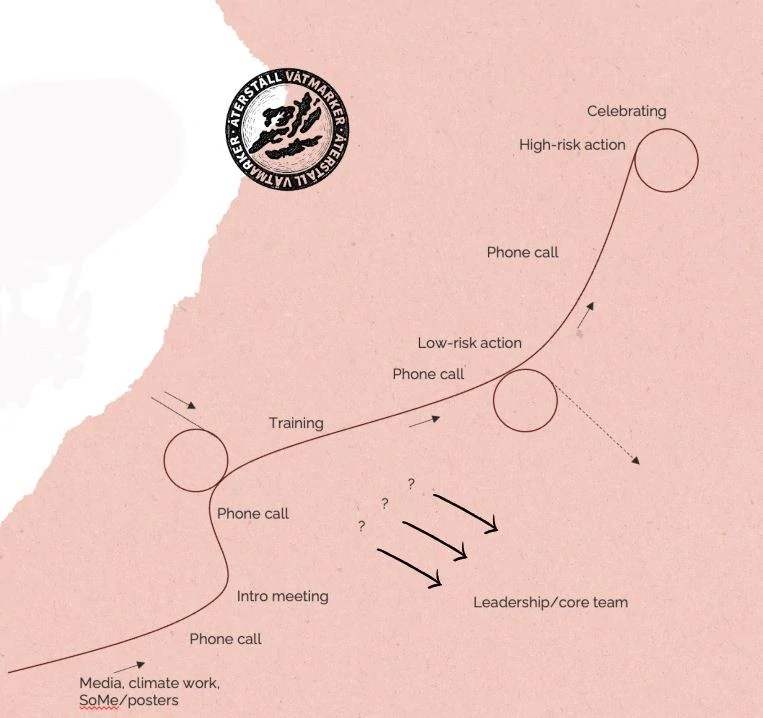
Points of contact: Posters, social media, other climate work, media coverage, donating etc.
Call To Action: Join an intro meeting.
The intro activity is an intro meeting. Here, people will be invited to a non-violent direct-action training and afterwards get a phone call. Almost all interactions are followed up with a phone call to open for participants taking the next step.
The circles in the stream diagram signal that people can stay at the same step such as donating (and sometimes also leave at this step).
Next step could be a low-risk action. Afterwards, there is also the opportunity to join more high-risk actions. At the action parts of the stream, celebration is an important aspect.
The stream leading to leadership and core team is unclear, which might make it an important place in the stream to reflect on.
(Important: this stream is one conceptualisation based on a single workshop, and others might draw it differently and point to other challenging points).
Activities
Integration Stream Timeline
Purpose: Reflect on what new members meet as they enter the organisation and identify where they might be lost along the way.
How: The integration stream is a timeline where you map every step of the process from showing up for the first time to taking on leadership roles. Draw your organisation’s stream:
- Try to map out as much as possible. From seeing the first poster, taking part in informal settings and parties, being invited to an action and to taking on long-term roles.
- Which elements are there, and what happens at different steps?
- When are people contacted – and by whom?
- Is there a next step at every step reached?
Questions to reflect on afterwards:
- Where do you see difficulties/what works well?
- Are there places where it seems unclear what the next step is?
- Where does the stream end? Do we know what happens there?
- Where do we help people take a step up the pyramid of engagement?
Speed Dating Working Groups
Structure
- Make sure it is a welcoming setting and make clear that this event is primarily for new members.
- Open the event with a short welcome and presentation of the working groups present.
- Have three-four rounds – there is maybe not enough time for everybody to listen to everything, but that’s ok.
- New members talk with one or two persons from an established working group.
- Maybe give a short presentation, but emphasis on connecting with new members.
- After 7-10 minutes everyone must rotate. That way new members get to talk to different people.
- At all groups, there is a sign-up sheet for people to indicate interest.
After the speed-dating
- Organisers meet with working group representatives. Reflect on the experience.
- Decide who follows up with the new members. Everyone who signed up should get a call – preferably from someone in the specific working group.
Advantages
- Time enough to ask questions from people actually doing the work.
- Opportunity to feel seen and personally connect with people in the working group.
- Commitment: Always have a sign-up sheet where new members can write their contact details – and remember to follow up.
- A way to distribute responsibility for integration to the working groups themselves and create a culture where more people to recruitment work.
Download Resource
The Little Handbook on Recruitment and Integration in Climate Grassroots Groups- PDF
Literature and Inspiration
The Little Handbook draws on many other publications and projects, including:
- People, Power, Change – Marshall Ganz. You can also access the People, Power, Change Organizing Guide.
- How Organisations Develop Activists – Hahrie Hahn. Read a review.
- The Psychology of Collective Climate Action: Building Climate Courage – Karen Hamann, Eva Junge, Paula Blumenschein, Sophia Dasch, Alex Wernke & Julian Bleh
- Tools for Radical Democracy – Joan Minieri and Paul Getsos. Read an excerpt: Deciding Whether To Do Electoral Organizing.
- Momentum Community Training – explore Momentum webinar recordings.
- Catalyst – Community Knowledge
- Green New Deal Rising
- Borgerlyst.dk
- The Commons Social Change Library (you’re here!)
Explore Further
- We Do Democracy
- Engagement Pyramid: Visualise the different ways a person might get involved
- Levels of Commitment from Community to Core
- Building Leadership Capacity: The Ladder of Engagement
- Circles of Commitment: A Model of Engagement
- Supporter Engagement
- Plugging People In: Orienting New Members & Volunteers to a Local Group
- Organising: Start Here