
Introduction
Like traditional organizing, digital organizing is the practice of building a group or community of people who support a particular goal or change who then work together to achieve that goal. For any party or organization, these people can be referred to as your supporters and they are incredibly important to build your power in the world!
How you interact with your supporters online is no different from offline: relationships need to be nurtured, developed, and sustained. However, online communication happens at a much larger scale, so supporter engagement must be designed for mass participation—from thousands to millions of people.
To grow a strong and active supporter base, it’s essential to communicate consistently, in ways that serve not only your goals but also the interests and needs of your supporters.
To build an online community:
- The goal is to engage as many people as possible and encourage them to be involved in something bigger than themselves alone.
- The task is to create and organize meaningful opportunities to channel people’s energy into social change.
This resource covers where to find new supporters, how to engage them, approaches to deepening and maintaining those relationships, and a list of practical supporter-focused tactics.
Where and How to Engage Potential Supporters
People spend on average 4-6 hours a day on their phones or laptops so we know where to find people. Meet them where they already are:
- Social media platforms
- Instant messaging platforms
- Online forums
- Websites
- Watching TV/streaming services/podcasts
What is the goal when reaching potential supporters?
After engaging with these supporters for the first time, the most important thing is to ensure you can continue to engage with them directly either via email, phone, or through an instant messaging platform. This is sometimes referred to as ‘list-building’.
Email is the most effective platform for direct digital engagement because everyone has an email address, messages can be highly personalized, and well-designed tools allow you to automate sequences and build targeted email ladders.
Why is direct connection important?
- No mediators: you will not depend on mass media corporations or algorithms.
- No noise: you can directly communicate your message without competing with other voices.
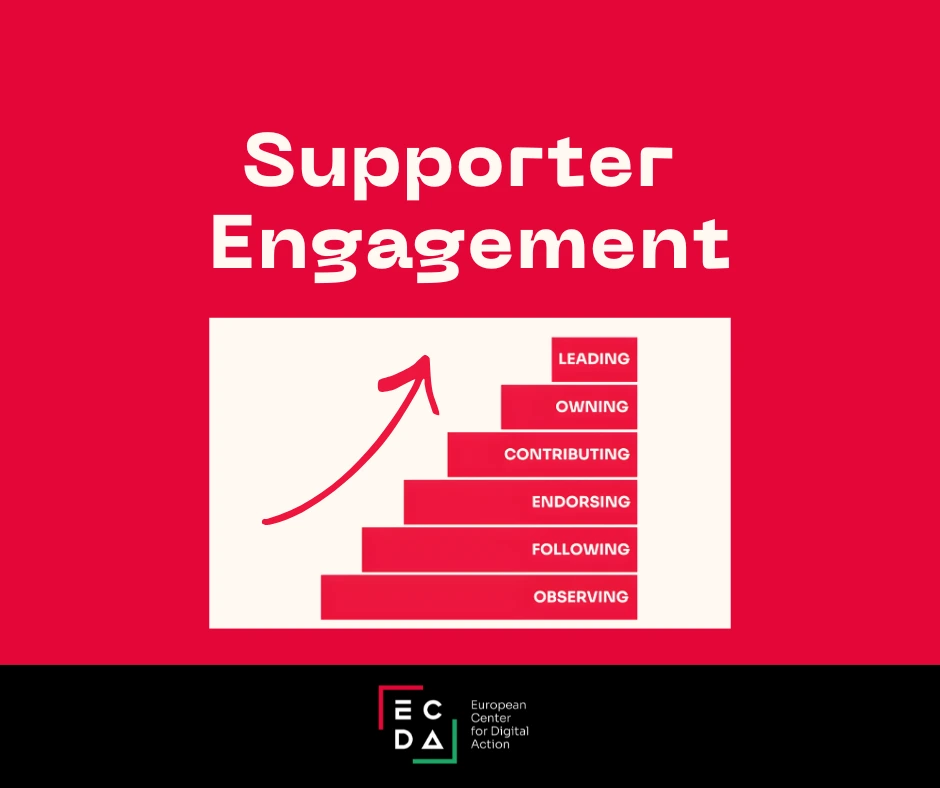
The Engagement Ladder
Engagement is more than just a single activity (signing a petition or showing up to a demonstration), it is the basis of the sustained relationship between your campaign and those who contribute to it.
Think of it as a collective effort. When we provide clear opportunities and pathways for involvement, we harness the power of community. This creates a ripple effect whereby each person’s dedication and passion can lead to real, impactful change.
Not everyone will be a leader or even an owner and that’s okay. What is important is that supporters move up and down this ladder and are given opportunities to be active at multiple levels.
Example: Engagement ladder for a political party

How can people move up and down the ladder?
This means offering a range of actions, from low-bar options such as signing an online petition to more intensive, high-bar opportunities like volunteering to host an event or help coordinate offline activities. We refer to this as a “low-floor, high-ceiling” approach: by providing both accessible entry points and deeper forms of engagement, campaigns can achieve higher participation rates and greater overall impact.

It’s the job of an organizer to offer people meaningful opportunities up and down the ladder. This enables people to tailor their involvement based on their preference, situation, and available capacity.
Offering only low-bar actions to supporters will lead to less impact in the long term. Likewise, offering only high-bar actions will lead to less supporter engagement and lower impact.
Digital Tactics that Engage your Supporters
Low-bar Tactics to Build your List
- Petitions/Open letters
Invite people to take a simple action by adding their name to a public demand.
Example: Signing a petition calling on the city council to protect green spaces. - Pledges
Ask supporters to make a low-commitment promise connected to your cause.
Example: Pledging to vote in the upcoming local election. - One question survey
Invite supporters to answer a single, highly focused question that captures their priority or opinion with minimal effort.
Example: Do you think everyone should have a home?
Medium-bar Tactics to Engage your Existing Supporters
- Surveys
Gather information from supporters while giving them an easy way to engage.
Example: Completing a two-minute survey about top election issue areas or evaluating the organization’s election campaign. - Online events
Encourage supporters to participate in a virtual gathering that requires some time investment.
Example: Attending a 45-minute webinar with a issue expert - Sharing content or petitions with friends and family
Ask supporters to amplify your message through their personal networks.
Example: Forwarding a petition link to three close contacts. - Pledging to take an offline action
Invite supporters to commit to a real-world activity tied to your campaign.
Example: Pledging to join a demonstration or hand out flyers on election day. - Posting a picture from an event on social media
Request that supporters share visual proof of participation to build momentum and visibility.
Example: Uploading a photo from a climate march with a campaign hashtag. - Letter campaigns (emailing a decision maker)
Mobilize supporters to contact the decision-maker directly to express their position.
Example: Emailing the health minister urging increased funding for hospitals. - Testimonials
Ask supporters—especially those affected by an issue to tell their personal story.
Example: Nurses submitting a short account of working in underfunded hospital wards. - One-off donations
Encourage supporters to contribute a single financial gift to advance your work.
Example: Chip in €10 to help us buy a billboard ad outside the decision makers office. - Crowdsourcing creative tactic ideas
Engage supporters by inviting them to co-design actions that can energize the campaign.
Example: Ask supporters to submit ideas for an attention-grabbing stunt. - Stickers
Design & deliver creative stickers that supporters can either buy or get for free via an online form.
Example: Stickers with slogans or artworks ‘I support women’s rights’
High-ceiling Tactics to Move your Supporters up the Ladder
- Becoming a recurring donor
Invite supporters to commit financially on an ongoing basis or raise funds from their networks.
Example: Setting up a €15 monthly donation - Volunteering for an event or organization
Encourage supporters to give their time and skills for campaign activities.
Example: Painting a banner, marshalls for a protest, or helping run a barnstorm event, specific skills (graphic design). - Joining a phone bank or canvassing event
Organize supporters to talk directly with voters or community members.
Example: Spending an evening calling undecided voters before an election. - Recruiting three friends
Ask supporters to expand your activist base by bringing in new participants.
Example: Each supporter commits to recruiting three people for your next action. - Calling a politician
Encourage supporters to directly call decision makers to influence their stance.
Example: Phoning an MP’s office and asking what they are doing about an upcoming piece of legislation.
Tip
You should always set up your own ladder with low-bar and high-bar actions according to the specific context. In some countries, participating in a demonstration would be a low-bar action. In other countries or contexts, it is a high-bar action. It depends on the political situation and the culture.
Explore Further
- Engagement Pyramid: Visualise the different ways a person might get involved
- Levels of Commitment from Community to Core
- Building Leadership Capacity: The Ladder of Engagement
- Circles of Commitment: A Model of Engagement
- Green Islam: Shifting Hearts and Minds on Climate in Indonesia
- How to Recruit more People: Lessons from Rukiya in 350 Kenya