Introduction
This resource is based on a session from the Democracy Resource Hub Learning Series, a series of practitioner-focused learning experiences designed to strengthen civic capacity, local leadership, and democratic practice. In this session, Roshan Bliss and Ben Fink introduce a practical framework for identifying the local partners who matter most when you are trying to start or grow place-based civic work.
This resource is especially useful for local civic leaders, hub builders, and community groups asking a basic but important question: where do we start? Rather than beginning with a broad or unfocused outreach effort, this session offers a way to identify strategic local partners, understand where legitimacy and capacity already exist, and prioritize relationship-building accordingly. It pairs well with the companion resource on one-to-one conversations: that resource focuses on how to build civic relationships, while this one focuses on who to prioritize and why.

When would I use this?
Use this resource when you are trying to decide which local relationships to prioritize first.
It can help when you are:
- starting a local civic initiative and unsure where to begin
- trying to identify the organizations, leaders, and spaces that matter in your community
- deciding which relationships are most important to build first
- looking for a more strategic alternative to broad, unfocused outreach
- trying to understand where trust, legitimacy, and capacity already exist
- building partnerships without falling into a recruitment or pitch mentality
This resource is not a comprehensive stakeholder analysis. It is a practical mapping guide for focusing your relationship-building energy where it is most likely to matter.
What Makes This Approach Different
Many partnership guides focus on institutional influence, stakeholder management, or recruitment.
This approach is different.
Here, the goal is not simply to make a list of organizations or convince people to join your work. The goal is to identify the people, groups, and spaces that already hold trust, legitimacy, and relational power in the community, and to focus your time where meaningful partnership is most possible.
This means:
- looking for community centers of power, not just prominent institutions
- paying attention to legitimacy, trust, and capacity, not just visibility
- assessing alignment with your values and self-interest
- using strategy to focus relationship-building, rather than treating every possible connection the same
- approaching potential partners with humility and curiosity, not a sales pitch
A successful mapping process does not produce a complete or permanent picture. It gives you a working map of where to begin.
Key Concepts
Strategic local partners
Strategic local partners are the people, organizations, and spaces that are most likely to matter for your civic work because they hold trust, influence, capacity, or alignment.
Community centers of power
The session encourages leaders to look for “community centers of power”: organizations or spaces that demonstrate accountability, belonging, and co-creation. These are often strong places to begin building relationships.
Legitimacy and trust
Not all organizations have the same standing in a community. A key question is how much trust or legitimacy a group already holds with the people around it.
Capacity and impact
Some groups may be trusted and important, but too stretched to take on new work. Others may have more capacity and momentum. This framework helps you account for both.
Alignment
The session also introduces a way to assess how aligned a person or organization is with your values, self-interests, and work. This helps clarify where deeper partnership may be possible.
Leaders with a following
A leader is not just someone with a title. In the discussion, leadership is framed more practically: a leader is someone with a following — someone whose participation or endorsement can help bring others into the work.
How to Identify Strategic Local Partners
1. Start by asking: where should we focus?
The first step is not to contact everyone. It is to decide where to focus your attention.
The session suggests looking first for “community centers of power”: organizations and spaces that already play a meaningful role in community life. These are often better starting points than groups that are visible but disconnected from the people they claim to serve.
Relationships are a form of power.
2. Look for community centers of power
The session names three qualities to look for:
Accountability
Community centers of power are:
- responsive to the people they claim to represent
- part of the community fabric
- reflective of the diversity of the community
Belonging
They are places where:
- people can participate and feel welcome
- people can access the work or space
- the organization or space is central to community life
Co-creation
They are also places where:
- people make things together
- people can help shape leadership or agenda
- the organization adapts to new participants and changing conditions
This can include formal organizations, informal networks, and sometimes individual community leaders.

3. Prioritize potential partners
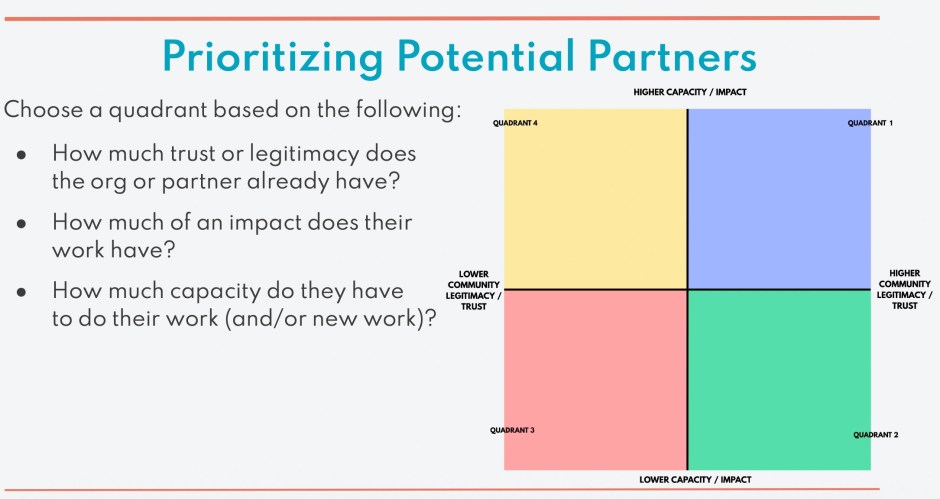
Once you have identified possible partners, the next step is to place them in a simple quadrant tool.
The session recommends asking three questions:
- How much trust or legitimacy does this organization or partner already have?
- How much impact does their work have?
- How much capacity do they have to do their work, or take on new work?
This helps you sort potential partners based on two main dimensions:
- legitimacy / trust
- capacity / impact
The point is not to rank people morally. It is to decide where to invest relationship-building energy first.
Video: How to Not Talk to Partners
4. Assess alignment
The second tool is a set of concentric rings that helps you think about alignment. The rings move from your own core leadership outward:
- Core leaders
- Very aligned / potential leaders
- Somewhat aligned / active participants
- Mixed alignment / passive supporters
- Unaligned / non-supporters
This gives you a way to think about how closely a person or organization aligns with your values and self-interest, and what kind of relationship may make sense.
A key point from the session: this is a snapshot in time, not a permanent label. People and organizations can move.
If you treat a one like a five, you leave power on the table.
5. Map your community
The session’s final mapping exercise combines both tools.
The process is:
- choose the quadrant first
- then place people or organizations according to the alignment “rings”
- prioritize outreach and engagement based on the map
This produces a practical working map of your community — not a perfect analysis, but a clearer view of where to begin.
The goal of one-to-ones is more one-to-ones.

Video: Mapping Your Community
6. Build relationships without “pitching”
Even though this session is about identifying partners, it also includes clear guidance on how not to approach them.
The presenters caution against:
- pitching your effort
- approaching conversations as recruitment
- educating local leaders about their own community
- asking for big commitments too early
Instead, they recommend:
- approaching potential partners in a spirit of partnership
- asking for insight into community history, leaders, and dynamics
- asking about strengths and challenges
- making small asks, such as an introduction, a second meeting, or an invitation to an event
Humility and curiosity matter.
Humility and curiosity go a long way.
What Makes This Hard?
This work is simple in structure, but not always easy in practice. Some of the main tensions include:
Inclusion vs. strategic focus
Civic work often aims to be broad and inclusive. But leaders still need to decide where to focus first. This framework helps you engage broadly while making choices about where to invest limited time and energy.
Institutional status vs. real community legitimacy
A well-known organization is not always a trusted one. One challenge is learning to distinguish formal prominence from genuine relational power.
Mapping relationships vs. instrumentalizing people
A strategic lens can become overly transactional if it is handled poorly. The session pushes against this by emphasizing partnership, curiosity, and listening rather than extraction or recruitment.
Clarity vs. discovery
Many emerging civic efforts do not yet know exactly what their eventual project or campaign will be. In the debrief, participants noted that mapping can surface a lack of goal clarity, but that this is not necessarily a failure. It can help clarify what kind of work is possible.
Watch the Recording
Jump to Key Moments in the Video
- Session overview and agenda
See how the session frames strategic local partners, relationship-building, and the mapping tool. - How not to build partnerships
A useful warning against pitching, recruiting, over-asking, or showing up as the expert. - Community centers of power
Introduces accountability, belonging, and co-creation as qualities to look for in local partners. - Prioritizing potential partners
Explains the quadrant tool for assessing legitimacy, trust, capacity, and impact. - Assessing alignment
Walks through the alignment rings, from core leaders to less-aligned or unknown partners. - Opposition, alignment, and conflict nuance
Explores how groups can be unaligned in one moment without becoming permanent opponents. - Mapping your community
Shows how to combine the quadrant and alignment rings to decide where to focus outreach. - Leaders with a following
Clarifies why real influence is not always tied to formal titles or institutions.
Related Resources
- Session slide deck (PDF)
- DIY Community mapping graphics:
- Where Should We Focus?
- Prioritizing Potential Partners
- Assessing Alignment
- Mapping Your Community
- Community Centers of Power
About the Facilitators
This is part of the Learning Series produced by the Democracy Resource Hub, a project of the Shift Action Lab.
This was the third session of a three-part mini-series, Who, What & How: Foundations for Civic Leadership, designed for people building place-based civic renewal projects.
Roshan Bliss
Roshan Bliss led this session as a longtime community organizer and trainer. He is based in Denver and serves as Director of Democracy Innovations for the National Coalition for Dialogue and Deliberation, though he joined this session in his organizing capacity rather than in that formal role. In this session, Roshan shared frameworks for identifying strategic local partners, understanding community centers of power, and mapping relationships for place-based civic renewal work. Bliss Collaborations
Ben Fink
Ben Fink co-facilitated this session and contributed his experience as a community organizer working across rural and urban communities in the eastern United States. He is based in Philadelphia and described himself as an organizer, theater maker, and singer who pays close attention to the role of stories and cultural work in communities building power. Download Ben’s resources here.
Explore Further
- Listening as the Invitation: One-to-One Conversations to Build Civic Relationships
- Orienting Around Shared Purpose in Diverse Communities
- Related Commons Library resources