Introduction
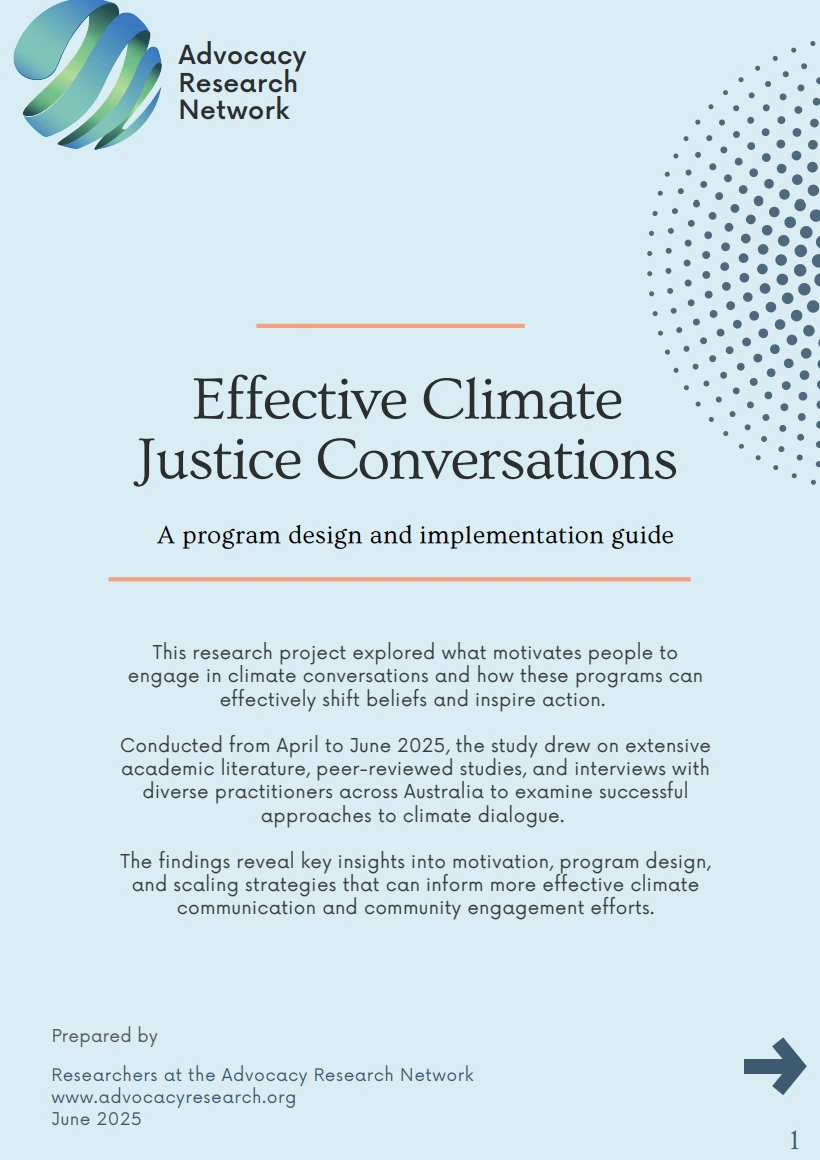
This report by the Advocacy Research Network in Australia offers strategic guidance and tactical tools for organisations ready to invest in conversation-based approaches to climate advocacy.
What This Report Is About
The Climate Justice Coalition commissioned this research to help inform how they could build a highly ambitious conversations programme. Through their program they aim to support communities and leaders to have hundreds of thousands of conversations that will help Australians believe:
- climate change is impacting their lives here and now,
- rank it as a top priority,
- understand the economic case for action, and
- recognise the role of fossil fuel billionaires in creating the crisis.
The report combined academic research with activist expertise to provide an evidence base and practical guidance needed to make that vision a reality.
The Research Behind the Report
Conducted from April to June 2025, this project brings together multiple sources of evidence:
- 10 in-depth interviews with experienced climate activists who have delivered conversation programmes across Australia
- Comprehensive literature review covering peer-reviewed studies in climate communication, political science, psychology, and volunteer management
- Analysis of grey literature including evaluation reports, campaign toolkits, and organisational case studies from Australia and internationally
- An exploration of detailed case studies of Australian organisations running conversation programmes
The interview participants represented diverse contexts—from large national NGOs to local grassroots groups—with experience in door-knocking campaigns, kitchen table conversations, community forums, and digital outreach.
Four Key Questions, Four Sets of Answers
The report is structured around the four critical questions any organisation faces when scaling climate conversations:
1. What motivates people to join conversation programmes?
Key Finding: People are most motivated when they feel connection, purpose, and agency.
The research reveals that successful programmes offer clear asks, supportive communities, and visible impact. Once involved, volunteers stay active when they have opportunities to grow into leadership, feel supported by peers, and see how their efforts contribute to a larger movement.
The report draws on both academic research on volunteer motivation and concrete tools from Australian practitioners.
2. What makes conversations most effective?
Key Finding: Values-based, emotionally resonant conversations rooted in trust are most powerful.
The evidence shows that peer-led or relational formats—like kitchen table conversations—create deeper belief shifts, while door-knocking offers scale and visibility. Programmes focusing on the “persuadable middle,” using shared values, and structuring conversations to build both climate identity and action knowledge have the greatest success.
Importantly, the research identifies challenges with “climate justice” framing, noting a lack of peer-reviewed research on its effectiveness and suggesting terms like “fairness” may be more persuasive across political spectrums.
3. How can these programmes be successfully scaled?
Key Finding: Scaling requires decentralised leadership, ready-to-use toolkits, and both emotional and logistical support.
Academic research on scaling grassroots conversation programmes is extremely limited—a significant gap the report identifies. However, practitioner insights reveal that successful scaling requires offering multiple ways to participate, enabling progression along engagement ladders, and partnering with existing community groups and trusted networks, especially in remote or harder-to-reach areas.
4. How can impact be evaluated, especially in decentralised models?
Key Finding: Layered approaches combining story, data, and self-reflection show the most promise.
Research on evaluating decentralised, volunteer-led programmes is notably absent from academic literature.
The report finds that while rigorous impact evaluation remains rare in grassroots models, the most effective approaches prioritise self-efficacy and relational outcomes over immediate behaviour change, embed evaluation into volunteer practice rather than treating it as external oversight, and use peer-logged systems and gamified approaches.
Practical Tools and Resources
Beyond analysis, the report serves as a practical guide, including:
- Conversation frameworks tested by Australian organisations
- Volunteer recruitment and retention strategies backed by research
- Evaluation tools designed for grassroots programmes
- Language guidance for effective climate communication
- Training resources and toolkit recommendations
Key Insights for Practitioners
Several findings stand out as particularly important for anyone designing conversation programmes:
- Start with values, not facts
Technical information rarely shifts deeply held beliefs, but conversations grounded in shared values and personal stories create lasting change. - Design for accessibility and inclusion
Not all conversation formats work for all volunteers—programmes need multiple pathways for participation. - Invest early in local understanding
Tailoring approaches to community dynamics and local issues is essential for resonance and trust. - Focus on relationship outcomes
Rather than expecting immediate behaviour change, measure volunteer confidence, relationship building, and community awareness. - Embed evaluation into practice
The most sustainable evaluation approaches feel natural to volunteers rather than burdensome.
Research Gaps and Future Directions
The report identifies several significant gaps in academic research that limit evidence-based programme development:
- Limited research on communicating climate justice concepts effectively
- Almost no academic literature on scaling grassroots conversation programmes
- Absent research on evaluating decentralised, volunteer-led programmes
- Insufficient attention to accessibility and inclusion in conversation programme design
These gaps highlight opportunities for future research to support movement building.
Why This Research Matters
As the climate crisis intensifies and traditional advocacy approaches face limitations—from COVID disruptions to tightening protest laws—many organisations are turning to conversations as a core strategy for building public support and political will.
This report provides the evidence base needed to do this work effectively. By combining rigorous research with practitioner wisdom, it offers both strategic guidance and tactical tools for organisations ready to invest in conversation-based approaches to climate advocacy.
The stakes are high: Australia needs rapid, large-scale shifts in public opinion and political support to achieve the emissions reductions required this decade. Done well, conversation programmes can build the people power needed to make that transformation possible.
Table of Contents
Executive Summary
Recommendations
- Motivation to Participate
- Best Practice Conversations
- Scaling Conversations Programs
- Evaluating Conversations Programs
Research Review
- Motivation to Participate
- Best Practice Conversations
- Scaling Conversations Programs
- Evaluating Conversations Programs
Guides and Toolkits
References
Report Excerpts
Here is a sneak peek into the report.


Access Full Report
Effective Climate Justice Conversations: A program design and implementation guide (35 pgs PDF)
The complete report includes detailed methodology, comprehensive literature review, full case studies, practical toolkits, and extensive references. It represents the most comprehensive analysis of climate conversation programmes in Australia to date.
Related Research Resources
Explore more resources related to this article and 2025 research project conducted by the Advocacy Research Network, in partnership with the Climate Justice Coalition.
- Climate Justice Conversations in Action: 11 Case Studies
- Talking Change: How Climate Conversations can Shift Public Attitudes and Help Build Movements
- From First Chat to Long-Term Changemaker: How to Grow and Sustain Volunteers in Climate Conversations
- Fighting Fire with Listening: How Climate Conversations can help Tackle Misinformation
- Beyond Headcounts: Evaluating Climate Conversations for Real Impact
Explore Further
- Door Knocking: A Case Study in Moving People to Take Action
- Persuasive Conversation Campaigns Guide
- Climate Organizing Shorts Podcast: Conversations with Climate Organizers
- Talking About the Bushfire Crisis and Climate Change
- How Powerful Conversations Won Abortion Rights in Ireland
- Tools for Canvassing and Door Knocking
- Conversation Tips for Stalls, Events & Door Knocking
- Tips for Phonebanking or Calling Volunteers
- How to Have a Persuasive Conversation, GetUp
- Structured Conversations on Campaigns, Amnesty Australia
- How to Have a Persuasive Conversation, GetUp [The Four C’s]
- Circles of Commitment: A Model of Engagement
- Deep Canvassing Scripts and Examples
- Deep Canvassing to Shift Hearts, Mind and Votes
- First Nations and Multicultural Voices from the Climate Movement