Introduction
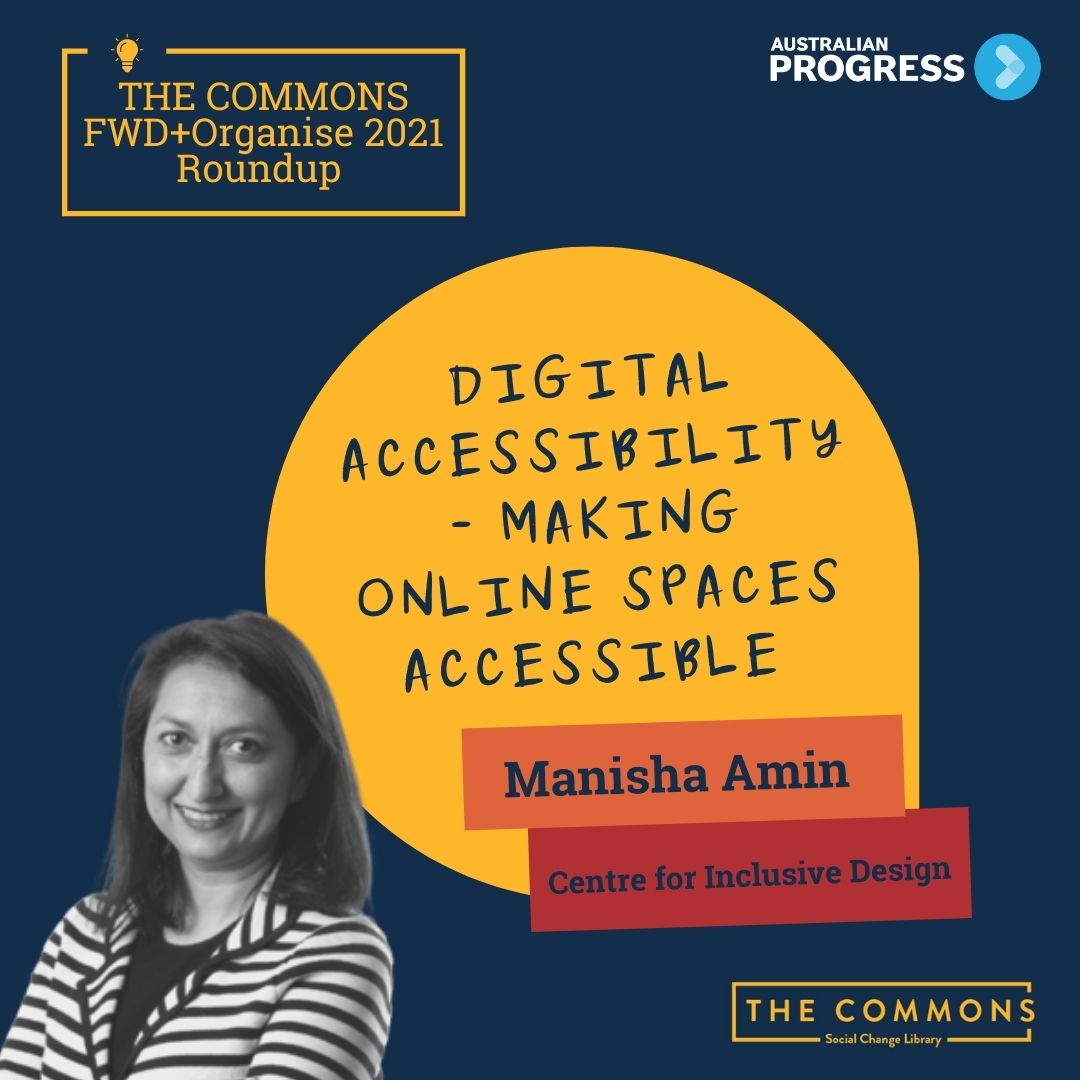
With so much organising taking place online, it’s crucial that the spaces we make are accessible to everyone – especially those with disabilities. Here are tips, notes and presentation slides from a session at the FWD + Organise 2021 Conference held by Australian Progress with Manisha Amin from the Centre for Inclusive Design.
Inclusive design doesn’t mean you’re designing one thing for all people. You’re designing a diversity of ways to participate so that everyone has a sense of belonging. – Susan Goltsman
Inclusive design
Inclusive design –
- is design that considers the full range of human diversity with respect to ability, language, culture, gender, age and all other forms of human difference
- is about designing a diversity of ways for people to participate
- is about personalisation as things work differently for different people
- results in better experiences for everyone.
We need to bring the ‘edge’ in as:
- 18% living with medical disability
- 70% of disabilities are invisible
- 20% long term health condition
- 28% living in regional remote areas
- 48% born overseas or had a parent born overseas
- 8% men colour blind
…any one of the 25 million Australians can be susceptible to fall in either the temporary or situational category, even if we don’t live with a permanent disability – The Benefit of Designing for Everyone Report
Set the Meeting Ground Rules
Making things better for one person, we are solving issues for all of us – we just didn’t realise it yet. – Manisha Amin
Set the ground rules at the beginning of the meeting. The ground rules used at the Centre for Inclusive Design include:
- Respect
Though this term is used widely, ‘respect’, means different things to different people. What does respect mean to all of us? - One voice, all ears
When one person speaks, everyone else listens. - All experiences are valid
Everyone has unique experiences and perspectives that are valuable contributions. No one will be alienated or criticized for having unique perspectives. Everyone should also be responsible and accountable for their own experiences. - Confidentiality
Everyone needs to feel secure that what is shared will not be shared outside. People are encouraged to share in the group. - Accountable for our own emotions
We don’t know each other’s situations and so we can’t judge them.
Make meetings more accessible
Videos – On or off?
- Video on
- Helps people to lip read and see facial expressions,
- Builds rapport and connections
- Video off
- Can be distracting for people with neurodevelopmental disability like Attention Deficit Hyperactivity Disorder ADHD / Autism Spectrum Disorder ASD
- Zoom fatigue
- Saves bandwidth
- Option
- One rule for presenter another for participants
Recordings and Break outs
- Allows people the space to speak
- Private conversations
- Recording can help with transcription
- Focus on the type of conversation you are having
Use of mute and active speaker
- Pros
- Helps active speaker if noise is limited
- Is distracting if the speaker jumps because of noise
- Cons
- Less people speak or wait until they are called
- Options
- Raise hands ask if people are OK to be called on
Captioning and interpretation
- Provide a link
- Pin the interpreter
- Book two weeks in advance if you can
- Online captions are a poor back up
- Benefits: transcription for people for the future
Preparation – Accessibility
- Agenda
- Practice
- Know your audience
- Support for you and the participants
- Accessible slides and talk through them
- Accessible multimedia
Preparation – Inclusion
- Create a safe space
- Know that you may get it wrong
- Different options and breaks
- It’s a journey
- Don’t take it personally but learn
And…
- At the beginning of a presentation share your presentation with participants
- Share PowerPoint presentations as a PowerPoint (not just as a PDF) so people can also read the speaker’s notes if available
- Talk about the functionality of the platform at beginning of the meeting
- Don’t use acronyms
- Ask participants to mute to stop background noise coming through
- Talk through the images if they are non-decorative
- Ask people what’s not working
Power, Choice, Control
As the facilitator of the meeting be aware of the power dynamics in the room amongst meeting members, especially gender imbalance. Facilitators need to change the power. Some questions to ask yourself
- Who has the loudest voice/
- Who is the person with the pen?
- Who has the most money?
…true innovation is always on the edge … see the innovation opportunities that come from designing for the outsiders … the beauty of innovation is all around us we simply need to invite it in. – Manisha Amin
About Speaker and Conference
- Manisha Amin (she/her) is the chief strategist and visionary at Centre for Inclusive Design. With a background in strategic marketing, communication, transforming cultures and creativity she is a thought leader in the power of thinking from the edge. She has a unique talent for seeing beyond the horizon to emerging trends, defining them and building powerful communities to bring them into being.
- FWD+Organise 2021 was a conference held by Australian Progress for community organisers and digital campaigners from across Australia and Aotearoa to share practical skills, learn innovative approaches to advocacy and build lasting collaborations to win systemic change. Sessions included keynotes, workshops, masterclasses, and expert briefings. Access other conference sessions here.
Download Slides
Explore Further

- Accessible Online Meetings Micro Course by DARU, the Disability Advocacy Resource Unit
Just like designing an accessible website or face to face meeting, a bit of planning and consideration is all it takes to make your meeting accessible.The tips in this resource focus on making meetings inclusive for people who are Deaf or hard of hearing and people who are blind or vision impaired. However, it’s worth remembering that embedding these practices into all your online meetings is simply just good inclusive practice, which is better for everyone! - Power Dynamics and Inclusion in Virtual Meetings
Tips from Aspiration Tech on how to facilitate inclusion, manage power dynamics and hold space with awareness and intentionality in virtual meetings and spaces. - Diversity and Inclusion Topic Overview
This collection includes a variety of resources to help groups to develop skills and culture to be inclusive and welcoming. You’ll find materials to support that in this topic, as well as stories and perspectives from different communities, identities and struggles. - Improve your Website Accessibility
A comprehensive list of tools, checklists and websites to improve your website accessibility. - Lessons from the Disability Justice Movement
Recording of the ‘Lessons from the Disability Justice Movement’ plenary session from Virtual Progress 2020. - Disability Justice Links
A crowdsourced list of disability justice resources from Virtual Progress 2020.