
Introduction
An excerpt about democratic decision making and mapping authority within your organisation from AORTA – Anti Oppression Resource and Training Alliance.
Make Power Plain
In order to shift how we govern, we must first understand how decisions are currently made. Many groups never get around to writing down who has authority over what decisions, and we get why.
Writing down the nuts and bolts of decision making can feel both tedious and intimidating! But when there is no map, it’s easy for authority and information to accumulate in inequitable ways over time without anyone realizing it. Often, the people who have the most understanding of how decisions are made are also the people who have the most power, leaving people who have less power in the dark.
What to Try
Build a map of the key decisions that the group makes. Include who makes each decision, who influences each decision, and how each decision is made. Make sure everyone in the organization understands the map.
Distinguish Culture from Structure
Have you ever been a part of an organization that had a culture of collectivity, but when you looked under the hood, the culture of
collectivity was not matched with a structure of collectivity? Sometimes, the culture can be encouraged by leaders who are uncomfortable with the positional power they hold and are unintentionally obscuring their authority behind the “feeling” or language of consensus.
At other times, the group started out small and structurally collective, but as it grew, the structure shifted but the culture remained the same. This dynamic has the most negative impact on people with less power, stirring up confusion (“Wait, are you asking for my idea because it might influence the decision?”) and eventually frustration (“I’m tired of putting energy into these conversations when my contributions aren’t actually doing anything!”) over time.
What to Try
Once you have mapped who has authority and influence in the organization (see above!), discuss the cultural and social norms in the group. Where do they match the structure, and where is there dissonance?
Every Decision does not Require Everyone
It’s a common misconception that the only way to share power in decision making is to have complete transparency and no
hierarchy. Instead, we believe there are many levers in the stages of decision making to distribute power while accounting for
efficiency and difference in skill and role.
Many of us have made the mistake of trying to express our values of power sharing by having every single person in the group
involved in every decision. The result?
Eternal meetings, low morale, and the feeling of “never getting any real work done.” Yikes! At AORTA, we have a flat structure where we are all co-owners of the business. But we’re always experimenting with role differentiation. and delegating decisions.
What to Try
Build the practice of identifying who should play which roles in specific decisions and why, and make sure the who and why are clear to everyone. We like to use the decision making sequence in Lesson 1 to map on who
has what authority over which stage of the process. This can support the full group toknow and understand who has what authority over which stage and why.
Reflection Questions
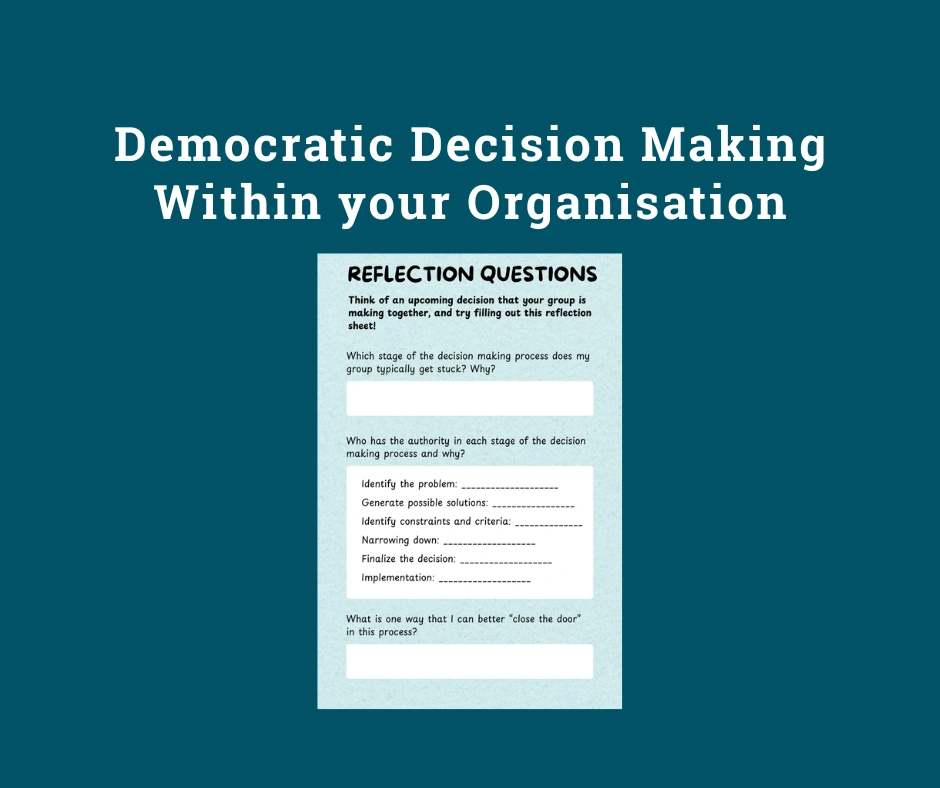
Think of an upcoming decision that your group is making together, and try filling out this reflection sheet! (see pg 19 of PDF)
- Which stage of the decision making process does my group typically get stuck? Why?
- Who has the authority in each stage of the decision making process and why?
- Identify the problem:
- Generate possible solutions:
- Identify constraints and criteria:
- Narrowing down:
- Finalize the decision:
- Implementation:
- What is one way that I can better “close the door” in this process?
Access Resource
Explore more in the zine about lessons on decision making. This excerpt has been adapted from the zine which is licensed under Creative Commons Attribution-NonCommercial 4.0 International.
About the Author
AORTA is a worker-owned cooperative of facilitators, coaches, and consultants devoted to movements for liberation. AORTA offers
facilitation, coaching, process design and thought partnership to groups. They offer training and coaching.
They focus on:
- strategy and planning;
- values and purpose;
- shared leadership and democratic practice;
- navigating organizational transitions;
- relational tending and conflict; and political
- education and practical skill-building.
Explore Further
- Leaderful Organizing Tool: Blended Decision Making
- Leaderful Organizing Tool: Chapati Power Diagrams
- Constitutions: How To Build Durable Groups
- Consensus Decision Making
- How to Make Better Decisions Together
- Consensus decision making: A guide to collaborative decision-making for activist groups, co-ops and communities
- Facilitation Skills for Deliberative Democracy
- Facilitation 101: A Beginner’s Guide to Dialogue and Deliberation