Introduction
What does it take to build long-term deep power? The Deep Roots, Real Power session at Progress 2026 featured four community organisers reflecting on depth and breadth in their organising work. They share stories and lessons from their very real experiences, speaking of times they didn’t invest deeply enough in long-term organising, what that cost them, and what they’ve done differently since.
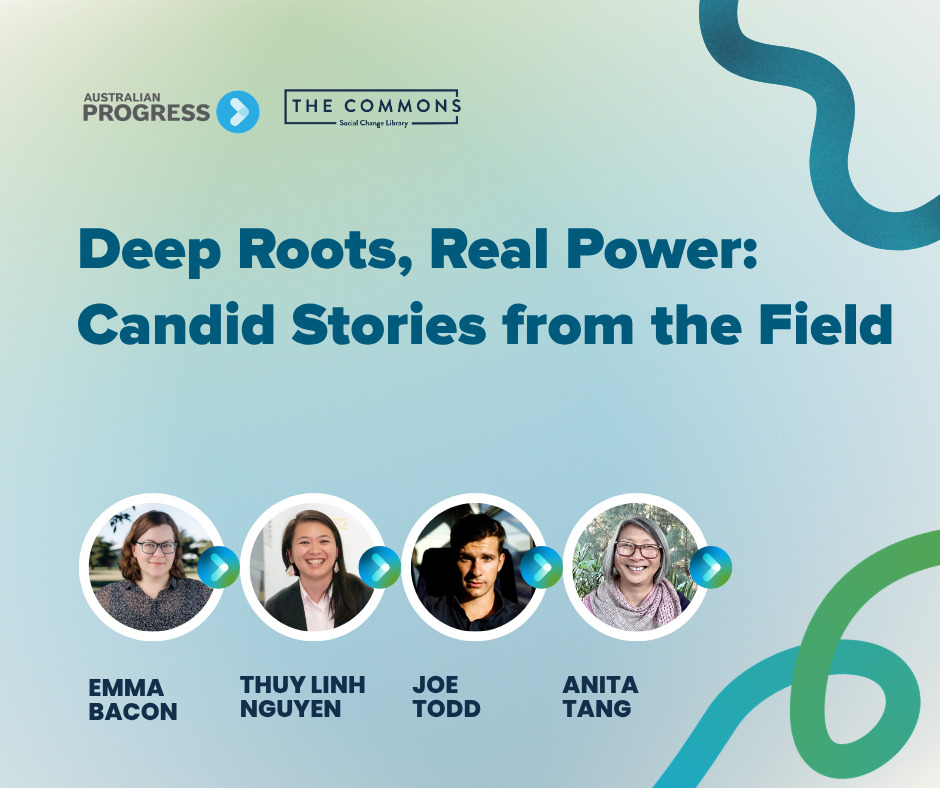
The panel, moderated by Anita Tang from Australian Progress, included Emma Bacon from Sweltering Cities, Thuy Linh Nguyen from Uniting, and Joe Todd from the Movement Research Unit. The article below outlines the key lessons and learnings shared throughout the conversation.
The Progress 2026 conference was hosted by Australian Progress on March 24-25 at the Melbourne Convention and Exhibition Centre in Narrm/Melbourne. This article was produced by The Commons Library to enable ongoing learning.
When have we failed to build deep roots?
In sharing stories from their own organizing lives, the resounding reflection from all panellists was that short term campaign pushes and project work are the biggest inhibitors to building deep roots, and that this is something most organizers have done.
All campaigners expressed regret over projects that were too short, and didn’t have long term visions or plans for what to do with the communities and individuals after the immediate push was over. Without maintenance and follow through, these relationships were sometimes soured. People would say “you come every few years and then disappear.”
Afterwards, I had deep regret that we didn’t build deeper roots in the party—that we didn’t focus on our people in the party more, we didn’t build them up as activists. We focused so deeply and obsessively on the moment, rather than thinking more broadly about the party as our project, and building that deeper and building up our people better over time. – Joe Todd
The panel reflected on the importance of focusing on people more, building depth in relationships, and building people up as organisers and campaigners in their own right.
There’s a movement tendency to engage people just for a moment, and it can be quite transactional. – Anita Tang
Challenges
Building on the previous question, Anita prompted the panellists to consider the main challenges to building deep roots in community organizing. The sections below outline the key themes in their responses.
1. Funding and Time
The length of a grant is usually not enough time to build community trust. – Thuy Linh Nguyen
As each panellist explained, a focus on short-term campaign outcomes is a major inhibitor of building deep roots. And ultimately, this comes down to funding. Funding limits time. Thuy saw time as the primary challenge, and spoke to the lack of funding available for the further work after a major campaign push, and therefore the lack of ability for any longevity or follow through.
There was also discussion around the pressure to be defending and justifying our organizing work to our funders, needing to constantly be demonstrating small wins, demonstrating that our work is valid and worth investing in. This presents a challenge: because political work is always building on a lineage, on a long trajectory of people who have come before, it can be very hard to prove the validity of incremental wins, or slow relationship building to funders who want to see results immediately.
It’s based on deeper roots! And we need to get funders to see that—not just looking at the shoots which we grow in our short little seasons, our two years of work or funding. -Thuy
2. Incrementalism
Emma emphasized the difficulties around tangibility and incrementalism when you’re dealing with really big, concrete issues.
Working with communities in hot suburbs and hot homes, Sweltering Cities have conversations with people who are dealing with significant issues both in their own houses and neighbourhoods, but also on a much larger scale. They want to see a plan to address the big problems at the huge scale they feel it, and also at a tangible local level; “What does resilience look like at your home, in your street?”
Emma spoke to the way these big asks can be watered down in the electoral system, how it can change from big, bold ideas to more subtle, incremental changes—”what’s achievable right now”— it becomes about what the Government is willing to do, rather than what actually needs to be done.
3. Connection and isolation
Finally, Joe expressed the difficulties in organising in a socially isolated society, where people spend a lot of time online or alone. This inhibits our sense of community, of relating in person. Without community, there isn’t any community organizing.
I don’t think we can win if we don’t get people out of their homes and relating with other people. – Joe
Opportunities for Deep Power
1. Start in your own community
My challenge to everyone is: Who are the people that are already in your community? Start there. – Thuy
Thuy emphasized the importance of building relationships with the community you’re already in, and start trying to talk to these people about power, and the issues that are affecting their lives. In particular, she emphasized the importance of avoiding jargon and instead focusing on lived experience, and the things people can relate to: climate change, or cost of living pressure. And then, build people’s confidence to act on these things.
We have to be courageous to have people step into their power and agency and step up to the plate, and bring their story to the table. – Thuy
2. Campaigns that are tangible, winnable, and relevant
In my experience, people don’t feel limited by whether campaigns are possible, when they feel it’s important. – Emma
Speaking about Sweltering Cities’ bus shelter campaign, Emma emphasized the huge amount of interest and enthusiasm in the community in working to get proper bus shelters around the hot suburbs of Sydney. So many people surveyed during the campaign said they found it too hot to leave the house, and certainly too hot at the bus stop. People reported feeling sick and isolated during summer. The idea of better bus stops was relevant, tangible, and an incredibly clear campaign goal for an issue affecting so many people. This meant that it got a lot of traction, ultimately leading to success: $1.5 million dollars for bus shelters in Western Sydney!
The important takeaway from this is that it was something the Government said was impossible, until we forced them to make it possible. The campaign is tangible, winnable, and relevant. That’s what people are enthusiastic about, and where we need to do the work. – Emma
3. Providing avenues for people to use their skills for what they believe in
Joe’s work with the Movement Research Unit involves organizing expert volunteers—academics, tech heads, scientists, etc, who want to do work that is aligned with their values. They are connected by the Unit to various campaigns and projects that need their expert assistance.
We’ve come across so many useful, experienced, talented people who are so humble and willing to give their time and their work to people so different to them: this gives me so much hope. – Joe
Speaking about how easily this network has expanded through experts recommending each other, Joe explained that people are frustrated with never doing values-aligned work. By providing avenues and connections for people to use their valuable skills for important things, the Movement Research Unit is able to facilitate the building of relationships between experts and movements, and bring experts into movements for the long term.
We want people to see themselves as social movement researchers—that this is their obligation and role within movements. We hope they transform and grow as activists through this work. – Joe
Community Leaders
Professional community organizers will not always be there. As discussed above, limitations on time that come with funding restrictions mean that organizing projects are often cut short. So, who carries the torch when you’re gone?
During the panel, audience members prompted discussion of community leaders. This has two aspects:
1. Building relationships with existing community leaders, and;
2. Encouraging and building up new leadership.
Communities need to stay organised in a sustained way when professional organisers are gone. So, organizers can work to identify existing community leaders and build their skills, use their time to train them to continue on and lead the work in an ongoing way. This is deep roots organizing; organizing that looks far beyond the project timeline.
To build these relationships, you need trust. And to build trust, you need to listen.
After building some trust, people came back to us… So, the organiser started with listening, and learning what was really at stake for the community and what they were worried about, therefore establishing mutual trust, and then being able to talk about more. – Thuy
The panel mentioned the difference between activists and natural leaders – see Jane McAlevey’s definition of organic leaders.
In terms of finding new leaders, the panellists spoke about mentorship, and how emerging leaders can learn, take the baton, and carry on the work. This can involve training from organizers, but it is also about mentorship relationships with existing community leaders, and working to make sure you uphold the leaders within a community who have good approaches to sharing power, and raising those ones up as examples for the others.
Crucial emphasis was placed on supporting the webs of relationships within communities which create networks of resilience and support.
How can a community recover from big crises? How can communities still thrive? It’s about social connectedness, deep roots. – Thuy
Building power with young people
An audience question led to a discussion around building power and roots with young people in our movements.
Thuy responded by urging trust in young people, suggesting that we can pave the way for young organisers with philanthropy and networking connections, but that ultimately we need to get out of their way, and give them the space to do the organizing themselves.
Joe’s addition was an encouragement towards intergenerational organising and mentorship.
I would have valued older people who could have supported me to not make mistakes, to have taught me from their learnings. – Joe
Hope in Deep Roots
Anita posed a question to the panel: “What’s the opportunity in this moment for leaving with hope that is related to the idea of deep roots?”
People don’t feel represented in the core institutions of colonial power. People are furious with these institutions. Too much of the progressive movement is trying too hard to be close to these institutions. We need to be aligned with the people on the streets and their rage, rather than meeting with as many Canberra staffers as we can. – Emma
We know how to do this. Let’s trust that. I don’t think we need more innovative solutions. People can feel the crises in their lived experience, let’s turn that into action. – Thuy
People are furious and disenfranchised and there is a massive opportunity there for us to win. – Joe
About the Speakers
Emma Bacon is the Founder and Executive Director of Sweltering Cities. Since the beginning of 2020 Sweltering Cities has connected with thousands of people around the country, working directly with communities in our hottest suburbs to campaign and advocate for more liveable, equitable and sustainable cities. Emma is a passionate organiser, campaigner and activist. She has worked across movements for social and environmental justice for over 12 years on campaigns including an international asbestos ban, 10 cent deposits on bottles and cans, and union campaigns with shopping centre cleaners. She has run successful political campaigns and been part of winning significant outcomes for progressive change at local to international levels. Emma is committed to building a broad movement for climate justice. For more insights from Emma Bacon and Sweltering Cities see Lessons in Solidarity: Collaboration Across Climate and Disability Movements and Creative Community-led Action: The Busted Bus Stops Campaign.
Thuy Linh Nguyen is a community organiser and campaigner dedicated to building the power of marginalised communities to drive systemic change. She is a Senior Social Justice Advocate at Uniting NSW.ACT, where she leads Uniting’s climate justice campaigns and high‑level government and Pacific stakeholder engagements. Previously, she was the Director of Innovation and Impact at the Multicultural Leadership Initiative and led the Voices for Power campaign at the Sydney Alliance, empowering culturally diverse communities on energy justice. With an established history working in civil society coalitions and partnerships, and with grassroots communities, she seeks to push for a shift towards clean energy that support people experiencing the worst impacts and leaves no one behind.
Joe Todd is the founder and organiser of the Movement Research Unit. He was Head of Communications at the campaign group Momentum during the 2017 and 2019 UK General Elections, helping build a nationwide grassroots movement and organise tens of thousands of activists to knock on hundreds of thousands of doors. He is part of the Social Practice, a collective founded by Bernie Sanders organisers, which support unions, candidates and campaigns to organise at scale. He also helped found The World Transformed, Europe’s largest festival of politics; Common Knowledge, a worker coop that designs digital tools for grassroots activists and The Movement Research Unit, a network of 650 researchers who support 80 grassroots groups a year. He researches and writes on progressive parties for the Rosa Luxembourg Stifung, Novara Media and on Substack. He is the co-host of the Life of the Party podcast.
Anita Tang is the Organising Director at Australian Progress. Anita is passionate about building people power to secure public policies that benefit the community. During her career, she’s explored many ways to make a difference – through direct service, policy development, consumer protection bodies, and Parliamentary Committees, and non-government policy advocacy. During her 12 years at Cancer Council NSW, she led the development of the grassroots advocacy approach that led to significant campaign wins on smoke-free legislation, cost of chemotherapy, access to treatment, and policies to protect people from known cancer risks. Currently, Anita is focused on increasing the impact of the advocacy work of NGOs by helping them unlock the potential of their grassroots supporters. Read Anita Tang’s articles on The Commons Library.
Explore Further
- Organising Beyond the Cities: Building Power in Regional Australia
- Lessons from the Zohran for NYC Campaign: Strategy, Organising and People Power
- Jane McAlevey: Organizer Extraordinaire
- Community Organising Templates and Training Tools
- Psychology, Trust and Joy in Organizing
- Template: Developing/Reviewing an Organising Program
- Deep Canvassing
- Explore the Organising Topic on The Commons Library
- Explore the Australian Progress collection on The Commons Library
- Explore other resources from Progress 2026
- Australian Progress Events & Training