Introduction
Solidarity and collaboration across disability and climate movements strengthens our collective power to build solutions that are more just for everyone.
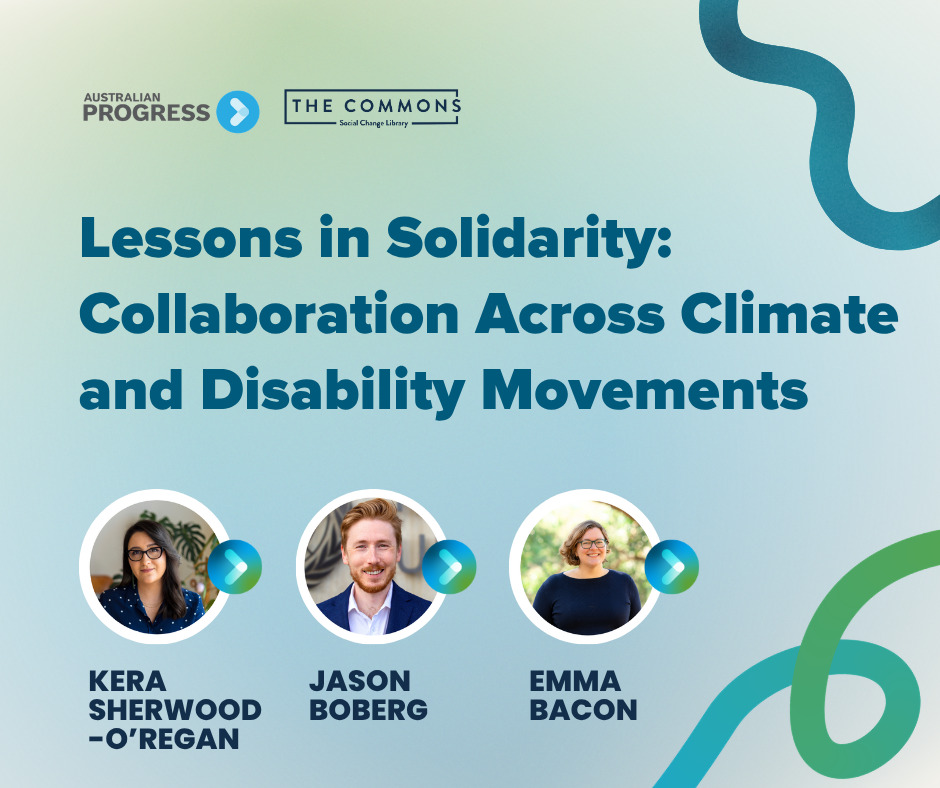
For Progress 2026, writer and disability advocate El Gibbs organised a panel to explore this topic with Kera Sherwood-O’Regan and Jason Boberg from Activate Agency, along with Emma Bacon from Sweltering Cities. Below we share a summary of the session, alongside a selection of quotes from the speakers.
Disabled people are among those most impacted by climate change. Both the disability advocacy and climate advocacy movements have long been home to some of the most innovative problem solvers. This session explores what becomes possible when climate and disability movements collaborate as equals, ensuring that those most affected are not only included, but centred in designing the future of climate justice campaigning. – Session Abstract
The Progress 2026 conference was hosted by Australian Progress on March 24-25 at the Melbourne Convention and Exhibition Centre in Narrm/Melbourne. This article was produced by The Commons Library to enable ongoing learning.
Disability Justice Recap
Presented by Kera Sherwood-O’Rega(from notes by El Gibbs, who was unable to attend)
The Disability Justice movement came to prominence via the work of Sins Invalid, a Disability Justice Collective of queer, disabled women of color – including Paddy Berne, Stacey Milbern, and Mia Mingus.
The movement has also been shaped by Alice Wong‘s leadership in launching the Disability Visibility Project and Podcast, as well all her work writing, editing, and mentoring emerging activists. Her legacy helps demonstrate the power that can come from amplifying marginalized voices when advocating for systemic change.
At its core, disability justice is about being intersectional and anti-capitalist.
When we talk about Disability Justice, it isn’t just about inclusion. It’s about the table being changed by us being there… through our own unique ways of being and making change – Kera Sherwood-O’Regan
Why Actual Climate Justice Requires Disability Justice
Presented by Kera Sherwood-O’Regan

Actual climate justice requires disability justice, and disability justice is climate justice. As the slide image illustrates, it is the systems of colonialism, racism, ableism, and capitalism that uphold intersecting injustices and connect to each other to create and maintain symptoms of oppression such as biodiversity loss, culture and language loss, and institutionalisation.
The same systems of oppression that cause our communities harm are the systems that produce climate change. Drawing on the representation of the glass table supported by interconnected wooden legs, we know that if we chip away at the table top we won’t get very far. In contrast, any work that helps destabilize the legs helps to dismantle the table as a whole. – Kera Sherwood-O’Regan

Mainstream climate activism tends to act in reactive ways that target the symptoms of climate change, often excluding disabled people, and sometimes directly contributing to the disproportionate impacts of climate catastrophes on disabled people.
Mainstream climate action disconnects us from our power and each other. It ultimately reinforces the systems that cause climate harm anyway. – Kera Sherwood-O’Regan
Mainstream climate action targets the symptoms of climate change, not the systems that cause it. – Kera Sherwood-O’Regan
Even the pockets of disability inclusion tend to become short-term reactive tokenism that disconnect us from our power and each other, and reinforce the systems that cause climate change. For example, ableist climate solutions tend to focus on individual well-being and demonstrate that we are not part of the imagined public as the ‘solutions’ ignore what is needed for disabled people to participate in public spaces.
This kind of activism is often reactive, driven by fear, panic, short term thinking and individualism – and can be exhausting for the activists involved!
By contrast we can take the following lessons from the disability climate movement:
- An effective climate movement requires intersectionality
- Inclusion: Disabled leadership and power-sharing
- Critical feedback is a taoka (gift) – take it as such
- Reflect on your organisation’s positionality
- Seek guidance from diverse tuakana + mentors
- Choose targets for action wisely – with systemic change in mind
- Remember that real change happens in community
Climate movements must include intersectionality by moving away from token efforts at inclusion and towards sharing power by recognising that we have our own knowledge and expertise and ways of making change. Meanwhile, we also need to build relationships that enable us to coordinate across disability spaces: we need to think about our positionality and recognise that we are not always part of the right organizations to make a change and find ways to support those who are.

Lessons from the Sweltering Cities Summer Survey
Presented by Emma Bacon

Public health literature highlights that heat waves kill more people than floods, fires, and storms combined. Focusing on experiences on the ground, Sweltering Cities developed specific questions aimed at doing deeper work with respondents with disability and chronic illness.
The Sweltering Cities Summer Survey results highlight the increased risks disabled people experience during heat waves, as well as the many structural factors that mean heat waves contribute to health concerns. For example, a housing system that is more about the accumulation of capital than treating housing as a human right puts people at risk during heat waves.
Responses to questions about how to reduce risks and support disabled people during heatwaves highlight that disabled people are more likely to take responsibility for themselves and also care for others in their communities. Responses with suggestions for improving support for people with disabilities during heat waves included:
- Accessible cooling spaces, reliable home cooling assistance, clear heat-health guidance, and policies that ensure extra care of check-ins for people with disabilities during extreme heat events.
- Flexible NDIS funding, with reviews for NDIS during different seasons as people’s support needs change
- Better provision of transport to enable people to access services in the heat
- Improved building code standards and programs to retrofit homes
- Better climate policies, and end to capitalism, and planting more trees
If all the solutions proposed by people with disabilities were implemented, this would also benefit the structural resilience to climate for us all. – Emma Bacon

An Activate Agency Case Study
Presented by Jason Boberg

Activate Agency has been involved in multiple climate initiatives with Auckland Council. A foundational piece of work for these initiatives was a baseline review and analysis of the current gaps in the Council processes. This involved going deep into the Council’s climate plan, getting communities involved, doing literature reviews, and having conversations that helped shift the dial.
Without equitable access to life saving information we don’t get the option to stay alive during disasters. – Jason Boberg
One example of these initiatives emerged from identifying gaps in climate planning: the lack of accessibility in the natural hazard documentation for disabled people. Creating a tool to assess how communities respond to documentation, enabled solutions such as ensuring that the information shared is what is actually needed by communities. Another example was a pilot program for community-led projects to design what disabled people need to get through climate disasters.
If the climate movement doesn’t give us space to lead; no one is going to get through climate change. – Jason Boberg
Three Q&A Discussion Highlights
1. Challenging Climate Movement Strategies
There are ways to challenge climate movement strategies that are directly or indirectly discriminatory to disabled people, such as increasing the cost of waste disposal at home; replacing accessible parking with electric charging stations.
- There can be windows of opportunity for open-letters that call-out eco-abelism which can help convince climate organisations to collaborate more across disability/sustainability strategies – Jason Boberg
- It can be worth looking at organisations with websites that state climate justice principles and then doing a lit bit of “friendly holding their feet to the flame” – Kera Sherwood-O’Regan
- While the community legal sector is underfunded, they are doing some great work – especially in the context of disaster response. For example, the ways the ARC Justice team in Shepperton supported community responses following floods – Emma Bacon
2. Reflections on law reform
Reflections on the degree to which environmental sustainability laws will make a difference to how governments act on urban heat issues:
Laws are only as good as those that we can force them to act on. So many laws are ignored. Where we do have wins for long term change (like the sustainability acts) we need to hold them to account for implementing these. We don’t want to consider legal change as the end of the road; we need to realise these changes in practice. – Emma Bacon
3. Shifting the Narrative
Some ways to shift the narrative to take collective power:
- “We need to move away from describing ‘climate vulnerable communities’ – it is a really othering turn of phrase and obscures the agency and power of disabled people who are part of the solution. This ‘vulnerable’ language can contribute to climate adaptation solutions made in the abstract that are can be inaccessible to many (such as centrally-located heat shelters) instead of based on what people are saying they need to feel safe (such as better housing standards).” – Emma Bacon
- “Disabled people have both the technical knowledge and the relationships within communities to make things work.” – Kera Sherwood-O’Regan
- “When disabled people tell disabled stories, we shift the narrative and take power back to the community.“ – Jason Boberg .
About the Speakers
El Gibbs is a person with disability with over fifteen years of experience in policy, strategy, and advocacy for the rights of people with disability. She has worked as a sought-after consultant in policy, communications, and strategy, and has held senior roles at various national disability representative organisations. Additionally, El is an award-winning writer, regularly published on NDIS and disability issues in leading publications. She has most recently been the CEO of the Disability Advocacy Network Australia, and is also a member of the Jobs and Skills Australia Ministerial Advisory Board. El lives on unceded Wiradjuri country, in regional NSW.
Kera Sherwood-O’Regan (Kāi Tahu) is an indigenous and disabled multidisciplinary storyteller and rights advocate based in Te Waipounamu. She is the Co-founder and Impact Director at Activate Agency. Kera’s recent writing includes co-authoring From threat to opportunity: Climate change and health in Aotearoa with Dr Rhys Jones.
Emma Bacon is the Founder and Executive Director of Sweltering Cities. Since the beginning of 2020 Sweltering Cities has connected with thousands of people around the country, working directly with communities in our hottest suburbs to campaign and advocate for more liveable, equitable and sustainable cities. Emma is a passionate organiser, campaigner and activist. She has worked across movements for social and environmental justice for over 12 years on campaigns including an international asbestos ban, 10 cent deposits on bottles and cans, and union campaigns with shopping centre cleaners. She has run successful political campaigns and been part of winning significant outcomes for progressive change at local to international levels. Emma is committed to building a broad movement for climate justice. Emma lives and works on the land of the Wurundjeri Woi wurrung people.
Jason Boberg is a proudly disabled climate change and disability rights advocate and social entrepreneur. The co-founder of Activate Agency and our incubated organisation, the SustainedAbility Disability & Climate Network, he has advocated for disability inclusive climate action at the UNCRPD and the UNFCCC, particularly campaigning for a formal Disability Constituency to bring disabled people together and promote disability rights within the UNFCCC.
Resources
Disability Justice
- 10 Principles of Disability Justice and Skin Tooth and Bone – Disability Justice Primer by Sins Invalid
- Care Work: Dreaming Disability Justice, by Leah Lakshmi Piepzna-Samarasinha, 2018
- Building Ambition and Growing Movements for Disability Justice: A Case Study, by Dom Kelly and a Commons Librarian.
- Insights from Disability Campaigning from El Gibbs and Elly Desmarchelier by 3CR, El Gibbs, and Elly Desmarchelier
- All About El Gibbs, Disability Advocate: a collection of writing, videos and podcasts on disability justice.
- Disability, Mobility and Climate Justice reflections by Eav Brennan, 2024
- A list of disability justice links crowdsourced during Virtual Progress 2020
- Moving at the Speed of Trust: Disability Justice and Transformative Justice
Disability Justice deals with the oppression of disability, but at the same time also deals with other systems of oppression and injustice – it is a ‘multi-issue politic.’ It moves beyond rights- and equality-based approaches, beyond access and inclusion in unjust systems, instead working towards collective justice and liberation, towards transforming society as a whole. – Mia Mingus
Climate Justice
- Climate Justice Conversations in Action: 11 Case Studies, by Advocacy Research Network, 2025
- Climate Justice needs an Intersectional Approach: Toolkit, by Jada L. Kennedy, Youth and Environment Europe YEE, 2025
- Why North-South Intersectionality Matters in Climate Justice: Perspectives of South Asian Australian Youth Climate Activists, by Ruchira Talukdar, 2022
- Climate change hits some of us much harder than others – but affected groups are fighting back, by Naomi Joy Godden, Kavita Naidu, and Keely Boom, 2022
The term ‘climate justice’ reflects increasing awareness that climate change will affect not only our environment but also the social fabric of communities and nations – Climate Justice: What does it mean?
Disability Justice and Climate Justice Collaborations
- Nothing About Us Without Us: Climate Change and Disability Justice, by Jason Boberg and Kera Sherwood O’Regan
- Lived Experience Guide to Climate Campaigning, By Bronwyn Gresham, Emily Watkins, Jo Dodds, Kathryn McCallum, Serena Joyner
- Creative Community-led Action: The Busted Bus Stops Campaign by Commons Librarians
- A view of COP30 as a Turning Point for Disability-Inclusive Climate Action, thanks to Indigenous disabled people who have been doing the work of creating opportunities for more diverse forms of participation in COP.
- Climate Justice and Feminism Resource Collection by CounterAct, Womens Climate Justice Collective (WCJC), 2020

Acting in Solidarity for Collective Liberation
- Solidarity: The Past, Present, and Future of a World-Changing Idea by ByAstra Taylor,Leah Hunt-Hendrix
- It’s All About Power: A Guide to Thinking Differently about Power for Solidarity in Social Change By Sheila McKechnie Foundation
- Insights into Indigenous Solidarity, Creativity and Social Justice with Laniyuk & Te Raukura O’Connell Rapira (Commons Conversations Podcast)