Introduction
The housing crisis is impacting people across generations, tenures, and political perspectives. During Progress 2026, researchers and advocates for housing-justice explored what voters actually think about the housing crisis, and why it matters. This article outlines key lessons from the Australian Cooperative Election Survey (ACES) for how we can win stronger housing policy.
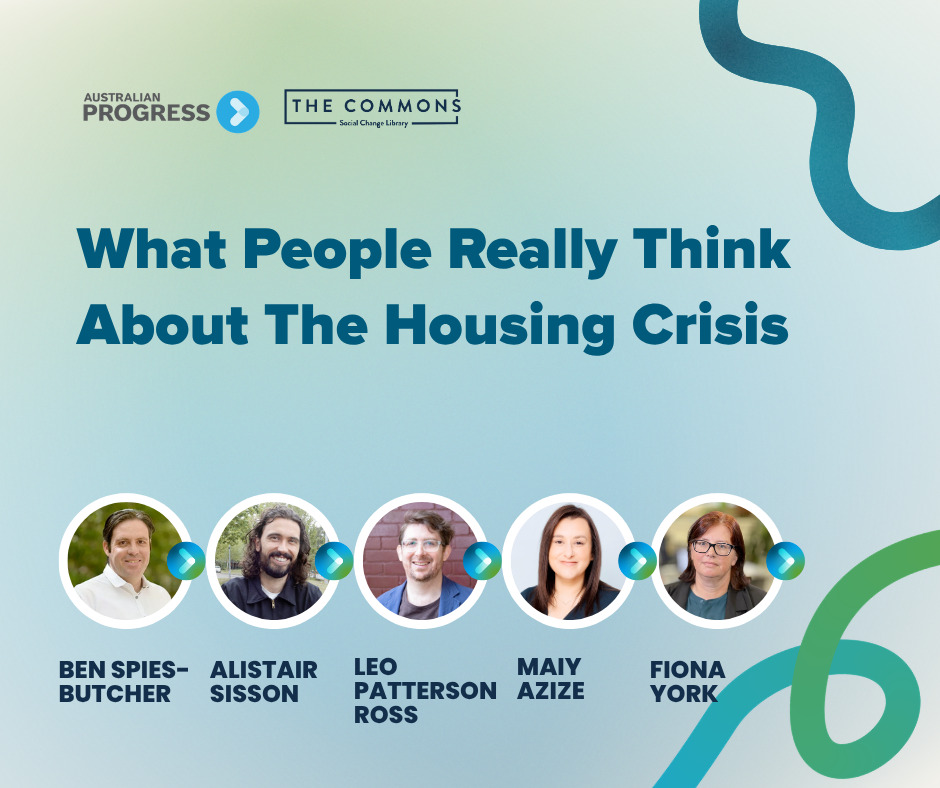
Organised by A/Prof Ben Spies-Butcher, this session began with Dr Alistair Sisson offering an overview of ACES responses from a sample of voters asked about the housing crisis in the lead-up to the 2025 federal election. The three panelists each offered detailed reflections on these findings from their different perspectives: Maiy Azize, as deputy director of Anglicare Australia and national spokesperson for Everybody’s Home, a campaign to fix Australia’s housing crisis; Fiona York, as the executive officer of Housing for the Aged Action Group (HAAG); and Leo Patterson Ross, the CEO of the Tenants’ Union of NSW.
Panelists were asked to reflect on the positives and negatives of key findings, and how these may inform how we navigate the new kind of politics of housing in 2026 and beyond. Following the panelist responses, questions from participants in the session prompted a deeper discussion of these lessons.
The following summary is structured around the lessons I (E.T. Smith, Commons Library reporter) took away as a participant in the session, along with a selection of quotes from the presentation, panelist responses, and discussion. You can also listen to an audio recording of the presentation and panelist reflections shared by 3CR on Raise the Roof (08 April 2026), and read the full report of the ACES finding on Housing and the 2025 Australian Federal Election: Between Crisis and Inertia. Further resources are included for those interested in opportunities to participate in housing justice organising, as well as historical context and additional research.
The Progress 2026 conference was hosted by Australian Progress on March 24-25 at the Melbourne Convention and Exhibition Centre in Narrm/Melbourne. This article was produced by The Commons Library to enable ongoing learning.
Overview of the ACES findings
Presented by Dr Alistair Sisson
An overview of the ACES study module on housing was offered with supporting slides detailing the relevant graphs. This presentation complements earlier publications of these findings in the Conversation and on Pearls and Irritations, and highlighted the following points for further discussion:
- Despite the media focus on mortgage stress due to interest rate rises, renters are feeling the impacts of the crisis most strongly.
- People are experiencing the housing crisis as a cost-of living crisis.
- There is high support across the board for investing in social housing and limiting rent increases.
- There are different views on both the causes and potential solutions by generation, tenure, and voting intentions. There is also an ‘insider-outsider divide’.
What we might be seeing here is a kind of insider outsider divide on housing, as well as the left-right divide on housing… It really seems that the kind of base of both major parties is increasingly people who benefit from, or are comfortable with, status quo housing policies. And, in contrast, minor parties on the left and the right are appealing to people who are perhaps locked out of, or disenchanted with, the housing system or the ‘Australian dream’. – Alister Sisson

Lessons from the ACES findings
Lift people’s expectations of what is possible
The survey results show that people are starting to shift away from treating the prices and rents of houses as something that ‘just happens’, and towards an understanding that it is possible for governments to intervene in the housing market. To build on this shift, we can continue to lift people’s expectations about what it is possible for governments to do in a housing crisis.
There’s a quote that stuck around with me for a long time. And it said ‘people base their satisfaction on what they believe is possible’…. With electricity prices, we saw every single parliament around the country come back from holidays to try and save people a few $100. But they weren’t lifting a finger to stop house prices or rates going up much more quickly, because they thought that the voters thought it wasn’t something that was possible to change, and so they weren’t gonna be dissatisfied if you didn’t change it. I think these results are starting to show that it is no longer holding. – Leo Patterson Ross
I think there’s a lot that’s positive for people who are advocates to work with in the data. You can see that people expect governments to intervene in the housing market… it’s hugely popular across the board. – Maiy Azize
That there was such a big group of respondents who were not satisfied with [the government’s] performance shows us that we have a lot of room to tell different stories about what should be expected, and what is going wrong… It doesn’t have to go to an anti-immigration story, a reactive story. It can go towards a more productive vision of a better housing system, one that works for people.” – Leo Patterson Ross
Act at the point of assumptions
When lifting expectations, it is important to review our assumptions to avoid misdirecting our efforts. For example, a common misconception is that people need to have an education about economics to understand the housing crisis; they don’t. Additionally, this assumption buys into a level of complexity that only benefits people who want to maintain the status quo. Acting at the point of assumptions can also help us to resist the spread of misinformation and disinformation, simplistic models of supply-and-demand that scapegoat immigrants, polarising progressive vs conservative assumptions, and boomer vs. millennial divisions.
People think our job needs to be educating people about capital gains tax or educating them about insurance. We don’t. We just need to tell them what’s really happening, which is that the government is spending billions of dollars lining the pockets of investors to make it more expensive. And when you say that, it’s actually quite rare to find that people disagree with you. – Maiy Azize
That picture is not the boomer versus millennial rhetoric that we hear. We’re seeing a lot of boomers who have missed out and who are really struggling, and we’re seeing millennials who are inheriting housing from their parents. – Fiona York
There were some really horrific stories from migrant workers and really horrific stories from international students. And it would be really good if people could be exposed to that; that they’re being harmed by the same system that everybody else is. – Maiy Azize
Having [international students] talk through the process of why they got to where they were and what decisions they made was very illuminating for people who aren’t exposed to those experiences. [It’s] not just demonstrating the difficulty, but also the thinking behind it…. the promises made about what international students’ experience would be like in Sydney. – Leo Patterson Ross
What also underlies [concerns around immigration] is an acceptance of the really blunt supply demand economics that it’s a really logical step for people who aren’t necessarily coming initially from a racist viewpoint, but they’re coming from buying into a very quantified understanding of the world and economics and how we do things. If you have more people and not more houses, then there’s gonna be a problem. And, you know, it’s not that that’s entirely untrue. It’s that the solution to that isn’t to make other people’s lives more miserable. It’s to… start building what people need. – Leo Patterson Ross
Build connection to find a shared narrative
Rather than focusing on education or accepting the divisive frames of reference, we can be creating opportunities that expose people to their neighbors and other people around them. Not necessarily aiming at a particular issue, but using an issue to bring people together in community.
I’m gonna go down the nostalgia track; postwar migration was also the time we built the most public housing. So we can do it. It has been done. And we now see the benefits of that in a great multicultural community, relatively harmonious and awesome place to live. So, yeah, I think we can lean into the good things about migration. – Fiona York
I don’t think it’s a bad thing for us to capture some of that nostalgia when we campaign on housing and housing security. – Maiy Azize
We can see the connections that people are making from a range of groups sharing their experiences, the struggles that they’re having, and then other people can go away and feel like they want to help make a difference to that. Then when a solution is proposed, their question isn’t ‘why should I pay for it?’ Their question is, ‘well, how can I help?’… What’s growing is the concern for your family, for your friends, for the other people in your community who you also feel are being left behind – Leo Patterson Ross
Share the range of cost-of-living crisis impacts
One way to build a shared narrative is to amplify the ways in which the cost-of-living crisis is impacting us in different yet related ways. While it was never the case that everyone owned a house, far fewer people are now expecting to be able to own their own home outright than previously. While their details differ, people across all ages, tenures, and political positions share the same core need to access affordable housing. For older people the details include a wide spectrum of knock-on health and well-being considerations of precarious housing. Meanwhile, younger renters are increasingly frustrated that the government is not sorting out the cost-of-living problem regardless of whether or not they still aspire to ownership.
The population in Sydney has gone up by 14% in the last twenty years. Housing prices have gone up by 240%. So this is not totally disconnected from immigration, but you can’t just explain that with numbers. [We can] take the numbers out of it and tell the story in a way that lines up with people’s experience of how much more expensive it is to live, in just about every part of this country. – Maiy Azize
There are fewer people owning their own homes. About 42% of older people own their own homes. There’s been a 73% increase in private renters, and there’s been a big increase in the number of older women experiencing homelessness. – Fiona York
People are having to make choices between paying the rent and paying for their medication. And it’s really increasing social isolation. So people can’t go out for a cup of coffee. They can’t buy things for their grandkids, and they’re not able to participate as volunteers – Fiona York
What are we gonna do about this when we’ve got working class people and people who have been artists and musicians and activists who’ve been lifelong private rentals, people that we know are now in their sixties, seventies, and eighties. Really, really, dire straits. – Fiona York
There’s a growing diversity of people who rent their homes, people renting for longer, people renting more likely to be renting even into retirement, but certainly with families with children. – Leo Patterson Ross
Name who is responsible and ask for what we want
This is a crisis of governance that developers and investors benefit from. By building on the shared narrative, we can name who is responsible for creating this housing crisis, as well as those benefiting from it. We can then ask for what we want in ways that allow those responsible to do something about it.
We do see people want more and bolder… re-distributive action… like rent control, high wages, and higher income support payments – Allister Sisson
Our sector, when it talks about the housing crisis, simply says the housing crisis is really bad or it’s getting worse, and that’s why governments need to do x, y, and z…. We need to be a bit bolder about naming who is responsible, why this is happening, and what they need to do. – Maiy Azize
I think at a minimum, we do need to point out that investors are benefiting from the system…. I also wonder if there’s a way to tell the story that allows people who are investing in housing to start to see themselves as part of the solution if they do certain things… as opposed to just naming them as beneficiaries and leaving it at that. – Maiy Azize
[A lot of people] are being led by banks and by friends who tell them that it’s a good idea to invest in property to… save money for retirement and be self-sufficient. We need to increase their agency [and awareness] that the decisions they make in property directly impact the life of someone else. – Leo Patterson Ross
Support a public housing revival
The positives in this data include that people across the board expect governments to intervene in the housing market, with huge support for public and community housing. While this support is highest among older voters, it was supported across all demographics; even by 1 in 3 of people on the populous right. This demonstrates that governments don’t have mandates for particular things just because they have won. We can create opportunities to amplify and mobilise support for public housing by connecting people across demographic divides through their shared experiences in the cost-of-living crisis.
We just need to give more people the option to live in public housing if they want to. And a lot of people said they didn’t believe it’s possible, which is quite baffling because we’ve done it in Australia before… We’ve had homes that were affordable to rent and to buy, and it’s because the government provided those homes. – Maiy Azize
It is worth pointing out that public and social housing is actually more popular among older voters. Perhaps this is a group of people who have more direct or or more immediate experience of public housing being a more significant part of their housing system within their lifetime. – Alister Sisson
When they were growing up, it wasn’t as stigmatized. It wasn’t as ghettoized, and it wasn’t a dirty word. We’re actually allowed to say the words public housing [just like we say] public schools and public parks and public hospitals. – Fiona York
There is really strong support for building public and community housing or basically homes that people can actually afford to live in. – Maiy Azize
About the Speakers

A/Prof Ben Spies-Butcher is Deputy Director of the Macquarie University Housing & Urban Research Centre, Co-Director of the Australian Basic Income Lab, and is co-author of Housing and the 2025 Federal Election. His research explores the political and economic dynamics of social and ecological policy. Alongside his focus on housing, his funded research collaborations include The Climate Economy: Emerging Strategies for Australia (Australian Research Council), and Aboriginal led solutions: strategies for reinvestment (Australian Public Policy Institute). His most recent book, Politics, Inequality and the Australian Welfare State After Liberalisation, shows how our economy is changing and what governments and citizens can do to make it more equal.
Dr Alistair Sisson is a researcher whose work spans housing, planning and urban development. His research has particularly focused on issues in public and private rental housing – issues which he regularly discusses in media and public events as well as academic publications. As a research fellow in the Macquarie University Housing & Urban Research Centre, he has collaborated with the Tenants’ Union of NSW, Action for Public Housing, and Shelter NSW (and sits on the Shelter NSW Members Working Group). His current project examines how politics and policy is being reshaped by the housing crisis.
Maiy Azize is the National Spokesperson for Everybody’s Home, a campaign to fix Australia’s housing crisis. Everybody’s Home is made up of 500 housing, homeless and welfare organisations, and over 43,000 supporters who have come together with a shared vision of ensuring that everybody has a safe, affordable and decent home. Maiy is also the Deputy Director of Anglicare Australia, a network of welfare and caring organisations linked to the Anglican Church. She has authored many reports and studies, including Priced Out for Everybody’s Home and Homes for All: A Roadmap to Affordable Housing for Anglicare Australia.
Leo Patterson Ross (he/him) works to help renters, their advocates and the broader community navigate, understand and transform Australia’s housing system. After more than a decade of experience in community development, individual and systemic advocacy roles Leo became CEO of the Tenants’ Union of NSW in 2020 and continues to provide analysis and commentary that focuses housing debate on making a difference in the real world. He brings together social, economic and legal frameworks and the on-the-ground experience of the 30,000 renters the Tenants’ Union and Tenants Advice and Advocacy Services of NSW work with each year.
Fiona York is the Executive Officer of Housing for the Aged Action Group (HAAG), an organisation dedicated to ensuring older people have safe, affordable, and appropriate housing. With extensive experience advocating for social justice and community rights, Fiona has led HAAG’s efforts to highlight the challenges older people face in the housing system, particularly older women at risk of homelessness. She is a respected voice in housing policy and brings a wealth of knowledge about the practical and systemic changes needed to support older Australians.
Resources
Read the Full Report
Read the full report of the ACES findings on Housing and the 2025 Australian Federal Election: Between Crisis and Inertia.
Listen to the Panelists
Listen to an audio recording of the presentation and panelist reflections shared by 3CR on Raise the Roof (08 April 2026).
Organising Updates & Opportunities
- What is Dwelling Justice? by Raise the Roof on 3CR, 2025
- Save Public Housing Collective (SPHC)
- Standing Together for Public Housing Forum, as reported by the Renters and Housing Unions (RAHU), 2025
- Home at Last Model by Housing for the Aged Action Group (HAAG)
- Homes for All: A Roadmap to Affordable Housing by Anglicare Australia
- Housing Lab – Messaging Guide Resource
- Purple Pingers Guide to Digital Organising for Housing Justice, at FWD+Organise 2024
- Everybody’s Home – Resources Lists
Research Details
- Housing and the 2025 Australian Federal Election: Between Crisis and Inertia: Report from the 2025 Australian Cooperative Election Survey, by Shaun Wilson, Ben Spies-Butcher, Adam Stebbing, Kristian Ruming and Alistair Sisson, 2025
- Breaking Point: A national survey of housing stress, energy hardship and insecurity by Maiy Azize, Everybody’s Home, 2025
- Priced Out: An index of affordable rentals for Australian voters by Maiy Azize, Everybody’s Home, 2025
- Most Australians agree there’s a housing crisis. But they differ on what’s causing it – and how to fix it, by Ben Spies-Butcher, Adam Stebbing, Alistair Sisson, Kristian Ruming, and Shaun Wilson, 2025
- As the home ownership dream fades, Australians may be open to a frank conversation about house prices by Alistair Sisson, Ben Spies-Butcher, Kristian Ruming, Shaun Wilson, and Adam Stebbing, 2025
- Regulating rents: international examples & experience by Alistair Sisson and Penelope Bowyer-Pont, 2023
- There are no silver bullets but they could help make renting fairer by Alistair Sisson and Penelope Bowyer-Pont, 2023
Historical Context
- History of the Housing for the Aged Action Group (HAAG)
- Homeless camps are rising as affordability falls. It’s a problem Australia has solved before, Rachel Gallagher, 2026
- Australian Housing Justice and Unwaged Rights Campaigns, Iain McIntyre, 2020
- Squatting’s Place in Winning Emergency Housing, Iain McIntyre, 2019