
Introduction
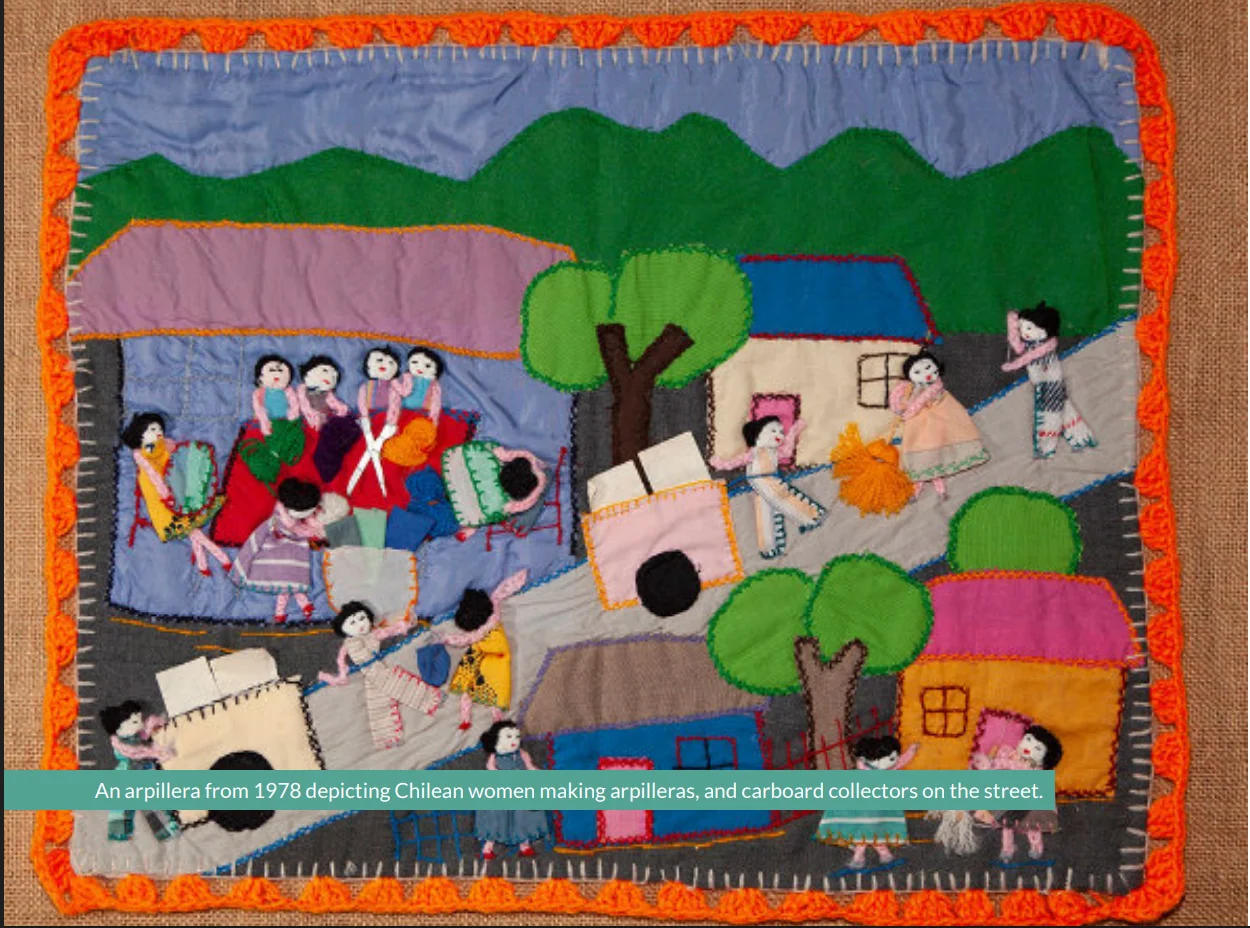
A powerful illustration of how stories can be told in empowering and engaging ways are arpilleras. Arpilleras are three-dimensional, hand-sewn appliquéd tapestries that “tell a story with each stitch”. They originated in Chile as a medium for women, generally working collectively, to denounce the human rights abuses and repression of the Pinochet dictatorship in Chile.
They have since been used to capture the first-person, lived experience of individuals and communities around the world, in response to war and conflict, and a wide range of other forms of oppression and social injustice.
Arpilleras originated in Chile – the families who experienced human right violations or whose family members were “disappeared” often had no way to explain what had happened. This was true in at two sense: literally, in the sense that their stories simply weren’t told or heard; but also, because families didn’t know what had happened to their loved ones there was rarely a conclusion or “ending”, so their experiences didn’t seem to make sense even to themselves – telling their story in such circumstances is very difficult.
In the 1970s a Chilean facilitator and educator called Valentina Bone recognised the power of people telling a story using materials and fabric that everyone had access to in their everyday lives. The products of these workshops – arpilleras – were smuggled out of Chile and sold via the international solidarity movement, becoming an important way of sharing stories from Chile, but also providing much needed income to families who had often lost their primary bread winner. Arpilleras were eventually proscribed in Chile after a Quaker woman was arrested as she left Chile with arpilleras, and was held in detention for several days.
Working in textile rather than words means the arpillerista moved beyond the immediate facts of their story, and quickly begins to explore the meaning within it: “What does it mean to be a mother looking for a son?” “What does it mean to be a son looking for a father?” “What does it mean to have limited access to water?”
In Chile, arpilleras also offered people opportunities to tell stories in times and spaces when they otherwise wouldn’t have been able to – because the political environment was too oppressive of course, but also because of their domestic context (they
could sew when children were asleep, for example).
Arpillera’s continue to be used to tell stories around the world. The workshops where they are created are often gentle, low key events, mixing the practical aspects of making an arpillera with the emotional work involved. Facilitators focus on helping participants to “find a safe space” to “contain” and “absorb” what they have experienced.
The goal – other than producing something powerful and beautiful – is to move participants from thinking of themselves as a victim that makes demands, to becoming active agents who work with others to find solutions to their problems.
Facilitators are not instructors, they simply ask questions – facilitators are themselves an arpillera, interpreting and finding shape.
Arpillera workshops are also very collaborative – limited materials are provided to encourage participants to communicate and decide who will use what material, to help each other, and to discuss their work. Following workshops, people don’t take their product away, it becomes a communal product – the arpillera is owned collectively. Finally very few limits are placed on who can make arpilleras and since their inception in Chile they have been produced and displayed all over the world, from shanty towns to national museums.
Access Resource
This excerpt is from a toolkit Where Peace meets Climate Justice: A Toolkit for Taking Action (pgs 13 – 16) by War Resisters International.
This case study was produced following an interview with Roberta Bacic, Conflict Textiles’ founder and curator. Conflict Textiles is a live collection of 440 documented arpilleras and other textiles, with a digital archive hosted by Ulster University’s Conflict Archive on the INternet (CAIN).
Explore Further
- Arpilleras from Chile in the CAIN digital archive
- Indigenous Storywork website and book
- Threads of conflict – a short documentary about Conflict Textiles and arpilleras
- Stitching History: The Role of Chilean Arpilleras in Social Activism and Culture
- Stitching Resistance: An Educator’s Guide t s Guide to Chilean Arpiller o Chilean Arpilleras
- Creative Activism: Start Here