
Introduction
The Right to Sit campaign in Kerala organized women textile workers around a simple demand—seating at work—and turned their shared grievances into a 2018 legal amendment mandating seats in shops and commercial establishments. The following article discusses their campaign and the need for workers to keep organizing and monitoring conditions to defend protections.
From Individual Struggles to Shared Demands
For many women working in Kerala’s textile shops in India, sitting down was something they had to fight for. They spent long hours on their feet, and some were not even allowed to lean against a wall. Workers reported knee pain and restrictions on toilet breaks. Some avoided drinking water because their shops lacked toilet facilities.
The Right to Sit movement brought these working conditions into public view. Organising centred on Kozhikode, with protests also taking place in Thrissur and Alappuzha. Penkoottu, a women’s collective whose name means “women’s nest”, and the Asanghadita Meghala Thozhilali Union (AMTU), a union for workers in the unorganised sector, helped workers organise. Tailor and activist P. Viji played a leading role. Their immediate demand was simple: employees should have opportunities to sit during work. They also wanted legal protection, so that this basic need would no longer depend on an employer’s goodwill. Employers controlled workplace conditions, while the state government and labour authorities were responsible for legal protection and enforcement.
Their immediate demand was simple: employees should have opportunities to sit during work.
The struggle also exposed gender inequality at work. Anila Backer’s research records how some employers and union representatives treated women’s employment as a way to pass their time. This attitude overlooked both their paid work and the domestic work they did at home. Low wages and dependence on income made it difficult to challenge employers. Viji described established trade unions as having neglected women in the unorganised sector. Penkoottu and AMTU gave them a place to share experiences and develop demands together.
There was also a gap in the law. The Kerala Shops and Commercial Establishments Act, 1960 included labour protections but did not explicitly require seating. According to Viji’s account to Backer, labour officers at a 2014 meeting asked whether any law stated that workers could sit. The organisers asked whether any law prohibited it. The exchange shows why an explicit legal duty mattered: workers’ needs could otherwise be dismissed because the law did not clearly address them.
Making the Demand Visible
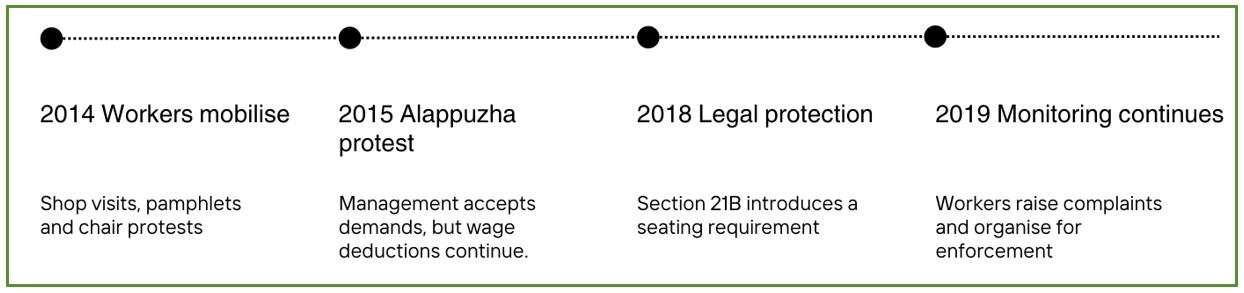
Around 2014, organisers visited shops, distributed pamphlets and held public protests. Conversations between workers helped them recognise that their experiences were shared. Pamphlets explained the demands, while protesters carrying chairs made the issue visible.
The chairs made the demand easy to understand. By carrying an everyday object into the street, protesters drew attention to conditions usually hidden inside shops.
At Kalyan Sarees in Thrissur, social media helped draw attention to a protest overlooked by mainstream media. Supporters shared the workers’ concerns online, and some came to the protest site to show solidarity. This gave the campaign more than visibility: it brought people into the action. But online attention alone could not settle the dispute. Workers and organisers still needed to negotiate with management.
In August 2015, workers at Seema Textiles in Alappuzha protested with support from the trade union CITU. Reporting noted that management accepted their demands, but wage deductions continued. The report does not specify which demands were accepted. In 2016, the National Human Rights Commission (NHRC) requested reports from state authorities about women textile workers’ conditions. Public protests and institutional engagement kept the issue on the agenda; in 2018, Kerala amended the law to require seating.
Less visible communication helped keep that effort going. Backer’s fieldwork records WhatsApp voice messages used in 2019 to invite members to protests and discuss complaints and arrangements. Public posts reached supporters, while internal messages helped members coordinate. Members also needed practical information about when an action would take place and how to take part. Internal communication helped turn concern into organised activity. Its role after the amendment also shows that communication remained part of the campaign as workers continued seeking enforcement.
Dismissive attitudes towards women’s work made their demands harder to win. Dismissals or transfers could threaten workers’ income, making participation risky. Yet workers also had channels for collective action. CITU’s support for the Alappuzha protest showed how an existing union could help workers organise. Labour authorities and the NHRC provided routes for raising complaints beyond individual workplaces. These channels helped bring working conditions under official scrutiny, although scrutiny alone did not ensure that employers changed their practices.
A Legal Victory, an Unfinished Struggle
The movement’s clearest achievement was legal change. The 2018 amendment added Section 21B, requiring shops and commercial establishments to provide suitable seating so employees could use opportunities to sit during work. The provision covered all employees, extending protection beyond the women who led the struggle.
A legal right did not automatically become a right workers could exercise. More than a year after the amendment, Backer recorded Latha being told to stand while working in a warehouse. Organisers continued raising complaints and helped bring about labour inspections. In a 2021 interview reported by ABC News, Viji explained that the union still checked stores and lodged complaints when seating was absent.
Taken together, these gains show real but incomplete social change. The campaign helped turn a basic workplace need into a legal duty. Reports of employers accepting demands suggest some progress, but do not establish lasting improvements in working conditions. Workers still needed support to make employers follow the rule. The sources used here do not show how many workplaces across Kerala complied or how much workers’ health improved.
For organisers elsewhere, this case shows the value of starting with a problem people face every day. A clear demand can bring workers together and help others understand why change is needed. But asking people to speak up also means taking their risks seriously. Organisers should consider how workers can share concerns and take part when public involvement could threaten their income. The case also offers a lesson about planning beyond a policy victory. Campaigns can identify who is responsible for enforcement, help workers understand how to raise complaints, and keep checking workplace conditions. What matters is whether people can use the rights they have won. Keeping affected workers involved helps a movement judge its progress through their experiences, rather than through public attention alone.
Communication for Social Change
This article was submitted to The Commons Library by a student completing Communication for Social Change at the University of Queensland. Explore other case studies from UQ students.
Explore Further
- Chintha Mary Anil. Kerala’s textile store employees are struggling for their rights to sit down or take a leak
- Harsha Raj Gatty and Sarada M. Meet Viji P, Who Fought for Saleswomen’s Right to Sit
- Anila Backer. Challenging Capitalist Patriarchy and Negotiating for Women Worker Rights: Exploring the ‘Right to Sit’ Movement in Kerala
- An account of the movement’s protests, digital organising and continuing efforts to enforce the right to sit.
- Kerala Shops and Commercial Establishments (Amendment) Act, 2018
- Indian shop assistants finally win the right to sit down, after years of standing up
- Penkoottu shook awake Kerala’s consciousness several times
- An interview with P. Viji about her experiences of gender inequality and her work organising women for workplace rights.
- An official statement requesting reports from Kerala authorities on restrictions on sitting and toilet access for women textile workers.
- Organizing: Start Here