
Introduction
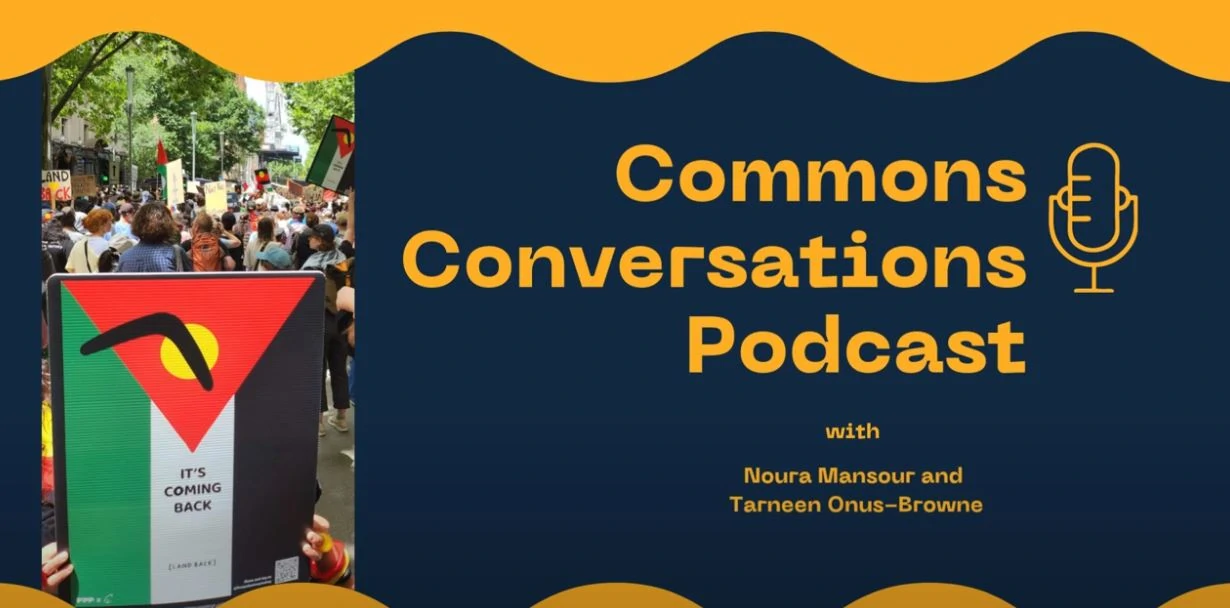
In a conversation held in late 2024 Tarneen Onus Browne and Noura Mansour discuss solidarity between First Nations and Palestinian communities in Australia, highlighting the resilience and strength derived from resistance to shared experiences of genocide and settler colonialism.
Bio
Tarneen Onus-Browne is a proud Gunditjmara, Yorta Yorta person through their mother and Bindal and Meriam person through their father and they live on the unceded land of the Wurundjeri peoples. They are a community organising lead at Australian Progress and a community organiser for Warriors of the Aboriginal Resistance working on Invasion Day, Black Deaths in Custody and Black Lives Matter. Noura Mansour is a Palestinian educator, political analyst, writer, activist and community organizer who is the National Director of Democracy in Colour.
Listen to Podcast
Read Transcript
- Transcript of Interview (HTML- Read below)
- Transcript of Interview (Word Document)
- Transcript of Interview (PDF)
Tarneen
Thank you Noura, for agreeing to do this interview with me. I’m really excited to have a yarn to you about Black and Palestinian solidarity, and I guess, what’s keeping you strong in these moments as well. And it’s been, you know, a really rough 14 months, and I think that it’s good to slow down and have yarns together. And I know that we have yarns together anyway, but it’s nice to put something out in the world as well.
Noura
Thank you for the opportunity Tarneen. I think there’s nothing else that I’d rather be talking about, other than Indigenous solidarity, and especially solidarity between Palestinians and First Nations people on this continent. So it’s a topic that I feel closely, I feel strongly, and I hold close to my heart. So thank you for the opportunity.
Tarneen
Yeah, it’s been over a year since the genocide of Palestinians has been exacerbated. And I say that because we know it didn’t start in October last year. It’s been going on since the first Nakba. And you’ve been doing so much work around this for a long time, but particularly, you know, in the last year as well. And I really want to know what’s given you strength in these moments, and what are you most proud of?
Noura
That’s a great question. We often talk about the workload, and the struggle and the fight and the challenges. And I think it’s important to stop and think about also what gives us power and energy and what inspires us to keep going. Look, the last 14 months have been like nothing I’ve experienced before, nor, I think, anything that any Palestinian, including Nakba survivors have experienced before. I think about my grandparents’ story and their testimonies from the Nakba. And while it mirrors what we’re seeing today, it mirrors all the crimes against humanity in terms of the targeting of civilians, and people in shelters and in tents in refugee camps. The sexual violence is also not something that is new. We know that this is a practice that the Zionist militias have applied since the Nakba, since 1947. And it’s all well documented, mind you, documented by Palestinian and even Zionist historians such as Benny Morris, who talks about using rape and sexual violence as a tool of genocide as well. So it’s been horrible having to see the testimonies of my grandparents happening again in 2024, 2023.
And definitely happening with more intensity, more advanced, more technologically advanced, and, you know, quote, unquote, as some European Western leaders would call Israeli practices, “creative,” when they describe the whole pager attack on Lebanese civilians as well. So yes, it’s exacerbated, it’s more brutal, it’s cruel and it’s more destructive, but still enjoys the same impunity that it has enjoyed since 1947. Imagine it’s taken 14 months for the ICC to issue arrests, despite all the evidence that we have, all the documentation of war crimes that are happening every day in Gaza and the West Bank. It’s taken 14 months for the ICC to issue warrants against Benjamin Netanyahu, and Yoav Gallant. So I think, yes, this genocide is not new to Palestinians, but also genocide as a notion is not new to First Nations people or Indigenous people around the world.
And that’s why I think you asked me a question like: What keeps me going? What gives me strength? And I think it’s the strength and the resilience of people who have lived experience. And that’s why when we talk about solidarity, why it’s such a no brainer for me. You know, when I first landed on this continent 10 years ago, it was a no brainer for a Palestinian who lived under occupation, who was born and grew up under occupation, and had that lived experience of what these power structures do to Indigenous people. We talk about the ongoing nature of the Nakba or the genocide here as well, and how it manifests in different ways. So when you’ve lived that, of course it’s a no brainer that you’re going to go and stand in solidarity with people who have gone through the same experience. And it’s not even a decision sometimes that you make rationally. You know, it’s like, of course, yes, these are my people, and this cause is my cause, and I will always stand with people who have lived experience with settler colonialism, with racism, with oppression. I’m mentioning this because this also is a source of strength for me – the resilience, but also the creativity in which Indigenous people globally, but also on this continent more specifically, have managed to redefine the struggle, to reframe the struggle, to emphasize what their cause is about. I mean, you know, 250+ years on, and we’re still talking about Landback, and we’re still talking about sovereignty and self determination and what it means.
And that’s inspiring for me as a Palestinian who’s – mind you, the occupation in Israel is younger. The settler colonial project is younger, compared to Australia. But I think currently we’re seeing it at its worst manifestation. So I think that’s inspiring for me to see that, yes, we can carry our struggles and our values, and we will keep passing on these values and traditions and cultures and languages that we hold so dear, and truth. So that’s inspiring.
Tarneen
Yeah, 100%. Thank you. It really makes me also think about Dr Crystal McKinnon on a panel last year, she said that settler colonies learn violence from each other, but indigenous people learn the fight and the strength from each other. And the way that we build up solidarity around that and learn how to fight for a better world together is really beautiful. Just really made me think about that.
Noura
Yeah, I’m a big fan of Dr Crystal McKinnon, and absolutely endorse everything that you just quoted. Settler colonial states actually rally in support of each other. We’ve seen that most recently, with the Foreign Minister and the current Australian Government standing… 20,000 Palestinians were killed, and then the government was still saying in December last year, in 2023, the government was still saying, “Israel has the right to defend itself.” So there was that whole solidarity on full display, where settler colonial projects jump in to support and defend each other, definitely from actions, but also from impunity, it’s just providing full impunity and sheltering them from any accountability.
So we see that, we know that this is what they do, and that’s all the more reasons why we as Indigenous, as a movement for freedom and justice and equality for all, we need to stick together as well, for us to balance. And when you think about who we’re up against, the most powerful power structures globally, and it’s not just settler colonials, but even oppressive regimes around the world. So us, you know, the movement for, and that’s how I define the movement for Palestine; is the movement for freedom, justice, equality, self determination for all. And that’s all the more reason why we need to stand in solidarity with each other. But also, it’s not that I’m standing in solidarity with a different cause. It’s the same cause by the end of the day. So same values, same shared future, same shared values.
Tarneen
That’s so true. Like the Indigenous movements, yeah, it is the same movement. Landback now.
Noura
Yeah, absolutely, absolutely.
Tarneen
So the next question I wanted to ask you was, I was really proud of the Melbourne Invasion Day, where so many people from your community came out in the streets in solidarity with blackfellas. Did you know that people traveled from interstate to come, because of the blackfella and Palestinian solidarity element of invasion day? And also I know heaps of blackfellas that have traveled interstate to come to a Free Palestine rally in Melbourne as well. Something about Wurundjeri Country and the Wurundjeri Country that fosters so much movement building is really special. What do you think and how do you feel?
Noura
I’m also extremely proud of that partnership that kind of took shape in that joint rally to commemorate Invasion Day and the genocide that occurred on this continent. But also, it just made sense that as this genocide is happening, we also connect to our local context and commemorate the genocide that has happened and continue to manifest in different ways. So I think it was quite heartwarming to see the community show up. I’m very proud of the Palestinian community who came from different parts of the state to stand in solidarity and to emphasize that this date is significant, and to understand why it’s significant for First Nations people here. But also it was a moment of realization that it clicked, right? It clicked for so many people, who is the parallel of the First Nations, and how the settler colonial project operates here versus in Israel, for many people, maybe the parallels and the links were not very visible before and were not very clear, but on that day, it was right in front of you. It’s just right in your face. And people can no longer pretend. There was no room for vagueness anymore.
So of course, yes, Invasion Day, Palestinian community will be there, because it’s the Nakba Day for us, it’s the equivalent of Nakba Day. And what does that mean in terms of standing in solidarity as a movement and linking all these dots together? So I’m very proud of all the Palestinian community who showed up. I’m also very proud of all the work that First Nations people have done, in being so generous in sharing that space and sharing as well that date. Because that date is extremely significant. I know what it’s like, right? I mean, we know what’s every Nakba. We know how we feel, we feel it, and we know what it’s like to reflect on the losses. We know what it’s like to reflect on the violence that occurred, and we know what it’s like to reflect on the injustice that continues to happen. So it’s not an easy day for First Nations here. And that embrace that we were given by organizers such as yourself Tarneen, thank you so much.
And I remember those conversations that you and I were having in the lead up to Invasion Day in terms of, how can we, I guess, for lack of a better word, give it the weight and the value and the manifestation that it deserves? So I’m very grateful for you and for your mob, for embracing us, for giving us space and for sharing that very significant day, which is extremely painful and crucial. And you know, you just want to sit and reflect on your own pain. But so generously, you also brought us in, and you’ve allowed heaps of space as well for Palestinians to express their grief and their pain, and that was done so beautifully together. And I think that this is how solidarity looks like.
Tarneen
Yeah, I think that there’s so many things that go into it, right? It was the conversations, the back and forth conversations we were having, like, does the Sunday rally go ahead? Does it not go ahead? What does that look like, you know, all of these yarns that were happening behind the scenes that rely on solidarity as well, to negotiate and to be just being honest, but being caring and loving to each other in the movement and trying to figure out, like, what should we do? You know? And I think that was a really beautiful moment that we got to have together as organizers and figuring out what do we need to do, and what’s best for right now, and how do we show respect to each other? Like, “oh, you know, I don’t want to ask you to cancel a Sunday Rally,” then you guys were like, “no, I think we have to!” Just, like, the back and forth. And while I was like, Oh God, I don’t remember having chatted to the invasion day crew, in WAR, and I was like, “I don’t know.” And we arrived at the point where you guys weren’t gonna have the rally, and redirected people to the Invasion Day rally.
And I remember being at Flinders Street Station, and I was bawling my eyes out, because there were drummers, and so many people, and every speech that was made by blackfella included Palestinian people, and the solidarity we have, without even being prompted, you know? So yeah, the work that we did together to make that happen, I think, was really beautiful. And I think because of misinformation, disinformation, and the state of affairs of Black leadership right now, lots of, you know, well not lots, but a few First Nations leaders were talking about standing in solidarity with Israel. And this was a moment where there were so many blackfellas out and were just like, “No, we don’t. We’re here with Palestinians.” And I guess we had to prove that we as a community, particularly here in Melbourne, have solidarity with Palestinians, and there find justice.
Noura
Just reflecting on those conversations from our end, and I think it’s unique to Wurundjeri Country, I must agree with you. It was a no-brainer for us that, of course, we’re not gonna hold the Sunday rally on the weekend of Invasion Day. There’s no point, you know. Like, why would you have two rallies for the same cause? Does that make sense? Like this is Invasion Day, commemorating a significant event in history, which relates to what’s happening at the moment as well. So how do we then make the best of this? And this is an opportunity once again. You know, we talk about solidarity. How do we practice solidarity? How do we practice what we preach? That was an opportunity to do that. So from our end, it was a no brainer. Of course there’s no need for a Sunday rally, because on Friday or Saturday, or, you know, whatever day we would decide, we would be still protesting settler colonialism and genocide and with our First Nations siblings, brothers and sisters. So I do think it’s special, Wurundjeri Country is special in that respect.
Tarneen
100%. There’s something about it that makes us all like, have a bit more fire.
Noura
There was another point that also you mentioned that I would like to touch on, which is that, you know, that there’s some blackfella plus Israel solidarity, and that’s also something to me that’s a byproduct of settler colonialism. And we have some similar things going on as well in the Palestinian community, where they think, “Oh, you know, what is being Australian, and how do I be a good Australian, and how do I fit in?” Specifically, if you think about people with refugee backgrounds, whom have you know, their homes or states or countries or whatever you want to call it, have been literally destroyed, and they can’t return, and they think that the best way for them to localize is to actually assimilate in the settler colonial project. And this is where our work is valuable, I think. I think we shouldn’t give up on these people, because by the end of the day, they are part of our community, and they are also victims of settler colonialism.
So what’s going on, that dynamic, you know, we talk about how there’s different ways in which people under occupation or oppression resist or try to survive. So there’s the logic of resistance or pushing back. And some people just think maybe the logic of survival is just to assimilate. So I think that’s where, once again, we have a lot to do. And how do we bring our people, because they’re still our people by the end of the day, how do we keep talking to them and bringing them on, and explaining actually, that there is a better way for you to be in alignment, you know, to live on stolen land and support, and show solidarity with First Nations people, and still be in alignment with your own values as well.
Tarneen
Yeah, for sure. And it goes the same with people in my community that say that they support Israel, right? I think a lot of in our community lies a lot with religion and Christianity, the people that do support Israel. And it’s very much connected to that, and it’s hard, like, I’ve had hard conversations with one of my family members even, to be like, “Hey, you know that Palestinians are Indigenous, right?” And unpacking that and having tough conversations with people that I love and care about, to bring them to a point where they’re just like, “Oh, wait, we are the same, and we’re all fighting for justice and landback and freedom and liberation from settler colonialism.”
And to align those values and that thinking, really, like, with one of my family members, brought them along. And it was really rough one, because it’s been conversations I’d been having with this one family member for a long time, probably since like 2016, or 17, I reckon. And it wasn’t till in the last year that I was like, “Hey, now’s your time, like you need to wake up to yourself.” It was frustrating. But I was like, “Hey, this is what’s happening. You’re really going to stand on this side of history in this moment?” And it is, you know, those hard conversations that we have to have with our community members. And what that does as well for us as organizers and campaigners, it makes us think critically about the way that we communicate with our community and bring people across the line. But also how to share knowledge and build on the values that these people, our community members, already have, and to be like, “Hey, I know this is not what your values are, but who you’re supporting is telling me that a different story, but I don’t believe that’s who you really are.” Even though I don’t have that much patience with everybody, I have to admit.
But it does tighten the tools for us as organizers and campaigners, when we come up against our community members who are supporting things that you don’t believe are in their values, right? And it makes us better communicators. And because we are relying on trying to get a message across to people that sits with them and changes their minds, so that they can take action, and when we do that, it’s like, wow, who else can we bring along with us? Like, who else can we bring on this journey of, you know, fighting for freedom and justice? It’s bloody hard, but I think it’s one of the best things that you can do as an organizer and campaigner, when there are those shared values in the Indigenous fight for freedom.
Noura
There’s so much good stuff in all the things that you just mentioned, but probably most importantly, that relates to the whole point that you made at the very beginning in terms of misinformation and disinformation, right? And how that, for instance, in this specific case, Zionism has managed to position itself as progressive, but also it doesn’t even shy from using religion, as well, to claim the land that you know obviously does not belong to the Zionists. So Zionism uses whatever tool that exists so that it can justify the land theft. And in that respect, so you know, they obviously use religion, they use Judaism, but even Christianity as well. And that’s a good point as well to make, I think right now. That you don’t have to be Jewish to be Zionist. You can be, obviously, evangelical Christians are extremely Zionist. And if you think about now, with some of the Abraham Accords, the normalization deals that we have UAE, for instance, which is a Muslim country, so you can also be a Muslim Zionist in that respect. Because Zionism is an ideology, and it’s not a religion. It’s a political ideology. So it can be actually endorsed by Jewish, Christians, Muslims, you know, Hindus as well. When you have nationalist movements as well.
So I think that’s an important point to make, that whole misinformation and disinformation exists. And then in terms of all these ideas that they have about Indigenous folks as well, and what Indigenous people do and what they don’t, what they have the right to do, and what fights they are entitled to undertake, and what fights, you know, so all of that stuff. And then we internalize it, right? Which is also a byproduct of settler colonialism. We, some of us, internalize these ideas and biases. And then we think, “Yeah, right, that makes sense. Palestinians are, you know, this and that. First Nations people are, you know.” There’s all these stereotypes that exist, and then I think that’s where absolutely, I think it’s important then, our role in terms of speaking and communicating and raising awareness and connecting and bringing people together, and doing that kind of work within our communities.
And also building on the knowledge that exists, which is something that you mentioned, we don’t have to reinvent the wheel. It’s not that we have some kind of magical solutions, and then there’s people before us who have been doing this kind of work. How do we build on what they’ve achieved and take it, you know, from one success to another? So I think we could potentially, as organizers, be learning. I mean, for me, everything is constant learning, and that’s something that we need to do. How do we build on the success and the work that those who were here before us have done? How do we respect that and give it credit as well, and learn from it, and then keep building on it? And how do we, yeah, get out of the bubble? Like, you know, I love the bubble. It’s so comfy, right?
Tarneen
I could float around in it all day.
Noura
Right? But by the end of the day, what is our impact? If that’s our territory that we operate within, what kind of impact, what value are we adding to these very important causes that we have? And it’s a cause that is just, right? It’s a just cause. Both causes. I can talk about, eventually they’re kind of the same. We’re saying that it’s about the rights of Indigenous people to live peacefully, freely, equally on their lands, right? How do we protect Indigenous existence, be it here on this continent or in Palestine, how do we protect it? And how do we allow for those in the specific context of Palestine who want to return? How do we allow for the return, you know? How do we protect Indigenous existence, and how do we ensure its continuity and access to the land, to their land, to their ancestral land?
And to do that, I think we do need to speak to, you know, yes, those family members who are not exactly, they haven’t had the privilege of, you know, meeting Tarneen, maybe, and working closely with Tarneen. So, you know, they lived a different life, and they went to different schools, or, you know, different – who knows, right? So we have to give people the benefit of the doubt, and we need to constantly be having these conversations.
Tarneen
Yeah, and even when someone said to me, like, “Why is Palestinian and blackfella solidarity a thing, how are we even connected?” And I was like, “Mate. Like, really? Okay, cool. Let me, you know…” and I think particularly in the beginning when there were lots of questions, from the media and people in the public that were just like, “What does this mean, and why does it matter to you?” And I remember, there was an inquest into the death of Joshua Kerr here in Victoria. And he died in Port Phillip Prison, and it’s a private prison, and it’s operated by the same company that would manage Palestinians getting in and out of Israel and into Gaza. They’re so interconnected and they’re so dangerous.
And Josh wasn’t the only one who passed away at that prison, lots of blackfellas have passed away in those private prisons. Well not passed away, you know, murdered or killed. And it just blows my mind that people think, “Oh, they’re not connected at all,” when we have their companies operating here that have imprisoned Palestinians in Palestine. And this is where so much of their technology is used: on blackfellas here. The same companies making money off it, and these big corporations that continue to harm us as blackfellas, harm Palestinians in Palestine as well. And it just grinds my gears that people don’t think about it and like, don’t think about the amount of investment, and think that there’s a separation. But Israel is also causing harm to First Nations people here, and benefiting from that. You know, this is how settler colonial states are in solidarity with each other.
Noura
It’s not just the political solidarity that they give each other, you know, like internationally, right? It’s also actual tools, and exchange of expertise, and trainings and military tech and whatnot. The thing is that people don’t know. And this kind of information is not made publicly available for people. And even when you try and you want to, like for instance, dig deeper, it’s not easy to access this kind of information, it’s well kept under the radar. So I think there’s an element of just unearthing all this evidence and making it again visible and for people to access. But yeah, I agree with you. It’s pretty much the same ideology and the same, you know, strategy and the same tactics and the same tools that they use.
Tarneen
For sure. One thing I will just jump in and say the funniest thing was being there with Nasser Mashni, and I carry masking tape with me in my backpack in case I need to, like, label something, in case I need to stick something up, like, whatever, I carry it around in my backpack. And at this point in time, I was carrying masking tape in my backpack to label things. Anyway, we were at the coronial inquest here in Victoria, and the security part is managed by G4S. And they took my masking tape and they confiscated it, and they put it in this little clear snap lock bag or whatever. And I remember unpacking it, and it had ‘G4S’ on the bag, and I held it up, and I was like, “Oh my god, this is hilarious. Worried about sticky tape, these guys?” And we’re just all eating together, me, Nasser, April, and my mum actually, and we’re all laughing together, because can you imagine these guys? “Oh, wow, this person has sticky tape, but like we’re out here…”
Noura
You’re gonna stick stickers on them until they just, you know, stop breathing. Look everything and anything we do as Indigenous people is vilified, is perceived as a threat, like the example that you just gave, it’s tape, right? But anything that we do is going to be perceived. Because, this is again going back to the whole fundamental, I guess, not values, because I don’t think settler colonialism has values, but I think, to the core guiding principle of settler colonialism, which is the logic of extermination, right? So they really want to exterminate us. They’re not joking. They’re waging a war on the entirety of our existence. The fact that we exist and we carry tape in our bags is perceived as a threat. The fact that we just breathe is a threat to them. Because they are very exclusionary. It’s a very exclusionary project, and it cannot coexist. Actually, as much as they would like to say, “Oh, let’s coexist,” they can’t coexist with others. So they have to annihilate and exterminate.
Tarneen
Absolutely. And I think we have to remember that in everything that we do, we have to remember that the threat is always there. Even though we are here, that, it’s always there. Fourth question, who has been your favorite Palestinian speaker or blackfella speaker who’s moved you in the last 14 months, or ever really?
Noura
Wow, I mean, it’s really hard to choose just one. Every time I listen to speeches made by mob or by First Nations Indigenous people during the Sunday rally, I am moved to tears. I can’t believe. I feel like, “Oh my God.” The generosity, and the support, I don’t take that for granted. I don’t take that for granted, especially coming from people who have lived experience. Because I know what it does to you, and I know that sometimes it’s really hard to show up for your own cause, for yourself, for your own community, let alone showing up for others, you know, quote, unquote, ‘others’. So I really don’t take that for granted.
And look, every speaker brings a different perspective, right? There hasn’t been two speeches that were the same. And even sometimes people who speak in, you know, in different rallies, they don’t say the same thing. It’s always different. There’s so much nuance, and there’s so much diversity in every speech that I literally enjoy and I’m moved by every speaker, Palestinian or, First Nations, Indigenous.
I think what moves me the most is that diversity and the fact that we are still showing up for each other, 14 months on. I mean, mind you, we’re all tired, exhausted and drained. But again, going back to that very first thing that you mentioned, that first question of what gives me power and what inspires, is this. That we’re still doing this, and we’re still showing up and upholding our moral duties as humans to speak up against these atrocities and say that, no, there’s not going to be business as usual.
Tarneen
For sure. I just think as well, I’m super surprised, but also not surprised that people are not saying the same thing. You know, I’m genuinely surprised, because it’s hard work, if it’s the same person writing lots of different speeches. And it just tells you that people care so much about this cause, but also about the words and the values behind that, and how to bring people together. It’s really beautiful, because for people that don’t know, politicians go around and like, have the same speech and do it like 10 times.
Noura
Yes, that’s so uninspiring. It’s boring. But maybe, you know what, if I had to choose and pick one person, obviously, Professor Gary Foley, Uncle Gary. Every time. I mean, I remember the first couple of months, where we’re still in shock, imagine, you know. We were still in disbelief, and at the political level, they were saying, “Israel has the right to defend itself. Israel has the right to defend itself.” And it’s targeting hospitals and babies in incubators. And then every time Uncle Gary spoke, he spoke to that pointâ¦
Tarneen
I love him, and part of that question was to bring out Professor Foley, because he does move so many people. His speeches, every time move me with his intelligence, his care for the world and his bravery. He’s just incredible. And I remember at the Nakba rally in October, I said to him, “I am tired and I’m burnt out.” He was just like, “What the fuck are you burnt out for? You’re only 30 something years old. I’m only starting to be burnt out now.” And I was like, “Well, things were different back then, all right? People used to write letters to each other…”
Noura
Oh, this is gold!
Tarneen
“Now people can just call you whenever and talk to you whenever,” and he was just like, “Yeah, whatever.” I just thought, oh, my God, this is so funny, I’m getting ripped by him. Kind of need to wake up to myself. But just, he’s got so much energy, and he’s got so much fight and it’s in every part of his body work, I just can’t get over it.
Noura
And someone like him, right? I mean, we’re like, “Oh, we’re tired and burn out.” He’s like, “What?” He’s still there, you know, on the platform every Sunday, giving these stellar speeches, right, and inspiring people. So definitely an inspirational figure, and so much knowledge and so much expertise and so much to learn from. And I mean, absolutely, I think, look for me, it’s just been amazing that the leadership as well is there. You know, it’s not just the young organizers and activists, but also, the leadership is there.
Because we have a leadership crisis, you know, as Palestinians, we don’t have leadership. And mind you, I mean, Israel as a settler colonial project, also played a part in this to ensure that we don’t have proper leadership, but also to weaken the leadership that we have. And for me, seeing Uncle Gary saying these words, because we’re politically orphans, you know. And then suddenly there’s this amazing guy with, you know, history, Professor, Uncle Gary Foley there, and he is talking about my cause. And I’m like, “Oh God,” tears. Like I couldn’t hold my tears. I felt held, you know, I felt like someone has our backs. Which, like, no Palestinians feel that they have that kind of support from leadership.
Tarneen
Although, I’ve just learned a lot, as well. I think that people listening will be thinking, “Oh yeah.” It’s really difficult to find leadership in our communities. And I think particularly when there’s been so many things stripped away, and also the displacement for Palestinians, and even though blackfellas have experienced displacement, it’s not moving continents. You know? So in that way, it’s like, different but the same. And I feel like we have a huge leadership issue as well. And there are obviously leaders. But I think there’s not many like Gary Foley where you can be like, Oh, he gets it. And, you know, down to the blood and bones of who we are, he gets it.
And there’s something really beautiful and powerful about that, I think, particularly for men, right? Like there is this beauty of him, and black men being, I don’t know, there’s not many black men in the movement anymore, but having Professor Foley around and seeing him doing the work that he does is really moving. And the way that he backs black women and Palestinian women is really moving as well, he sees the strength of what we do. And it’s weird, like, it’s not that I want to be seen by men, right? But being seen by an elder who’s been here and done it all before, is really beautiful. And I really appreciate him and the way he makes us feel held and seen.
Noura
Absolutely. And that legacy. I’m thinking, how do we protect his legacy as well? And you know, the way that he conducts his advocacy or activism, or whatever we want to call it, how he fights for his cause. How do we protect that and mainstream it? How do we create more Gary Foleys? I mean, our Gary Foleys are in prison. You know, if I think about the equivalent of Gary Foleys in the Palestinian context, they’re in prison. Or sadly martyred, you know, have been assassinated. So how do we, again?
Because how important and valuable it is to have someone like Uncle Gary leading and creating space and empowering, making people like myself feel that they’re seen. And something that you mentioned as well, and again to that point, it’s not that I want to be seen by men, but it’s what kind of men. You know, it’s an elder, it’s a leader, and it’s someone who has been there, has done it, and yeah, so much to think about.
Tarneen
Yeah, that was a nice ending with Professor Foley. And thanks everyone for tuning in. And thank you Noura for joining me in conversation.
Noura
It’s always a pleasure Tarneen. I can’t wait for our next yarn.
Explore Further
- Palestine Solidarity Conference Resources
- Four Roles in Palestine Solidarity Activism
- Protest Camps: Tips for Set-Up and Strategy
- Palestine 101: Videos, Factsheets, Books & More
- 3 Key Insights for Building a Powerful and Loving Movement against Oppression in Palestine-Israel
- Defiance Creates Hope Zine: Grassroots Action for a Free Palestine
- Board Members, We Need to Talk About Palestine
- New to Activism, Organising and Campaigning? Start Here
- Commons Conversations Podcast