
Introduction
GOLD is the Global Organising and Leadership Development programme, created by MOVE, the Global Social Movement Centre. The courses are based on the concept of the Movement Cycle that looks at the rise and fall of a social movement’s power over time. It is used to understand how social movements emerge, grow, peak, decline, and sometimes resurge and the patterns that occur in those moments. By exploring these trends, movements can better assess what obstacles they will face in the moment and the future, design strategies that will build people power and develop the skills needed now.
GOLD is an online learning and support programme for young activists engaged in social movements, youth groups or informal networks. It’s 100% free, can be taken any time, anywhere and from any device.
Access Courses
You will need to Sign up and Login to access courses. Watch the The Gold Journey video for an introduction to the courses and then How to Navigate and learn how to navigate your dashboard, enrol in courses, access content and get support.
Courses
Entry
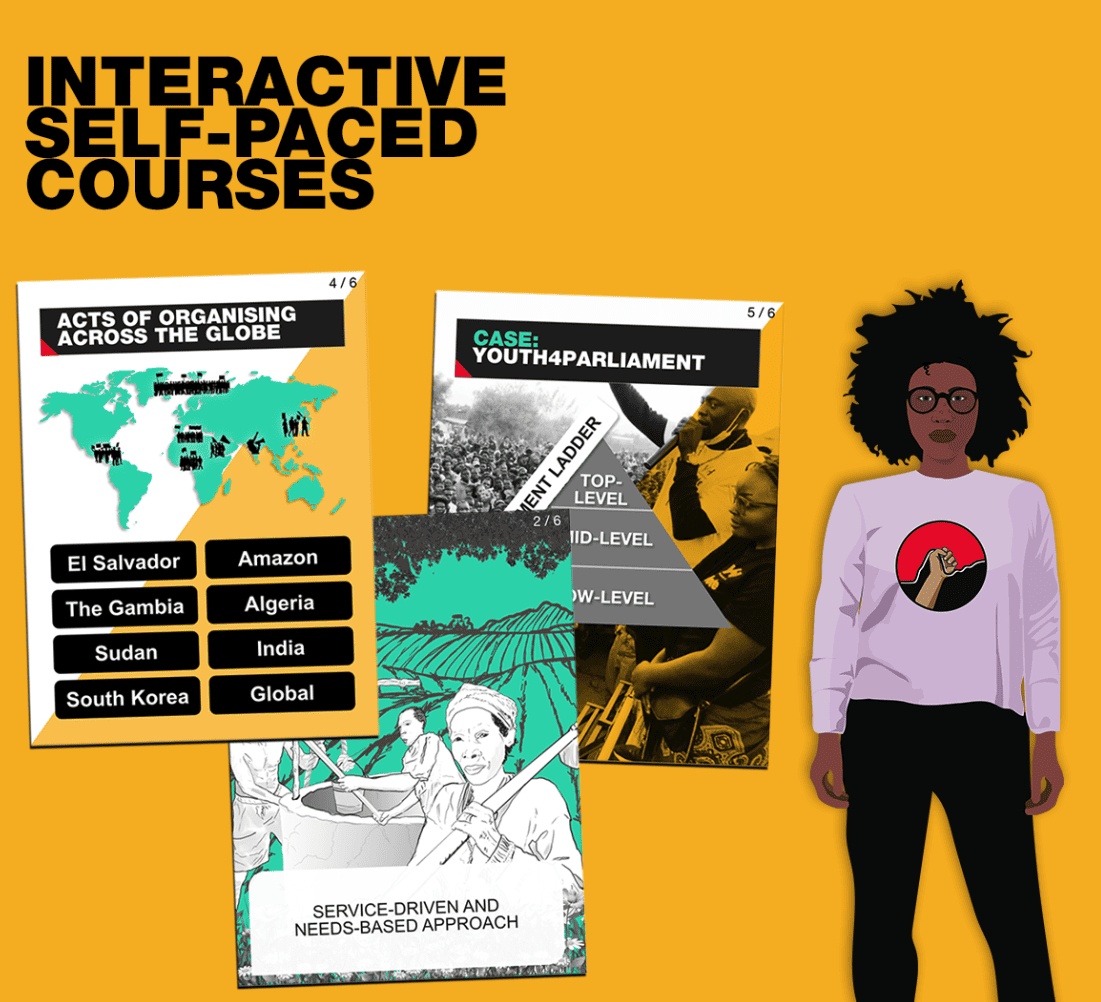
The Entry stage is your first stop on your GOLD journey. In this stage there are six 10-15 minute long courses on the foundations of organising, distributed leadership, social movements, forms of power, collaboration between NGOs and movements, and the concept of the Movement Cycle.
Before diving into tools, tactics and strategy, the Entry courses explore the basics to create a common language around organising and why it is so important. The Entry courses are available in English, Spanish, French, Arabic and Ukrainian.
See the full list of courses below:
Why Organising? – Explore why organising is needed now and be introduced to examples where people organised and brought about change.
What is Organising? – Explore what organising actually is, a possible definition of a social movement, learn some basic principles of organising and the importance of people power in organising efforts and movements.
Organising vs Mobilising – Reflect on the concepts of organising and mobilising. Explore how they work in practice, how they can be effective and when to choose one approach over the other or a combination of the two.
NGOs and Social Movements – Identify the potential benefit of social movements and formal NGOs working together and combining their strengths.
The Movement Cycle – Explore the Movement Cycle, to better understand the various phases a social movement goes through over time and the common characteristics of those phases.
Story of a Social Movement – Go through a framework that helps with understanding movements at different stages of their life cycle. It is told through a fictional story about a young woman who joins a movement in her local community and experiences the different phases the movement goes through over time.
Take a peak at parts of the Entry course:


Growth
The Growth courses are designed around the specific phases of the Movement Cycle. This is an introductory course where you try to assess your needs as a group by identifying the phase in the movement cycle where you believe your movement to be. The learning content highlights tools and tactics, as well as cases from around the world, scenarios where you can reflect on what actions to take, quizzes and assignments.
A course is made up of several modules and it only takes a few hours to go through the self-paced content. The modules are available separately as well, making it possible for you to design your own learning path based on your needs.
See the full list of courses below:
See the full list of modules below:
- Action Design
- Building Relationships
- Celebrating Victories
- Communication
- Conflict Resolution
- Distributed Leadership
- Dreaming Big
- Formulating Grievances
- Healing and Building Resilience
- Leadership and Handover
- Movement Culture
- Negotiation
- Nonviolent Discipline
- Plans, Goals and Alliances
- Power: Pillars of Power
- Power: Spectrum of Allies
- Reflection
- Security
- Storytelling
- Strategic Campaign Planning
- Strategic Thinking
- Supporter Journey
- Tools for Resolving Conflicts
- Trigger Events
GOLD also offers these modules for trainers in the form of presentations, along with slide notes, suggested exercises, activities and additional resources.
Take a peak at parts from the Growth course:


Momentum
The Momentum stage of GOLD is open for all organisers, leaders and activists from movements across the globe. Momentum is an attempt at creating a network of movement leaders, experts and trainers to learn from each other, get more into depth on a specific theme for instance and, share challenges, ask questions and get inspired. GOLD hosts webinars and masterclasses focused on subjects such as Feminist Leadership, Campaign planning, Security, Climate Justice, amongst many other themes.
As part of Momentum, there is also the On The Move newsletter. Each edition spotlights emerging movements and moments, exploring how organisers are reshaping power in the streets, online, and inside institutions.Drawing on a case in the real-world, they explore lessons, strategic tools, cultural resistance, and practices of care—designed to help movements not just rise, but endure and succeed. A webinar or masterclass is connected to each issue where you can learn from experts and frontline activists.
Sign up to the On the Move newsletter.
Watch past On the Move Masterclasses on YouTube.
Transformation Stage
The Transformation stage offers the highest level of individualised support for groups including:
- Connecting people, movements and causes through physical events such as the annual Global People Power Forum (85+ practitioners and thought leaders) and safe online spaces to share skills, strategies and experiences on how to most effectively make change through a social movement.
- Flexible funding for small scale actions when opportunities arise (‘direct action’ fund) or when context demand it (‘rapid response’ fund for individual activists in danger).
- Strategic funding to build internal structures, recruitment and retention plans, and ne tune the long-term strategies of the movement.
- Action-research with practitioners and movement minded scholars and institutions, for example on how to measure and resist nuanced ways of repression or how to mobilise and support diaspora communities.
- Curating and sharing lessons and insights and engage people in it through stories that inspire shared via blogs, webinars and short publications
- Organising and leadership development through mentorship or capacity programs on how to build sustainable movements and employ campaign tactics including crafting messaging strategies, planning protests and engaging power holders in dialogue.
- Advocacy and solidarity actions to support social movements by adding attention, legitimacy and international pressure for their cause and to condemn crackdowns they may face.
Explore Further
- More online courses by ActionAid
- Introduction to Campaigning and Social Movements (Online Courses), 350.org
- Digital Campaigning and Online Organising Courses with Social Movement Technologies
- 7 online MOOCs about Social Change and Activism
- The Movement Cycle Methodology, Beautiful Trouble Toolbox
- Democracy Resource Hub
- Organising: Start Here