

Introduction
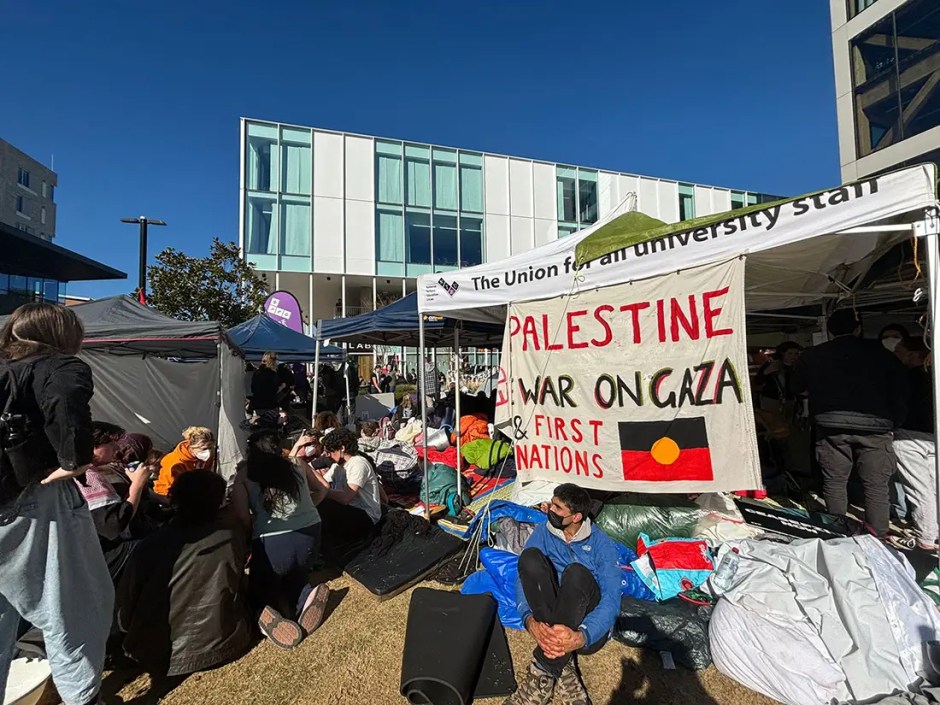
In 2024 a 110 day Gaza Solidarity Encampment took place at the Australian National University on Ngambri and Ngunnawal Land (Canberra). Demos Journal is a volunteer-run progressive publication for emerging writers based on this land. A themed issue was published in late 2025 which focused on the experiences of those involved in the encampment and the issues it addressed. Two excerpts can be found below as well as the table of contents and a link to a PDF of the publication.

Editorial
This issue serves as an archive of the 110 days that students at the Australian National University spent at the Gaza Solidarity Encampment. It has been developed to mark a decisive moment in the history of social movements at ANU and, indeed, in the whole of so-called australia, and to bear witness to what took place, despite ongoing attempts to erase or sanitise the record.
On the 29th of April 2024, ANU students met on the ANU Student Association balcony and voted to establish the Gaza Solidarity Encampment. Hours later, tents were raised on Kambri lawns in solidarity with a wave of student encampments across this continent and around the world. What followed was not simply a protest site, but a living community: a space of political education, mutual aid, cultural practice and collective resistance.
The Encampment existed in the shadow of a long history of Indigenous collective resistance, from which it had much
to learn. First Nations people on this continent have famously organised encampments, most notably the Aboriginal Tent Embassy, as a powerful form of resistance to the white settler colony. It was critical that Gaza solidarity encampments, particularly the camp at ANU, build solidarity with the ongoing struggle of Aboriginal and Torres Strait Islander peoples, and Encampment organisers remain committed to doing this work. It is also important to acknowledge that the task of building solidarity with Indigenous liberation is never finished and there is much more that can, and should, be done.
This issue brings together raps, essays, interviews, reflections and analyses from students, academics and community members who experienced the Encampment in different and deeply personal ways. It does not claim to represent every perspective, nor to exhaust the complexity of camp life. Rather, it offers a brief snapshot of what was lived, built and upheld over those 110 days.
Throughout the issue you’ll find pieces written by Battikh 🍉, representing several participants and contributors
who have chosen to remain anonymous. Their contributions include providing the Encampment’s demands, a comparative timeline of the 110 days of the Encampment and those of genocide in Gaza, a creative recount of one of the camp’s daily meetings, and interviews conducted with ANU academics and Palestinian community members who supported the camp.
Students and staff have shared their experiences of the Encampment in different ways, including: direct contribution to sustaining camp, teaching and learning support for staff and students, and mobilisation of the union movement. Evan Meneses reflects on his personal motivations for participating in the camp and the self appointed roles he took on to contribute to the continuation of the camp. Romola Nolan explores the growing imperial hegemony of the military industrial academic complex embedded in our institutions. Nick Reich recounts his ‘disciplinary’ meeting with ANU Deputy Vice-Chancellor offering a critique of the ANU’s response to Palestine solidarity protestors. Beth Marsden and Ben Silverstein reflect on their teach-ins at the Encampment and how learning and solidarity take place during a genocide like that committed by the zionist entity. Lachlan Clohesy provides reflections of his overnight stay at the camp and the role of the National Tertiary Education Union’s support, republished for this issue. Anna Denishensky contributes two pieces exploring her identity as an anti-zionist Jew and the ostracisation she faced on campus from zionist staff and students.
Many amongst the university’s staff and wider community also played direct roles in supporting the Encampment. Nick Cheeseman, Tamara Jacka, Elise Klein and Sango Mahanty (the ‘mediation team’) reflect on their experience as the group of academics who mediated on behalf of the camp in attempts to negotiate with ANU executives for divestment. Elise Klein explores the position of academics within the academy and collective failure to speak out against ongoing genocide. Khalid Al Bostanji conducts a series of interviews with Palestinian community members who reflect on their experience of the camp as key supporters and on the conduct of the university in responding to student protests. He also interviews an ANU academic from outside the mediation team to document the broader experience of staff and their own engagement with the university’s executive.
Some reflections from ANU students and community have engaged more deeply with the context that shaped the Encampment, the genocide in which ANU is so complicit that it invests directly in the military complex allowing atrocities to be committed.
Muhammad Ali explores how the university prioritises profits over people, speaking to the university’s ‘socially responsible investment’ policy and their continued investments in weapons. Jemma Abdilla explores how the university’s disjointed teaching of humanitarianism compares to the daily practices of empowerment, solidarity and humanity exhibited at the Encampment. Mahdi Souweid contributed a series of songs and raps, four of which are spread throughout the issue. His raps explore feelings of pain and trauma as he witnesses livestreamed genocide at the age of twelve.
Other reflections on the Encampment deal with the university stepping up its crackdown on political expression in recent years. Maeve Powell delves into the history of student protest at ANU and the role of the Encampment creating spaces of connection between ‘town and gown’. Siân H explores creativity and artistic expression embedded within the Encampment against the backdrop of ANU’s repression of pro-Palestine artistic expression. Aleesya Amirizal speaks about the BIPOC Department’s experience of the university’s racism in the last two years, its attempts at suppression and its threats to autonomy and political expression due to the Department’s Palestine advocacy. Pip Grimshaw and Mio collaborate to explore the creation of spaces and community through art at the Encampment. The issue also reflects on the bigger picture of what the Encampment achieved. Asaf Ali Lone compares his own experiences in Indian occupied Kashmir to tactics used by the university against the Encampment. Sara Abdelmawgoud ends the issue with an essay exploring the role of civil society at the Encampment, and the community support that sustained the camp throughout its 110 days of protest.
The purpose of documenting this moment is both historical and political. On one hand, it is a rare opportunity to record what happened from the perspectives of people who sustained the protest and experienced the Encampment to fight back against
zionist attempts to erase this record.
The university worked persistently, and continues to work, to delegitimise, minimise and erase this brief but profoundly important chapter in ANU student history. Against that erasure, this archive insists on memory. Documenting the Encampment is also an opportunity to highlight the kind of anticolonial politics espoused by such protests.
These politics have arguably gained their greatest level of popularity with the tide of global solidarity turning in favour of Gazans and the Palestinian struggle more broadly. The anticolonial politics of the Encampment also exposed students to the politics of Arabs and Palestinians themselves, giving them greater appreciation for liberation struggles globally and steadfastness in their protest locally.
Contributors to this issue have participated with courage and at real personal risk, aware of the pressure that the zionist lobby and institutional actors can mobilise against critics of settler colonialism and violence. Concerns for safety, welfare, and institutional retaliation were carefully considered throughout the making of this publication. Still, the responsibility to tell the truth of the Encampment, and to defend both its legacy and the people who built it, outweighed those risks. The risk of having antisemitism weaponised against this issue by the zionist lobby is equal to that faced by the Encampment itself. But we know that these attacks are a distraction from the issue at hand.
Above all, this issue is a historical record, a testament to those who stand in solidarity with Gaza and refuse the silence that structures complicity. It is an act of remembrance, documentation, and continuation, part of the broader struggle for Palestinian and Indigenous liberation, and part of the ongoing story of resistance on Aboriginal Land.
From The River To The Sea,
Always Was Always Will Be.

110 Days of Solidarity: ANU Gaza Encampment and Civil Society Action
By Dr Sara Abdelmawgoud, Amnesty Gaza representative and member of Amnesty International’s Activism Leadership Committee.
Reflections on challenges and outcomes
Every social movement faces moments that test its unity, strategy, and resolve. The ANU Gaza Solidarity Encampment was no exception. Beyond its daily routines of rallies, speeches, and solidarity, students also had to navigate difficult choices about how to sustain the protest in the face of pressure from the university and external authorities. These challenges revealed both the movement’s strength and the tensions that inevitably arise when diverse groups come together to sustain a long-term campaign.
One of the main challenges came on 27 May, when university officials ordered tents removed from Kambri Lawn, citing safety concerns. After initial resistance, students voted to relocate to avoid forcible eviction, and by 28 May the camp was moved under threat of police action. The decision to move was not taken lightly. At first, many students strongly resisted the relocation, arguing that the university’s real aim was to marginalise the Encampment by pushing it into the peripheries of the university, which would lose visibility. In the general meeting that followed, the debate became heated and protracted, involving not only students but also representatives from supporting civil society groups who brought different perspectives. Some of these interventions helped shift the mood, and eventually a majority of students agreed to relocate.
I was present at this meeting. My own view at the time was that relocation, though painful, would be the safer option. I feared a direct clash with police and the possibility of students being suspended or harmed. But many students took the opposite view. They argued that arrest was preferable to relocation, because it would attract community and media attention to the cause and show they had done nothing illegal. From their perspective, a clash would amplify the movement rather than weaken it.
Ultimately, the students agreed to frame the move as a tactical decision rather than a surrender. Yet in hindsight, I believe this was a mistake. The relocation gave the university exactly what it wanted. In the weeks that followed, ANU gradually undermined the Encampment further by cutting off electricity during the cold Canberra winter, making it increasingly difficult for students to continue.
Scholars of social movements describe these moments as ‘strategic dilemmas’, when activists must choose between confrontation and compromise in ways that can shape the future of the movement (McAdam et al. 2001). The ANU encampment’s relocation illustrates this dilemma. By moving, students avoided a direct clash with police and preserved the camp’s longevity, but they also lost their central symbolic space on Kambri Lawn. The outcome showed both the challenges and resilience of coalition-based activism, where unity requires negotiation among diverse actors with different risk thresholds. It also revealed the influence and pressure that supporting civil society groups can sometimes place on student-led movements, shaping decisions in ways that may diverge from students’ instincts or priorities.
Another significant challenge occurred at the very beginning of the Encampment, when ABC Radio Canberra interviewed two of the student organisers. In that interview one student said: ‘I actually say that Hamas deserve[s] our unconditional support … not because I agree with their strategy … (I have) complete disagreements with that. But…’ The following day, the story ran under the headline: ‘ANU Gaza solidarity Encampment organiser says Hamas ‘deserves our unconditional support’ (ABC News, 2024). The headline was profoundly misleading, stripping away the student’s context and framing the Encampment as extremist.
Regardless of this wording, during the nine minutes of the interview the students outlined the Encampment’s demands and emphasised the importance of ensuring the safety of all students on campus. For much of the time, the questions were reasonable, until the interviewer suddenly raised the issue of Hamas. The students later acknowledged that such questions distracted from the Encampment’s purpose, yet they chose to respond. This interview needs to be seen in a broader context: in an media environment where mainstream media often approaches Palestine activism with suspicion, outlets such as the ABC appeared less interested in understanding the Encampment than in searching for flaws to exaggerate.
However, this was not the right platform for such a statement, particularly in a place where Hamas is a proscribed terrorist organisation and where media framings of Palestine activism are frequently hostile. The consequences were immediate: ANUSA withdrew visible support for the encampment, the students involved were expelled, and the media amplified the headline to overshadow the Encampment’s actual demands for divestment and human rights.
For the movement, this incident underscored the critical importance of media discipline and framing strategy; lessons every civil society campaign must navigate in order to prevent its message being redefined by others. Major organisations such as Amnesty have already consistently condemned violations of international law by all parties, including Hamas, the Israeli government and other armed groups.
Another challenge the Encampment faced was communication. At times, when we needed to offer support to students, it was difficult to know who was the correct point of contact. Within Amnesty, as mentioned, Gaza Representatives were the first point of contact. But at the Encampment itself, particularly in the early weeks, representatives often had to reach out to several different people before receiving a response. The difficulties stemmed directly from the Encampment’s horizontal structure: rather than having a single leader, decisions were made collectively, which made the space more inclusive but also slower and harder to navigate for outsiders. Over time, this improved as relationships developed and informal systems of coordination took shape, for example, students began designating specific roles such as a media contact, which made communication more effective.
Despite these challenges, the Encampment secured tangible results. In July 2024, ANU announced it would amend its investment policy to ‘not invest in controversial weapons manufacturers and civilian small arms manufacturers’ (Petrovic 2024). Students celebrated this as a partial victory, ‘we’re really happy with the work we’ve made for that policy to be revisited’, even as they recognised the struggle was ongoing.
However, the same period also saw tighter restrictions on student expression. In early 2025, ANU introduced a revised Poster and Banner Policy that tightly regulated how activism could be made visible on campus. Posters were confined to designated noticeboards, all materials had to carry author attribution, and non-affiliated groups were barred from posting. Signs, placards and banners could no longer be displayed freely on campus grounds or attached to offices, doors or buildings outside authorised protest areas. Student leaders condemned these measures as a direct attack on freedom of expression, launching a ‘Tear Down the Poster Policy’ campaign in response.

Viewed in full, the Encampment’s legacy is mixed. On one level, it resulted in a limited but significant adjustment to ANU’s investment policy, and heightened public awareness of weapons divestment. It exposed racism within university systems, drew attention to the gap between ANU’s stated SRI commitments and its actual investments, brought diverse groups together, and amplified the reality of human rights violations in Gaza. On the other hand, those same gains came with trade-offs: increased surveillance, tighter policies, and censorship measures that will likely constrain future dissent.
These outcomes are not unusual in social movements, every step forward can trigger pushback from institutions trying to regain control. As the students themselves said, ‘the struggle will never stop’ and they will continue, though in new forms.
Conclusion
Across 110 winter days on Kambri Lawn, the ANU Gaza Solidarity Encampment demonstrated what civil society can do when people come together: students took the lead, NGOs gave legal and political backing, unions offered protection, and Muslim communities provided food and constant support. But it was never easy. Muslim women carried the financial and practical strain of providing meals, night after night. Amnesty gave crucial legal and political support but also struggled with limited staff, resources, and the emotional toll on its Gaza Representatives. Students themselves faced heavy pressures: surveillance, expulsions, relocation, and the challenge of making collective decisions under constant threat. Misleading media coverage added further risk, showing how quickly the story of a movement can be reshaped by others.
From these experiences, several lessons stand out. First, solidarity requires resources, financial, emotional and human, and these must be spread across the movement, so they do not fall on a few. Second, media discipline and training are essential to protect campaigns from being misrepresented and undermined. Third, student-led movements need clear systems of coordination and communication so that decisions can be made under pressure without losing inclusivity. Fourth, NGOs like Amnesty can give vital legitimacy and legal support, but their limitations mean alliances with unions, faith groups and community networks are just as important. Finally, institutions will push back with surveillance and restrictions. So campaigns must prepare for these countermeasures and plan how to resist them.
The question now is how we continue the fight: how to turn a limited divestment step into broader accountability, how to protect protest rights against tightening rules, and how to carry forward the trust and solidarity built during those 110 days. The tents are gone, but the struggle for justice remains, and what we learned from the encampment will guide the path ahead.’
The Encampment’s real legacy lies in how it expanded the boundaries of civil society in Australia. It showed that when people act together, whether by drafting letters, preparing food, or holding vigil, they can not only sustain protest but also make injustice visible and force institutions to respond. In that sense, the ANU Gaza Solidarity Encampment stands as a victory in itself and as a reminder of the unfinished work of solidarity.
This is an excerpt of an essay. The full article can be accessed on the Demos website.
Bibliography
ABC News. (2024). ‘ANU Gaza solidarity encampment organiser says Hamas “deserves our unconditional support”’ [Audio] April 30 2024. ABC Radio Canberra. Canberra Drive.
McAdam, D., Tarrow, S., & Tilly, C. (2001). Dynamics of contention. Cambridge University Press. https://doi.org/10.1017/CBO9780511805431
Petrovic, V. (2024, August 14). ‘ANU changes investment policy to exclude certain arms manufacturers following months of pro-Palestinian protests on campus’. ABC News.
Table of Contents
- Acknowledgement & Dedication
- Leah House
- Editorial
- The Gaza Solidarity Encampment: A Brief Summary, Evan Meneses
- Camp Demands, Battikh 🍉
- How Did We Get Here: Universities and the Militarised Political Economy of Death, Romola Nolan
- At the Encampment, Battikh 🍉
- Encampment Meetings, Battikh 🍉
- تعل ّمنا أن نحبّ أرضًا لم نرها قط… حوار مع شاهدة على المخيم التضامني من الجالية العربية, Khalid Al Bostanji
- “Can’t Breathe in Gaza”, Mahdi Souweid
- Food as Solidarity: Food as love, Battikh 🍉
- Arbitrary Powers in the Marketplace of Ideas: What ANU’s response to Palestine solidarity protestors reveals about the university, Nick Reich
- Encampment as Classroom: Reflections on Learning and Solidarity in a Time of Genocide, Beth Marsden and Ben Silverstein
- NTEU: A Night in the ANU Gaza Solidarity Encampment, Lachlan Clohesy
- ‘Fringe Jew’: Reclaiming Identity in the Fight for Solidarity, Anna Denisenko
- From the Verge, Nick Cheesman, Tamara Jacka, Elise Klein and Sango Mahanty
- ANU’s Shame, Elise Klein
- Speaking From the Encampment: Media Work in a Hostile Landscape, Pip Grimshaw
- Support Letters
- Profits Over People: What the ANU Encampment Revealed About Institutional Conscience, Muhammad Ali
- The Death of Humanitarianism, Jemma Abdilla
- Palestine, Intersectionality & Global Liberation Struggles, Annto Hassen
- Speaking Against Institutional Silence: Interview with a Senior Academic at the ANU, Battikh 🍉
- Images I Can’t Unsee, Mahdi Souweid
- Timeline, Battikh 🍉
- Screw the Silence, Mahdi Souweid
- ANU and Canberra’s Landscape of Protest, Maeve Powell
- لكنة المثقف… الحديث عن فلسطين من بعيد, Khalid Al Bostanji
- Art-making and world-making against institutional erasure: A case study of the Shababeek Memorial Gallery, Siân H
- Attempted Suppression of the BIPOC Department: Threats to autonomy and political expression, Aleesya Amirizal
- A Zionist Safe Space on Campus, Anna Denisenko
- 110 days of Incidents, Battikh 🍉
- Creating Statements, Spaces and Community: Experiences of Art at the ANU Gaza Solidarity Encampment, Pip Grimshaw and Mio
- Rising From Collective Loss: The Gaza Solidarity Encampment and the Canberra Palestinian Community, Battikh 🍉
- Institutional ‘Neutrality’ and Systemic Racism: A Conversation on the ANU Gaza Solidarity Encampment, Battikh 🍉
- When Your Home Becomes Your Grave, Mahdi Souweid
- What did the Encampment achieve?, Asaf Ali Lone
- 110 Days of Solidarity: ANU Gaza Encampment and Civil Society Action, Sara Abdelmawgoud
- Submission to the People’s Inquiry into Campus Free Speech on Palestine
- Whose Freedom of Speech?
- Biographies
Download the Resource
Demos Journal: ANU Gaza Encampment (PDF)
Explore Further
- Protest Camps: Case Studies
- The Long History of Protest Camps
- Protest Camps: Tips for Set Up & Strategy
- Lessons from the Tents: What Protest Camps Can Teach Our City
- For Educators Grappling with Student Protests, Here’s how to Play a Supporting Role
- Occupy Reflects: A Collection of Reflections on Occupy Melbourne
- Lessons from Occupy Wall Street