
Introduction
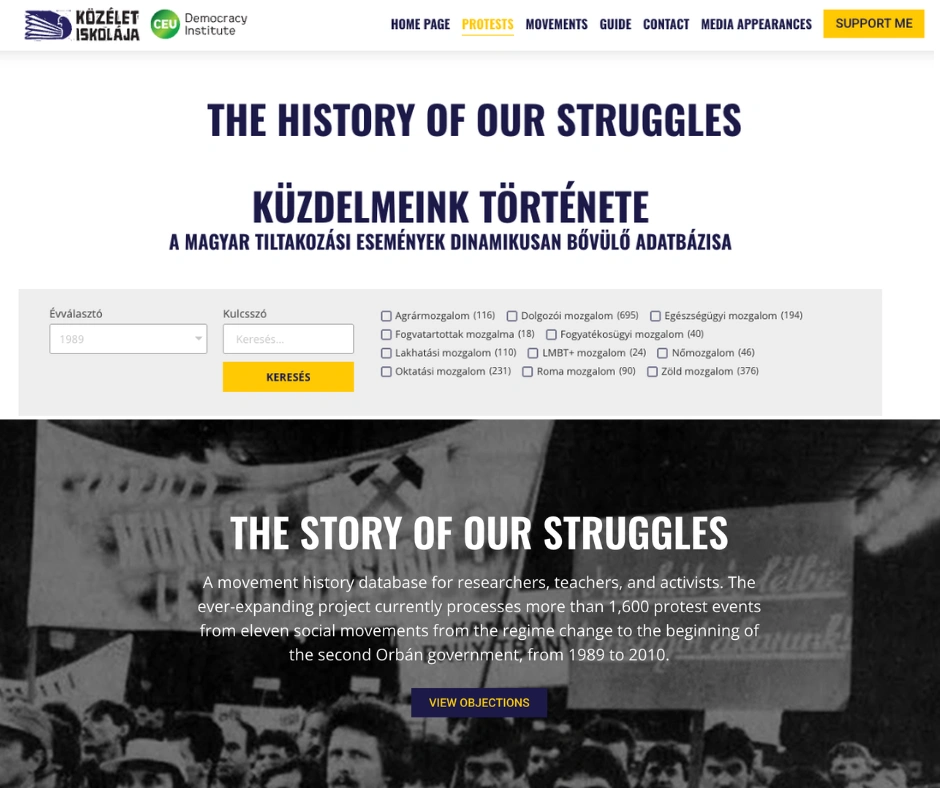
The Story of Our Struggles is a unique database of protest events that offers insights into the history of Hungarian social movements. In its current state, it covers more than 1,600 protest events of eleven social movements on a user-friendly, searchable platform, spanning the period from the transition to democracy to the start of autocratization—from 1989 to 2010.
It amplifies the voices of those who protested—whether as part of an organization or, at times, as lone activists. The database brings their struggles to life, revealing what demands movement members considered important and how far they were willing to go to achieve them.
The database is in Hungarian. Please use your browser’s translation feature to access the website if you are a non-Hungarian speaker.
About the Database
The Story of Our Struggles was developed as a cooperation between the School of Public Life, an activist training center, and the CEU Democracy Institute, a research organization. The goal was to build a bridge between the past and the present, so that organizations active today can draw strength from the successes of their predecessors and learn from their mistakes.
The Story of Our Struggles is, therefore, also an educational tool. Drawing on the protest data, educators at the School of Public Life developed an interactive “movement timeline” workshop in which activists co-create movement history together, while building the timeline of their movements and contributing with their knowledge and memories.
Although the collective memory that preserves movement struggles and protests plays an important role in the development of society, this knowledge has not yet entered the mainstream in many Eastern European countries, including Hungary. We also observe a common misconception that Hungarians in general do not stand up for their rights and that our civil society is weak.
The Story of Our Struggles challenges this misconception and negative self-representation, and makes movement history accessible to Hungarian activists, helping them better assess present political struggles and design more effective strategies. – Bernadett Sebaly
The different protest movements represented in the database include:
- Agrarian movement
- Labor movement
- Health movement
- Prisoner movement
- Disability movement
- Housing movement
- LGBT+ movement
- Women’s movement
- Educational movement
- Roma movement
- Green movement
The database provides summaries of various movements in Hungary. Trainers can also use the timeline method for a group learning exercise to build the history of participants’ own movement or cause. See How Can I Use the Database as an Activist, Trainer or Educator? in the FAQs.
Access the Database
Search the database for protest events by movement, year, or search term.
Listen to Podcast
Listen to an interview in English about the development of the Story of Our Struggles and civically engaged research.
In this conversation, Bernadett Sebály discusses the inception and development of the online database of protest events in Hungary, 1989–2010, entitled Küzdelmeink története, or “The Story of Our Struggles”; its use in pedagogical settings for students, activists, teachers, and everyday citizens; and the importance of its place between activism and scholarly research in the Hungarian illiberal context.
Explore Further
- The Transformative Potential of Community Organizing and its Challenges: The Case of Living Gyál, Hungary
- Grassroots Activism Under Pressure: 10 Creative Practices from Hungary and Serbia
- The Power of Organizing: Stories of Community Organizing Campaigns from across Europe
- Community Organising Program in Hungary: Case Studies, Successes and Lessons Learned
- Confronting Authoritarianism and Organizing Resistance: Case Studies and Lessons Learned
- Can Nonviolent Struggle Defeat a Dictator? This Database Emphatically says Yes
- The Rebel’s Notebook: Data-Driven Strategy for Activism
- 198 Methods of Nonviolent Action by Gene Sharp
- Global Nonviolent Action Database