
Introduction
Passion gets a movement started, but it doesn’t guarantee a win when facing powerful systems. Which tactics actually work here? What do we do next? How do we keep momentum when the pushback comes? Answering these questions can be the difference between a movement that changes things and one that gets crushed.
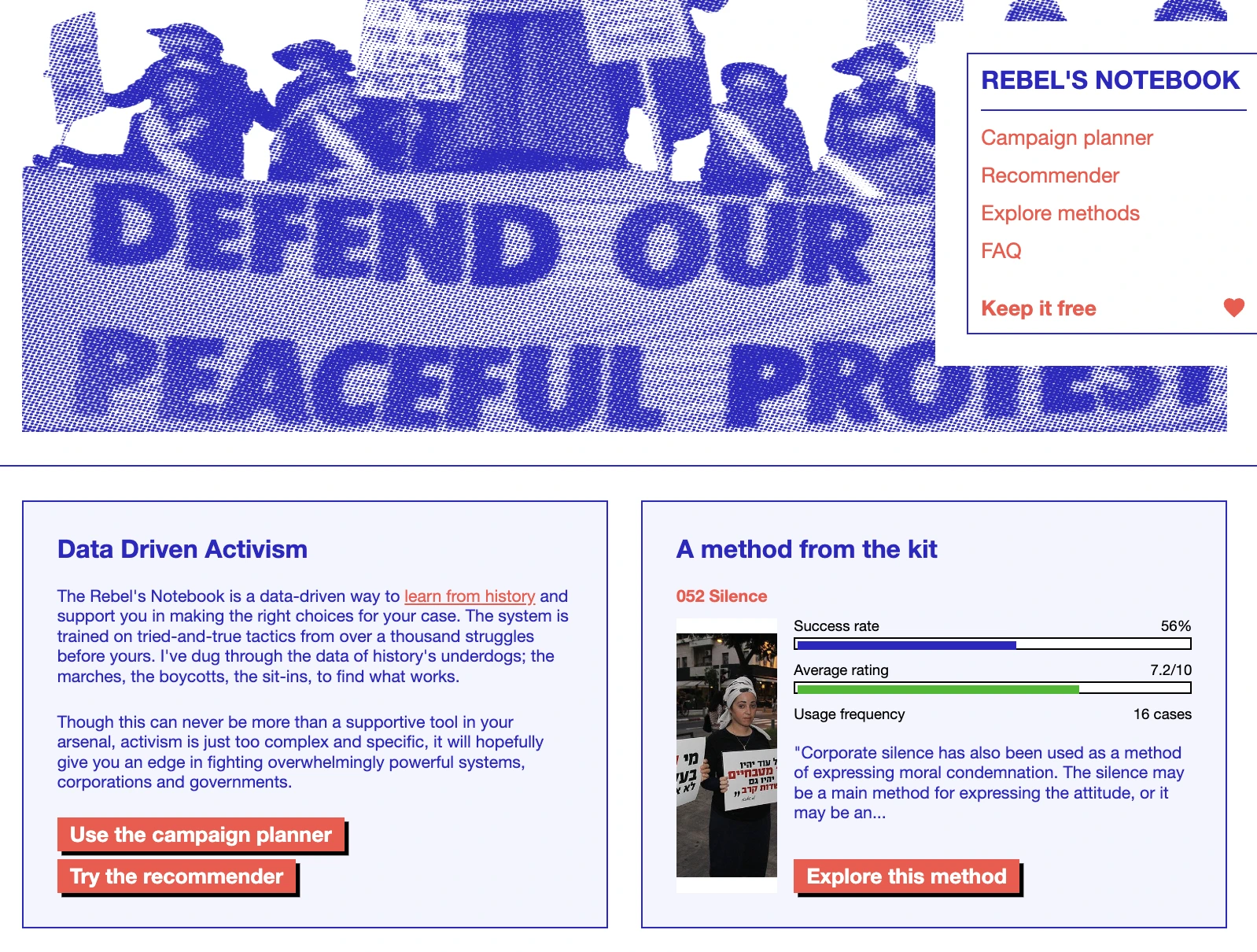
This is why The Rebel’s Notebook was built. It’s a data driven tool for activists that is trained on thousands of past nonviolent campaigns to help you plan your next move with more than just intuition. It’s not here to tell you what to do. It’s a tool to sharpen your own judgment and inspire you to diversify, built by people who believe in empowering grassroots movements.
Recommendations aren’t pulled from thin air. They’re built on the Global Nonviolent Action Database (GNAD), a massive research project from Swarthmore College. The database contains detailed records of over 1,400 real-world campaigns—from the Mombasa workers’ strike in 1947 to the Abalone Alliance’s fight against a nuclear plant. We analyze the goals, methods, opponents, and outcomes of these struggles to find patterns in what works.
The Rebel’s Notebook draws from Gene Sharp’s widely recognized list of 198 methods of nonviolent action.
These methods are broadly grouped into three powerful types of moves:
- Protest and Persuasion: These are often symbolic actions meant to send a message and win hearts and minds. Think public speeches, marches, vigils, or even creative pranks.
- Noncooperation: This is about withdrawing your support or participation. This could mean social boycotts, student strikes, economic boycotts, or refusing to cooperate with unjust rules.
- Nonviolent Intervention: These are direct actions designed to disrupt a situation and force change. Famous examples include sit-ins, fasts, blockades, or even setting up alternative institutions.
Tools for Your Arsenal
The Rebel’s Notebook offers several tools:
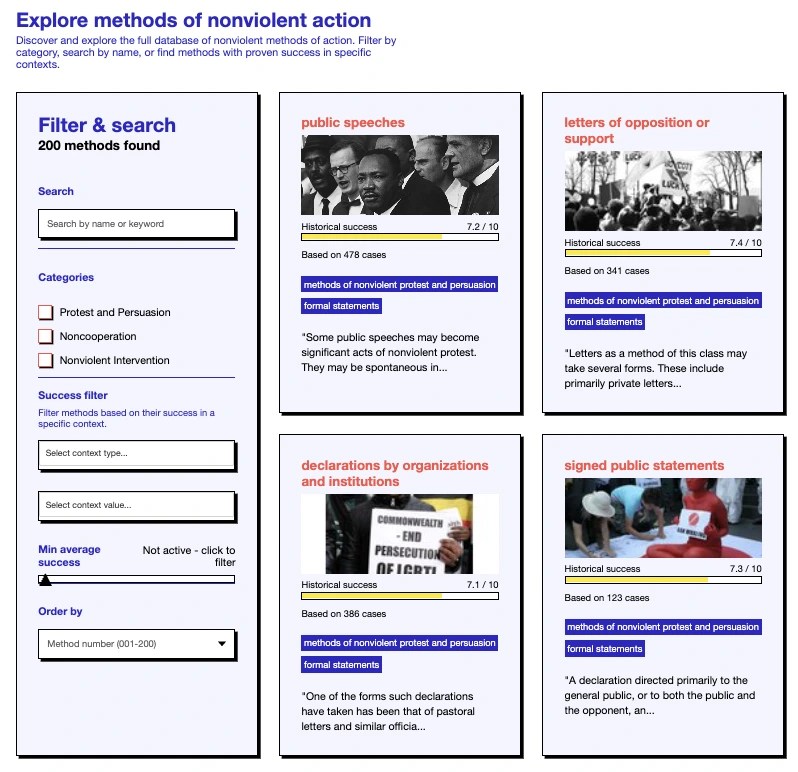
- The Methods Library
Explore the 198 distinct nonviolent tactics, from marches and boycotts to sit-ins and the creation of alternative institutions from Gene Sharp. Each method comes with a data card showing its historical success in different contexts, campaigns and successful methods to partner it with. - The Basic Recommender
Need quick ideas? Tell the tool at least your goal, opponent, and country, and it will generate a list of tactics that have worked in similar fights. - The Campaign Planner
This is the core of the platform. It’s an interactive canvas for building a complete, multi-phase campaign strategy from the ground up, combining your knowledge on the ground with data driven suggestions. The focus here is on timing: when to do what in your context?
How the Planner Works
The Campaign Planner doesn’t just pick popular tactics. Its logic is built on three key pillars:
- Context is King
A tactic’s success depends on the situation. The planner scores methods based on how they’ve performed against specific opponent types (e.g., corporations vs. governments), under different political regimes, and for campaigns with different goals and scales. - Timing Matters
A campaign unfolds in stages. The data shows that tactics like marches are often most effective early on to build awareness, while strikes and boycotts work best in the middle phase to apply pressure. The planner recommends methods that fit the phase you’re in. - Tactics Must Work Together
A good plan is more than a shopping list of actions. The engine analyzes which methods have been successful when used together in the past, suggesting tactics that create synergy and amplify each other’s impact.
Dynamic, Interactive Planning
The Campaign Planner is designed for real-time strategic thinking.
- Start with an archetype
Don’t start with a blank page. Choose a “Strategic Archetype” Your choice helps the engine prioritize methods that fit your campaign’s intend, for example a Focused Strike (Short & Focused), Rapid Swarm (Short & Diverse), Sustained Pressure (Long & Focused) or Adaptive Saga (Long & Diverse) - The ripple effect
The planner is interactive. When you “pin” a non-negotiable tactic, the entire plan instantly reshuffles to find other methods that work best with your choice. When you exclude a bad suggestion, it finds a better alternative on the fly. Every change you make gives you instant feedback. - Learning over time
The Rebel’s Notebook gets smarter by learning from your experience. After you complete a campaign phase, the tool will prompt you for feedback. This feedback powers a learning loop that benefits both you and the entire community. Your (anonymized) ratings are fed back into the system, helping it understand which tactics are working for activists right now in the field.
A Tool That Learns from You
The Rebel’s Notebook is a living system. When you use the planner and give feedback on which methods worked (“thumbs up/down”), that information is used to improve the system for everyone. It combines three perspectives:
- History: What has worked in past campaigns like yours?
- Community: What are other activists finding effective right now?
- Personal: What has worked for you before?
No Black Boxes
We believe in transparency. When the tool recommends a tactic, it tells you why! Showing you the historical data, the synergy score, and the phase suitability. This isn’t about replacing your judgment; it’s about giving you the data to make your judgment more powerful.
Remember…
Good strategy tends to come out of people with a shared mission deliberating together. Use the recommendations as a discussion starter and apply your own critical lens. It should also be noted that Gene Sharp’s 198 Methods of Nonviolent Action, which The Methods Library is based on, was written in 1973. There are many other tactics to consider, including the broad array of digital actions.
Join the Open Alpha
The Rebel’s Notebook is in “open alpha,” which means it’s a work in progress. We need activists, trainers, and rebels to use it, test it, and help us make it better. The challenges we face are huge, but by combining our on-the-ground knowledge with the lessons of history, we can give ourselves a strategic edge.
About the Author
The Rebel’s Notebook is made by me, Jasper, a teacher in digital design and social design at the University of Applied Sciences in Utrecht. My goal is to help designers see the impact they’ve got on today’s world. I’ve got my masters in Data Driven Design and this passion project combines all my fields of expertise into something I very strongly believe in. You can contact me through LinkedIn.