Introduction
This article looks at the importance of connecting local and larger struggles to unleash the transformative potential of community organizing. It includes a case study of a community organization in Hungary, Europe, called Living Gyál. It is an excerpt by Bernadett Sebály from the book, Handbuch Community Organizing Geschichte, Theorie und Praxis (in German).
The Transformative Potential of Community Organizing
Organizing affects politics. It involves marginalized constituencies in shaping the political decisions that affect their lives. But organizers do not start with coordinating big rallies or marches. They begin with people.
Organizers help directly impacted people regain political agency and build organizations in which they can develop skills to take collective action and represent their shared interests in the public arena. With the focus on people and their immediate interests, however, organizers may easily lock themselves into isolated localized fights and lose sight of larger struggles.
The aim of this article is to encourage organizers to see their fights as part of broader injustices and connect them to the vision of economic, environmental and social justice.
Historically, community organizing has not lacked radical social critique. It was exactly the opposite: organizing has often been a prominent strategy in ideological struggles from labor rights movements in Europe to organizing for Black liberation in the United States.
These larger struggles always have localized fronts, such as workplaces, churches, or neighborhoods.
Organizers fused local organizing struggles together to create a larger social critique and vision and the scale of power necessary to achieve the desired change. Over the last decades, from being a revolutionary strategy, organizing became a profession and the followers of the practice built a sector with – more or less – established funding streams (Beckwith et al. 2019).
Even though building progressive grassroots and worker power as part of larger social movements has a long indigenous history in Europe dating back to the pre–World War I period, the scope of community organizing has overall shrank and drifted away from radical social critique.
The “realist” organizing canon that has had a huge influence on how people in Europe teach and practice organizing has locked organizers into isolated localized fights.
Realist vs. Transformative Approach to Organizing
The “realist” or “pragmatic” approach, often associated with the iconic organizer Saul Alinsky, aims to confront unequal power structures, reinvigorate politicalness, and contribute to general welfare (Coles 2006, Inouye 2022). As part of this tradition, organizing has often been taught as a process, a set of steps which, if followed, will contribute to public goods and revitalize democracy.
Organizers apply a generic formula to forge relationships among people, agitate them into action based on their shared interest, develop leaders, and build organizational structures through which directly impacted people can act collectively and represent themselves in the public arena.
Anyone who organized has experienced the power of this process. However, unless organizing is inherently connected to a radical critique of social and economic arrangements, this process may end up boxing organizers into localized fights and decoupling organizing from significant larger struggles (DeFilippis, Fisher and Shragge 2010).
For example, organizers may work around the lack of trash containers to eliminate garbage piles without problematizing the ineffective allocation of funds to elevate low-income or segregated communities.
They may fight against the closing of one kindergarten without addressing the lack of access to quality education nationwide. Organizers may focus on local (or small) fights with the hope that they boost people’s confidence to take on larger, more significant issues, but the gap often proves to be unbridgeable.
The transformative approach to organizing is a critique of this flaw – it fine tunes the formula by what it is missing. By bringing values and politics back in, transformative organizing emphasizes radical analysis and advances an ambitious agenda in opposition to oppressive social and economic structures.
It illuminates the deep-seated power imbalance between ordinary people and the political and business elites, and aims at the radical restructuring of power relations along the axes of exclusion such as class, race, gender or disability (Mann 2010, Maruschke 2014).
Certainly, communities, whether they form at workplaces, schools, neighborhoods or churches, are the basic building blocks of the organizing process. However, social problems experienced by locally rooted communities are always the manifestation of a broader injustice.
When organizers help leaders see their personal or communal suffering as a localized version of a larger political problem, they build bridges and reinforce the interconnectedness horizontally – between various communities, issues and even constituencies – and vertically – between local and national (or even global) social-political struggles.
To move forward the field of community organizing, this interconnectedness should be made explicit. Unless organizers build this bridge between local and larger struggles, organizing will remain marginal.
In the next section, I will provide an example of how to make a localized fight part of a larger struggle. Then, based on the lessons learned from the case, I will offer a framework that marks the three levels of organizing that connects local work to the vision of long-term structural changes.
How to Connect Missing Street Lights to National Politics
Andrea Homoki grew up in Gyál, a town in Hungary. Gyál has a population of over 22,000 and is in the metro area of the capital, Budapest. In 2016, Andrea decided to build a community organization in her town. She applied for the organizing grant of the Hungarian Environmental Foundation, an intermediary of the donor Porticus. Mentorship to organizers came through the Civil College Foundation. The author of this article was Andrea’s mentor during the first two years of her organizing, 2016-2018.
Andrea was well aware of Hungary’s democratic crisis under Viktor Orbán’s illiberal government. She had been active in memory politics struggles for two years before she started organizing in Gyál. She was a leader in a voluntary group, Living Memorial, which protested against the installation of a statue of the German occupation in 1944, which according to many denied the responsibility of the Hungarian state in the Holocaust.
Living Memorial occupied the public space around the statue in Budapest to prevent the inauguration of the memorial and made the occupation permanent by erecting a counter-memorial of the personal relics of fellow-Hungarians and holding several hundreds of discussion circles to protect the counter-memorial in the next few years.
Andrea had to realize quickly that in Gyál most people were not interested in Hungary’s acute political issues in a way she was. When Andrea conducted a listening process, the lack of appropriate street lighting was flagged as the primary issue by about 300 residents. Even though the town did a significant overhaul of public lights in 2015, street lighting became worse than it had been before. The new, energy saving lights replaced the old ones but the company did not install enough of them and the streets got darker.
A new community organization, named Living Gyál (in Hungarian: Eleven Gyál), emerged during the listening process and started a research action to find out who installed the lights. Members, together with Andrea, soon found that the contractor was a company called Elios, belonging to the son-in-law of Prime Minister Viktor Orbán. Elios, which carried out the overhaul of street lighting in 35 Hungarian towns and cities, including the Fidesz-led Gyál, was in the middle of a vast corruption scandal under investigation by the Hungarian police and the EU’s anti-corruption agency (Vorák 2015).
Living Gyál members decided to work on both the quality of street lighting and the corruption dimension, connecting their local struggle to a national issue. While the group’s primary goal was to achieve that the city council replaces the missing public lights, they also contributed to exposing the corruption scandal.

Over two years of campaigning, Living Gyál created a database that identified all the missing street lights by their location and handed it to the mayor. They conducted a survey among residents, collected 1,600 signatures for a petition, and reported accidents resulting from the darkness in the streets. They requested a professional opinion from a street lighting expert to underscore their statements.
They did street performances and hung banners. They turned their photos of dark streets into postcards and organized an exhibit in front of the city hall. They spoke at public hearings and organized candidate forums in the run-up to the elections.

They took the mayor, a member of the governing Fidesz-KDNP party, on a walking tour to show him the scale of the problem. They also made it to the national media and built alliances with other movement actors.
On the corruption front, they requested that the city council publish the contract between Elios and the municipality. They sued the municipality to provide access to the project expenses in the agreement. In 2018, when the Hungarian authorities terminated the legal process against Elios, a Living Gyál member spoke at a demonstration in Budapest. They were also active in the national pro-democracy, anti-government protests in 2017.

On both campaign fronts, they achieved significant initial victories. In 2020, one year after the municipal elections and after much pressure, the still Fidesz-led city council unanimously voted for installing the 650 missing street lights and published a timetable of the installation. The legal process against the city council was also successful, and the organization could publicize the expenses of the compromised project.
Thus, Living Gyál was able to connect a local issue, lousy street lighting, to a national issue, a dysfunctional, corrupt economy.
However, winning is usually a long-term process with many challenges along the way that are sometimes bigger than us. In this case, it was a worldwide catastrophe that provided the initial loophole for the Gyál administration to evade its commitment – and Living Gyál to lose focus. In 2020, a new coronavirus swept the world and took its toll on many areas of our lives.
In Gyál, it allowed the city council to gain time and protract the planning process of the installation of the missing lights for three years. Living Gyál acted in good faith – and spiraled into an endless set of negotiations. In the meantime, Russia invaded Ukraine in 2022, triggering a prolonged energy crisis. COVID-19 and the energy crisis created enough opportunities for the municipal administration to finally drop the installation ironically referencing the importance of energy saving.
The 3 Levels where Organizers (should) Operate
The story of Gyál beautifully makes the case for the fact that we do not live in a singular community. Our life takes place in “nested communities” – families, neighborhoods, cities, regions, countries etc. – that are all dependent on each other (Hunter 2018).
As a result, a local community can become the site and localized version of a larger campaign that demonstrates what is at stake in the city, in the country or sometimes, in the world. To take advantage of this potential – and prevent potential failures –, organizers should keep in mind the following three levels of organizing.
Micro Level
At the micro level, organizers create an organizational space where directly impacted people can acquire the skills to participate, overcome internalized disprivilege, and increase self-confidence and the capacity to construct collective political preferences (Cornwall and Coelho 2007).
In these organizations – just like in Living Gyál – people recognize their agency to mould their future and develop a more positive self-concept.
Organizers create this organizational space through intentional personal conversations (one-on-ones) and by uncovering people’s individual stories and examining them in light of others. Thus, at the micro level, organizers build basic units of representation, such as grassroots teams that meet regularly, and enhance people’s personal and collective ability to act
Meso Level
Local communities, however, are often weak on their own. Their collective power can amplify when they align their action with others. At this meso level, they can connect locally organized units across space, institutions, issues or constituencies and integrate them into a larger organizational unit or network.
In this “vertical dimension of communities,” a community is “still spatially and locally rooted but federated and fused through the social and political construction of ever larger communities of interest and identification” (Hunter 2018:13).
At this level, organizers also build relationships with other types of actors, such as advocacy organizations, digital mobilizers, service organizations, or even parties and funders; in the case of Living Gyál, these were the pro-democracy groups.
These interactions also shape how community organizations will be able to use strategic opportunities to achieve their goals.
At the meso level, therefore, organizers facilitate the coalescence of actors, both by connecting structures and resources and adopting a common frame of messaging.
Macro Level
The nuances and trajectory of these organizing processes depend heavily on the particular socio-cultural and economic conditions of the place where the organizing takes place. This macro level of power and opportunity structures determines the outcome of collective social struggles at the micro and meso level.
In other words, what happens in national (or global) politics will define the opportunities for social change – as we saw with COVID-19 in the case of Living Gyál. Living Gyál exemplifies that it is not easy to navigate this macro terrain.
But when organizing is grounded in analysis, organizers may be able to turn the – positive or negative – turn of events to their advantage.
In Gyál, the following could have been a possible approach. In Hungary, the pandemic exposed low healthcare capacity and corruption scandals related to the procurement of ventilators (Transparency 2023). If local elected officials in Gyál aim to sustain cohesion on their turf during a pandemic, the #1 step is to fix a project they messed up.
How can the people of Gyál expect that the municipal administration will handle a public health crisis faithfully if elected officials allowed their town to become complicit in corruption linked to a public safety issue, adequate street lighting? As a result, at the macro level, by using their resources strategically, organizers work for a grounded vision and provide meaning to evolving political opportunities at the time of an opening.
Final Thoughts
Organizers do not start with coordinating big rallies or marches. They begin with people.
They build an organizational space in which directly impacted people can increase their self-confidence, develop skills to take collective action and represent shared interests in the public arena.
With the focus on people and their experience and immediate interests, organizers may easily lock themselves into isolated localized fights and lose sight of larger struggles and the political economy of the country where they work. Therefore, this article has pointed out the importance of connecting local and larger struggles to unleash the transformative potential of organizing.

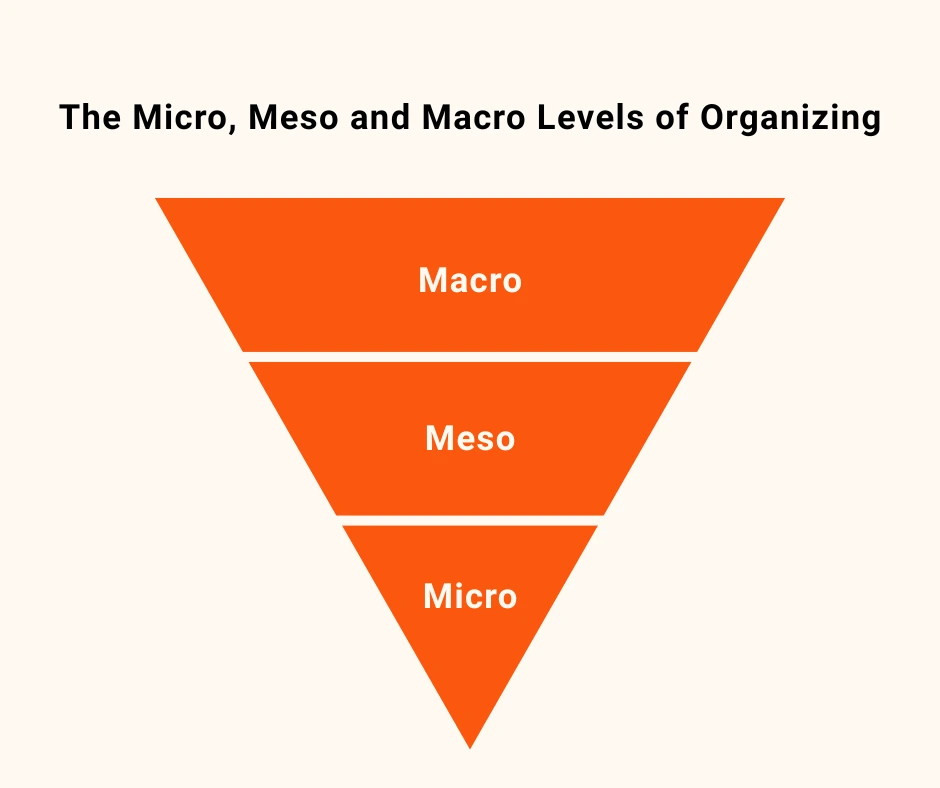
Figure 1: The micro, meso and macro levels of organizing.
The figure above demonstrates how micro, meso and macro levels work for organizers. In sum, at the micro level, organizers create organizations where affected people can enhance personal and collective ability to act. At the meso level, organizers connect already organized units and integrate them into a larger organizational unit or network. At the macro level, organizers look into political and social structures to have a grounded vision and be able to give meaning to evolving political opportunities.
If organizers work and coordinate along these lines, their efforts may achieve that people from multiple communities feel part of a stronger, bigger and more diverse “we,” and are able to demonstrate what is at stake in their communities without losing sight of broader economic, environmental and social injustices that shape their lives.
References
This article is an excerpt from the book, Handbuch Community Organizing Geschichte, Theorie und Praxis (in German).
Beckwith, Dave, Deborah Doane, Steve Hughes, Bernadett Sebály, Anna Striethorst and Gordon Whitman (2019). Making a Way Forward: Community Organising and the Future of Democracy in Europe. Ariadne and the European Community Organizing Network, organizeeurope.org.
Coles, Romand (2006). Of Tensions and Tricksters: Grassroots Democracy between Theory and Practice. Review Essay. Perspectives on Politics, 4(3):547-561.
Cornwall, Andrea and Vera Schattan P. Coelho (2007). Spaces for Change? The Politics of Citizen Participation in New Democratic Arenas. London: Zed Books.
DeFilippis, James, Robert Fisher, and Eric Shragge (2010). Contesting Community: The Limits and Potential of Local Organizing. New Brunswick, NJ: Rutgers University Press.
Hunter, Albert (2018). Conceptualizing Community. In: Handbook of Community Movements and Local Organizations in the 21st Century edited by Cnaan, Ram A. and C. Milofsky. 3-23. Handbooks of Sociology and Social Research. University of Wisconsin and Springer.
Inouye, Mie (2022). Starting with People Where They Are: Ella Baker’s Theory of Political Organizing. American Political Science Review, 116(2):533-546.
Mann, Eric (2010). The Seven Components of Transformative Organizing Theory. Charleston, SC: Frontline Press.
Maruschke, Robert (2014). Community Organizing. Zwischen Revolution und Herrschaftssicherung. Eine Kritische Einführung. Münster: edition assemblage.
Transparency International (2023). “Corruption in healthcare procurement for protection against the coronavirus pandemic,” transparency.hu, February 7. Retrieved from: https://transparency.hu/en/news/corruption-in-healthcare-procurement-for-protection-against-the-coronavirus-pandemic/
Vorák, Anita (2015). “Company of Hungarian PM’s Son-in-law Keeps Winning Public Projects Without Competition. Here Is What Made That Possible,” direkt36.hu, March 11. Retrieved from: https://www.direkt36.hu/en/tiborcz-istvan-es-az-elios-innovativ-zrt-sikerei-ledes-kozvilagitasi-kozbeszerzeseken/
About the Author
Bernadett Sebály is a political sociologist and a former organizer. Her research focuses on how social movements can effectively influence policy and politics, and how they can develop counter-hegemonic potential to leverage major political and cultural shifts. She is on the board of the European Community Organizing Network (ECON) and a member of the editorial team of the Community Organizing Journal. Contact: sebaly.bernadett@gmail.com
Explore Bernadett’s work:
- I’m a Veteran Organizer From Hungary. Here Are My Lessons for the Trump Era
- Podcast: The Story of Our Struggles – A social movement database
- Stepping stones in larger struggles. How can we combine colliding struggles in the care crisis?
- Building Stronger Democracies Through Broader Participation: Can Community Organizing Meet the Challenge?
- “We all have to live somewhere!” The last three decades of the Hungarian housing movement – a bottom-up view –1989-2021
- Social Movements and Policy Change: Case Study on Caregiver Benefit Policies in Hungary
Explore Further
- The Power of Organizing: Stories of Community Organizing Campaigns from across Europe
See stories from Hungary of activist movements adopting a community organizing approach in order to win – pgs 12 – 15. It also includes case studies and stories of community organizers working in Europe from climate work in Poland to Roma rights in Slovakia and more. - Community Organising Program: Case Studies, Successes and Lessons Learned
Case studies, analysis of the successes and lessons learned from the Civil College Foundation’s Community Organizing Program in Hungary. - So, What is Community Organising?
- A Guide to Power Analysis in Community Organising
- High Trees Community Organising Self Assessment Toolkit
- Community Mapping Introduction and Worksheet
- Organising: Start Here