

Introduction
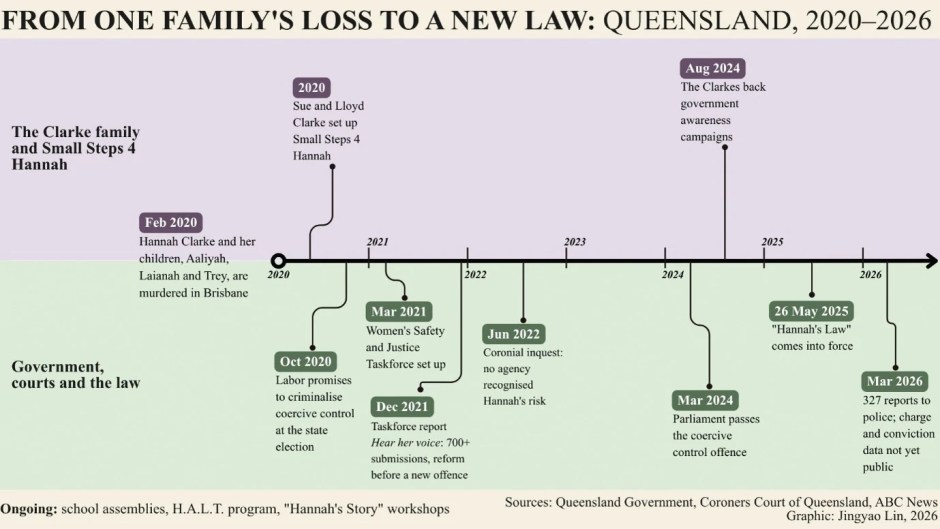
In February 2020, Hannah Clarke and her three children, Aaliyah, Laianah and Trey, were murdered in Brisbane, Queensland, Australia, by the husband she had recently left. Her father, Lloyd Clarke, kept asking how he had missed the signs.
Part of the answer was a term many people did not know yet: coercive control. It means using a pattern of behaviour to dominate a partner, such as cutting her off from family, tracking her, and controlling her money. This abuse often leaves no visible injuries.
Within weeks, Hannah’s parents, Sue and Lloyd Clarke, set up the Small Steps 4 Hannah Foundation. It supports people affected by domestic violence, teaches students, workers and families to spot coercive control, and has pushed the Queensland Government to make it a crime. This post argues that Small Steps used one family’s story to make hidden abuse visible and help write it into law in 2024. Whether the law brings real safety is still unclear.
Hidden Abuse and a Gap in the Law
In its 2016–17 Annual Report, Queensland’s Domestic and Family Violence Death Review and Advisory Board found signs of coercive control in almost all the deaths it reviewed. Yet services rarely responded unless physical violence was also reported. Two gaps lay behind this. First, non-physical abuse was less likely to be recognised by services, victims and the public. Second, the Domestic and Family Violence Protection Act 2012 covered coercive and controlling behaviour only through protection orders. It was not a crime in itself.
Hannah’s case brought this blind spot into public view. A 2022 coronial inquest found that further action by police or services was unlikely to have prevented the murders. It also found that no agency recognised how much danger she was in, probably because the abuser had not been physically violent and had no relevant criminal history.
There was a failure to recognise the risk of intimate partner homicide which results from separation in a coercive controlling relationship. Deputy State Coroner Jane Bentley, 2022
Back in 2020, a new offence was still only a Labor election promise. In March 2021, the government set up the Women’s Safety and Justice Taskforce to advise on it.
From One Family’s Story to a State’s Agenda
Sue Clarke has said they only learned about coercive control after the murders, so the Foundation’s core message is that abuse is not only physical, and its warning signs can be learned. Sue and Lloyd tell the story themselves in media interviews and have joined school assemblies. “Hannah’s Story” workshops use Hannah’s experience to teach early red flags, and the #HALT hashtag, built from the initials of Hannah and her children, is a call to stop the violence. Most of this is a diffusion approach, with Hannah’s parents as trusted speakers. The H.A.L.T. school program goes further. Its three sessions, starting with “What is Safe?”, were shaped by teacher and student views. That is a small move towards participation. Most of the work still flows one way.
For the legal campaign, the Foundation also lobbied, reporting more than 75 meetings with officials. The Premier later said that the experiences of the Clarkes and others made the government more determined to set up the Taskforce, which received more than 700 submissions, including about 500 from survivors. Researchers who study power would call the Clarkes’ media presence a “claimed” space and the Taskforce an “invited” one for less-heard voices.
Public shock and an election promise helped, but two challenges remained. The inquest found that some of the abuser’s friends excused his behaviour, a sign that community attitudes were part of the problem. Sisters Inside, led by criminalised women, made a joint submission to the Taskforce with the Institute for Collaborative Race Research. It warned that in a colonial context, a new offence could increase police and prison control over First Nations women. The Taskforce still recommended a new offence, but only after wider reform. This included a strategy co-designed with First Nations people to address their over-representation in the justice system. One family’s story can reach many people, but it may not speak for First Nations and criminalised women. For them, Sisters Inside argues, the state itself can be a source of control.
Hannah’s Law and What It Has Yet to Prove
In March 2024, the Queensland Parliament passed the offence with support from both major parties. Widely known as “Hannah’s Law”, it began on 26 May 2025, with a maximum penalty of 14 years. The law’s start was delayed to train frontline workers, and the Clarkes’ backed government awareness campaigns. The Foundation reports more than 10,000 students have engaged in H.A.L.T. An ABC report also credits the Clarkes and other advocates with making “coercive control” a more familiar term.
Hannah didn’t know she was in an abusive relationship because she wasn’t being physically harmed. – Lloyd Clarke, co-founder, Small Steps 4 Hannah, 2024
Police had received 327 reports by March 2026. Charge and conviction data were still not public in May 2026. In a 2023 national survey of 1,261 victim-survivors, 87.5% said coercive control should be a crime. Of those who supported criminalisation or were unsure, 72% expected it to improve safety, compared with only 31% of First Nations supporters in the same group. No independent evaluation of the Foundation’s education programs appears to be public.
Small Steps worked alongside the Taskforce, hundreds of survivors, and other victims’ families. Its contribution was to keep public attention on coercive control while the law was made. Three lessons follow. First, a personal story can make a legal term feel real. Second, pair a new law with training for police and education for the public. Third, involve the groups a law may harm before it passes. First Nations women’s doubts about safety show why.
Lloyd once asked how he could have missed the signs. Today, more Queenslanders can name the abuse he did not know about. Whether that keeps women safe is the next test.
Need Support?
Call 1800RESPECT on 1800 737 732 or chat online at 1800respect.org.au. In Queensland, call DVConnect Womensline on 1800 811 811. For crisis support, call Lifeline on 13 11 14. All are available 24/7. In an emergency, call 000.
Communication for Social Change
This article was submitted to The Commons by a student completing Communication for Social Change at the University of Queensland. Explore other case studies from UQ students.
Explore Further
- Small Steps 4 Hannah Foundation.
- Queensland’s coercive control laws. A plain-language government guide.
- Victim-survivors’ views on criminalising coercive control (PDF). Australian Institute of Criminology, 2024.
- Coercive control laws and First Nations women. The Conversation, 2022.
- The Allison Baden-Clay Foundation. A related campaign for teenagers.
- Organizing: Start Here