
Introduction
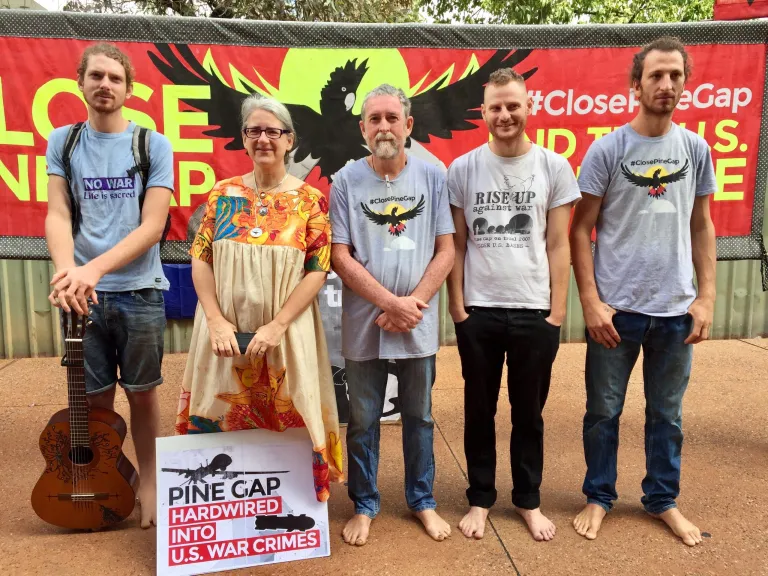
On 28 September 2016, a group of five people calling themselves “Peace Pilgrims” entered a prohibited zone around Pine Gap, a US military base in Australia. They were arrested and tried for trespass. The maximum penalty for their act was seven years in prison.
The story of this action and its aftermath is told with care and sympathy by Kieran Finnane in a new book titled Peace Crimes: Pine Gap, National Security and Dissent. Finnane is a long-time resident of Alice Springs, a town in central Australia. Although she was aware of the nearby Pine Gap base, she had never paid much attention to the issues involved until the protesters took their action in 2016. With Peace Crimes, she has provided the most detailed account yet available of this form of protest in Australia and the response of the government to it.

I’m interested in this story for several reasons. In 1979, I became involved in the peace movement, with a special interest in nonviolent alternatives to military defence. I’ve studied the likely effects of nuclear war and followed disclosures about mass surveillance. Not least, for many years I’ve known one of the Peace Pilgrims, Margaret Pestorius, an incredibly knowledgeable and committed activist.
In the following, I first tell about Pine Gap and the Peace Pilgrims and then present a series of perspectives for understanding one or both of them. I’m omitting a lot of the detail and complexity of the story. For example, in addition to the group of five Peace Pilgrims, another Peace Pilgrim protested individually and was tried at the same time. For these and other aspects, and an engaging narrative, read Peace Crimes.
Pine Gap
Beginning in the 1950s, the US government made arrangements with the Australian government to set up a number of military bases in Australia. Officially they are joint facilities, and in some bases today half the workers are Australians. However, Richard Tanter, who has carried out research on the bases, has a useful counter to the idea that they are genuinely “joint” facilities. He says that considering that the bases were built by the US government, their operations are paid for by the US government and their only functions are as part of a network of US military and spying facilities, it is reasonable to call them US bases to which Australian personnel have a degree of access.

Source: Richard Tanter, “Tightly bound“, GlobalAsia
For decades, the most important US bases were Pine Gap and Nurrungar in central Australia and North West Cape on the western coast of Western Australia. These days, with changing technology, Pine Gap is the most important base.
One part of the base receives and analyses data from US surveillance satellites that collect vast amounts of electronic communications from land, sea, air and space origins. These satellites are in orbits that position them permanently in the same location above the earth. Another part of the base intercepts transmissions from foreign satellites, especially Russian and Chinese ones. The base also is a relay station for signals indicating potential enemy nuclear missile launches, though this function is now redundant given that signals can go direct to the US via satellite-to-satellite transmissions.

Pine Gap from the north (photo: Felicity Ruby, 23 January 2016)
Pine Gap is part of the Five Eyes network that sucks up electronic communications of all sorts, a massive surveillance operation that aims to collect everything sent via phone, email, social media, you name it. The so-called Five Eyes are the US, Britain, Canada, Australia and New Zealand. They share surveillance information, though the US National Security Agency plays the dominant role.
Over the years, a number of writers and researchers have exposed aspects of this highly secret network. One of them was New Zealand investigator Nicky Hager in his 1996 book Secret Power, which received relatively little public attention. In 2013, Edward Snowden leaked massive numbers of NSA documents to the media, generating international awareness of the extent of government surveillance.
Pine Gap’s surveillance capacities assist in US counter-terrorism and other military operations. US systems collect information about possible human targets. When a decision is made and an opportunity arises, drones are instructed to unleash missiles to destroy a target. Some of these drone attacks are in war zones such as Afghanistan; others are in places like Pakistan and Yemen. Drone killings can be called assassinations. Alleged enemies are not arrested and brought to trial, but simply killed. As well, quite a number of civilians die in the attacks. Via Pine Gap, the Australian government is implicated in a system of extrajudicial murder.

The most significant US bases were installed in the 1960s when Australia had a conservative government, run by the Liberal-Country Party coalition that had held power since 1949. The opposition Labor Party, at the time having a socialist and nationalist orientation, had a platform that rejected US bases. However, after Labor was elected in 1972, it did nothing to implement its bases policy. Later, after Labor lost office in 1975, opponents of the bases struggled with how to proceed.
In the early 1980s, there was a huge expansion of the worldwide movement against nuclear weapons, which invigorated sentiment against the US bases. Activists argued that the bases contributed to the possibility of nuclear war and made Australia a nuclear target. Indeed, to the extent that nuclear arsenals were “counterforce” — targeted at the enemy’s nuclear war-fighting facilities — then Pine Gap was a prime target in a nuclear exchange. Without US bases, there was little reason for the Soviet military to aim nuclear missiles at Australia.

Australian anti-base activists argued that the goal should be to get the Labor Party to change its platform to again oppose the bases, and then to get the Labor Party elected. These hopes were forlorn. After Labor was elected in 1983, it took steps to give the impression of Australian partnership in running the bases, while more deeply integrating Australia’s military posture with the US’s.
By the late 1980s, the Australian peace movement was in steep decline. Then in 1989 Eastern European communist regimes collapsed. The Cold War was over, and the Soviet Union dissolved two years later. US bases in Australia fell completely off the public agenda, though they continued their crucial role in US nuclear war-fighting operations, surveillance of electronic communications, and information gathering for military operations in Afghanistan, Iraq and elsewhere.
Peace Pilgrims
After the 1980s, Australian peace movement activity was low-key except for huge surges in public opposition to foreign wars, including the 1990–1991 Gulf war and the 2003 invasion of Iraq. Some activists, though, maintained attention to US bases. There have been quite a few protests, including major ones at Pine Gap in 1983 (the Women’s Peace Camp), 1987 and 2002. Of special interest here are religiously motivated activists.
There is a long history of religious opposition to war. In countries with universal male military service, there have been resisters, those who refuse to participate, and many have been driven by their religious beliefs. In the US and several other countries, small numbers of activists have taken direct action against weapons systems, for example sneaking into military bases and using hammers to damage missiles. They are called ploughshares activists, because as Christians they take inspiration from passages in the Bible, such as this one from the book of Isaiah:
He shall judge between the nations, and shall decide disputes for many peoples; and they shall beat their swords into ploughshares, and their spears into pruning hooks; nation shall not lift up sword against nation, neither shall they learn war anymore.

Ploughshares actions, although occasionally damaging military equipment, are largely symbolic. The activists take full responsibility for their actions and do not attempt to evade arrest. They feel driven to bear witness against war. Some US activists have spent many years in prison. Their stories are documented in The Nuclear Resister, published for many years by Felice and Jack Cohen-Joppa, who I see whenever I visit Tucson, Arizona.
The 2016 action at Pine Gap was in the tradition of radical Christian peace action. The group of five protesters — Franz Dowling, Jim Dowling, Andy Paine, Margaret Pestorius and Tim Webb — expressed their commitment to the Biblical commandment “Thou shalt not kill” and, as well, adopted lives of voluntary poverty and service to others in need.
The contrast between their lives and the mainstream churches is stark. Mainstream Christianity has adapted to the surrounding culture and political system. Soldiers, arms manufacturers and political leaders might be Christians, but have accepted the need for killing, and indeed have supported the development and deployment of weapons systems with the potential for mass slaughter. The Christian vow of poverty — exemplified by the Biblical saying that “It is easier for a camel to go through the eye of a needle than for someone who is rich to enter the kingdom of God” — has been displaced by materialism. Some churches espouse the “prosperity gospel” that glorifies making money.
The protesters who called themselves “Peace Pilgrims” wanted to intervene against Pine Gap operations to hinder what they saw as its death-dealing. However, border security around the base is tight. The area is actively monitored for trespass. The outer fence is easy to get through, but not the high inner double barbed-wire fence. In practice, the Peace Pilgrims were making a statement by the simple fact of going into a prohibited area.
The Pilgrims made careful preparations. To get as close to the base facilities as they could, they needed to walk through the night in rather treacherous territory. Andy prepared to film the base and their efforts. Margaret brought her viola and Franz his guitar so they could play a lament.

Margaret and Franz
Peace Crimes provides plenty of fascinating detail about the Pilgrims’ preparations, action and arrest. They expected to be arrested, and they were. Then there was a different sort of drama: in the courtroom. The Pilgrims were charged under a piece of federal legislation called the Defence (Special Undertakings) Act. The maximum penalty was seven years in prison.
Finnane attended the case, which went on for days in the Northern Territory Supreme Court, and reported on it in the Alice Springs News.
The prosecution was led by a top-gun lawyer who did everything possible to achieve a conviction and push for harsh penalties, including imprisonment. The government was obviously doing what it could to deter anyone who might try to follow the Pilgrims’ lead.
The Pilgrims had little money and were unable to afford legal representation — so they represented themselves. Margaret and Andy led their effort to develop questions and an argument for the court. They received a bit of free general legal advice, but actually they preferred to run the case themselves since that gave them the most freedom to do it the way they wanted. A lawyer would have been more constrained.
In Peace Crimes, you can read about the legal machinations: decisions about the appropriate jurisdiction, choosing members of the jury, questioning of the judge’s objectivity, attempts to keep the proceedings closed, efforts to exclude evidence and witnesses, giving of evidence and cross-examination, and the subtle factors that determined what could be raised in testimony and what couldn’t. The Pilgrims pleaded not guilty, their grounds being that Pine Gap played an active role in committing crimes, namely in facilitating extrajudicial murder. Peace Crimes also provides fascinating information about the lives of each of the activists.

If you are familiar with any of the issues involved, you may have a view about Pine Gap and the Peace Pilgrims or both. Here, I offer a variety of perspectives for looking at the issues. Each perspective can potentially offer insights.
Moral versus Legal
The Pilgrims were driven by a deep sense of what is right and wrong, and they believed that military systems — especially those involved in foreign assassinations — are wrong. They confronted an opponent, comprising the government, the military and parts of the legal system, that justified its position based on law. The court case, described in detail in Peace Crimes, can be read as an extended conflict between morality and legality.

Northern Territory Supreme Court building, Alice Springs
The Pilgrims defended their actions in terms of morality, and tried on every occasion to bring morality into the picture. This occurred when they were arrested and questioned, and it occurred in the courtroom. They liked to bring up Biblical examples of the breaking of unjust laws.
The prosecution, taking its cues from the federal government, attempted to exclude morality from the discussion. The prosecution repeatedly objected to testimony that brought up the Pilgrims’ motivations and instead focused on a narrow legal matter, whether they had knowingly trespassed on the prohibited area around the Pine Gap base. From the prosecution’s viewpoint, it was immaterial why the Pilgrims were there. All that had to be proved was that they were there, aware that they were breaking the law.
Power
The interaction between the Australian government and the Peace Pilgrims can be seen as a power struggle. On the surface, it is a very unequal struggle. The government has the power to make and enforce laws, and has at its disposal police and prisons. Then there is the wider power of the US government and military, which supports the Pine Gap operation.
On the other side, the Pilgrims seem to have relatively little power, but this is deceptive. Why would the Australian government bother with an expensive trial against a seemingly harmless and nonthreatening group of activists who never had any realistic prospect of interrupting activities at the base? The reason is that the Pilgrims represented the potential power of citizen opposition. These few individuals posed no direct threat to Pine Gap operations but if their example were followed, a much greater threat might develop.

The Peace Pilgrims including Paul Christie, third from the right
The Pilgrims, in their action, were setting an example. The government, by prosecuting them, was also trying to set an example.
Nonviolent Action
Suppose you want to change the government’s policy on Pine Gap. How could you go about it? You might write scholarly articles, set up a newsletter, lobby politicians, join political parties and campaign for politicians who support your viewpoint. You might launch an online petition or form a citizens group. All these methods are what might be called conventional political action. In Australia, they are commonplace and widely considered acceptable.
At the other end of the spectrum, you might join with a few others to launch an armed attack on Pine Gap or, more easily, on its workers or on politicians supporting it. This approach can be called armed struggle or, by its critics, terrorism.
In between conventional political action and armed struggle are a variety of methods, including ostracism of politicians supporting the base, boycotts of companies supplying it, strikes by workers opposed to the base, sit-ins in parliament — and entering the restricted zone around the base, taking photos and playing music. These sorts of methods are called nonviolent action or, alternatively, civil resistance. They go beyond the routine and acceptable methods but refrain from any physical violence.
The Pilgrims were committed to this sort of action. It can make things difficult for authorities, because it involves noncooperation, yet avoids physical violence and so cannot easily be stigmatised as terrorism.

Within the nonviolence field, two approaches are commonly distinguished: principled and pragmatic. Principled nonviolence, associated with Mohandas Gandhi, is based on a moral commitment. Pragmatic nonviolence, associated with scholar Gene Sharp, is undertaken because it is seen as more effective than violence. The Pilgrims obviously fit into the principled camp. But this distinction is a bit academic in Australia, where all activists refrain from using arms.
Activist and researcher Stellan Vinthagen offers an insightful definition of nonviolence: it is without violence and against violence. The Pilgrims, like most people in their daily lives, did not use physical violence. However, unlike most other people, they acted against violence, namely against Pine Gap and its role in military operations.

Antiwar Strategy
Nearly everyone says they are against war. Those who support military defence say it is needed to deter war. Many soldiers are strongly in favour of peace.
The question is not whether to oppose war, but how. For those in what is called the peace movement, who question the current military posture, there have been a variety of views about goals. Some oppose use of Australian troops in foreign wars, as in Afghanistan and Iraq. Some support the Australian government cutting ties with foreign powers and having an independent defence policy. Others favour disarmament. Yet others support development of a nonviolent defence system.
Despite this wide range of visions, amazingly the peace movement has mobilised large numbers of Australians to protest against war and war preparations — but only on some occasions, such as just before the 2003 invasion of Iraq. In between such mobilisations, few have maintained their activism.

Australian rally against 2003 invasion of Iraq
What about strategy for the peace movement? How will it achieve its goals? Some favour public education, aided by critical analyses of military preparations. Others pursue peace movement goals by lobbying politicians and joining political parties. More visible are public protests. Another approach is to undermine the war system by challenging its roots, including the state, militarism and patriarchy.
In this context, the Pilgrims pursue peace by prophetic witness. Through their actions, they show their commitment and their vision of an alternative world. They are less worried about effectiveness than being true to their beliefs.
Evil
Steven Bartlett, a philosopher and psychologist, made an exhaustive study of evil, which he uses in a non-religious sense to refer to the propensity of humans to harm each other and the environment that supports their life. In his epic book The Pathology of Man he traverses a wide range of classic writings about disease, ethology, psychology, genocide, ecological destruction and war. His central conclusion, suggested by the title of his book, is that the human species is pathological, namely having the characteristics of a disease. He argues that aspects of human thought and behaviour are so dysfunctional that they are a danger to survival, yet most humans participating in damaging activities are psychologically normal.

One of Bartlett’s case studies is war. He observes war preparations and the willingness of humans to harm each other, face to face or remotely. War preparations involve only a fraction of the population. What is significant is that so few people do anything to resist. Bartlett concludes that most people do not want to stop war preparations and war. This is a testament to the pathology of the human species.
The stark contrast between the peace Pilgrims and the power of the state used to restrain them is compatible with Bartlett’s analysis. Although there have been large protests at times, most Australians have been content to support or at least tolerate Australian military preparations and their links to foreign wars and assassinations.
One feature of this human shortcoming, according to Bartlett, is the low level of most people’s moral intelligence. Very few develop a strong feeling of disgust about cruelty, violence and other forms of human evil and have the conviction to act on their beliefs. Bartlett’s analysis suggests that the Peace Pilgrims are among these few with high moral intelligence.
Media
From the perspective of communication and the media, the role of Pine Gap and the challenge by the Peace Pilgrims can be seen from several angles. One obvious point is that the role of Pine Gap, or even its existence, receives very little attention. Arguably, Pine Gap is Australia’s most important target in the event of nuclear war, and, if Australia lacked any foreign bases, the country might not be thought worth targeting at all. Yet this existential issue is seemingly off the agenda in the mass media.

No doubt the reluctance to cover Pine Gap-related matters is in part due to the two major political parties having the same stance, which means there are no significant political disagreements to report on. The government’s draconian laws restricting media coverage of matters of “national security” no doubt play a role. Government secrecy about the role of US bases makes reporting more difficult. Also important is the absence of a strong peace movement. Social media are far less inhibited, but even there, Pine Gap is not a major issue.
The Peace Pilgrims, and other direct actions at Pine Gap, provide a news angle. Unusual events, especially arrests, are newsworthy. Imagine that the Pilgrims had asked, “What can we do to generate attention to US bases?” Their protest would have been as good an answer as any.
Finally, there is the important role of Kieran Finnane, the journalist who reported on the protests and trial and whose book Peace Crimes provides an engaging introduction into the issues — and stimulated me to write about it. Those who seek media coverage often want the largest possible audience, but just as important is the depth of impact, which can be influential when only a few individuals are affected. The Peace Pilgrims had a loyal following, in part because of the government’s heavy-handed response. Their action, as a form of communication, was not widely covered but the coverage it did receive has been quite influential.

Kieran Finnane
Moral Foundations
Jonathan Haidt has written an insightful book titled The Righteous Mind. In it, he explains research by himself and collaborators concerning what he calls “moral foundations.” These are values that influence what people think is right or wrong. Haidt identifies six principal moral foundations: care, fairness, liberty, authority, loyalty and sanctity. Each one has played a role in human evolution.
Consider care, the value people place on protecting and nurturing others. The protection and support that parents give to their children has obvious survival value. In many cases, people expand their sense of caring to those outside their immediate family or tribe, as when a person risks their life to save a stranger.

Haidt argues that the influence of moral foundations operates on each person’s intuitive, fast acting mind, usually without conscious awareness. Through ingenious experiments, he has shown that people make moral judgements intuitively and then try to justify them with rational arguments, which are sometimes highly contorted. In other words, people commonly reach conclusions quickly and automatically and only justify them later. More intelligent people can be better at coming up with rational-sounding explanations for their intuition-driven choices.
Haidt’s framework can be applied to the contrasting views about Pine Gap and the Peace Pilgrims. Each of the six moral foundations is relevant, but they are applied in quite different ways.
Care for others is a key driving force for the military establishment: the care is for those being defended from enemies. The Peace Pilgrims, in contrast, direct their care concerns to the victims of drone attacks and to the world population threatened by wars, especially nuclear war.
Haidt in The Righteous Mind is especially interested in differences between US liberals and conservatives. He found that liberals draw more from the moral foundations of care, fairness and liberty whereas conservatives draw more evenly from all six foundations. Consider authority, a value commonly associated with conservatives. The military is based on obedience to the authority of the military hierarchy and more generally to the authority of the government. The prosecutions of the Pilgrims were backed by the authority of the state, as manifested in the legal system.
Arguably, the Pilgrims were also drawing on authority. However, in their case, the authorities to which they responded were God and their own consciences.
Another moral foundation is sanctity, which can be expressed in rules for eating and hygiene. For example, many people find the eating of the flesh of certain animals to be disgusting. The Pilgrims might be said to be driven by their concern for the sanctity of human life, including individuals killed, far away, in drone strikes. The role of sanctity for the prosecutors does not seem so obvious until we think of Pine Gap as a sacred territory. Authorities were alarmed about the Pilgrims transgressing on the Pine Gap prohibited zone, and prosecutors took great pains to prevent images of the area surrounding the base being made public or even being seen in open court. It seems as if Pine Gap is analogous to a church; entering its grounds and taking graven images are a sacrilege to its holy mission.

Pine Gap by night. Photo by Kristian Laemmle-Ruff
It would be possible to consider each one of the six moral foundations to see its role in the thinking and actions of the Pilgrims and the defenders of Pine Gap. Each foundation plays a role, but with different anchors. A key point is that the influence of moral foundations is usually unconscious, providing an emotional drive for particular thoughts and actions often without individuals being aware of the source of their thoughts and choice of actions. It is fascinating to imagine that the careful, and sometimes torturous, legal argumentation presented in the trial is a rationalisation for choices influenced by unconscious commitments about what is right and wrong.
Outrage Management
When a powerful group does something that others see as wrong, the group can take various steps to reduce the level of public outrage. For example, after the 1991 Dili massacre, when Indonesian troops opened fire on peaceful East Timorese protesters at Santa Cruz cemetery, the Indonesian government and military took steps to reduce international concern. They tried to cover up the existence of the massacre, denigrated the protesters, minimised the scale of the killing, set up investigations and gave minimal sentences to a few low-level perpetrators, and intimidated the surviving East Timorese population.
Despite these efforts, the Dili massacre triggered a large increase in international support for East Timorese independence. The massacre, intended to subjugate the resistance to its rule over East Timor, backfired on the Indonesian government. Perpetrators of a wide range of injustices, from sexual harassment to genocide, use the same outrage-management techniques as those used following the Dili massacre.
The same set of tactics can be observed in relation to Pine Gap, which some people might see as contributing to a number of injustices. The key tactic is cover-up: the intense secrecy about the base and its functions and activities serves to reduce public concern. In relation to drone assassinations, there is an additional tactic: devaluation of the targets, who are portrayed as dangerous terrorists. Then there is the tactic of reinterpretation, namely providing a benign explanation for actions. Defenders of drone killings never use the word assassination. They claim that few civilians are killed, using the euphemism “collateral damage.” Finally, anyone who challenges the programme may be subject to intimidation. This is where the Defence (Special Undertakings) Act comes into play, with its severe penalties for even trivial offences.
The arrest and trial of the Pilgrims can be seen as a form of intimidation of protest, deterring anyone who might follow their example. However, the arrest and trial of the Pilgrims were potentially a new source of public outrage, so it is to be expected that the same sorts of tactics would be used by the government. The tactic of cover-up is most obvious in the concerted attempts by the prosecution to exclude evidence about Pine Gap activities.
The tactic of devaluation is apparent in the prosecution of the Pilgrims as serious criminals who should serve time in prison for their actions. A key tactic of reinterpretation is the assumption underlying the prosecution that the case is about obeying the law, with the possibility of questioning the law off the table.
One of the methods used by powerful perpetrators to reduce outrage from their action is to use official channels to give the appearance of justice. In the case against the Pilgrims, the legal system itself was the most important official channel. By going to court, the prosecution might be seen to reassure observers that it was ensuring justice — even though the legal process in this case was one-sided, with the government throwing enormous resources into the case and using its power to restrict testimony.
Powerful perpetrators do not have it all their own way. The Dili massacre illustrates how attacks can backfire on the perpetrators. To counter the tactics commonly used, challengers can use counter-tactics. They can expose the action, validate the targets, interpret the actions as unfair, avoid official channels and instead mobilise support, and resist intimidation.
The Pilgrims and their supporters used all of these counter-tactics. To counter cover-up, they publicised their arrest and trial.

To counter devaluation, the Pilgrims had only to describe their beliefs and activities: their lives of voluntary poverty and service undermined the prosecution’s portrayal of them as dangerous threats. Furthermore, they organised to get famous and not-so-famous people to write to the Australian Attorney-General requesting that the charges dropped — and to have the letter published in the Saturday Paper.
To counter reinterpretation, they described the prosecution as a gross overreaction, as itself unjust. Rather than relying solely on legal defences, they mobilised support. Finally, to counter intimidation, they valiantly resisted throughout the entire case, refusing to capitulate.
In light of the different methods used by the government and the Pilgrims, did the arrests and prosecution backfire on the government, drawing more attention to Pine Gap and resistance to it than might otherwise be the case? That is hard to judge because there is no easy way to guess what might have happened had the government decided not to press charges. In any case, the issue has not gone away. Pine Gap continues its activities and the Pilgrims, and others, bide their time.

Pine Gap. Photo by Kristian Laemmle-Ruff
Conclusion
Reading Kieran Finnane’s book Peace Crimes inspired me to write something about the issues it raises. One issue is Pine Gap and military bases more generally. Another is the Peace Pilgrims and their principled challenge to military systems. Yet another is the existence of different ways of understanding protests against Pine Gap.
The dominant mainstream framing is that Pine Gap is a valuable part of Australia’s defence and that the Pilgrims, however well intentioned, should not be permitted to threaten the base’s security. Then there is the peace-movement framing, seeing Pine Gap as part of the US military machine that endangers lives around the world. It is useful to understand these positions and to be aware that they are ways of understanding Pine Gap and the Pilgrim challenge — but not the only possible ways. There are many others, including peace movement strategy, the contrast between moral versus legal imperatives, the role of human evil, and outrage management tactics.
Is there a best way of understanding Pine Gap and the Pilgrims? It all depends on your purpose. If you want to pass judgement, some perspectives are more useful than others. If you want to know what you might do to take action, that’s another matter. It is quite useful to draw a key insight from the study of moral foundations, namely that people commonly form a judgement based on their intuitive response and then subsequently find or create rational-sounding justifications for their views. The implication is that it can be extremely difficult to change someone’s mind by providing evidence and rational arguments. When judgements are grounded in gut reactions, changing them usually requires something other than reason.
In the case of Pine Gap and the Pilgrims, a key judgement is whether it is worth paying any attention to them at all. Because there is little mainstream media coverage, many people assume nothing important is happening. If you decide there is, and you want to know more, then it is valuable to seek information from a variety of perspectives. One crucial source is Kieran Finnane’s Peace Crimes.

P.S. The Peace Pilgrims were found guilty. The prosecution had called for imprisonment but the judge instead imposed fines of a few thousand dollars each. For the Pilgrims and their supporters, this was good news.
Attribution
Brian Martin – bmartin@uow.edu.au
For assistance and valuable comments, thanks to Cate Adams, Sharon Callaghan, Jack Cohen-Joppa, Kieran Finnane, Margaret Pestorius, Yasmin Rittau, Richard Tanter and Tom Weber.
Explore Further
Peace Crimes : Pine Gap, national security and dissent, Kieran Finnane, 2020 (Book)
Peace Crimes by Kieran Finnane (Video)
Women for Survival: Pine Gap Protest 1983 (Video)
More Resources by author Brian Martin in the Commons library
Campaigns that Changed the Northern Territory
Nonviolent Direct Action Resources in the Commons library
About the Author
Brian Martin is Emeritus Professor of Social Sciences at the University of Wollongong, Australia.