
Introduction
Two resources to explore from the BLIS Collective about narrative and solidarity infrastructure, how to measure these infrastructures and conduct narrative research as a tool for cultural transformation to help movement, narrative, and cultural workers move beyond message-testing toward a broader, more comprehensive understanding of shifting narratives, growing movements, and converting support into collective action.
Explore snapshots from the resources below and download them via the link.
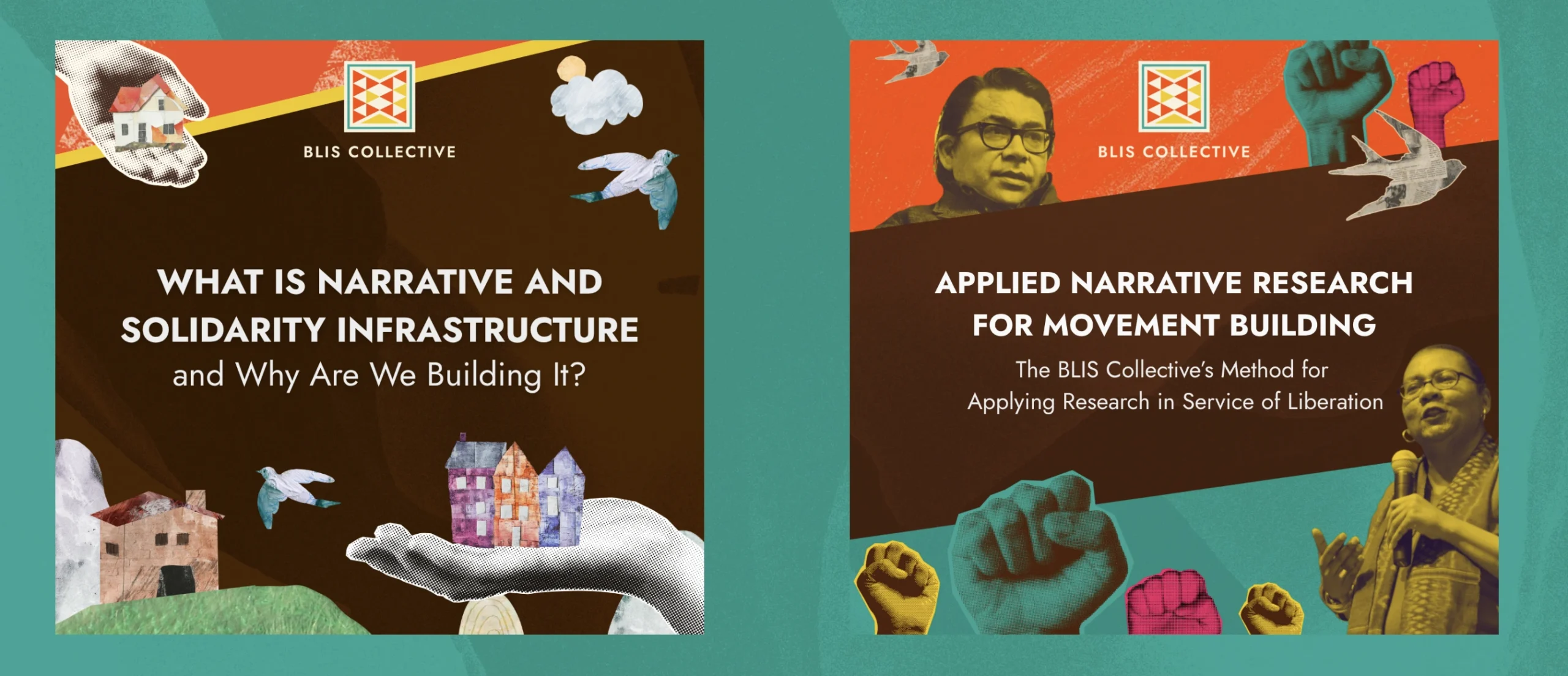
What Is Narrative and Solidarity Infrastructure and Why Are We Building It?
“While the term narrative change has helped shift organizations away from a narrow focus on messaging toward a broader understanding of how societal perceptions, values, and ideologies shape our cultural and political reality, it has also, at times, produced a reformist orientation, one that seeks to adjust or soften dominant narratives rooted in our oppression, rather than dismantle and rebuild them. We believe that this moment demands more of us, and have begun using the term ’narrative transformation’ – because our charge isn’t just to chip away at the stories that uphold inequality, but to fundamentally transform them.” – pg 4
- Introduction: The Crisis at Hand
- What is Narrative Infrastructure?
- What is Solidarity Infrastructure?
- What Narrative and Solidarity Infrastructure looks like at BLIS
- Measuring the Impact of Narrative and Solidarity Infrastructure
- Moving at the Speed of Love

The BLIS Measurement Framework
We measure what we build: narrative and solidarity infrastructure that enables movements and cultural ecosystems to act together over time. Our approach combines quantitative measures with storytelling and membership input, spans multiple time horizons, and honors emergence. We value contribution over attribution, owning our enabling role in a living ecosystem rather than striving to claim sole credit for change.
This framework blends:
- Community-centered metrics
Indicators of hope, trust, and alignment that we will refine with Collective members. - Mixed-Methods
Numbers are accompanied by stories and qualitative insights to provide
context and meaning. - Multiple Time Horizons
We look at short-term outputs, mid-term alignment and narrative uptake, and long-term policy and cultural shifts. - Non-linear & Emergent
We recognize that some outcomes are not always planned or linear, and we approach our measurement of impact pragmatically. - Evolution
We regularly reflect on what we measure, how we measure it, and expect to adapt metrics over time.
Applied Narrative Research for Movement Building: The BLIS Collective’s Method for Applying Research in Service of Liberation
- Part 1 – Understanding Narrative Power
- What is Narrative?
- How Do Narratives Shape Social Movements?
- Part 2: Defining Applied Narrative Research
- What is Applied Narrative Research?
- Why It Matters for Narrative Change
- What Sets Applied Narrative Research Apart
- Part 3: The BLIS Approach to Applied Narrative Research
- Theoretical Foundations: An Interdisciplinary Approach
- Research Methodology
- Part 4: Applied Narrative Research in Practice
- Conclusion
“Narrative transformation requires a critical diagnosis of the current narrative environment and a forward-looking power-building strategy. We hope that the eight dimensions we explore through our research support movements in doing both in an increasingly complex media and cultural landscape.
By systematically examining everything from dominant narratives and public understanding to emotional drivers and movement-building potential, organizations can move beyond hoping their stories resonate to knowing how, why, and with whom they work. This approach acknowledges that narrative transformation is neither quick nor simple, but rather a strategic process that requires deep understanding of audiences, careful attention to power dynamics, and sustained commitment to both rigor and relationship-building with movement and cultural workers.
As movements face mounting challenges—from rising authoritarianism to climate crisis to deepening inequality—the stakes for effective narrative strategy have never been higher.
The difference between movements that achieve lasting change and those that remain marginalized often comes down to their ability to shift the stories that shape public imagination about what’s possible and necessary. Applied narrative research provides the tools to make those shifts intentional, strategic, and measurable.
We opened this paper with the Huey Newton reminder that “Revolution is a process. It is not a particular action, nor is it a conclusion. It is a process.” We begin and end there because this truth sits at the heart of our approach to applied narrative research. Transformation is not a single moment of rupture, nor is it a single victory. It is the sustained, iterative, and collective work of chipping away at structures of power and reconfiguring how people see and interpret the world. In this ongoing process, we believe that research will help us stay sharp, disciplined, grounded, and strategic; not just for us, but for the next wave of movement, narrative, and culture builders who will carry our analysis and struggle forward.” – pg 15
Access Full Resources
About Author
BLIS Collective stands for Black Liberation-Indigenous Sovereignty. The BLIS Collective sparks radical collaboration and narrative alignment between and within Black, Indigenous, and transformative social movements to repair, decolonize, and reshape culture.
They are a cross-movement Solidarity & Action Hub braiding narratives and growing movements to win policy and shift culture. They bring together 45 member organizations and individuals to strengthen solidarity across movements, shift culture, and win transformative policy.
Explore Further
- Liberation Stories: Building Narrative Power for 21st Century Social Movements
- Reparations Narrative Tools and Resources
- Transformational Ethical Story Telling (TEST) Framework
- Narrative and Storytelling: Training and Planning Tools
- Narrative, Storytelling and Messaging Directories and Libraries
- To Build Narrative Power for Reparations, We Need Infrastructure
- The Power of Story: The Story of Self, Us and Now, Marshall Ganz
- Conditions to Flourish: Understanding the Ecosystem for Narrative Power
- Building Narrative Power for Racial Justice and Health Equity
- How to Change the Narrative / Story: Guides, Worksheets and Templates
- Narrative Change: Start Here