Introduction
Rural and regional communities are often framed as places that need to be persuaded, activated, or led from elsewhere. But as two organisers working in these contexts make clear, that assumption misses the point.
This article draws on interviews with Hayley Sestokas (Environment Victoria) and Lucy Graham (Cairns and Far North Environment Centre, CAFNEC), conducted as part of a broader Commons Social Change Library project on effective rural and regional organising and campaigning in Australia. Their insights are supported by a systematic review of Australian and international research on regional and remote organising. Together, they highlight how campaigns are initiated, how strategies are developed, and what enables or undermines progress over time.
Rather than presenting a step-by-step model, the lessons outlined here reflect the realities of working in place-based contexts shaped by strong relationships, diverse values, and long-term exposure to environmental and social pressures. They offer practical guidance for both local organisers and city-based organisations seeking to support this work effectively. Across both conversations, a consistent message emerged: rural and regional communities are not blank slates. They already hold knowledge, leadership, relationships, and lived experience. Effective campaigning depends on recognising and working with that reality rather than importing metropolitan assumptions about strategy, speed, or support.
Key Lessons
- Campaigns are most effective when led by local people already embedded in the community.
- Relationships are the foundation. Strategy follows, not the other way around.
- Build campaigns around what people are experiencing now, not abstract organisational priorities.
- Frame issues through local justice, not national abstractions.
- Work with whoever is willing to engage, even across different values, and actively look for unexpected advocates.
- Trust takes time, so expect slower timelines and invest in long-term presence.
- Adapt to complexity rather than applying ideal strategies.
- Work every available institutional lever, not just community mobilisation.
- Many communities are already living the impacts. Campaigns must reflect this reality.
- External support should strengthen local leadership, not override it. That means investing in regional leadership development for the long term.
1. Effective Rural Campaigns are Locally Led
Both interviews were clear that rural and regional organising begins within the community. Successful rural and regional campaigns are most often initiated and sustained by a small number of highly committed local people. These are people who are living with the issue, observing changes over time, and willing to act.
These campaigns are frequently supported by existing local networks such as Traditional Owner organisations, Landcare groups, citizen science communities, and other place-based groups. In practice, campaigns often cut across issue areas, reflecting the overlap between environmental, social, and economic pressures in regional contexts.
It’s looking at where your most active members of the community are, I guess, as a starting point… all the people who are on the ground seeing what’s happening out in the world. They know their places, and they know what’s changed, and they can tell you the shifts in the world around them. Even bird watching groups and citizen science groups are also really important ones in the local landscape… We also do a bunch of work with community disability and aged care groups, because when we talk about climate change… the drivers of those issues are pretty similar. – Lucy Graham
This reflects a broader pattern: regional campaigns are often grounded in lived experience and sustained through networks that already exist. Effective organising begins by recognising and supporting those structures, rather than attempting to replace them.
Researchers sometimes describe these community members as ‘circumstantial activists’. These are people drawn into politics not by ideology but by a direct threat to their land, water, health or community. Their effectiveness derives precisely from the fact that they are not professional activists: their authority is rooted in who they are and where they live.
2. Start with Relationships, Not Strategy
A defining feature of rural and regional campaigning is its relational nature. In smaller communities, organisers cannot simply build a base of people who already share their politics or worldview. Instead, they must work across differences by engaging with people whose values, priorities, or identities diverge significantly from their own, but who share a connection to place or concern about a specific issue.
We need to work with the people that are showing up, and that means working with people that often have different beliefs and views and sometimes different values to us, and finding ways to communicate and connect with those people in spite of that, or maybe because of that… While tradition and security might not be the values that I would personally put as my highest values… to be able to connect with the local people and run a successful campaign, we had to talk about the things that most connected to them. – Hayley Sestokas
Lucy Graham reinforced that relationships are not secondary to the work, instead they are the work:
Regional, remote work, it’s deeply relational. The most important thing is the relationships you have, not the work that you do, because you will never have enough resources to do the work you need to do well. It relies on relationships, collaborations, and getting people working together… If you’re not focused on the relationships and the interpersonal dynamics of why these problems exist, you won’t ever win. – Lucy Graham
This principle shapes everything from where to start (kitchen-table conversations, not public meetings) to how to measure progress (depth of trust, not contact numbers). It also means there is rarely a point where advancing a campaign should take priority over protecting a relationship. In small communities, burned bridges don’t grow back quickly. In this context, campaigns are built from relationships outward. Strategy follows connection, not the other way around.
3. Build Campaigns Around What People Are Experiencing Now
A key difference between metropolitan and regional campaigning lies in how issues are identified and prioritised. In larger organisations, campaign selection is often shaped by strategic calculations: policy windows, electoral cycles, or opportunities for national impact. In regional communities, campaigns are more likely to emerge from immediate, tangible concerns. These are issues that directly affect people’s land, livelihoods, health, or community.
People who are out in community, they’re not like, ‘I want to work on this because I know it’s the most strategic thing I can do to change this policy issue.’ No, people are like, there is something happening in my backyard that is radically going to affect me or my country… and I’m going to fight for that. So when you’re in bigger organisations, you look at the resources you have and say, where can we work strategically? Whereas in regional communities, you look at the work you have to do and figure out what resources and relationships you can leverage to make sure that work happens. – Lucy Graham
This does not mean regional campaigns lack strategy. Rather, they begin from a different starting point by understanding what matters most to the community, and building from there.
4. Frame with Local Justice, Not National Abstractions
One of the most consistent findings in research on regional organising is the failure of abstract national or global frames in communities that experience issues through entirely different lenses. Climate metrics, biodiversity targets, and just transition packages have repeatedly landed poorly in regional communities. This is not because people don’t care about the environment, but because these frames feel like someone else’s priorities being imposed on their backyard. What resonates instead are three forms of justice that run deep in regional communities:
- Procedural justice: the sense that a community has not been properly consulted, that decisions were made without their voice.
- Recognition justice: the feeling that local knowledge, culture, and experience are being dismissed or overridden.
- Distributional justice: the straightforward anger at seeing local communities bear risks while corporate profits flow elsewhere.
In coal and industrial communities, this challenge is particularly sharp. Research consistently shows that transition narratives which ignore identity, pride, and economic reality trigger defensive mobilisation. This is even among people who privately know the industry is declining. The goal is not to avoid talking about change, but to ensure that change is framed as something the community is driving for itself, not something being done to it.
These things absolutely need to happen, but we totally have to take people with us. We can’t tell them that this is going to happen and we’re going to force this on them. It’s going to be done best and most equitably when everybody can come along, understand what’s happening, understand why, and then be able to advocate for their own needs. – Hayley Sestokas
She also spoke to the deeper shift that’s possible when campaigns find the right frame:
The ‘greenie’ is still a really dirty word out here in a lot of spaces. But we are really changing that. There are new stories that we’re managing to tell, and there are stories that people already feel are right. It’s like: we all love this place and we all love this country, but we just have different ways of doing it. – Hayley Sestokas
This is an important starting point for countering misinformation as well. The regional media landscape presents both challenges and opportunities for campaigners in how they frame their advocacy. In many communities, media is concentrated in a small number of outlets such as a single newspaper, a handful of Facebook pages, or limited local radio coverage. This can make it difficult to introduce alternative perspectives, particularly where dominant narratives reinforce existing political or ideological positions. The media plays a significant role in shaping perceptions of division.
It’s telling the story of how we’re all really different and how we’re increasingly alone… whereas the reality is regional folk do have allies in the city, and we do have power. – Lucy Graham
Both interviewees suggested that countering misinformation requires more than correcting false claims. It involves rebuilding connections, creating spaces for dialogue, and strengthening local networks. Practical approaches included supporting alternative community media, offering training on misinformation, and creating regular opportunities for people to come together. This can happen through forums, gatherings, and informal community spaces. These efforts help counter isolation and provide pathways for people to reconnect across differences.
5. Work with Available People, Values, and Networks
Campaigns in regional contexts must be adaptive. Organisers often work with limited resources, small teams, and a diverse mix of perspectives. Rather than selecting participants based on alignment, successful campaigns involve working with whoever is willing to engage and finding ways to connect across differences.
One of the highest-leverage investments a campaign can make is identifying what researchers call unexpected advocates: leaders with regional, conservative, or resource-industry identities whose credibility lies precisely in their distance from mainstream environmentalism. A farmer who has spent forty years on the same land carries a different kind of authority with other farmers than any environmental campaigner, however skilled. These figures can open doors that are closed to others.
Australian anti-CSG and anti-coal campaigns produced some of the most powerful examples of this: cross-class, cross-ideological alliances stabilised by shared values rather than shared politics. Farmers, environmentalists, townspeople, First Nations custodians, and conservative business owners have campaigned together effectively when the frame is stewardship, fairness, and democratic voice — not progressive ideology. As Sestokas’ example of the Nuclear Free Gippsland Alliance illustrates, this approach enables campaigns to build broad-based support while remaining grounded in local realities.
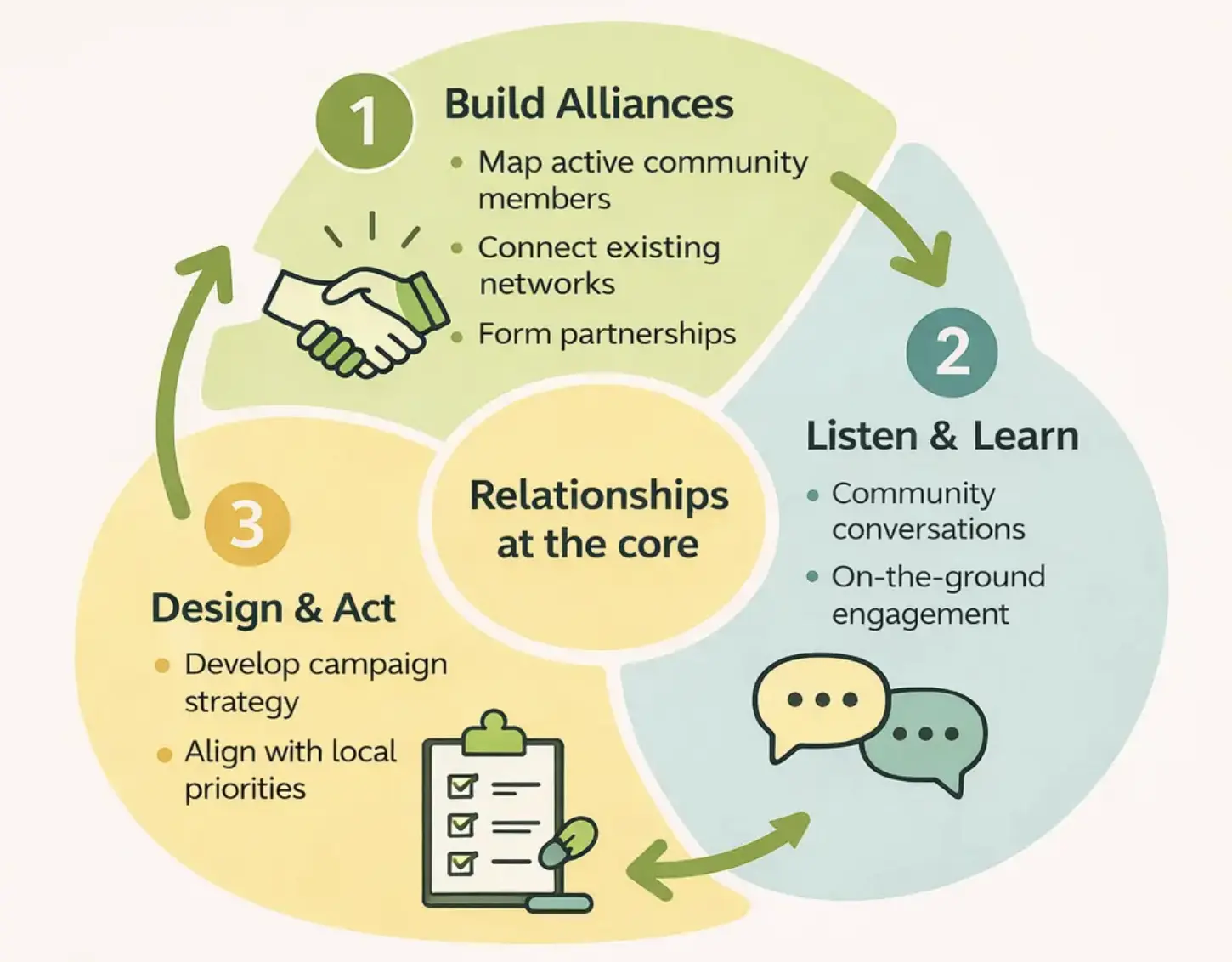
These alliances work in part because regional communities cannot afford the luxury of ideological sorting. In a small town, the person who holds very different politics from you is also your neighbour, your doctor, and possibly your local councillor. First Nations leadership deserves particular attention. In many Australian regional struggles, Traditional Owner groups bring cultural and moral authority rooted in custodianship and long resistance that non-Indigenous partners cannot replicate. Engaging with Traditional Owner groups early, and in ways that respect existing governance structures, is not optional. Instead, it should shape strategy from day one [see Figure 1].

Figure 1: The campaign cycle process
Though complex, campaigns in rural and regional contexts typically follow a three-stage process: building alliances by engaging existing networks and collaborators; listening and learning through community engagement to understand local priorities and concerns; and designing and implementing actions that integrate these insights within available resources and capacities. This process is adaptive and shaped by skill or resource constraints, requiring organisers to work across diverse perspectives and relationships to sustain effective collective action. Crucially, it is iterative. Campaigns evolve through ongoing cycles of engagement, reflection, and adaptation as community needs and conditions change.
6. Move at the Speed of Trust
Organising in rural and regional areas is often slower, more complex, and more resource-intensive than in metropolitan contexts. Trust-building is central to effective organising and it takes time. Distance, limited infrastructure, entrenched political identities, and long-standing community narratives all shape the pace of change.
Organising in regional areas takes time, because we have some really deep narratives and traditional economies and things… Distance is a thing to think about… all of this takes more resourcing. And the deep narratives and stories about who people are as a region and as a community are so important… when we pose alternate narratives that clash with them, there’s just an automatic resistance. – Hayley Sestokas
She also highlighted the importance of consistency and long-term presence:
Moving at the speed of trust… is so important… particularly in regional areas. I think it’s about the consistency and sticking around and showing up… making sure that you’re finding the people who are already there and building up their capacity, because that’s actually the long-term change. – Hayley Sestokas
This emphasis on trust-building has implications for how campaigns are designed and resourced. Short-term engagement or rapid mobilisation strategies may be ineffective or even counterproductive if they undermine relationships that take years to build. Campaigning in rural and regional communities is a long-term process. Progress is often incremental, and success depends on sustained engagement over time. This reflects both the complexity of the issues involved and the importance of building trust within communities. Long-term organising in regions like Gippsland has taken place over many years, but this time and investment has been essential for building relationships, credibility, and ultimately achieving campaign outcomes.
7. Expect Complexity and Adaptation
Campaigning in rural and regional areas requires adapting to complex, place-specific conditions rather than applying idealised strategic frameworks. Organisers must account for geographic distance, limited infrastructure, diverse and often entrenched values, and overlapping social and environmental pressures. As a result, campaigns are often shaped by what is possible within a given context, not what is theoretically optimal.
We have to be something to everyone most of the time. That means that we can’t turn people away and say, ‘That’s not a strategic issue to work on’. We have to find a way to help everyone… and figure out what resources, relationships, and different things we can leverage to make sure that work happens. – Lucy Graham
This complexity also extends to how campaign priorities are set. Regional organisers often need to balance multiple interconnected concerns such as environmental protection, economic pressures, community wellbeing, and cultural values, within a single campaign space. Unlike metropolitan contexts, where issue fragmentation can lead to separate groups or campaigns, regional organisers are often required to hold these tensions together.This can create challenges where local concerns do not fully align with those of city-based organisations. Managing this “agenda drift” requires ongoing dialogue, flexibility, and a willingness from all parties to adapt strategies to local contexts rather than expecting alignment by default [see Figure 2].
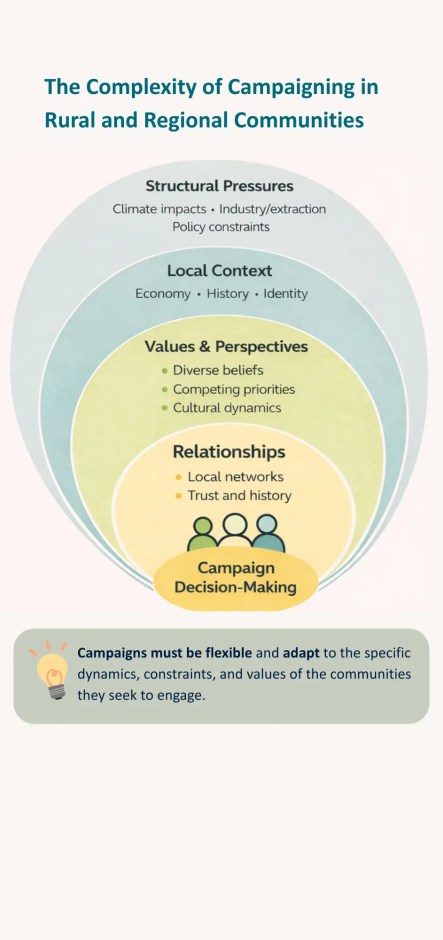
Figure 2: The complexity of rural and regional campaign design
Campaigns in rural and regional communities are shaped by overlapping layers of entrenched social and political narratives, long-term environmental and economic pressures, and diverse community values and perspectives. These interdependencies require organisers to navigate competing priorities and deeply embedded identities, often across historically contested issues. As a result, there is rarely a single “optimal” strategy; instead, campaign design must remain flexible and responsive to place-based dynamics and lived experiences.
8. Use Every Institutional Lever at Your Disposal
While local organising is central to many successful campaigns, both interviewees highlight the importance of being clear about how local actions are expected to contribute to broader change. In some cases, local organising plays a critical role in shaping community attitudes and social licence. In others, achieving outcomes may depend on influencing decision-makers operating at state or national levels. For regional organisers, this often means working across multiple levels at once, requiring building local support while connecting campaigns to wider networks and decision-making processes. Key questions to hold include:
- Social licence: Local action can powerfully shape community attitudes and legitimacy. But broader impact may require linking local efforts to wider media attention or coordinated campaigns.
- Decision space: Not all decision-makers operate at the local level. Campaigns may need to consider whether those being targeted have the authority to enact the changes being demanded.
- Multi-level change: Many forms of social change occur across multiple levels over time. Local organising is often most effective when connected to broader strategies.
Understanding where decisions are actually made is what determines which levers to pull [see Figure 3]. Effective regional campaigns rarely rely on community mobilisation alone. The most successful Australian campaigns have combined grassroots organising with institutional levers at multiple scales: local direct action alongside council advocacy, planning submissions, legal challenges, media work, and national alliance-building.
Local governments have been particularly powerful allies, most notably in Northern NSW anti-CSG fights, where councils ran community polls, formed advocacy committees, and took joint legal action. These institutional tools gave community campaigns access to resources, venues, and legal standing that informal groups cannot access on their own. The public record created by a formal council resolution or poll is far harder for industry and government to dismiss than social media posts alone. This is what some researchers call ‘truth infrastructure.’
Digital tools play a supporting, not central, role in this framework. The most effective digital strategy in regional settings uses online platforms as extensions of existing offline networks: a Facebook page run by known local figures, pushing clear calls to offline action. Ambitious online community-building often fails in regional areas precisely because it tries to replicate the density of urban digital networks in contexts where trust travels through face-to-face relationships.
The best way we’ve been able to cut through is really just by conversations and actually getting out and talking to people. It’s a bit of a boring answer, because it’s probably what every organiser will tell you, but it is the power of face-to-face conversations. – Hayley Sestokas

Figure 3: From local action to broader change. While local organising can shape community attitudes and build pressure, change is contingent on engaging decision-makers with the capacity to act. Consequently, effective campaigns often require coordination across local, regional, and national levels. This highlights the importance of aligning strategies with the relevant “decision space,” ensuring that local efforts are directed toward sites of influence where meaningful outcomes can be achieved.
9. Remember that Many Communities Are Already Living the Impacts
For many regional communities, campaigning is not about preventing future harm, instead it is about responding to impacts that are already unfolding. This was particularly evident in discussions of climate change, where both interviewees described communities already experiencing drought, bushfires, flooding, and long-term environmental degradation. In some regions, these pressures are compounded by histories of extraction, industrial activity, political neglect, and sustained economic or social disadvantage.
We can’t just campaign on preventing climate change now… particularly in Northern Australia, we are at the most risk for a lot of the climate impacts, and we are feeling them now. When you’re on the front line… bad stuff has been happening for a really long time. It’s super systematic. There’s never one silver bullet that fixes these issues. – Lucy Graham
This shifts the nature of campaigning. Rather than focusing solely on future-oriented messaging, organisers are working within communities already dealing with complex, overlapping harms. Campaigns must therefore reflect this lived reality, focusing on both immediate impacts and longer-term change.
10. Strengthen and Invest in Local Leadership, don’t Override it
Regional campaigns are often driven by just a handful of people taking on large-scale issues with limited resources. In small, highly visible communities, being a public campaign leader carries real personal costs: ostracism, harassment, fractured relationships, and the grinding weight of fighting powerful opponents with far greater resources. Lucy Graham reflected on the intensity of this during the Fight for the Reef campaign:
We had been fighting a 4.8 million ton dredge proposal in Cairns Harbor on our own… dealing with some pretty violent vitriol in our community. And I just remember, as a volunteer who’d been fighting so hard… almost feeling tears of relief that there was some support. – Lucy Graham
Research shows that anger drives initial mobilisation, but joy and celebration sustain campaigns over the long term. Gatherings, shared meals, and marking wins explicitly are strategic investments, not soft extras. Hayley Sestokas captured the spirit of what sustains this work:
It’s not just work, right, like this is our life. It’s our reality… As organisers, it’s all about relationships, and they are real relationships with real reciprocity. And when somebody is asking for support, you want to show up. – Hayley Sestokas
City-based organisations cause the most damage when they front regional campaigns, run high-profile actions designed for national audiences without local co-authorship, or extract stories without investing in durable local capacity. The appropriate role is infrastructural and where possible invisible: legal support, research, media training, coordination, and amplification. Lucy Graham described what good support looked like during Fight for the Reef:
They didn’t come in and say, ‘This is how you campaign.’ They said, ‘We would love for this campaign to be included in our big, broader movement.’ And we’ve won, right? – Lucy Graham
A broader structural problem remains: investment in regional leadership development is badly underdeveloped.
It took me three years to find a mentor as a regional director. There’s a really big gap in intentional leadership development in our movement, and particularly in regional areas. Where do regional leaders get to sit with national leaders and share and scheme? – Lucy Graham
Addressing this gap is critical for the long-term strength of rural and regional organising.
Conclusion
Rural and regional communities across Australia have a well-documented history of initiating, sustaining and winning campaigns. The evidence is clear about what makes the difference: organising that starts with relationships rather than strategy; frames grounded in local justice rather than imported abstractions; coalitions that cross ideological lines around shared values; and deliberate investment in the people doing the work.
None of this requires city-based organisations to stay away. It requires them to show up differently: as long-term partners rather than periodic visitors, as back-office enablers rather than public faces, and as funders willing to invest in regional capacity rather than extract regional stories. The communities doing this work already hold the knowledge, leadership and commitment. What they need is support that recognises that, rather than overlooking it.
The strongest campaigns are built from place and with communities, not for them.
Listen to Regional Organisers
Lucy Graham and Hayley Sestokas were interviewed by Holly Hammond from The Commons Library, as part of the Commons Conversations Podcast and 3CR Acting Up show. The interviews were made possible by Pew Charitable Trusts to contribute to research and movement best practice in regional organising.
Rural and Regional Organising: Research Report
Explore the full report, Rural and Regional Organising: A Literature Review, by the Advocacy Research Network.
The literature review draws together evidence from 120 documents on organising and campaigning in rural, regional and remote communities, primarily in Australia, with additional material from the United States, Canada, New Zealand and internationally. It was conducted to support practitioners working in these contexts by synthesising what is known about effective strategies, the outcomes organising produces for participants, and the role that city-based organisations can usefully play.
Report Contents
- Executive Summary
- What We Did
- Research Question 1: History and approach
- RQ2: What kinds of organising and campaigning in remote and regional communities have been most effective, both in terms of issues and working models?
- RQ3: What have been the outcomes for people based in those communities who are undertaking campaigns or organising? Eg community support, community backlash. What could support them in their roles?
- RQ4: What are the most effective roles for city-based organisations for supporting rural and regional organising and campaigning? What should city-based organisations not do?
- RQ5: What should city based organisations consider when seeking to work in/with regional communities? What are the key barriers and enablers?
- RQ6: How does the regional media landscape affect campaigns? What interventions may be useful to counter mis/disinformation in regional areas?
- RQ7: What resources and/or educational content is already available to support rural and regional organising?
- Reviewer’s Commentary
- References
Explore Further
- Watch the Effective Organising in Rural & Regional Australia Webinar Recording
- Rural & Regional Organising: Research Hub
- Rural & Regional Organising: Interactive how-to guide and resource list
- Organising Beyond the Cities: Building Power in Regional Australia
- Advocacy Research Network: Submit a research request or become a volunteer researcher
- Explore social movement research on The Commons Library
- Commons Conversation Podcast: Insights Into Activism