
Introduction
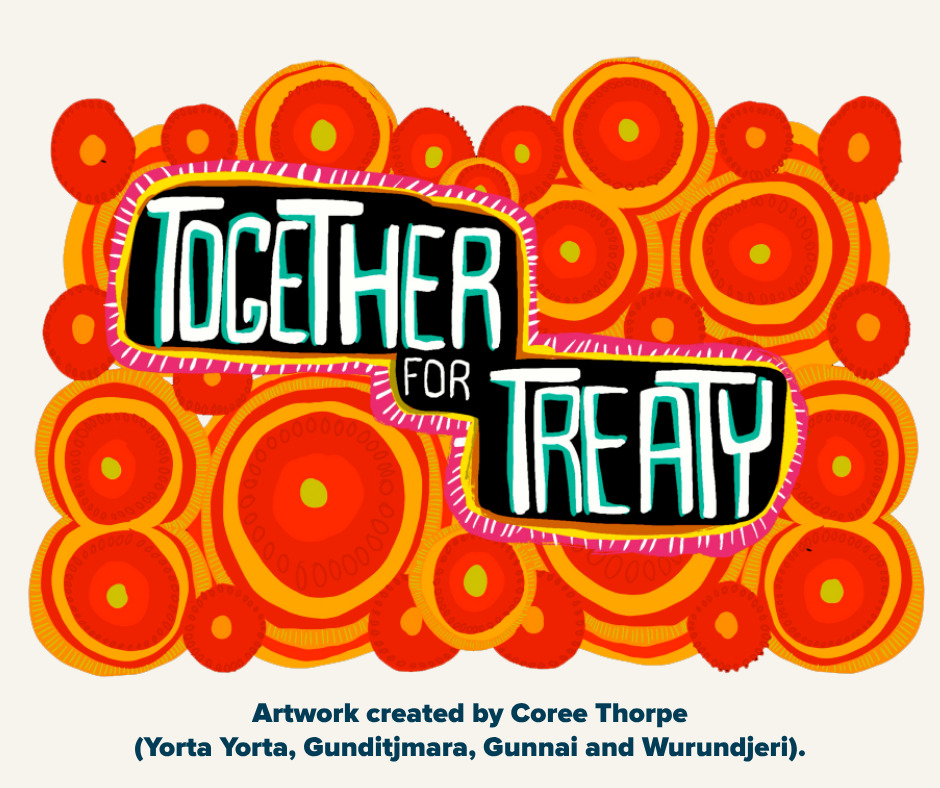
A treaty with traditional owners has been a key demand by First Nations communities for decades. Tamika Sadler and Alex Hill from Common Threads presented a session at Progress 2026 focused on building public support for Treaty and First Nations justice across Australia. The session outlined what Treaty is; the powerful example of the Victorian Treaty; the situation in other states; the Together for Treaty campaign; and how to spread persuasive messages to build support for Treaty.
There’s a role for all of us to play to celebrate and defend Treaty from the far right’s attacks and make sure that the space remains open for mob in all areas across this continent to push forward with Treaty and truth telling on their own terms. We need you to walk this journey with us and you can start today by getting your organisation involved in the Together for Treaty campaign, mobilising your members, amplifying First Nations stories and sparking conversations that cut through the far-right misinformation. – Tamika Sadler, Progress 2026 plenary presentation
The Progress 2026 conference was hosted by Australian Progress on March 24-25 at the Melbourne Convention and Exhibition Centre in Narrm/Melbourne. This article was produced by The Commons Library to enable ongoing learning.
What is Treaty?
A Treaty is a formal agreement between sovereign entities. In the context of First Nations peoples and the Australian government, Treaties would recognize the sovereignty of First Nations peoples and establish frameworks for addressing historical injustices, protecting rights, and creating pathways for self-determination. There are currently processes underway to explore Treaty negotiations at a local, state and national level. – Together for Treaty
‘Treaty is about putting First Nations people in the driver’s seat of decisions that affect our communities, our culture and our Country. Through truth-telling and Treaty-making, we can secure tangible outcomes and justice for our people – and build a more unified future for everyone.’ – Together for Treaty
Treaty recognises that Aboriginal people are the experts when it comes to our Country, culture and communities – and makes sure we can use our local knowledge to come up with and deliver practical solutions to improve health, education and housing outcomes for our communities. – Ngarra Murray, Victorian First Peoples Assembly
Explore the Journey to Treaty timeline from the first moment of colonisation to today.
After the Referendum
In the wake of the unsuccessful 2023 Australian Indigenous Voice referendum, First Nations activists and communities are advocating for treaty.
- 6 million Australians voted Yes! We have an opportunity to build on this momentum.
- Big picture level: We need to keep First Nations justice on the agenda and create the political space for truth to be able to be heard.
- Local level: Share skills and knowledge and mobilize your community.
- Victorian Treaty: This is the first treaty for this continent and will provide a practical model for future treaty making. There is great power in seeing Indigenous people leading in these spaces.
- But we must defend our wins: Victorian Liberals have stated they will dismantle the Treaty if they get elected, and they are trying to turn it into a culture war. We must make that a losing strategy.
Victorian Treaty
Victoria has established a framework, led by the independent First Peoples’ Assembly of Victoria, to negotiate treaties that address historical injustices, recognise Indigenous sovereignty, and set out practical measures such as self-determination, land rights, and cultural protection.
It represents a significant step toward reshaping the relationship between the state and First Nations peoples on a basis of negotiation rather than unilateral control. While Victoria has achieved the first major milestone, by becoming the first place on the continent to sign a formal treaty with First Peoples in November 2025, Treaty remains an ongoing process.
Assembly Members, Victorian Premier Jacinta Allan, the Victorian Cabinet and the Governor of Victoria, Her Excellency Professor the Honourable Margaret Gardner, met Thursday 13 November 2025 at Government House to sign Australia’s first Treaty with First Peoples and give Royal Assent to the Treaty legislation recently passed by Parliament.
The Assembly will form part of a new entity, Gellung Warl, which will also include an accountability arm and a truth-telling body.
For more information see About TREATY for Victoria on the the First Peoples’ Assembly of Victoria website, and Ngarra Murray’s plenary speech at Progress 2026.
What about the other states?
- New South Wales: Committed to a 12-month consultation process in 2023 with discussions beginning in the coming months.
- Queensland: A Path to Treaty process which began under Labor in 2019 was scrapped in 2024 by the incoming Liberal National Party.
- South Australia: Aboriginal leaders are keen for discussions to restart but the state government has said no treaty will be negotiated before the next state election in March 2026. South Australia has the first state-based voice which was legislated in 2023.
- Tasmania: The Tasmanian government has committed to a truth-telling process, but has dropped Treaty discussions.
- Northern Territory: The Country Liberal Party (CLP) government scrapped the treaty process in February 2025.
- Western Australia: Has made no formal commitments.
- Australian Capital Territory: In early 2023, the ACT Government announced it would set up an Aboriginal and Torres Strait Island Eminent Panel. While it was anticipated that this would be established by late 2023, no progress has been seen.
ABC New, 22 February 2026.
Spark Conversations
The presenters shared the Passing the Message Stick framework with the following steps.
1 Lead with shared values
- People form opinions based on emotions, sense of identity and values, not facts.
- Starting with shared values, such as fairness and equality, can create empathy and connection.
2 Focus on First Nations strength and capability
- Avoid deficit language, such as Indigenous communities being ‘vulnerable’ or in need of ‘saving’.
- Emphasise First Nations communities as strong, capable and having the solutions.
- We need to describe the problems we face by describing how we are overcoming those difficulties.
3 Name the unfair barriers that hold us back… and who created them
- By naming who is creating barriers, we help people understand that the problems we face are made by people, and can be solved by people. They are not inherent deficits.
- Example: instead of ‘First Nations people have poorer health outcomes’, say ‘ successive governments have failed to listen to our communities; invest in accessible, culturally safe health services; or provide access to healthy, affordable foods, and adequate refrigeration, clean water and housing.’
4 Combine truth and action
- Our messages need to include truth-telling linked to current injustices or harms. We need to name who is creating the barriers and harms.
- Feelings of guilt need to be channelled into actions. Truth-telling must be linked to actions our audiences can do.
5 Create a collective ‘we’
- All Australians need to feel included and part of a movement for a fairer future. That’s why we used ‘Together for Treaty’.
- Use the rule of threes: ‘we want a country that values all people, whether they have been here five years, five generations, or five thousand generations’.
6 Use simple language
- Use tangible examples whenever possible.
- Instead of ‘self-determination’, say ‘when First Nations people are in the driver’s seat of decisions that affect their communities, practical outcomes and better results follow’.
7 Never negate – don’t repeat what the opposition say
- Don’t myth bust, saying ‘treaty is not divisive’ only reinforces the message of Treaty being divisive. Instead say, ‘Treaty is about having First Nations people drive policies that impact their communities, because they understand their needs better than politicians in Canberra’.
- Lead the conversation, don’t follow. Don’t engage with disinformation.
Final reminders
- You don’t need to be an expert, facts aren’t convincing
- Listen more than you speak
- Find shared values to connect over
- Amplify First Nations voices
- Focus on First Nations strength, leadership and capability
- Share your story: Why do you care about First Nations justice?
Together for Treaty Resources
Download Community Resources from Together for Treaty including:
- Posters
- Conversation Guide
- Kitchen Table Conversation Guide
- How To: Letter to the Editor
- Taking Action for Treaty: Supporter Guide
About Common Threads and Together for Treaty
Common Threads is a new First Nations led organisation, harnessing the power of First Nations leadership, advocacy and change-making to win transformative change. Common Threads convenes Together for Treaty, a national movement of First Nations people and allies standing side-by-side for truth-telling, Treaties and justice.