

Introduction
Insurrectionary Uprisings: A Reader in Revolutionary Nonviolence and Decolonization is an extensive compendium of essays, speeches and interviews, freely available to download. It is edited by Wende Marshall & Matt Meyer.
The editors have gathered together some of the most important thinkers on radical nonviolence and its potential for bringing about revolutionary change. A broad range of perspectives are brought into conversation with each other, across time and place, to grapple with the complexities involved in challenging unjust systems and creating change. In bringing together diverse experiences, contexts and worldviews, the editors hope to explore both the commonalities and differences in thought, such that we may distill the lessons of the past and build the necessary coalitions needed to challenge today’s global capitalist order.
Wende Marshall and Matt Meyer have dedicated their lives as activists and scholars to challenging the injustices of globalised capitalism by bringing people together across differences. Published in 2022, this volume includes important perspectives on decolonisation as well as how we might approach revolutionary nonviolence in the early 21st century.
The book challenges the idea that there can be a universal strategy or singular ideal disseminated by ‘experts’, instead arguing that wisdom must come directly from the people and grassroots movements. By bringing together sometimes conflicting perspectives and voices, they argue we are better able to understand the complex ways in which struggles are interconnected, but also differentiated. They challenge us to look beyond our local framing or single issues to see the ways in which globalised systems such as colonisation and racialised capitalism shape all our struggles, while at the same time cautioning us against seeking any single solution.
The revolution we need will surely require more reading, writing and dialogue – some of it in forms much less public than a published book. We can only hope that this effort sets some spaces for these dialogues to take place. – Wende Marshall & Matt Meyer, page xx.
The book is organised into seven parts, which I will briefly introduce, to follow the trajectory the book takes to link the past to the present, in order to inform the future.
Part 1. Contemporary Roots of Radical Nonviolence: Before and Beyond Gandhi
The work of Mohandas Gandhi is often seen as a turning point for debates around the effectiveness of pacifism, and radical or militant nonviolence. This section is opened by Gandhi’s grand-daughter Ela, who was born and raised in South Africa and became a member of Nelson Mandela’s government; it is followed by the writing of Henry David Thoreau, an important influence on Gandhi’s thinking about the force of militant noncooperation and resistance. Hannah Arendt’s thoughts compliment this section by examining the nature of violence, and exploring whether the means may come to overwhelm the ends.
Authors in this section: Ela Gandhi, Henry David Thoreau, Hannah Arendt, Mohandas K. Gandhi, Pyarelal, Milan Rai, Arundhati Roy, Starhawk.
Part 2. Roots of the US Black-led Freedom Movement
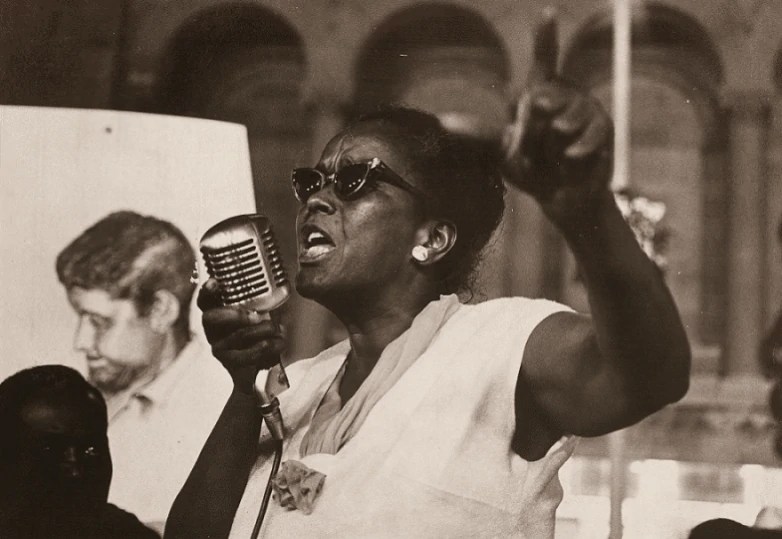
The US ‘civil rights’ movement is often seen as inheriting Gandhi’s practice of radical nonviolence, and while Gandhi’s influence is undeniable, this section seeks to explore some of the lesser known influences on the movement, such as that of Vincent Harding, who helped co-author MLK’s ‘Beyond Vietnam’ speech. A pivotal moment for the movement, which connected the struggles of Blacks suffering in the US, with those across the seas also suffering under the same white supremacist logic of the US empire. Theologian James Cone and Vincent Harding explore some of the parallels between Malcom X and MLK’s thinking, while the important role women played in the movement is highlighted in the works of Fannie Lou Hamer, Ruby Sales and Ella Baker.
Might events have taken a different path if we had found a way to infuse our struggle for Black Power with King’s philosophy of nonviolence? Is it possible that our relationships with one another today, not only inter- but intra-racially, would be more harmonious if we had discovered how to blend Malcolm’s militancy with King’s vision of beloved community? Could such a synthesis have a revolutionary power beyond our dreams? – Grace Lee Boggs, page 90
Authors in this section: Ruby Sales, Martin Luther King Jr, James Cone, Vincent Harding, Ella Baker, Grace Lee Boggs, Fannie Lou-Hamer.
Part 3. Self-determination, Self-defense and the Rise of Black Power
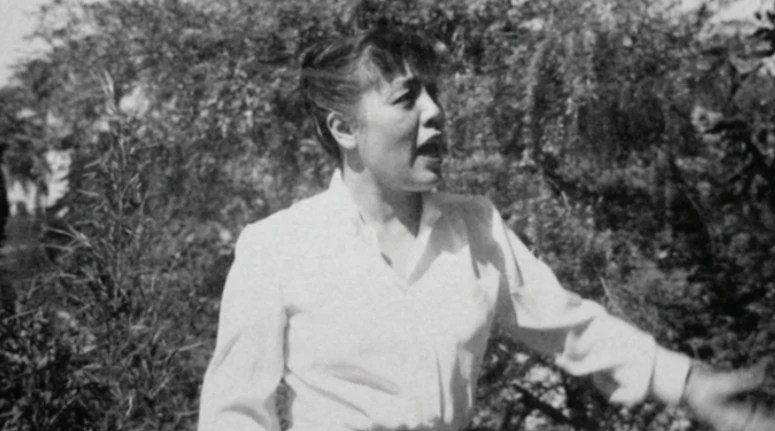
Following the devastating losses of Malcom X and MLK, the period from the late 1960’s till the 1980’s track a period of division within Black liberation movements, between those who felt that the limits of nonviolence had been reached, and those who continued to champion its usefulness. There was a sense of having to choose between the philosophies of Malcom X and MLK, even as we see in the previous section that the two came closer to one another’s thinking as they matured. This section is about leaving behind the conflicts of the two forefathers of the movement and forging a new coalition that rejects the divisiveness of this false dichotomy. The section is opened by Mareille Fanon, daughter to Franz Fanon, arguably the most important decolonial, internationalist political theorist, who grappled throughout his career with the question of violence in the liberation of the colonised.
Gandhi once said that although nonviolence is the best method of resistance to evil, it is better for persons who have not yet attained the capacity for nonviolence to resist violently than not resist at all… Nonviolence without resistance is like a soul without a body. – Dave Dellinger, page 126
Authors in this section: Mareille Fanon Mendès-France, David Ragland; Matt Meyer; and Natalie Jeffers, Student Nonviolent Coordinating Committee, Gwendolyn Zoharah Simmons, Dave Dellinger; Robert Franklin Williams; Martin Luther King Jr; and Dorothy Day, Mel Paisely, Sally Bermanzohn, Aislinn Pulley, Colin Kaepernick, Russell Maroon Shoatz and Steve Bloom.

Part 4. Revolutionary Nonviolence in Africa: Playing Between the Cracks
The African continent, in many ways considered ‘off the radar’, yet absolutely central in the development of effective, creative and potentially replicable campaigns and strategies for liberation movements which encompass small-scale grassroots affinity groups as well as large, multinational settings. It is in this section that the praxis between armed revolutionary struggle and the practice of radical nonviolence is realised. From this generative interaction, how might we produce new ways of imagining a post-colonial future?
Authors in this section: Kassahun Checole, Graça Machel, Frantz Fanon, Barbara Deming, Amilcar Cabral, Bill Sutherland and Matt Meyer, Nozizwe Madlala-Routledge, Kenneth Kaunda.
Part 5. ‘Combative Pacifism’ Against Patriarchy: Feminist Critiques of Movement Building
No exploration of the historical roots of nonviolent resistance can be complete without exploring the role gender has played in hierarchies of domination, and within the movements for liberation themselves. Thus, in this section the book contends with Audre Lorde’s righteous anger towards white feminists, the eco-feminism of Ynestra King, and the struggles of realising a truly feminist society in an interview with Nazan Üstündağ, of Rojava (also known as the Autonomous Administration of North and East Syria). This section explores the intersections of race, colonisation, class struggle, sexuality and gender in forging a new internationalism that addresses the root causes of these structures of domination.
Authors in this section: Ynestra King, Leora Skolkin-Smith, Women’s Pentagon Action, Arundhati Roy, Audre Lorde, Barbara Deming, Johnnie Tillmon, Beth E. Richie, Nazan Üstündağ, Leslie Feinberg.
Part 6. Resistance Against Empire
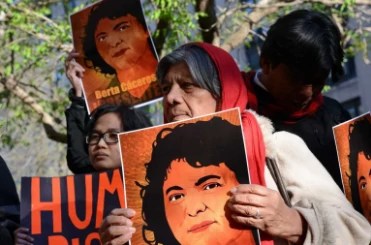
This section grapples with the particular ways in which colonisation as an ongoing process shapes our narrative framing, the systems under which we live and the institutions we often need to engage with in order seek liberation. In order to understand the ‘coloniality of power’ we need to analyse the role colonisation played in spreading a racialised, global capitalism throughout the world. Decolonial theorist Aníbal Quijano explores the ‘coloniality of power’, and Maria Lugones builds on his work to explore the gendered aspect of colonisation which spread ideas of gender binaries and hierarchies throughout the modern world.
Authors in this section: Wende Marshall, Berta Caceres, Haunani-Kay Trask, Wende Marshall, Maria Lugones, Aníbal Quijano, Aimee Carillo Rowe, Lolita Lebron.
Part 7. Revolutionary Nonviolence in the 21st Century
It is hard to imagine a more pivotal moment of collective awakening than the COVID 19 Pandemic, which locked down vast swathes of people across the globe and shone a light on inequities. The most essential workers were forced to brave the virus in order to keep society operating, often at minimum wage, while the ruling class saw huge increases to their wealth during a time of massive job losses.
In this collective moment of stillness, people paused long enough to imagine the world anew, and cries to never return to ‘normal’ echoed across the globe. As much of the world sat glued to their screens, the graphic killing of George Floyd sparked a surge of protests across the US and the world, as his final words ‘I can’t breathe’, struck a chord for so many, struggling under the weight of insurmountable debt, precarious, unending work, and disappearing safety nets.
This last section is a clarion call to action for those with the most privilege to use that privilege to bring forth a new world where power and privilege is redistributed. In the words of the editors;
If a new nonviolence, a decolonized, justice-driven peacemaking, is to emerge from the rubble of contemporary disasters, it must be because the lessons of the wretched of the earth, the most dispossessed who are also the best architects of ingenious social change, are learned and heeded by those who must give up privileges while fighting for a complete reallocation of power as we know it. Insurrectionary uprising must become more common and more global than infectious diseases, and our healing must be universal – for all humankind and for the earth. – Wende Marshall and Matt Meyer, Page vi
Authors in this section: Matt Meyer, Cooperation Jackson, Kali Akuno; Rose Brewer; Saki Hall; Wende Marshall; and Matt Meyer, John Holloway, Subcommander Moisés, Nick Estes, Mark Muhannad Ayyash, Wende Marshall.
Conclusion
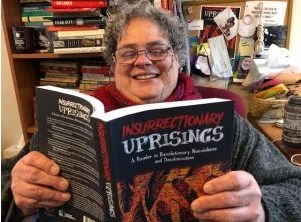
What I loved about this collection was the way it brought together different voices and experiences: scholars, activists, and resistance fighters from a multitude of regions across a span of time from the late 1950’s to today. In doing so I was able to traverse the stretch of radical thinking, foregrounded in the US civil right movement to understand the powerful influence Gandhi and his particular brand of militant nonviolence had on the thinking of liberation movements across the US and South Africa. I came to better appreciate the benefits of radical nonviolent struggle, while holding on to my belief that at times there is a place for violent struggle.
I gained much from the essays on decolonisation which explored the process of decolonising our minds and the ongoing process of unlearning the colonial framing of the world which has been rendered invisible to us. Learning to see coloniality means moving through the world with a sharpened awareness of the narratives presented to us—and of how they sustain colonial structures which, once recognised, no longer seem inevitable or immutable.
While the last section was written during a moment of hope amidst great suffering, reading this five years later has given me a longer view to that of the editors. Capitalism has shown its resilience in the face of the pandemic, but challenges continue to emerge.
As I write this in 2025 Israel’s genocidal attacks on Gaza continue, supported and aided by Western leaders. With Trump in the Whitehouse, all pretense is gone, the masks are off and the inhumanity of imperialism and capitalism are on full display. People’s movements around the world highlight the connections between capitalism, colonialism, authoritarianism and climate change.
Perhaps these ruptures to the Western narrative offer a crack into which we may plant seeds for a genuine internationalism, great enough to challenge the global elites and their techno-fascist imaginings for our future.
Let this book move us, and move us to act together.
Download the book
Download the free PDF of Insurrectionary Uprisings: A Reader in Revolutionary Nonviolence and Decolonization.
Watch Video
Wende Marshall & Matt Meyer on Insurrectionary Uprisings, April 9, 2022
About the Reviewer
Yuki Lindley is an activist, mother, and student of political philosophy and theory. I’m interested in understanding how power shapes our world, in order to find new ways of seeing that expand our ability to imagine and build different worlds.