
Introduction
In 2020, the Indian government introduced three farm bills, which allowed private sales outside government ‘mandis’. They were introduced as part of an agricultural privatisation policy. However, they were seen not as economic reforms but as assaults on Punjab’s and largely India’s agrarian legacy. The existing ‘mandi system’ (government-run trading markets) weren’t just markets; they were social-financial hubs offering Minimum Support Prices (MSP), credit systems, and governance support.
India’s 2020 farmer’s protest represents not merely political reaction to the farm laws, but a catalyst of social transformation – redefining rural identity, solidarity, and the relationship between citizens and the state. This article delves into how the protest demonstration as a participatory action succeeded in bringing social change in the region.
Social Uprising
Soon after the rolling out of the bills, the disgruntled farming communities resorted to protest demonstrations. The movement originated in Punjab’s ‘Majha’ region. Revered as the ‘land of warriors’ for its legacy of resistance against injustice, farmers from across this rural heartland mobilized through local unions, forming a coordinated and intentional protest. Farmers engaged in ‘horizontal learning’. Youth groups, women’s collectives and digital activists shared knowledge on farm laws, legal consequences and constitutional rights. This took them to the diagnostic phase: identifying the unjustness of the law and constructing a shared understanding of collective action. Collective planning was achieved by the farmer’s union delegating responsibilities to village committees, village-level clusters and loose federations.
Kisan Ekta Zindabad (Long Live Farmers’ Unity) became the hallmark of the protest, echoing unity and collective resistance.
Dabbling through India’s caste-based divisive social system, the unions successfully managed to bring all caste groups (Sikh, Dalit, Jats and other non-agrarian communities) on the same pedestal while diluting any inherent factionist tendencies.
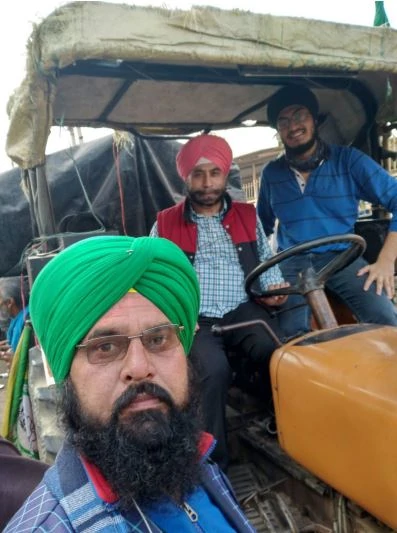
As their strategy moved to the next step, thousands of tractors, trucks, and cars, loaded with food and water, set out from Punjab and later Haryana, aiming to encircle India’s capital, New Delhi, and block all entry and exit points. This was a calculated pressure tactic to compel the central government to respond to their demands, especially after earlier efforts in Punjab failed to attract media attention.
Despite heavy resistance from state and union authorities, who deployed police and paramilitary forces at key checkpoints, the unarmed farmers simply pressed forward, largely avoiding conflict, and reached Delhi’s borders within days. The plan proved effective: in the following days, government officials and union leaders engaged in repeated negotiations to address the farmers’ concerns. From a social change point of view, as soon as the government and the farm unions sat together for discussions, the legitimacy of the protest was established. The protest sites also represented the reflection phase of the movement, where participants reviewed strategies and revised future demands according to changing circumstances. They held press conferences and nightly discussions, creating a sustainable movement.
Farmers were prepared to not just spend weeks on the protest sites, but months, even years till their demands were met.
Moment of Awakening
As negotiations progressed, the farmers’ protest evolved from opposing legislation to a broader social movement addressing rural cultural concerns. Over the course of a year, protesting farmers developed a gradual political consciousness, from challenging the law in legal terms to broader reforms toward preserving farming tradition. Through educational philosopher Paulo Freire’s lens, the farmers slowly recognized their social and political subordination to the neoliberal market structure, by engaging in a dialogical education. This happened in the form of mass meetings, village sabhas and social media forums.
For the background, Punjab’s identity is deeply rooted in agriculture. Land ownership, folklore, and Sikh traditions all stem from farming. The farmers’ unions rallied under the slogan “Kisan Ekta Zindabad”, which operated as a powerful instrument of collective identity formation. Punjabi Singers, loved by many in India, joined protests and sang folklore and songs that boosted the spirit of farmers. In a way, the soft power of the songs supplemented greater understanding of the social impact of the laws. The Freire concept of codification and decodification was achieved at this stage where the slogan transcended occupational and regional divisions, serving as a discursive tool that invoked solidarity across class, caste, and community lines.
On 26th January, 2021, it was decided that farmer unions would organize a tractor rally on the outskirts of New Delhi. 26 January is marked as the ‘Republic Day’, marking the creation of India’s constitution built on egalitarian and democratic values. Farmer unions chose the auspicious day for a grand tractor rally as a symbolic act of democratic assertion. It was chosen as a way for farmers to reclaim the national day and display their agency as citizens.
In Freirean terms, it was a praxis-driven performance. The message was clear: ‘we will occupy the space of the nation if you exclude us from policymaking’. However, the rally deviated from agreed routes, leading to clashes with police and the storming of Delhi’s historic Red Fort. This exposed the disruptive tendencies of the protest and reflected Freire’s warning that action without proper reflection can easily descend into blanket confrontation without any meaningful social change. It was a moment of collective reflection on the ‘praxis’ itself – a recognition that transformative struggle must be accompanied by careful planning and coordination.
The farmer’s protest, with all its faults, was the first movement managed with bureaucratic precision and careful planning, and with a religious and national fervour unmatched, it gained the support of millions of people in India and across the world.
Digital Mobilisation
The protest saw social media become a battleground for challenging narratives. Farmers, deemed uneducated by many, took to Twitter to counter the government’s claim that protestors were “anti-national terrorists” blocking Delhi. The #KisanEktaZindabad hashtag spread across millions of tweets, not just to resist propaganda but to raise issues of rural importance. With their communication rights under threat from state-supported and corporate media, farmers launched their own community media.
The Kisan Ekta Morcha coalition became the movement’s mouthpiece, addressing both rural and urban audiences. It promoted local culture, built networks, tackled fake news and hate speech, and made the movement more people-centric. As the agitation intensified, the growing online presence exposed the hypocrisy of national media.
Finally, after a long wait of close to a year, the government, with increasing pressure from farmer unions and the need of avoiding electoral miscalculations, conceded to the movement’s demands. The laws were repealed on December 1, 2021. The repeal of the laws marked the victory of collective social consciousness, breaking down barriers of caste and religion, and reaffirming the power of unity and democratic participation in shaping public policy.