
Introduction
The Tree Hugs movement won the argument over trees and lost the argument over accountability. Its petition to Hanoi’s People’s Committee made three demands: stop the felling, open up the decision, and hold officials to account. The first was met within four days. The other two never were. That gap is the lesson.
The movement began with a dismissal. On 17 March 2015, a Hanoi propaganda official was asked whether residents had been consulted about plans to fell 6,700 street trees. There was no need, he replied. Within days, tens of thousands of Hanoians had answered him on Facebook.
No single organisation led the response. It was a loose network of three Facebook groups, drawing mostly young people and women.
Why 6,700 trees became a turning point
The plan was approved in late 2013 without public notice. It would replace 6,708 trees on 190 streets for about US$3.4 million. Officials called it landscaping. Residents saw healthy, century old trees, many planted under French rule, falling within days in a city that shelters under their shade.
Speaking out carried risk. Vietnam has no independent press or protest law, and planning law lets citizens comment without obliging officials to consult them. On 16 March, a journalist’s open letter asked the city to pause. The official’s dismissal the next day turned private grief into public action.
…Tons of bombs B52 by Americans failed to destroy our old trees during wartime, why authorities dare to cut them down now? – Hanoi resident, quoted in Vu (2017).
From love to accountability: how the movement worked
A fast first win. The first group, 6700 People for 6700 Trees, was started by a young mother and soon drew in NGO leaders and experts. Its sequence was deliberate: gather evidence, work with journalists, petition, and only then protest. Each step lowered fear before the next. The approach worked. Their petition, citing constitutional rights to information and participation, gathered 22,000 signatures in less than a day. On the morning of 20 March, small groups carried it to city offices. That afternoon, the felling was suspended.
The suspension was not an admission. Officials acknowledged no wrongdoing and would not rule out resuming. Activists read it as a gesture, not a change of course.
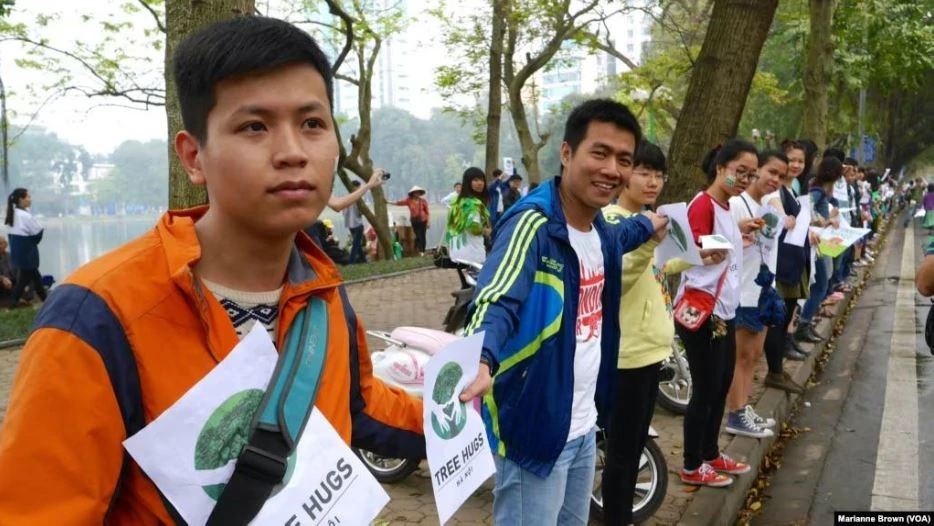
Taking it to the street, with love. Organisers then took the remaining two goals to the street. On 22 March, several hundred people gathered at Thiền Quang Lake, tying ribbons, singing and wrapping their arms around trunks. The petition asked for accountability. The street message was love. Pressure began within days regardless. Police warned a group member, called in students who had joined or tied ribbons, and told newspapers to stop covering the project. Independent activists who had been branded “reactionary” were asked to keep away by the 6700 People group.
It is not our hatred but our love which can save our city – 6700 People for 6700 Trees, Facebook, 18 March 2015, quoted in Vu (2017)
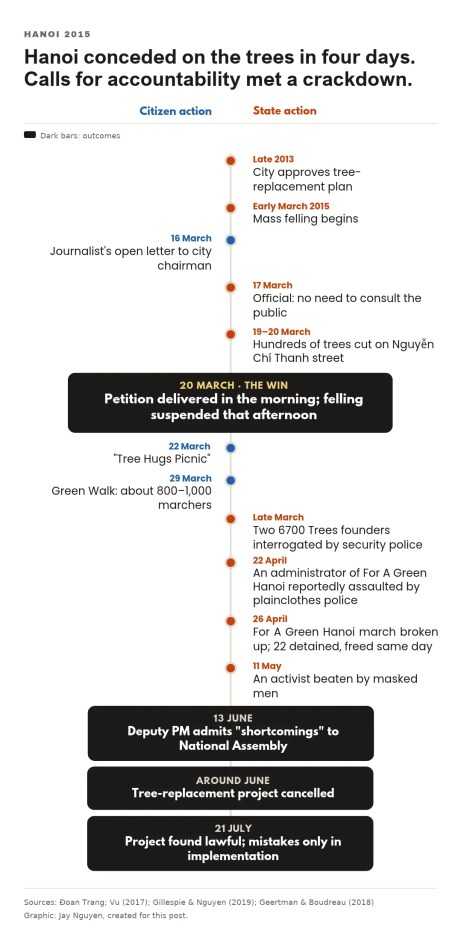
Pushing for answers. A second group, 6700 Trees, set up by architects, led a Green Walk on 29 March. Soon after, two of its founders were interrogated by security police, and the group stopped protesting. Those unwilling to stop formed a third, For A Green Hanoi. It kept pressing the accountability demands and added sanctions for those responsible. Its marches circled Hoàn Kiếm Lake, beside city government offices.
The state escalated in step. On 22 April, one of the group’s administrators was reportedly beaten by plainclothes police. On 26 April, 22 marchers were detained, among them young women in áo dài. Hanoi’s Party Secretary, Phạm Quang Nghị, first expressed empathy, then blamed “forces of evil” from outside.
We, citizens, are entitled to demanding a transparent and accountable government, and we can do it – For A Green Hanoi Facebook page, 16 April 2015, quoted in Vu (2017)
The pattern held throughout. The city gave ground on the trees, a concession it could present as its own responsiveness. As citizens pressed for answers, repression grew.
Why it faded. The groups withdrew one by one. Universities and families pressed students to step back, and facing arrest, organisers cancelled further street protests. By July 2015 the movement had wound down.
What changed, what didn’t, and what to take away
The movement won real ground. The city ordered an inspection and, about three months after the protests began, cancelled the programme and disciplined middle- and lower-level officials. Legal scholars John Gillespie and Quang Hung Nguyen read this as officials, publicly shamed, restoring their uy tín, or moral standing, not sharing power.
Openness and accountability were never achieved. The city did begin to listen, but only on its own terms. It consulted when it had to, without accepting any right for citizens to share decisions. Its final review in July found the project legal and procedural, with mistakes only in implementation.
So was this social change? In civic practice, yes. It produced a network, new skills and a public record. Unlike earlier Hanoi campaigns over urban planning, it also moved from expert petitions to the street. In how the city makes decisions, no. NGO participants themselves called it a test of civil society, not a victory.
For A Green Hanoi later became Green Trees, which went on to document the 2016 Formosa marine disaster: a quieter name, not quieter work.
The most transferable legacy is the solidarity infrastructure that let members keep going: lawyers’ open letters, experienced activists accompanying newcomers to the police station, and a legal complaint by the 22 detainees, which Đoan Trang’s Timeline describes as the first by Vietnamese protesters against those who suppressed them. The public record matters too. When state media controls the story, a dated record of events is itself a form of resistance.
Our small action might set a small brick on the way, but it will make a difference in the long run if we persist – New activist, For A Green Hanoi, quoted in Vu (2017)
Communication for Social Change
This article was submitted to The Commons Library by a student completing Communication for Social Change at the University of Queensland. Explore other case studies from UQ students.
Explore Further
- Timeline of the tree-felling project and tree protecting campaign in Hanoi
- Hundreds in Hanoi Protest Tree Cutting
- Hanoi Citizens Protest Tree-Felling Plan
- Grassroots Environmental Activism in an Authoritarian Context
- Between authoritarian governance and urban citizenship
- The Influence of Social Media in Vietnam’s Elite Politics
- Protests: Start Here