|||Photo by Dean Pugh on Unsplash|Book – James Price Point: The story of a movement by Damian Kelly|Julian Meehan's Flickr website – https://www.flickr.com/photos/140724511@N03/albums|https://www.nla.gov.au/legal-deposit
Get Archiving! Archivist Activist Backpacks, Hackathons and Other Ideas
A list of ideas for activists to archive their movements & moments including archivist activist backpacks, hackathons, collaborations, crowdsourcing archives.
Here is a list of ideas for activists to archive their movements & moments. e.g. archivist activist backpacks, hackathons, crowdsourcing archives.
Here are some ideas to get you started!
Archiving isn’t just about the old stuff, it is also about the now. You can archive as you go by being involved in the creation stage.
Ideas
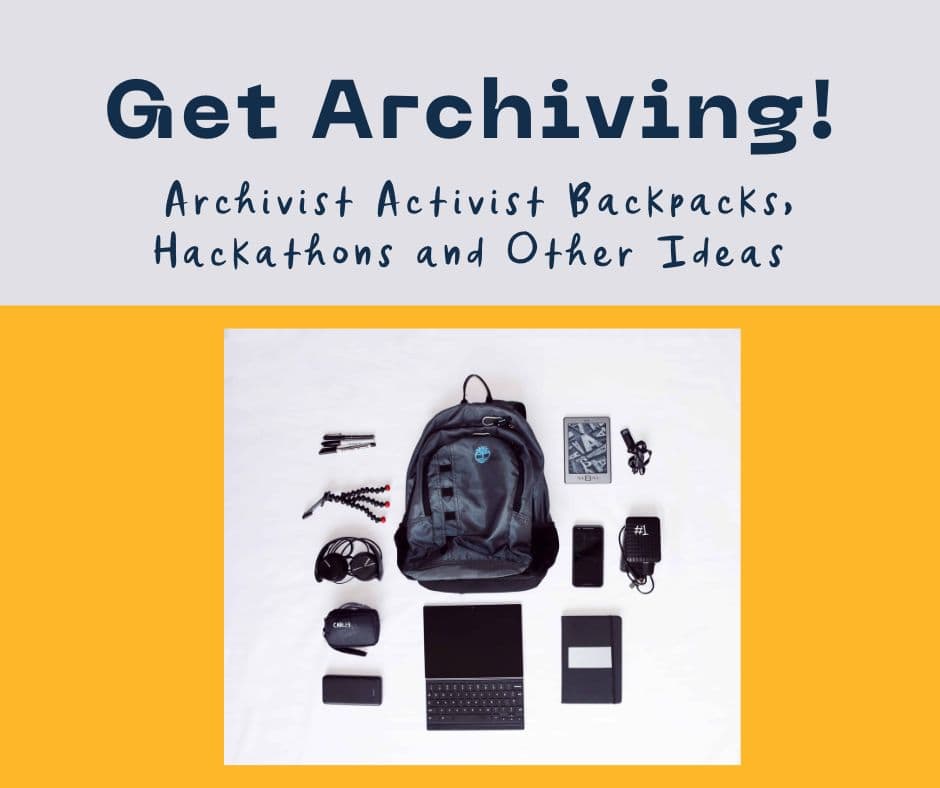
Set up Activist Archivist Backpacks
Supporters can capture and gather videos, interviews, images, stories, stickers, posters, etc at protests or particular movement moments. Items to put in the backpack may include:
Notepad and pen
Laptop
Camera and/or smartphone
Microphone and recording equipment
Thumb drive or hard drive (to copy digital files between devices)
Hold an Archivist Hackathon or Wikipedia Editathon
Invite people to remix and adapt your group/organisation’s resources into something new.
Create a space, online or in person, for people to play, innovate and problem-solve with your archives to make new content such as the Interference Archive do.
Set up an online archive and invite the community to tell their own stories. Examples include the US Occupy movement and Ferguson Uprising. This has been done using opensource, free software such as Omeka. See Crowdsource your archives: Community-based approaches to archives.
Images, images and images…
Have images uploaded from different people and groups to a central place using a platform such as Flickr. 350.org and Lock the Gate Alliance do this well.
Grab images that capture your movement such as batch downloading creative commons photos off Flickr using Bulkr.
There are many generous photographers such as Julian Meehan and John Englart (Takver) who have captured movement moments, posted them on Flickr, and made them available under Creative Commons licences.
Grab it before it’s gone: Social media archiving
With the ephemeral nature of social media and media platforms, such as YouTube, you may want to think about archiving your social media and videos now. See Tips and tools for archiving video and social media.
In Australia, there are libraries that will take care of your resources both hard copy and online. This system is called Legal Deposit which is a legal requirement for Australian publishers (this includes not for profits) to forward a copy of your publication(s) to the National Library of Australia and your state library. Most people don’t know this and there are no legal deposit police lurking in the corner. The process of legal deposit is easy – one can do it online or send in hard copies.
Hard copies: Start collating your hard copy publications, ephemera such as stickers, posters, brochures, etc. into a box and when it is full send if off the National Library of Australia and your state library.
Set up a staff/volunteer role to be in charge of legal deposit.


 Set up an online archive and invite the community to tell their own stories. Examples include the US Occupy movement and Ferguson Uprising. This has been done using opensource, free software such as Omeka. See Crowdsource your archives: Community-based approaches to archives.


 In Australia, there are libraries that will take care of your resources both hard copy and online. This system is called Legal Deposit which is a legal requirement for Australian publishers (this includes not for profits) to forward a copy of your publication(s) to the National Library of Australia and your state library. Most people don’t know this and there are no legal deposit police lurking in the corner. The process of legal deposit is easy – one can do it online or send in hard copies.