Introduction
In March 2025, three Indonesian students gathered at a coffee shop in The University of Queensland (UQ) and decided to do something unprecedented. Within three hours, they formed Brisbane Bergerak [Brisbane in a Motion], a grassroot collective movement challenging the traditional silence of Indonesian students studying overseas toward their homeland’s democratic backsliding. This article, based on interviews with members of the group, discusses their response.
Breaking the Silence
The formation emerged from frustration. Despite the national #IndonesiaGelap (#DarkIndonesia) movement protesting the government’s abusive and absurd policies, Indonesian students in Brisbane reacted with an unlikely bold statement regarding the critical issues affecting their nation. While there was another intellectual and critical forum conducted to discuss about Indonesia’s situation, they were keen on the need to act more.
We are not just do the talking in forums, we have to do something. We have to show bold movement. Brisbane Bergerak member, 2025.
Inspired by Melbourne Bergerak (infamous for large Indonesian activism abroad) and Mohammad Hatta (the first Indonesian vice president and a leader of the independence movement), the founders had backgrounds in union organising and campus labour activism. They converted their critical discourse to concrete action, demonstrating care for Indonesia.
Their first move came on May Day 2025. Three people walked through the UQ premises distributing flyers and raising their voices. Standing at the Chancellor’s place, they joined the international labour movement’s day of solidarity. Through modest and admittedly awkward, it established a crucial precedent: Indonesian students bridging physical distance with the existence of attention, claiming university places as sites of power. Even when initiated by a small number, these tactics exemplify the hallmark of social movement strategies.

Building Solidarity Without Hierarchy
Brisbane Bergerak deliberately rejected traditional organisational structures. There would be no leader or coordinator to reflect both practical concerns about operating as international students and ideological commitments to distribute the horizontal power dynamics.
The collective operates on shared concern which differs from formal hierarchy. Condemning the militarism, capitalism, and feudalism of Indonesia, they believe individual leadership bounds social change action. This structure, they argued, makes movement more resilient and harder to infiltrate. They maintained coordinated activities and shared goals through consensus-based planning.
If we define organisation as formal structure, we’re not that. But if organisation means something organised, with mission coordinated activities; then yes, we can claim that. Brisbane Bergerak member, 2025.
Operating from abroad limits directs confrontation with Indonesian institutions. Brisbane Bergerak pursues diplomatic engagement through international attention. They show that problems regarding Indonesia are not exclusively confined to its national borders but connect to global struggles. Their Palestine solidarity work, for instance, stems from consistent antimilitarism principles rather than religious sentiment, building coalitions across movements.
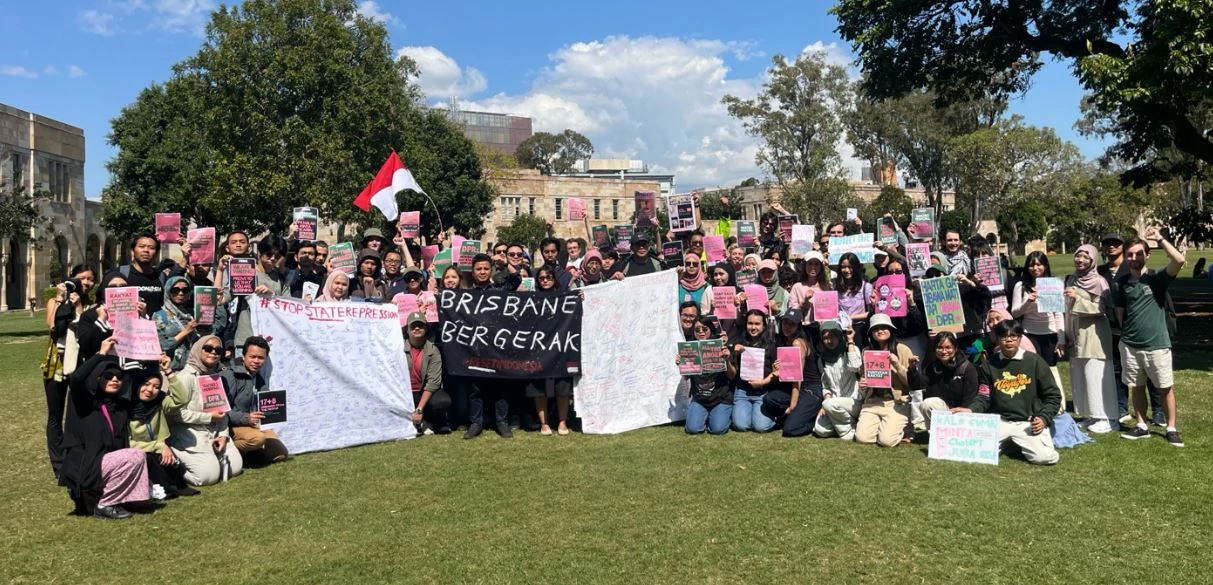
The collective’s most striking success was an aspiring movement on September 28, 2025, which reacted to the Indonesian government’s regulations granting house allowances to parliamentary representative members while citizens were struggling with living pressures. The Indonesian state responded to its critics with arrogance and ignorance, which further escalated the situation and provoked more anger nationwide and abroad.
Brisbane Bergerak, now comprising six founders, invited all Queensland Indonesian students to sign a petition supporting #ResetIndonesia and #StopStateRepression movement, as well as the “17+8” demands, a viral initiative engaging government dialogue on critical issues. The founders subsequently dispatched the petition through the Indonesian Embassy in Canberra.
The campaign utilised its Instagram account to disseminate information, multiple WhatsApp groups, and collaboration with UQ Socialist members. Crucially, they provided participants with freedom to express themselves through writing or creating their own protest slogans, embodying the right to communicate as the fundamental right of individuals to have experiences and perspectives recognised through equal and respectful interaction.

Organisers anticipated seven to fifteen participants. “We estimated maximum ten individuals,” one founder recalled. Instead, approximately 270 people in total joined through physical attendance and signatures over two days. “We were utterly surprised,” another member shared.
Every movement we do always has new people. That’s what’s interesting. If we talk about goals, yes, that’s it, we have awareness to add to ourselves, to multiply ourselves. Brisbane Bergerak member, 2025.
This success underscored profound concern among Brisbane’s Indonesia students. As international students, they acknowledged the privilege of remaining distant from the repression experienced by their compatriots in Indonesia, which triggered more of a sense of responsibility to escalate support.
Yet, sustaining engagement between crisis moments proved challenging. Early labour rights discussions drew only founding members. Initially, the collective expected to establish regular meetings, but these proved difficult given academic commitments and diverse student populations. This encouraged a methodological shift toward accessible approaches.
Brisbane Bergerak began experimenting with participatory education, especially through film screenings and casual discussion groups. They shifted the heavy issues to culturally resonant matters through poetry and cinema. These methods engaged students who might not initially identify as activists, introducing critical perspectives on the 1965 massacres, agrarian struggles, and human rights through informal atmosphere without pressure.
However, getting Indonesian issues to resonate with wider and diverse audiences beyond Indonesian students remains a challenge. How can they connect homeland struggles to broader social justice movements in Australia? How can they make Indonesian democratic backsliding relevant to non-Indonesian allies?
Additionally, with several founding members approaching graduation, Brisbane Bergerak faces sustainability work. They frame this as a natural evolution than a crisis by preparing remaining members to continue the legacy, hoping new students will adapt the collective to their own conscious and contexts, even changing its name while maintaining the spirit.
From three people on May Day to 270 participants in one rally, Brisbane Bergerak demonstrated diaspora students’ hunger for meaningful engagement with homeland struggles. While direct policy impact in Indonesia remains unmeasurable, the initiative successfully shifted the culture of Indonesian student organising in Brisbane, from silence to voice, from individual study to collective action.
Despite its humble beginnings and non-hierarchical structure, this movement offers fruitful lessons for future student movements: small steps of shared commitment to justice can make meaningful transformation, and collective memory remains significant even when individual members move on.
Brisbane Bergerak proves that even without the intention of being salient, movements need not remain silent.
Explore Further
- Brisbane Bergerak Instagram
Follow the collective’s ongoing actions - Right to Communicate: Building a Participation Information Society
A framework for understanding communication as fundamental right - Melbourne Bergerak: Assertive Long-Distance Nationalism Another article about Indonesian diaspora activism
- Indonesia Demands: 17+8 Movement The viral campaign Brisbane Bergerak supported
- Books to Read on Activism, Social Change and Justice Further resources for movement builders
- Protests Start Here Guides and resources for organising protests