This article was originally published as HOLY SH*T! 7 things to do instead of hoarding toilet paper on Waging Nonviolence.
Introduction
We’re facing down a global pandemic. If you find yourself saying “Holy shit! What do I do?!” you’re not alone.
A renegade bug is showing how deeply broken our system is. Beyond the absolutely critical tasks of taking care of yourself, harm-reduction, social distancing, hand-washing, and looking out for those around us who are most struggling, we must also make that brokenness plain.
We do not get to choose the historic moments we are born into, but we do get to choose how we respond. And as we recover, and put our world back together, we have a chance to put it back together differently and better.
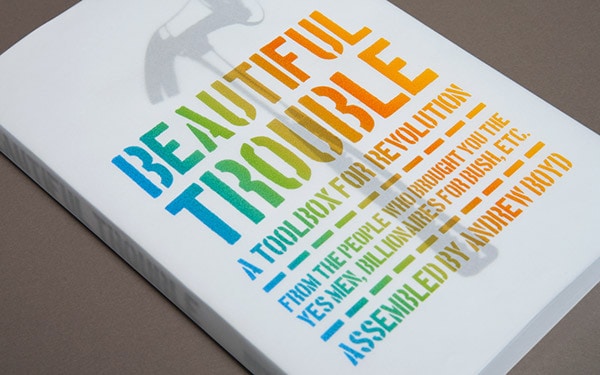
In that spirit, we’ve done a roundup of the most creative and effective social movement responses to COVID-19, filtered through seven of the most relevant tools from the Beautiful Trouble toolbox, with links to resources compiled especially for this moment.
Take leadership from the most impacted
Effective activism requires providing appropriate support to — and taking direction from — those who have the most at stake.
Jet-setters might spread it, but COVID-19’s impact is felt the hardest by our most vulnerable — immigrants, the precariously employed, the homeless, the elderly, people living with chronic illness and disability, prisoners, healthcare workers, and those on the margins of society. Let’s center ourselves in their needs, and build our social solidarity outwards from there.
The risk is universal, and our response must be universal as well: Medicare for All, paid sick leave, debt forgiveness, universal basic income — these are the acts of social solidarity that can see us all through.
We sink or swim together. Our actions today and in the coming days must be oriented toward lifting up those on the frontlines, not bailing out corporations and the wealthy.
Make the invisible visible
Many injustices are invisible to the mainstream. When you bring these wrongs into full view, you change the game, making the need to take action palpable.
In many ways, this pandemic has cracked open the veneer of our economic and social system to expose how unjust and unhealthy capitalism is. Our job is to make it clear that this is a system-problem, and to showcase more equitable, compassionate and creative solutions.
Here are just a few of the harsh realities we’ve grown accustomed to that this crisis exposes. Let’s name, shame and change these realities!
- If “healthcare is a human right” was a slogan before, it is a dire necessity now, as we see the gross lack of preparedness in our health care system for pandemic care. What are we doing to guarantee free health care for all people?
- Demanding that those who are sick stay home from work exposes our lack of affordable health care. Many workplaces simply do not guarantee sick leave to employees — especially food service and hospitality which are most at risk for transmitting illness. Failing to ensure those workers feel safe to take the time off they need puts all of us at risk. What are we doing to ensure these workers feel safe to take the sick leave that they need?
- Suggesting people prepare for weeks to months of containment, or be able to cover living expenses without employment, exposes the reality that many live paycheck to paycheck and cannot afford this kind of expense. As restaurants, bars, clubs and other businesses close, what do we have in place to insure long-term economic safety for low-income workers? What are we doing to ensure people aren’t losing sleep wondering how they’ll make rent at the end of the month?
- What seems a simple response of closing schools to limit community spread, exposes the impoverished situation of many students who depend on school programs to eat each day. Who will ensure those kids get the nutrition they need? Who will ensure they are cared for if their parents have no choice but to go to work? (See Beautiful Trouble’s module: Breakfast is persuasive.)
All of this is exacerbated if you are part of a marginalized community and already oppressed by the current economic system because of racism, sexism, homophobia, transphobia, ageism, ableism and more. What are we doing to fight for the people who are the most vulnerable in the current moment?
The principle of making the invisible visible helps us reframe our work and messaging toward a systems approach. “Social distancing” can be reframed as “spacious solidarity,” which connects us together in an act of taking space, rather than self-isolation. And if we can win some essential early victories (suspension of evictions, TSA regulations governing liquid limits on board flights, etc.), creative re-framing can help expose those oppressive structures as arbitrary and requiring systemic change.
Simple rules can have grand results
Movements, viral campaigns and large-scale actions can’t be scripted from the top down. An invitation to participate and the right set of simple rules are often all the starter-structure you need.
Like the coronavirus itself, which multiplies a simple cough into a global pandemic, we, too, by following simple rules — from washing hands to small acts of kindness to a flash mob in Italy that goes viral — can both defend against the virus and scale-up our activism.
Italians are singing rooftop to rooftop. Online actions coordinate phone banking and letter-writing to politicians who fail to act quickly enough. People collaborate on and distribute shared documents to build and support community. (Here are some of our favorites: Coronavirus Resource Kit, Plan Now to Adapt to Coronavirus Safety, Mutual Aid & Advocacy Resources, Resource Toolkit, Circles of Survival, COVID-19 Resources for Students).
In “Fractals: The Relationship Between Small and Large,” adrienne maree brown reminds us: “How we are at the small scale is how we are at the large scale. The patterns of the universe repeat at scale … what we practice at the small scale sets the patterns for the whole system.”
An abundance of tactics
Whose streets? Empty streets!
What to do when you can’t go out and organize mass protests? Get creative, as people all around the world are doing. Necessity is indeed the mother of invention and in response to this unprecedented moment, we are seeing a proliferation of creative tactics that build community and pressure the powerful.
In such moments, Al-Faza’a, or a surge of solidarity, is ever relevant in describing the idea of people stepping up in times of need/emergency and capitalizing on the popular sense of urgency and moral high. A good organizer will make the most of this surge, riding this wave of support to score victories that seemed impossible before.
Tactics for building a sense of community (even while social distancing)
- Cacerolazos: Italians took to their rooftops banging pots and pans and singing, an act that went viral. Cacerolazo has been used around the world, in Puerto Rico, Lebanon, Iceland, Quebec, Turkey and across Latin America.
- Distributed action: Let your neighbors know you support your health workers, your community mutual aid response, and more by hanging out a flag or poster, or wearing something identifiable when you take walks. Host a rooftop gym class or living room dance party, with an online DJ, like this.
- Use the power of ritual: Ritual can be a powerful tool for decreasing anxiety, building community, and unlocking the power of collective contemplation and action. Many faith leaders are responding to this moment by coordinating virtual services. Our familiarity with ritual makes it a great format for self-organizing.
- Training for the win: What better time to host an online training than now? Education and training have been documented as strategically critical for winning movements. (P.S. If you’re a professor trying to figure out what to teach your students online, check out our study guide or contact us.)
- Mutual aid networks are blossoming and expanding in many places to support vulnerable neighbors, and strengthen community capacity so we can take care of each other where there is an unmet need. Mutual aid can take many forms: getting medicine to a neighbor, coordinating volunteers to call those suffering from anxiety during the pandemic, and organizing together for structural change. As any of us who are navigating oppression daily, this is how we’ve survived so long.
Tactics for continuing to pressure people in power when mass street action is off-limits
- Shine a light on it: Guerilla projections and protest holograms require just a few people, and often require no permit! Consider projecting a live feed of comments as well.
- Mass distributed phone-banking: A new take on gathering in person to phonebank. From our own homes, we can all connect digitally and then simultaneously call elected officials with demands, encourage voters to vote, and canvass community members to see if they need support.
- Hashtag campaigns: Using a common visual element or #hashtag, people can share on their own channels while contributing to a bigger collated story, making a “social media bullhorn.” Connect online to offline activities like phone calls, flying flags, singing out your windows.
- Artistic vigil: Ask people to place signs (downloaded or made-at-home) visibly in their window or doors. Or consider this: an in-person vigil where everyone keeps a six-foot distance from each other with appropriate costumes (hey, masks are in!) and signs. Or, gather photos made of individuals with signs, print them out and display en masse publicly at the specific target. Consider chalking outlines of participants. Have a virtual political art making party. Check out these other ideas.
- Livestream rally and action: Hold the event as a livestream from the actual site of the protest or home/office. People can engage in the chat box, sharing who they are and why they are participating, and the facilitator can read aloud. Or visit each Facebook/LinkedIn/Yelp page of your target and leave the campaign message there!
- Divestment or investment: Get your (institutional) money out (of big pharma, oil and gas, war profiteers…) Or take advantage of low prices to buy stock for shareholder activism in the future! Invest in union-made cleaning products, local family-owned businesses and people in need right now: single parents, food service workers and artists who are out of work.
- Especially in this very serious moment, remember culture jamming and humor are powerful tools to undermine authority. Disrupt mainstream narratives that breed fear and unhelpful responses. Parody songs, like “My Corona,” the Wash Your Hands song generator, and laughter-inducing games, memes and cartoons are good for the soul! Disruption is not the only superpower of culture jamming — it is expert at the jiujitsu of redirecting the power of these symbols towards transformation.
- Activate international mechanisms: Not only is this pandemic affecting us globally, we also know that solutions will not be possible alone. Supporting global agencies (like the World Health Organization) rather than individualistic, nationalist America-First!-style responses are not only smart but necessary. Progressive responses must include capacity to share knowledge across borders, communicate globally about what works and what doesn’t and share implementation scenarios. It’s worth mentioning that some parts of the Global South have been persistently under emergencies for decades. When places like Somalia, Congo and Yemen had their own apocalypses, the international community failed to react to these world crises with efficiency and urgency. As one viral meme said, “Dear world, How is the lockdown? — Gaza.”
As many governments have so terribly botched their response to this virus, several groups have put together lists of demands for municipal and state governments. Don’t be boring, use these and other tactics for effective action on these demands!
Practice cultural disobedience
Civil disobedience is the deliberate violation of unjust laws. In a similar spirit, cultural disobedience bravely subverts dominant cultural norms.
Who knew that overthrowing patriarchy could help fight a virus, but consent culture is more important now than ever. It is not appropriate to touch or hug without asking first. We can elbow bump. We can bow. We can connect heart to heart instead of hand to hand. We can use the Wakanda salute. The handshake was created to show disarmament — to demonstrate that one was not carrying a weapon. Disarming connection now looks like not shaking hands as a sign of love.
It is beyond past time to overturn outdated, unhealthy cultural norms about who holds wisdom, power and answers and who sets the rules. We are the experts of what is best for our own communities, not those from the outside, whatever their bona fides. Maybe your boss isn’t going to make the best decisions for your workplace. We might have to do that for ourselves.
If slowing down and prioritizing care for loved ones is bad for the economy, then maybe it’s time for some new rules! Let’s prioritize compassion, provide needed services, and reclaim non-mainstream marginalized histories and experiences that show healthier ways of being.
Shame the authorities by doing their job for them. We can learn from past movements how to do this. On the “Irresistible” podcast episode “Coronavirus: Wisdom from a Social Justice Lens,” JD Davids, founder of The Cranky Queer, shared how in the absence of any medical standard of care during the early years of the HIV pandemic, ACT UP Philadelphia developed and published their own guidelines in English and Spanish. “It was something that people could take with them to their medical providers … and say, ‘Here’s what I know I know, and here’s what I know I need.’”
Let’s be careful with each other, so we can be dangerous together
Flatten the curve. So we can rise up together for the long haul. Rest and joy are also radical acts. Finding Steady Ground provides (a lucky?) seven reminders for us on self-care.
“Feeling good is not frivolous,” adrienne maree brown reminds us. “It is freedom.” Joy is a revolutionary force.
Take risks but take care. Some tactics should never be attempted without a thorough safety plan and skill-level assessment. Develop a list of questions to ask yourself. Here’s some to start with (adapted from Beautiful Trouble’s strategy card deck):
What’s the risk of…
- Contracting the virus oneself?
- Exposing others? (Including those you may come into contact with and those in your immediate home.)
- Doing nothing?
- Are there economic, environmental, legal, political or cultural considerations?
How we take care of ourselves and each other now is everything. Again, we fall back to poetry to say it all: Read “Lockdown,” by Rev. Richard Hendrick, OFM.
Now is the time to build a solidarity economy
A tradition of radical economic organizing that strives to replace dependence on exploitative economic relations with “solidarity chains” linking community-based alternatives.
Day by day as we witness the unraveling of an old system, capitalism, that no longer works, we are also seeing the upscaling of the new one. Why wait when we can build the future now? Many of the actions we’re seeing are prefigurative interventions: mutual aid, free online classes, food sharing, buying local and spending more time in nature. This crisis can be an emergent opportunity to change oppressive policies for good. As J.M. Greer says, “Let’s turn new normals into new beautifuls.”
In the aftermath of the horrific Triangle Shirtwaist Fire, where young women seamstresses jumped to their death because exit doors were locked, new labor laws required accessible, safe exits at all times. After the Titanic sank, killing more than 1,500 people, the rules changed to require life rafts and lifeboats for all passengers. How can we emerge from COVID-19 times to be more resilient, to provide more care for all, to ensure a safety net that supports humanity and the Earth?
While in conversation with adrienne maree brown (“On Rushing Toward Apocalypse”) Aja Taylor noted that this moment of apocalypse, or “uncovering,” presents many opportunities. “The things we fight for are not just right, but possible … COVID-19 came, and reminded me that the world we are fighting for is nigh. Now is not the time … to abandon hope. The world we are fighting for is just on the other side of apocalypse.”
If you made it to the end of this piece, you are cordially invited to vet your own creative ideas via our Resistance Hotline Facebook page. Have an organizing question? Contact us at 1-844-NVDA-NOW or training@beautifultrouble.org. And, while you’re at home, why not play a game of revolution with our new strategy card deck? Don’t just wash your hands, have a better hand available!
Additional support for this piece was provided by Juman Abujbara, Andrew Boyd, Chelsea Lee Byers, Dave Mitchell, Hazel Sher-Kisch, Phil Wilmot / Beautiful Trouble crew.