
Introduction
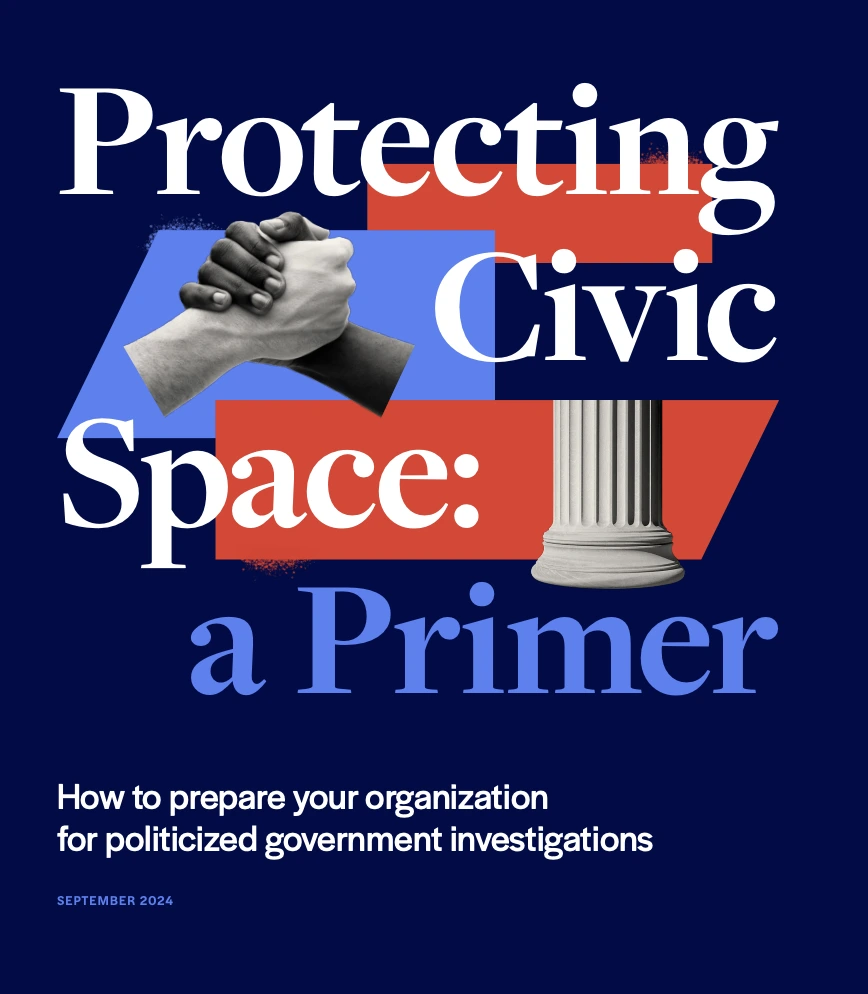
A guide from Protect Democracy in the United States about how to protect your civic space and prepare your organization for politicized government investigations.
Politicized government investigations can feel threatening. Indeed, that’s often the point. But as outlined in this guide, they need not be paralyzing.
Organizations can — and should — take steps now to ensure that lawful, mission-driven work continues even in the face of an investigation. In doing so, organizations can protect their ability to meet their missions and, more broadly, help guard against the closing of civic space — which remains one of the strongest defenses against the autocratic movement.
This primer has two goals:
- First, it aims to orient civil society organizations to the different types of vexatious or retributive investigations that state and federal government actors may undertake.
- Second, it is intended to help organizations identify concrete actions they can take now to prepare for and mitigate these threats.
Explore a snippet of the guide below or access the full guide here.
Note: This guide is not meant to, and does not, offer legal advice. Any organization or individual who receives a government inquiry should consult with an attorney.
Contents
- Introduction: the Threat to Civic Space
Why government investigations are a preferred tool for authoritarians - Investigations Quick Guide
An at-a-glance view of potential consequences and precautionary steps - Types of Government Investigations
How different types of federal and state entities conduct investigations - Key Investigative Tools
The methods investigators use and what actions organizations can take - Case Studies: Three Real Investigations
Actual examples of how politicized investigations play out- Attempting to shut down a Texas migrant shelter
- Heightened scrutiny for tax-exempt status of Tea Party-aligned groups
- Illegally recorded conversations and a faux scandal
- How to Prepare Your Organization
Eleven strategies to ready organizations for potential scrutiny - Conclusion
Resisting a looming threat
The Chilling Effect of Politicized Investigations
The Authoritarian Cycle
- An autocrat uses government power to investigate and punish groups or individuals they disagree with.
- A climate of fear leads to anticipatory obedience and fewer organizations operate in targeted sectors.
- With reduced civil society support, institutions weaken and fail to check the autocrat’s abuse of power.
- Government power is further consolidated, enabling even more pronounced abuses.
Investigations Quick Guide
How to Prepare Your Organization
One hallmark of a functioning democracy is a diverse range of active civil society organizations, some with ideological goals that are shared by elected officials and some that are not. If any of these organizations find themselves on the receiving end of government scrutiny, it can be unclear whether the attention is lawful and legitimate or motivated by partisan politics or authoritarian tactics.
The 11 strategies on the following pages outline how organizations can — and should — prepare for investigations in a way that mitigates risk and allows them to carry on with lawful work.
1. Keep Calm and Carry on with the Mission
Despite valid fears of potential investigations, organizations should resist the urge to panic and continue to serve the public interest by carrying out their mission.
Organizations should remind employees and stakeholders that they have plan in place to respond to governmental inquiries — one that ensures they can both respond to the inquiry and continue with their mission-related work.
2. When in Doubt, Contact a Lawyer
(And have one ready!)
If an organization does not currently retain counsel, it should know who it would call if it receives an investigative inquiry. Many law firms and legal services organizations may be able to provide representation, or at least an initial consultation, on a pro-bono basis. Additionally, most state bar associations offer lawyer referrals and can be a good place to start a search for legal services.
3. Have a Plan
Before an organization is subject to investigation by the government, it should already have a contingency plan in place. This plan should include a crisis communications framework and instructions on how to utilize its internal and external resources to respond to an investigation.
4. Embrace Good Governance
Even when there is less concern about politicized government investigations or other overreach, an organization should establish and maintain strong governance practices. Strong internal governance and finance practices can protect an organization if and when it comes under scrutiny. These practices include:
- Implementing strong internal procedures to ensure compliance with 501(c)(3) and/or 501(c)(4) tax status
- Ensuring that state registrations for charitable solicitations are up to date
- Authorizing an independent body to carry out annual financial audits
- Adopting and enforcing policies related to whistleblower protection
- Maintaining clarity around the board of directors’ roles and responsibilities
- Building or enhancing an independent, professional human resources role
5. Implement Document Retention Policies now
Organizations should develop and follow a document retention policy, including policies for email communications. They need a policy outlining what to keep and how long to keep it.
Having a policy that is documented, known by staff, and adhered to helps organizations manage their records and avoid later allegations that documents were destroyed improperly. Organizations should implement document retention policies now, before they are faced with the prospect of an inquiry or investigation.
6. Ensure Confidential Information is Protected
Alongside document-retention policies, organizations should ensure they have policies and procedures around handling confidential information, including document management systems for storage, standardized naming conventions for confidential information, and codified policies around how to safeguard and distribute such information.
7. Establish Physical and Cybersecurity Protocols
Organizations should be mindful of the physical security risks their employees might face while under investigation. Organizations should require physicalsecurity training and implement emergency response protocols to keep their employees both physically and emotionally safe.
Organizations should also be prepared to address the rising threat of cyber attacks. They can strengthen their cyber protections by implementing the following practices, among others:
- adopting written cybersecurity policies,
- conducting mandatory staff training that teaches employees how to spot and flag different hacker techniques, and
- installing a virtual private network (VPN) that protects users by encrypting their data.
8. Get honest with Funders and Partners
Organizations targeted for politicized government investigations should be upfront with their donors about these potential threats. Being honest shows integrity and demonstrates that the organization has nothing to hide. Moreover, funders and partners may be able to provide technical assistance or additional funding to support responding to an inquiry. And communicating with likeminded organizations, as appropriate, can be a good way to mobilize external resources and avoid interruptions to the work and mission.
9. Build Broad Coalitions
Organizations may think it is easier to deal with threats quietly by self-censoring, cutting off politically controversial funders, and distancing themselves from targeted organizations or those already under investigation.
Research shows, however, that organizations that work with a broad coalition and fight against
polarization within civic spaces combat authoritarianism more successfully.
10. Assume anything in Writing could be Disclosed
In addition to the federal Freedom of Information Act (FOIA), states also have their own FOIA laws, often called public records acts, to compel the production of certain categories of information. This could include an organization’s communications with government officials or agencies. Organizations should be aware of public records laws and assume that written work could eventually be disclosed — voluntarily or not.
When communicating with any agent of the state or federal government, especially in writing, organizations should keep in mind that, although some categories of documents are protected from disclosure by FOIA exemptions and exclusions, emails and other written records can often be obtained by a private party
via a FOIA or other public records request. This can include text messages to a government staffer’s personal number and emails to a staffer’s personal account.
Organizations should use good email hygiene and avoid communicating in ways that are prone to being taken out of context. If one document is swept into the scope of a subpoena or FOIA request without a large body of research or background information to provide important context, it could become a flashpoint.
11. Train Staff to be aware of Bad-faith Actors
Not every person who contacts an organization with questions or seeking services may be acting in good faith. If bad actors publicize surreptitiously recorded conversations, for example, that can snowball into scrutiny from government agencies. An organization can guard against this by considering what aspects of its mission or services may be considered controversial to opponents or most susceptible to scrutiny.
- Remember that phone and online conversations, as well as in-person visits, may be surreptitiously recorded. Political provocateurs have targeted nonprofits and other organizations by posing as volunteers, donors, potential clients, or even patients and eliciting statements (which they record) from an unsuspecting staff member that may later be taken out of context and used against the organization.
- Every organization should have a process in place for handling incoming inquiries and ensuring that any intake personnel follow predetermined scripts and do not give out unnecessary information over the phone.
- Remind staff that not everyone who contacts the organization “for help” may be doing so in good faith.
Access Full Resource
Protecting Civic Space: A Primer – How to Prepare your Organization for Politicized Government Investigations (40 pgs PDF)
Explore Further
- Safeguarding Civic Space: Harnessing Narrative Change to Restore Public Trust in Civil Society Organisations
- Confronting Authoritarianism and Organizing Resistance: Case Studies and Lessons Learned
- The Anti-Autocracy Handbook: A Scholars’ Guide to Navigating Democratic Backsliding
- Democracy Narrative Resources
- Organizing in Increasingly Repressive Environments: Pushing Against Criminalization
- The Authoritarian Playbook: How Reporters can Contextualize and Cover Authoritarian Threats as Distinct from Politics-as-Usual
- Authoritarianism: How You Know It When You See It
- Democracy Undone: The Authoritarian’s Playbook
- This is How Democracies Die
- Authoritarianism is Making a Comeback: Here’s a Time-Tested Way to Defeat It
- Renewing American Democracy: Navigating a Changing Nation
- Democracy Resource Hub