
Introduction
For decades, public protest was something many people in Japan preferred to avoid. However, the anti-nuclear movement that emerged after the Fukushima nuclear disaster changed both who participated in protests and how people were mobilised.
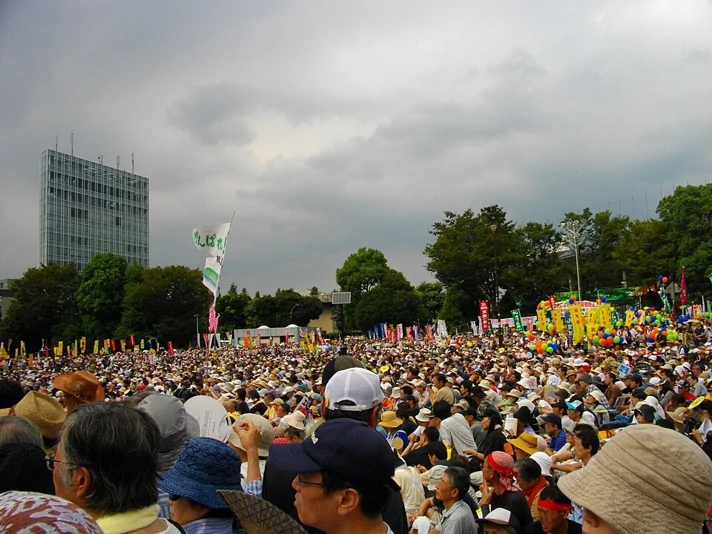
Beginning in March 2012, thousands of people started gathering outside the Prime Minister’s residence in Tokyo to oppose the restart of nuclear power plants. The movement was led by the Metropolitan Coalition Against Nukes (MCAN), a network of 13 small activist groups and independent volunteers campaigning for a phase-out of nuclear power in Japan.
Families with children, students, and many first-time protesters became the face of the movement. At its peak in June 2012, following the government’s decision to restart the Ōi nuclear reactors, participation surged dramatically. On 29 June, an estimated 200,000 people, according to the organisers, gathered around the Prime Minister’s residence, making it one of the largest protest movements Japan had seen in decades. The demonstrations continued almost every Friday for nearly a decade.
This article looks at how the movement mobilised ordinary citizens, many of whom had never joined a demonstration before, and maintained momentum through innovative forms of communication, organisation, and participation.
From Social Stigma to Civic Action
Since the 1970s, public protest had carried a social stigma in Japan. Violent incidents involving radical political groups left a lasting negative impression, while decades of economic stability reduced motivation for civic activism. As a result, participation in protests came to be seen as unusual for ordinary citizens.
The March 2011 Fukushima nuclear disaster dramatically changed this landscape. Although Japan functioned without nuclear power after all reactors were shut down for safety inspections in 2012, the government’s decision to restart the Ōi reactors sparked widespread public frustration. Concerns about food safety, the long-term health impacts of radiation, and the lack of transparency surrounding the disaster, combined with declining trust in mainstream media and government institutions, motivated many ordinary citizens to join the protests for the first time.
Three Core Features of the Anti-Nuclear Movement
What enabled Japan’s post-Fukushima anti-nuclear movement to grow so rapidly and remain active almost a decade? Three key features stand out:
1. A loose, flat, and leaderless organisational structure
MCAN, which led the movement, had no physical office, paid full-time staff, or a single leader directing the movement.
By establishing a structure that was not dominated by a charismatic leader, the movement secured a space where ordinary citizens could feel empowered to speak up for themselves.
Organisers also worked hard to maintain a peaceful atmosphere. After every demonstration, they bowed politely and expressed gratitude to police officers managing security. These gestures helped prevent unnecessary confrontation and made demonstrations feel safe and welcoming, especially for families and first-time participants.
2. The combination of social media and trusted personal networks
Traditional Japanese media outlets initially provided almost no coverage of the movement, unsure how to report on a social movement lacking clear leaders or a formal office. In response, citizen-run online media enhanced transparency through live-streaming demonstrations, giving participants a strong sense of ownership and making them feel that their voices were being heard.
Moreover, delivering information through social media like Twitter and Facebook connected individuals who had felt isolated in their workplaces, schools, or local communities with their anti-nuclear sentiments. At the same time, the strongest motivation to attend demonstrations came from direct invitations from friends, family, or partners.
Thus, it was the synergistic interaction between online reach and face-to-face relationships that dramatically expanded mobilisation.
3. The creative use of music
Inspired by the anti-war sound demos of the early 2000s, organisers brought sound trucks, DJs, punk bands, rappers, and marching drum groups into the streets.
By incorporating music, they transformed what had traditionally been perceived as gloomy, angry, and tragic demonstrations filled with shouting into an open, festival-like space that was accessible for anyone to join.
While early sound demos primarily featured audiences passively listening to performances, the format evolved into a highly participatory “call-and-response” model led by drum corps and rappers chanting rhythmic slogans. Designed around a four-beat rhythm that matched the pace of walking, the chants relied on short, repetitive slogans such as “Saikadō hantai” (“Oppose reactor restarts”) and “Genpatsu yamero” (“Stop nuclear power”), making them easy for newcomers to join.
In Japanese culture, shouting aloud in public streets traditionally carries feelings of embarrassment. The presence of music and rhythm helped people overcome their hesitations and created a sense of connection among strangers.

What the Anti-Nuclear Movement Brought to Japanese Social Movements
The movement’s greatest achievement was reshaping the Japanese public’s perception of protest, turning demonstrations into a form of everyday democratic participation. Through a loose, leaderless structure, social media, and participatory communication such as sound demos, it showed that political participation could be welcoming, creative, and open to everyone.
Its influence extended far beyond the nuclear issue itself. Many young people who first experienced collective action through these protests later led movements such as SEALDs (opposing security legislation) and C.R.A.C. (countering racism), establishing a new 21st-century model for activism.
After its peak in 2012, MCAN succeeded in bringing anti-nuclear concerns directly to the national political agenda, prompting the government to briefly adopt a policy phasing out nuclear power by the 2040s. However, when political leadership changed later that year, the target was abandoned. The movement’s loose network structure, while effective for mobilisation, was less suited for translating public pressure into lasting electoral power.
Although Japan still relies on nuclear energy, anti-nuclear sentiment remains a powerful force in public opinion. Ultimately, the movement created new forms of participation and a new culture of collective action to make citizens’ voices heard.
Explore Further
- Metropolitan Coalition Against Nukes
- The Fukushima Nuclear Accident Independent Investigation Commission
- Nuclear Power Protests Find Wide Support in Japan via The Daily Beast | The Atomic Age
- Shouting, Singing on Friday Night: Anti-Nuclear Protest Outside the Prime Minister’s Office | Asahi Shinbun Digital
- A New Wave Against the Rock: New social movements in Japan since the Fukushima nuclear meltdown
- Music in Japanese Antinuclear Demonstrations: The Evolution of a Contentious Performance Model
- Protests: Start Here