

Introduction
This collection brings together key research, guides, case studies and analyses exploring how gig workers navigate digital platforms, work instability, unions and algorithms.
The collection highlights practices of worker organising, union campaigns and collective action, showing how technology shapes both challenges and opportunities for labour rights in the modern gig economy.
Guides and Toolkits
Exploring the Gig Economy: Challenges and Opportunities Toolkit
International Labour Organization

This toolkit is a practical resource to better understand the online gig economy, whether for personal learning or to support awareness-raising and training sessions. It is a learning guide with detailed explanations, real-life examples and insights into online gig work.
Reports
Organizing On-demand Representation, Voice, and Collective Bargaining in the Gig Economy

Hannah Johnston, Chris Land-Kazlauskas, International Labour Organization
This paper examines challenges to freedom of association and the effective recognition of the right to collective bargaining for workers in the gig economy, and explores the broad range of strategies that gig-economy workers are using to build collective agency and to promote effective regulation of gig work.
Worker organizing, the development of agency, voice and representation, and its expression through collective bargaining, are the surest and most democratic way of achieving the future of work we want. When gains are realized through collective bargaining between trade unions and employers or their organizations, and through tripartite dialogue between employers and their organizations, trade unions and the government, we can be sure that achievements are lasting and that the interests of all parties are represented. – Source, p. 33
Gig Worker Learning Project
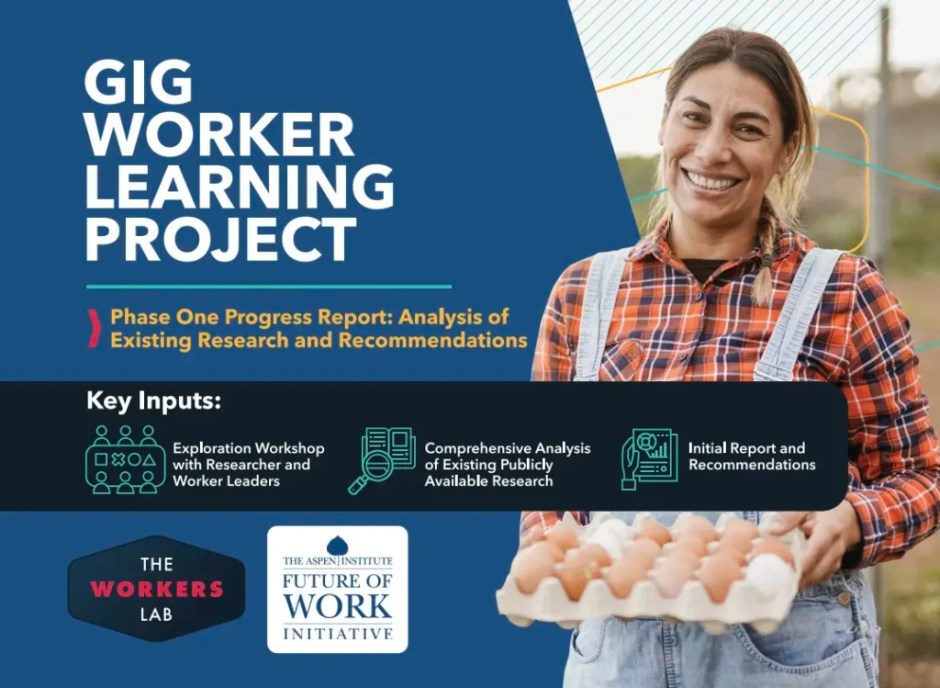
The Workers Lab, Aspen Institute of Future Work
The Gig Worker Learning Project is a valuable resource for anyone seeking to better understand gig workers and the challenges they face.The goal of the project is to better understand gig work and workers directly from gig workers themselves, regarding their motivations, challenges, and solutions that would impact their lives personally and professionally.
The central value of the project as a whole is worker voice. The data available about gig work and workers is largely incomplete and in some ways misleading. This project seeks to center workers and their experiences in the national understanding of gig work and workers so that worker leaders and other decision-makers across the country can make more informed decisions about how to better serve workers.
- Phase I Progress Report: Analysis of Existing Research and Recommendations
The Gig Worker Learning Project Phase I Report describes crucial gaps in knowledge of the ways people work. - Phase II Report: Just Make it Better, What Gig Workers have to say about Gig Work
The second phase of the project has sought to address these gaps by engaging people doing gig work directly in the research process.
This project is an opportunity to push the boundaries of participatory research, starting with conversations and focus groups and working toward the first worker-developed nationwide survey of gig and nonstandard work. We see it as a model to work from and build on, toward a vision of worker-centered, worker-developed knowledge to inform policy and practice nationwide. – Source, pgs 3 – 4
Gig and Platform Workers Perspectives on Worker Collectives
Telangana Gig and Platform Workers Union (TGPWU)

This report highlights findings from a survey conducted by the Telangana Gig and Platform Workers’ Union on platform workers’ perspectives around various worker collectives, particularly platform worker unions and cooperative societies.
The Telangana Gig and Platform Workers Union (TGPWU) is an independent, worker-led union founded in 2021 for gig and platform workers in Telangana, India.
The survey revealed strong worker support for democratic, worker-owned cooperative structures (with 75% interested in joining), prioritised services such as healthcare, insurance, and children’s education, mixed preferences for independent or affiliated unions (46% each), and broad agreement (66%) that unions should direct their demands toward both platforms and government.
Across different union structures, 66% of workers place high importance on union demands that focus on both platforms and governments. Source – pg 2
Podcasts
Podcast: A Rebel’s Guide to the Gig Economy
Brave New Europe

Need to understand more about the gig economy? Listen to this series of podcasts by The Gig Economy Project, a media network for gig workers in Europe.
Research Articles
Divided we Fall: The Breakdown of Gig Worker Solidarity in Online Communities
Peter Kalum Schou, Eliane Bucher. Journal article in New Technology, Work and Employment
The researchers asked if dispersed and diverse gig workers can build solidarity through online communities?’
With this particular research project they found that solidarity broke down due to the online community of gig workers realising different interests and identities.
“Our findings problematise the notion that online communities can work as spaces where solidarity between workers arises …. Recent research has been optimistic in regard to the potential of online communities in organising workers. The notion is that online communities can replace physical social networks …and that workers can build up bonds by using these communities…. Thereby, they serve as spaces for workers to organise. Again, our findings differ from these notions, which provide us with the opportunity to nuance and extend prior work.
Instead of acting as a space where workers build up solidarity and organise, the online community in our study became a space for conflict. There may be a number of reasons as to why our findings differ from previous research. First, in previous research, workers had the ability to meet up physically … This was not the case in our study. In contrast, our findings indicate that the virtual social ties that online communities provide are not strong enough to overcome narrow self-interest and create worker collectives. They may serve as spaces for symbolic solidarity but not for actual solidarity that includes letting go of self-interest. Moreover, online communities may serve as a complement to physical meetups but not as a substitute.”
Overall, whereas previous research has been more positive towards the possibility of workers building solidarity and conducting collective action … our findings point to the solidarity that workers initially showed as being largely symbolic. Workers may express initial joint outrage and collective sympathy, but then narrow self-interest emerges and the impetus to collective action collapses.
With or without U(nions)? Understanding the Diversity of Gig Workers’ Organizing Practices in Italy and the UK
Lorenzo Cini, Vincenzo Maccarrone and Arianna Tassinari. Journal article in European Journal of Industrial Relations
This article explores the diversity of workers’ organising practices within ‘gig economy’. It examines how gig workers, especially food-delivery couriers, organise themselves in different national contexts, comparing Italy and the UK. In Italy workers opted for self-organization and in the UK they have organized through rank-and-file unions.
Only in recent years established unions have started to ‘catch up’ and be effectively present in this new sector. Yet, whereas there is a growing Industrial relations (IR) literature on the gig economy, gig workers’ novel and heterogenous organizing practices have been thus far relatively under-researched. – Source
As the two case summaries have shown, the difference in the organizing models adopted by the riders in the UK and in Italy in the first years of mobilization is significant. In the British case, workers accepted the organizational support and expertise of rank-and-file unions, whilst in the Italian case they preferred to organize in informal collectives. We attribute this difference to two factors, which we identified from our abductive analysis as especially relevant, one relating to the features of the actors involved, and one to the features of the socio-political context: the capabilities of intervening unions arising from their relevant sectoral expertise, and the political tradition of militant organizing. – Source
Gig Economy Riders on Social Media in Thailand: Contested Identities and Emergent Civil Society Organisations
Yannik Mieruch, Daniel McFarlane. Journal article in VOLUNTAS: International Journal of Voluntary and Nonprofit Organizations
This article explores the dynamics of identity development among gig workers in Thailand and the emergence of new forms of labour-oriented civil society organisations that champion workers’ rights in a rapidly changing economy.
This study finds that Thai delivery riders use social media to overcome isolated gig work conditions, forming mutual aid networks that increasingly function like unions. Online platforms become key sites where riders contest identity narratives, shaping both collective action and the emergence of new labour-oriented civil society organisations.
The Hero and Worker narratives generate contrasting perceptions of rider working conditions and identities. On the one hand, the Hero narrative highlights gig work as empowering and self-determined. On the other hand, the Worker narrative conveys sentiments of powerlessness and dependence on the platforms. While the Hero narrative constructs riders willing to accept their precarious working conditions as individual challenges to overcome, the counter Worker narrative recognises the precarious conditions as intentionally created by platforms.
The researchers argue that these informal, digital groups should be recognised as part of Thailand’s changing civil society and calls for future work to examine how online dynamics connect with offline organising and how external civil society actors influence riders’ developing worker identities.
This shows that while the Worker narrative facilitates collective action the Hero narrative undermines these efforts. Therefore, the potential of these emergent civil society organisations to organise and garner the support of workers to collectively campaign for better working conditions and protection is contingent on the broad adoption of the Worker identity narrative among riders.
‘The Boring and The Tedious’: Invisible Labour in India’s Gig-Economy
Pratyay Suvarnapathaki, Viral Shah, Saarthak Negi, Nimmi Rangaswamy. Paper from HCI Workshop
India’s gig-based food delivery platforms provide crucial income to marginalised communities but also entrench workers in cycles of invisible labour.
Researchers analysed waiting time and repetitive UI interactions as key burdens that contribute to ‘digital discomfort’ for gig based food delivery agents. They found that workers employ creative strategies to navigate algorithmic management, yet remain constrained by platform-side ‘gamification’ and system opacity.
They proposed worker-centered Graphical User Interface (GUI) automation as a potential intervention to reduce friction while preserving agency. This position paper argues for rethinking Human Computer Interaction (HCI) approaches in the Global South to prioritise worker autonomy over efficiency-driven design optimisations.
Designs must align with workers’ lived realities, mitigating invisible labour. This involves reframing automation not for surveillance but as a tool for digital workerism, augmenting capabilities and agency. Technical interventions (UI design, algorithms, automation) must bridge representational divides, increase transparency, improve usability, and amplify worker agency to build humanely sustainable platforms. – Source, pg. 5
Gig2Gether: Data-sharing to Empower, Unify and Demystify Gig Work
Jane Hsieh, Angie Zhang, Sajel Surati, et al. Paper from CHI ’25: Proceedings of the 2025 CHI Conference on Human Factors in Computing Systems
This paper introduces Gig2Gether, a data-sharing prototype that enables gig workers across multiple platforms to voluntarily contribute and compare information about their earnings and experiences, helping them build solidarity, gain financial insight and challenge opaque platform practices. In a study with workers, the tool supported peer support, financial reflection and planning, revealing workers’ interest in using shared data to analyse algorithms, improve conditions and organise collectively.
The study highlighted key challenges such as data transparency, social and physical isolation, insufficient infrastructural safeguards and the need for actionable insights. It argues that collective data infrastructures like Gig2Gether could strengthen labour advocacy. However, further research is needed to scale such tools and connect them to long-term organising and complement existing structures to maximise worker empowerment and policy impact.
Advancing Workers’ Rights in the Gig Economy through Discursive Power: The Communicative Strategies of Indie Unions
Davide Però, John Downey. Article in Work, Employment and Society
The paper explores how gig-economy workers are often excluded from traditional union support, so some of them are turning to “indie unions” (small, flexible organising groups) to make change. The authors make the case that even when these workers don’t have lots of material resources or institutional power, they can still wield discursive power, for example influence through how they communicate, frame issues, tell stories, to advance their rights.
“Finding limited representation in established unions, a growing number of precarious and migrant workers of the gig economy have been turning to self-organization. Yet little is known about how these workers can compensate for their lack of material resources and institutional support and negotiate effectively with employers. Drawing on interviews, frame, and content analysis grounded in ethnographic research with the precarious and migrant workers of British ‘indie’ unions, we examine the significance of self-mediation practices in facilitating effective negotiations.
We find that the effectiveness of campaigns can be enhanced by strategically integrating vibrant direct action of workers and allies with self-mediated messages, which are framed to resonate with the general public and mainstream media – a practice that we call communicative unionism. These findings extend labour movement scholarship by showing the analytical importance of considering workers’ discursive power-building practices. They also contribute to addressing social movement studies’ historical neglect of workers’ collective engagements with employers.” – Source
Systematic Literature Review on Gig Economy: Power Dynamics, Worker Autonomy, and the Role of Social Networks
Gustavo R. Pilatti, Flavio L. Pinheiro, Alessandra A. Montini. Article in Administrative Sciences
This study explores the dynamics of the collective agency among gig workers in the digital platform economy, focusing on three key research questions:
- It examines power dynamics, worker autonomy, and the role of social networks in mitigating power imbalances imposed by digital platforms.
- It investigates how algorithmic management affects gig workers’ agency and their capacity for collective action.
- It proposes directions for future research to address power imbalances and enhance worker empowerment.
…this study reveals that gig workers, despite the control exerted by opaque algorithms, leverage social networks to enhance their autonomy and bargaining power. These networks enable information sharing, negotiation strategies, and collective actions that challenge platform-driven power asymmetries. – Source
“The study proposes a comprehensive framework illustrating the interplay of economic, technological, social, and regulatory forces affecting gig workers. These insights offer practical implications for policymakers and platform developers aiming to foster a more equitable gig economy. Future research should explore the long-term impacts on worker well-being and assess the effectiveness of regulatory interventions in addressing power imbalances.” – Source
FairFare: A Tool for Crowdsourcing Rideshare Data to Empower Labor Organizers
Dana Calacci, Varun Nagaraj Rao, Samantha Dalal, et al. Article in ACM Transactions on Computer-Human Interaction
In this paper, the authors describe how they designed, deployed and evaluated FairFare as a tool to measure the impact of payment algorithms in rideshare work.
“Rideshare workers experience unpredictable working conditions due to gig work platforms’ reliance on opaque AI and algorithmic systems. In response to these challenges, we found that labor organizers want data to help them advocate for legislation to increase the transparency and accountability of these platforms. To address this need, we collaborated with a Colorado-based rideshare union to develop FairFare, a tool that crowdsources and analyzes workers’ data to estimate the take rate — the percentage of the rider price retained by the rideshare platform. We deployed FairFare with our partner organization that collaborated with us in collecting data on 76,000+ trips from 45 drivers over 18 months.
During evaluation interviews, organizers reported that FairFare helped influence the bill language and passage of Colorado Senate Bill 24-75, calling for greater transparency and data disclosure of platform operations, and create a national narrative. Finally, we reflect on complexities of translating quantitative data into policy outcomes, nature of community based audits, and design implications for future transparency tools.” – Source
We focused on a specific issue that was informed by early initial engagement and relationship building with our partner organization, a labor union based in Colorado, interested in influencing a local bill … They identified unfairness in the rideshare industry as a particular area where quantitative data could help their advocacy. We worked with our partner to operationalize this, and designed FairFare to measure take rates: the proportion of a rider’s fare that platforms take from each transaction before paying drivers. FairFare is the result of nearly two years of collaboration with our partner organization, involving relationship-building, co-design, deployment, and ongoing evaluation. We continue to maintain FairFare today.
Organizing On-demand Representation, Voice, and Collective Bargaining in the Gig Economy
Hannah Johnston, Chris Land-Kazlauskas. Article in ILO Working Papers
“This paper examines challenges to freedom of association and the effective recognition of the right to collective bargaining for workers in the gig economy, and explores the broad range of strategies that gig-economy workers are using to build collective agency, and to promote effective regulation of gig work.” – Source
Worker organizing, the development of agency, voice and representation, and its expression through collective bargaining, are the surest and most democratic way of achieving the future of work we want. When gains are realized through collective bargaining between trade unions and employers or their organizations, and through tripartite dialogue between employers and their organizations, trade unions and the government, we can be sure that achievements are lasting and that the interests of all parties are represented. – Source, p 33
Trade Unions in the Gig Economy
Lorenzo Cini, Arianna Tassinari. Article in The Wiley‐Blackwell Encyclopedia of Social and Political Movements
“As the global gig economy grows in size and relevance, trade unions across the world have increasingly attempted to more systematically organize and represent gig economy workers. Unions seeking to intervene in the gig economy face a host of challenges related both to the characteristics of the gig economy labor process and to the legal framework within which gig workers have thus far been inscribed.
These challenges include the workforce’s physical dispersion, particularly pronounced for online labor platforms, which hinders workers’ capacities to build associational power; the potential pervasiveness of forms of “techno‐normative” control to which gig workers are subject; the internal fragmentation and differentiation of the gig workforce, which might hinder the consolidation of solidaristic attachments among workers; and gig workers’ legal classification as independent contractors, which limits the applicability of institutions of collective bargaining and the ability to use conventional channels for workers’ voices.” – Source
FareShare: A Tool for Labor Organizers to Estimate Lost Wages and Contest Arbitrary AI and Algorithmic Deactivations
Varun Nagaraj Rao, Samantha Dalal, Andrew Schwartz, et al.
“What happens when a rideshare driver is suddenly locked out of the platform connecting them to riders, wages, and daily work? Deactivation-the abrupt removal of gig workers’ platform access-typically occurs through arbitrary AI and algorithmic decisions with little explanation or recourse.
This represents one of the most severe forms of algorithmic control and often devastates workers’ financial stability. Recent U.S. state policies now mandate appeals processes and recovering compensation during the period of wrongful deactivation based on past earnings. Yet, labor organizers still lack effective tools to support these complex, error-prone workflows. We designed FareShare, a computational tool automating lost wage estimation for deactivated drivers, through a 6 month partnership with the State of Washington’s largest rideshare labor union. Over the following 3 months, our field deployment of FareShare registered 178 account signups. We observed that the tool could reduce lost wage calculation time by over 95%, eliminate manual data entry errors, and enable legal teams to generate arbitration-ready reports more efficiently. Beyond these gains, the deployment also surfaced important socio-technical challenges around trust, consent, and tool adoption in high-stakes labor contexts.” – Source
Decline Now: A Combinatorial Model for Algorithmic Collective Action
Dorothee Sigg, Moritz Hardt, Celestine Mendler-Dünner. Paper from Decline Now: A Combinatorial Model for Algorithmic Collective Action.
“Drivers on food delivery platforms often run a loss on low-paying orders. In response, workers on DoorDash started a campaign, #DeclineNow, to purposefully decline orders below a certain pay threshold. For each declined order, the platform returns the request to other available drivers with slightly increased pay. While contributing to overall pay increase the implementation of the strategy comes with the risk of missing out on orders for each individual driver.
In this work, we propose a first combinatorial model to study the strategic interaction between workers and the platform. Within our model, we formalize key quantities such as the collective benefit of the strategy, the benefit of freeriding, as well as the benefit of participation. We extend our theoretical results with simulations.
Our key insights show that the collective benefit of the strategy is always positive, while the benefit of participation is positive only for small degrees of labor oversupply. Beyond this point, the utility of participants decreases faster with increasing degree of oversupply, compared to the return of freeriding. Our work highlights the significance of labor supply levels for the effectiveness of collective action on gig platforms. We discuss organizing in shifts as a means to reduce oversupply and empower collectives.” – Source
Watch Video Presentation of Paper
Gig Worker Organizing: Toward an Adapted Attraction-Selection-Attrition Framework
Gordon B. Schmidt, Jestine Philip, Stephanie A. Van Dellen, Sayeedul Islam. Article in Journal of Managerial Psychology
“As conventional practices of working continue to be modified in the gig economy, more theoretical work examining the experiences of gig workers is needed. Relying on person-based fit and levels of analysis literature, this paper proposes an adaptation to the traditional Attraction-Selection-Attrition (ASA) framework to the gig economy….The practical implications of this research lie in gig employers understanding how workers experience gig employment and in helping employers be successful in attracting, selecting and retaining quality workers and thereby lowering permanent attrition.” – Source
Explore Further
- Collective Action in Tech
500+ documentations of collective action from workers in the tech industry. - Using Megaphone to organise workers (or why you should care about online petitions)
- the Gig Economy
- How these Photos Ended Child Labor
- The Fall (and Rise?) of Unions in the US
- Jane McAlevey: Organizer Extraordinaire
- How Decades of Fast Food Worker Organising Lead to “The Fight for 15”
- Narrative Change for Worker Rights: Directory of Messaging Guides
- Workers Rights Hub